By Peter H. Stone
Center for Public Integrity
Democrats are in a defensive crouch. They have no Karl Rove. Instead, they have David Brock, Bill Burton and Craig Varoga, none of whom have Rove's marquee fundraising appeal to fill the coffers of outside groups trying to influence the election.
Fresh off his astonishing success helping two GOP-allied groups raise tens of millions in 2010, Rove has set his laser-like focus on the 2012 trifecta: capturing the White House and Senate while keeping the House.
Rove is already in motion. He schmoozed with rich Florida Republicans in North Palm Beach and Naples last week, and he pitched conservative moguls in New York earlier this year.
The Democrats are desperately seeking their own Rove. They were late to recognize the avalanche of unregulated money unleashed by the Supreme Court ruling in January 2010, letting Rove, former White House adviser Ed Gillespie and other Republican money men write the new script for a Wild West era of campaign finance.
All told, the mid-term elections rang up a campaign finance tally just shy of $4 billion, a number likely to be humbled by a 2012 spending spree fueled by a no-holds-barred race for the White House.
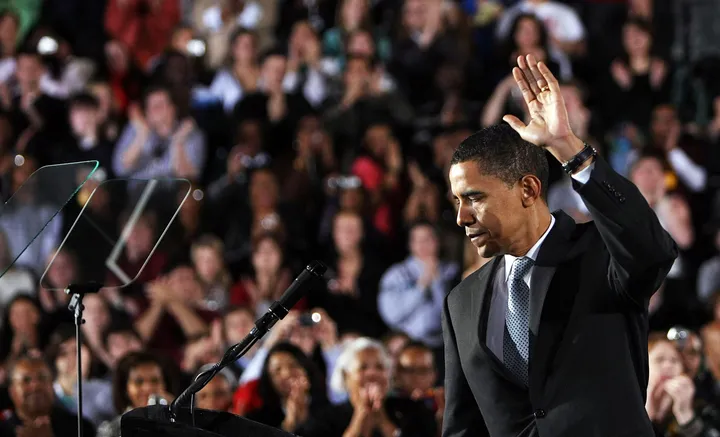
Democrats have little worry about the top of the ticket. President Obama has a decent shot at raising as much as $1 billion for his re-election race, having spent three-quarters of that amount to win in 2008. He'll try to rev up donors and fundraisers with a pep talk on Wednesday.
The field of Republican challengers tops a dozen, and about half of them will probably each raise $50 million in a primary slugfest to secure the nomination. GOP operatives project the nominee will need at least $500 million for the general election just to be competitive.
"Just as Olympic records are broken every four years, we can expect to see fundraising records shattered in 2012 by both outside groups and the main presidential candidates," said Larry Noble, former general counsel to the Federal Election Commission and now a private election law attorney.
The Supreme Court ruling in Citizens United v. Federal Election Commission gave the green light to corporations and unions to spend unlimited sums on ads and other campaign tools to directly advocate for a candidate's election. Curbs on campaign finance that had been in effect since the Watergate era were gutted.
Suddenly, six- and seven-figure checks were the weapon of choice in politics. Rove and other savvy political players channeled tens of millions to groups like the American Crossroads, which by law must disclose its donors, and its affiliate Crossroads GPS, which can keep donors' names secret.
"2010 was only Crossroads' opening act," Steven Law, the group's president, told the Center for Public Integrity. These two groups hope to rake in $120 million for 2012 compared to $71 million last year.
Republican efforts got a head start in 2010 from big donors including Houston home builder Robert Perry, who gave $7 million to American Crossroads. Multi-billionaires David and Charles Koch several years ago launched and helped finance Americans for Prosperity, which planned to spend $45 million last year.
Democrats initially stayed on the sidelines of the outside group money chase. But by fall, as the U.S. House began to slip away, the American Federation of State, County and Municipal Employees jumped in with $91 million, which led spending by all groups. AFSCME president Gerald McEntee said unions, now at war in states like Wisconsin with newly elected Republican governors, are determined to do more.
"We have to build a broader coalition to counter Rove & Co.," McEntee said. "2010 provided a lesson and a beating. We have a lot of work to do."
Democrats also hope to lure millions from George Soros, the billionaire philanthropist and hedge fund titan who sat out 2010. For now, they have a commitment from several rich liberals, including Taco Bell heir Rob McKay, who is backing David Brock's new venture, American Bridge 21st Century . Brock, a former conservative journalist turned liberal activist, intends to do opposition research and run millions in television ads to influence the presidential and congressional elections.
Two former White House aides, Bill Burton and Sean Sweeney, are launching another group to focus on Obama's re-election.
"Democratic donors are in a fighting spirit. Rove and his allies were virtually unopposed," in the last elections, Brock told the Center. "We're not going to let that happen again."
But talk of millions and billions is deflating to voters who gave small amounts to their favorite candidates.
"There is no way I can go up against mighty corporations," said Laska Nygaard, 40, a stay-at-home mom in St. Paul, Minn., who gave Obama $75 in 2008. "It seems like a tsunami of money."
Campaign finance reform advocates are also upset about the burgeoning piles of secret donations. "History tells us that secret money leads to corruption and scandals," said Fred Wertheimer, who runs the nonpartisan Democracy 21. "In 2012 we may well face hundreds of millions in secret contributions flowing into the presidential and congressional elections."

Chart by Paul Compton
The Presidential Money Chase
Obama's re-election campaign and his GOP rivals are already courting the "bundlers," well-connected Wall Street and corporate executives who can rope in hundreds of thousands each. That's no mean feat: under federal law, individuals are limited to giving $2,500 per election to a candidate for president, or $5,000 for the primary and general elections combined.
In 2008, 324 bundlers raised at least $100,000 apiece for Obama, according to the Center for Responsive Politics. For John McCain, 301 bundlers raised more than $100,000.
Historically, big bundlers often get special access in Washington. Some get sweet business deals and contracts; ambassadorial posts and other administration jobs; and invitations to exclusive social events at 1600 Pennsylvania Avenue.
"Bundlers are the moneyed elites who can deliver their social and financial networks on behalf of the nominees," explained Sheila Krumholz, who runs the nonpartisan Center for Responsive Politics.
To jump start the 2012 fundraising marathon, Obama will try to inspire some 300 elite fundraisers on the Democratic Party's national finance committee and national advisory board on Wednesday afternoon. If the Obama campaign is aiming for the magic $1 billion mark, bundlers are a crucial force.
Veteran bundlers stress that the smaller donors who displayed enormous enthusiasm for Obama in 2008 are unlikely to be as generous this time around.
Peter Buttenweiser, a Philadelphia bundler who raised more than $500,000 in 2008 for Obama, predicted that the re-election campaign will "need to rely more on the large givers and raisers."
Thus, within days of leaving the White House last month, former deputy chief of staff Jim Messina, who will manage the re-election campaign, was on a nationwide tour. His mission was to reconnect with big bundlers, some of whom have grumbled publicly that they haven't received enough attention from the White House and have been irked by its tough rhetoric aimed at Wall Street executives.
Messina's first stop was Manhattan, to soothe anxieties about the administration's attitudes towards business. On Feb. 3, Messina talked policy and politics with two dozen wealthy Democrats at the swank Park Avenue apartment of Ralph Schlosstein, the CEO of investment banking firm Evercore Partners, and his wife Jane Hartley, a long time Democratic fundraiser.
Those attending the cocktail party included Evercore executive Charles Myers; Orin Kramer, a general partner of Boston Provident, a big hedge fund; and former Nebraska Sen. Bob Kerrey, president emeritus of the New School in New York.
Messina's New York meetings were part of a choreographed effort in several big money centers such as Chicago, Los Angeles and San Francisco to improve the president's standing.
An equally intense effort is under way by Republicans. GOP operative Scott Reed estimated that a handful of the Republican candidates for president will each need about $50 million to $75 million just for their primary battles. Reed, who is helping one potential candidate, Mississippi Gov. Haley Barbour, said the eventual GOP nominee will need to raise at least $500 million for the general election.
"Republicans are going to need a full court press in 2012 to win the White House, including from the outside groups, the congressional campaign committees, and the eventual nominee," he said.
Some Republicans, such as Barbour, former Massachusetts Gov. Mitt Romney and former Minnesota Gov. Tim Pawlenty, have built fundraising machines to pull in millions as they test the waters by using a loophole in election laws. They created political action committees in several states where campaign finance rules don't impose any limits on individual or corporate donations.
Barbour, for instance, raised close to $2 million during the last election cycle using his federal Haley's PAC and two state PACs that take unregulated contributions. His state PACs in Georgia and Mississippi together raised almost $1 million in 2010. One notable donor, Texas-based financier Jamal Daniel, wrote a $100,000 check to Barbour's Georgia PAC.
Romney has already assembled an impressive list of big bundlers and displayed strong fundraising skills. Last year, Romney's Free and Strong America PAC raised about $6.3 million using a few state PACs.
Romney's team boasts veteran bigwig bundlers such as Woody Johnson, who owns the New York Jets; Wayne Berman, who chairs the lobbying firm Ogilvy Government Relations; and David Koch of Koch Industries. This trio and other big bundlers have done yeoman's work already. Last August, Koch and his wife hosted an evening soiree at their home in the Hamptons for Romney.
Former House Speaker Newt Gingrich has demonstrated enormous fundraising potential over the last few years too. He up a federal 527 political group called American Solutions for Winning the Future. It can accept unlimited donations but has to disclose the names of all contributors.
Since its inception four years ago, American Solutions has raised almost $52 million, to top all of the potential candidates. Among Gingrich's many financial backers, casino mogul Sheldon Adelson stands out: the Las Vegas Sands owner has donated $7 million.
The New Money Game
Is the competition for election dollars at cross purposes? "It's not a zero-sum game," said Gillespie, the former Bush adviser and one-time chairman of the Republican National Committee . "We're not robbing Peter to pay Paul."
The wild card is money from donors whose names remain secret. In the 2010 elections, the lion's share of $71 million the two Rove groups raised went to Crossroads GPS, which has 501(c)4 status that allows it to accept undisclosed donations.
Altogether in 2010 elections, conservative groups spent $190 million on ads and independent expenditures, while liberal leaning organizations spent just $92.7 million, according to the Center for Responsive Politics. Tens of millions more were spent by unions and some conservative groups to get out the vote.
Democratic groups are poised to counter. Brock, who in recent years won his liberal spurs through Media Matters for America, was one of dozens of Democrats who met at the Mandarin Hotel in Washington late last year with an eye to creating new outside groups to help retain the White House and the Senate in 2012 and try to regain the House majority.
That meeting helped inspire Brock's American Bridge 21st Century. He has brought on Kathleen Kennedy Townsend, former Maryland lieutenant governor and member of the Kennedy political dynasty, to court donors. The group has filed with the FEC as a PAC that is allowed to take unlimited donations that must be disclosed.
Brock also plans to establish a 501(c)4 arm of American Bridge that can legally accept undisclosed funds. This affiliate will focus almost entirely on opposition research, a valuable tool that may be used by allied Democratic groups being formed now.
Soon after high-level White House aides Burton (a spokesman) and Sweeney (a top aide to Rahm Emanuel) left the White House in late January, they were approached by political operatives about starting a new group to back Obama. Details are sketchy, but Burton and Sweeney will spearhead a multimillion-dollar outside effort to support Obama's re-election.
Another key player working with them is Craig Varoga, whose separate Patriot Majority PAC has raised $25 million in the last few election cycles from wealthy Democrats and union allies. Last year it plowed millions into ads in Nevada to help Reid win a tough election fight against Tea Party challenger Sharron Angle.
Alexis Simendinger contributed to this report.