More

Japan Earthquake 2011: Nuclear Emergency Workers Return To Plant

Japan Nuclear

AP/The Huffington Post   First Posted: 03/16/11 03:01 PM ET Updated: 05/25/11 07:40 PM ET

FUKUSHIMA, Japan -- Emergency workers forced to retreat from a tsunami-stricken Japanese nuclear power plant when radiation levels soared prepared to return Wednesday night after emissions dropped to safer levels.

(SCROLL DOWN FOR LIVE UPDATES)

The pullback cost precious time in the fight to prevent a nuclear meltdown, further escalating a crisis spawned by last week's devastating earthquake and tsunami that pulverized Japan's northeastern coast and likely killed more than 10,000 people.

It was unclear what happened in the Fukushima Dai-ichi nuclear plant's overheating reactors after late morning, when the workers stopped pumping in seawater trying to cool their fuel rods. Officials gave only sparse information about the reactors.

But conditions at the plant appeared to be worsening. White steam-like clouds drifted up from one reactor which, the government said, likely emitted the burst of radiation that led to the workers' withdrawal. The plant's operator reported a fire at another reactor for the second time in two days.

At one point, national broadcaster NHK showed military helicopters lifting off to survey radiation levels above the complex, preparing to dump water onto the most troubled reactors in a desperate effort to cool them down. The defense ministry later said it said it had decided against making an airborne drop because of the high radiation levels.

Officials are facing increasing criticism over poor communication and coordination.

Even the chief of the U.N. International Atomic Energy Agency, Yukiya Amano, said Wednesday he would visit Japan as soon as possible to obtain "firsthand information" about the nuclear crisis and improve the flow of information from the Japanese government.

"The anxiety and anger being felt by people in Fukushima have reached a boiling point," the governor of Fukushima prefecture, Yuhei Sato, fumed in an interview with NHK. He criticized preparations for an evacuation if conditions worsen and said centers already housing people moved from nearby the plant do not have enough hot meals and basic necessities.

The nuclear crisis has triggered international alarm and partly overshadowed the human tragedy caused by Friday's 9.0-magnitude earthquake and subsequent tsunami, a blast of black seawater that pulverized Japan's northeastern coastline. The quake was one of the strongest recorded in history.

Millions of people struggled for a fifth day with little food, water or heat, and already chilly temperatures turned to snow in many areas. Police say more than 452,000 people are staying in temporary shelters, often sleeping on the floor in school gymnasiums.

More than 4,300 people are officially listed as dead, but officials believe the toll will climb over 10,000 since several thousand more are listed as missing.

In an extremely rare address to the nation, Emperor Akihito expressed condolences and urged Japan not to give up.

"It is important that each of us shares the difficult days that lie ahead," said Akihito, 77, a figure deeply respected across the country. "I pray that we will all take care of each other and overcome this tragedy."

He also expressed his worries over the nuclear crisis, saying: "With the help of those involved I hope things will not get worse."

Since the quake and wave hit, authorities have been struggling to avert an environmental catastrophe at the Fukushima Dai-ichi complex, 140 miles (220 kilometers) north of Tokyo. The tsunami knocked out the backup diesel generators needed to keep nuclear fuel cool at the plant's six reactors, setting off the atomic crisis.

In the city of Fukushima, about 40 miles (60 kilometers) inland from the nuclear complex, hundreds of harried government workers, police officers and others struggled to stay on top of the situation in a makeshift command center.

An entire floor of one of the prefecture's office buildings had been taken over by people tracking evacuations, power needs, death tolls and food supplies.

In one room, uniformed soldiers evaluated radiation readings on maps posted across a wall. In another, senior officials were in meetings throughout the day, while nuclear power industry representatives held impromptu briefings before rows of media cameras.

Wednesday's radiation spike was believed to have come from Unit 3, where workers are struggling with a fuel storage pond believed to be leaking radiation, as well as possible damage to the containment vessel - the thick concrete armor built around the reactor - that would allow radiation to escape.

"The workers cannot carry out even minimal work at the plant now," Chief Cabinet Secretary Yukio Edano said Wednesday morning at briefing aired on television, as smoke billowed above the complex. "Because of the radiation risk we are on standby."

With no workers on site, efforts to cool the reactors likely ceased altogether, said Michael Friedlander, a former nuclear power plant operator who worked at a General Electric boiling water reactor in the United States similar to the stricken ones in Japan.

"They're in right now what's called a feed-and-bleed mode. In order to keep the core covered and keep the reactor cool they have to feed in water," said Friedlander, who is currently based in Hong Kong. "It's something that they physically have to be present to do."

Elevated levels of radiation were detected well outside the 20-mile (30-kilometer) emergency area around the plants. In Ibaraki prefecture, just south of Fukushima, officials said radiation levels were about 300 times normal levels by late morning. It would take three years of constant exposure to these higher levels to raise a person's risk of cancer.

A little radiation was also detected in Tokyo, triggering panic buying of food and water.

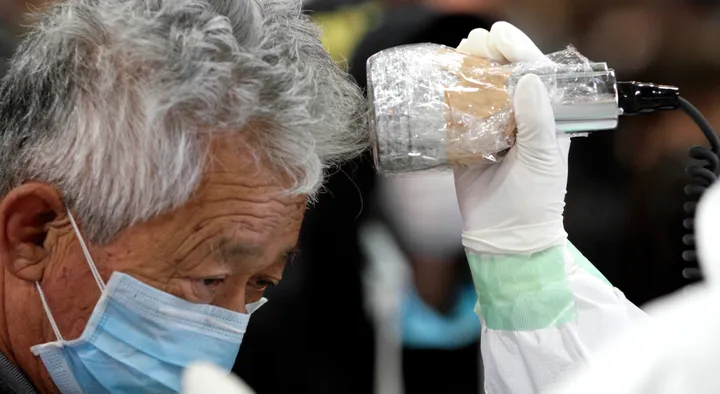
Given the reported radiation levels, John Price, an Australian-based nuclear safety expert, said he saw few health risks for the general public so far. He was concerned for the workers, who he said were almost certainly working in full body suits and breathing through respirators. The workers at the forefront of the fight - a core team of about 180 - had been regularly rotated in and out of the danger zone to minimize their radiation exposure.

Price said he was surprised by how little information the Japanese were sharing.

"We don't know even the fundamentals of what's happening, what's wrong, what isn't working. We're all guessing," he said. "I would have thought they would put on a panel of experts every two hours."

There are six reactors at the plant. Units 1, 2 and 3, which were operating last week, shut down automatically when the quake hit. Since then, all three have been rocked by explosions. Compounding the problems, on Tuesday a fire broke out in Unit 4's fuel storage pond, an area where used nuclear fuel is kept cool, causing radioactivity to be released into the atmosphere.

Units 4, 5 and 6 were shut at the time of the quake, but even offline reactors have nuclear fuel - either inside the reactors or in storage ponds - that needs to be kept cool.

Meanwhile, the Nuclear and Industrial Safety Agency estimated that 70 percent of the rods have been damaged at the No. 1 reactor.

Japan's Kyodo News agency said 33 percent of the fuel rods at the No. 2 reactor were damaged.

Reuters reports:

The risk of radiation contamination from Japan's damaged nuclear power stations has sparked food bans across the globe and more surprisingly, a buying frenzy from South Korean mothers who fear their favorite Japanese-made diapers may suddenly become unavailable.

Cho Myung-jin, who organizes online group-buying for Japanese diapers, saw her website collapse on Tuesday under the weight of traffic as panicked South Koreans chased brands they believe are better quality than locally-made products.

Read more here.

Share this:

Reuters reports:

Supply chain disruptions in Japan have forced at least one global automaker to delay the launch of two new models and are forcing other industries to shutter plants and rethink their logistical infrastructure.

Toyota Motor Corp (7203.T) said on Wednesday it would delay the launch in Japan of two new additions to the Prius line-up, a wagon and a minivan, from the originally planned end-April due to production disruptions from this month's devastating earthquake.

The world's biggest automaker has suspended production at all of its 12 domestic assembly plants at least through March 26 and has estimated a production loss of 140,000 vehicles until then.

Share this:

Reuters reports:

The towering waves that splintered thousands of Japanese homes and lives has forced the country to rethink one of its most sacred Buddhist practices: how it treats the dead.

Desperate municipalities are digging mass graves, unthinkable in a nation where the deceased are usually cremated and their ashes placed in stone family tombs near Buddhist temples. Local regulations often prohibit burial of bodies.

Share this:

Reuters Reports:

An earthquake with a preliminary magnitude of 6.0 jolted parts of northern Japan near a quake-stricken nuclear power plant Wednesday, national broadcaster NHK said.

Share this:

AOL spoke with Natalia Manzurova, a "cleaner" after the disaster in Chernobyl who suffered many side effects from radiation. Her advice to the people of japan was to leave quickly. She said:

Every nuclear accident is different and the impact cannot be truly measured for years. The government does not always tell the truth. Many will never return to their homes. Their lives will be divided into two parts: before and after Fukushima. They'll worry about their health and their children's health. The government will probably say there was not that much radiation and that it didn't harm them. And the government will probably not compensate them for all that they've lost. What they lost can't be calculated.

Read the rest here.

Share this:

The Japanese tsunami cracked a vault wide open, leaving a perfect chance for an opportunistic thief. The AP reports:

The earthquake and tsunami that pulverized coastal Japan crippled a bank's security mechanisms and left a vault wide open. That allowed someone to walk off with 40 million yen ($500,000).

The March 11 tsunami washed over the Shinkin Bank, like much else in Kesennuma, and police said between the wave's power and the ensuing power outages, the vault came open.

Share this:

HuffPost blogger Simon Saradzhyan writes that despite the nuclear crisis in Japan, Russia presses on with it's nuclear program:

While Russian authorities saw the recent calamities in Japan as a chance to initiate a rapprochement with the country, Moscow's overtures to Tokyo have received a cool reception. However, Japan's nuclear crisis nonetheless represents an opportunity for Russian policy-makers to take a fresh look at the country's nuclear energy policies in order to ensure that both existing and future plants are protected against natural or man-made calamities, even those that may still seem unthinkable.

Read the rest here.

Share this:

While radiation continues to leak from the reactor, the source is known, says the International Atomic Energy Agency. Reports Reuters:

"We continue to see radiation coming from the site ... and the question is where exactly is that coming from?" James Lyons, a senior official of the International Atomic Energy Agency (IAEA), told a news conference.

Share this:

Washington, D.C.'s Cheery Blossom Festival will seek to encourage aid to Japan this year. Reports the AP:

Organizers of the National Cherry Blossom Festival in Washington are urging people to donate to the American Red Cross for earthquake relief efforts in Japan ahead of the festival that honors U.S.-Japanese relations.

Festival spokeswoman Danielle Piacente says they are working on plans to recognize the tsunami tragedy during the festival, which runs March 26 to April 10.

Share this:

Reuters reports:

Japan's crisis will have macroeconomic repercussions beyond the country, the World Trade Organization (WTO) warned Tuesday.

Share this:

Very small amounts of radiation have reached Iceland. Reuters reports:

Miniscule amounts of radioactive particles believed to have come from Japan's crippled Fukushima nuclear power plant have been detected as far away as Iceland, diplomatic sources said on Tuesday.

They stressed the tiny traces of iodine -- measured by a network of international monitoring stations as they spread eastwards from Japan across the Pacific, North America and to the Atlantic -- were far too low to cause any harm to humans.

Share this:

Japan's human crisis is being compounded by an economic one. Reports Reuters:

The tsunami that hit Japan this month took such a huge toll on people, equipment and fish that supplies of some seafood could be cut off for a year or more, industry workers said on Tuesday.

The magnitude 9.0 quake on March 11 and the 10-meter (30-foot) tsunami it triggered are known to have killed more than 9,000 people and more than 12,000 are still missing.

But the damage to the coastline north of Tokyo has compounded the human tragedy with devastating commercial woes.

Read more here.

Share this:

Power lines have been reconnected to all six nuclear reactor units. The AP reports:

The operator of Japan's leaking nuclear plant says power lines have been hooked up to all six reactor units, though more work is needed before electricity can run through them.

The plant's operator, Tokyo Electric Power Company, announced the hookup Tuesday but cautioned that workers must check pumps, motors and other equipment before the electricity is turned on.

Reconnecting the Fukushima Dai-ichi nuclear complex to the electrical grid is a significant step in getting control of the overheated reactors and storage pools for spent fuels. But it is likely to be days if not longer before the cooling systems can be powered up, since damaged equipment needs to be replaced and any volatile gas must be vented to avoid an explosion.

Share this:
@ Reuters : FLASH: Japan econmin Yosano: Power shortages likely to have serious impact on Japan economy

Share this:
@ Reuters : FLASH: Japan nuclear safety agency: White smoke rising from reactor no.2 of stricken plant likely to be steam from spent-fuel pool

Share this:

Details from the U.S. Geological Survey.

Share this:
@ Reuters : FLASH: Official death toll from Japan quake & tsunami now exceeds 9,000 - Kyodo

Share this:

From ABC News:

A top U.S. Nuclear Regulatory Commission official today said the nuclear crisis in Japan is "on the verge of stabilizing," even as Japanese workers were forced to suspend relief efforts temporarily after gray smoke billowed from two reactors.

Full story here.

Share this:
@ BreakingNews : Radiation 1,600 times normal level is detected 12 miles from Fukushima plant, IAEA reports - Kyodo News

Share this:

Reuters reports:

Japanese authorities have taken a major step in managing a nuclear crisis by connecting all six earthquake-damaged reactors to power supply, but it's too soon to say the crisis has reached a turning point, experts said on Monday.

Power has been connected but not switched on to crank up most coolers and pumps, which may have been badly damaged in the quake and tsunami that on March 11 triggered the world's worst nuclear accident since Chernobyl. Only one pump has been activated.

Share this:

Reuters is reporting that the Fukushima plant had a history of safety concerns that are now under review:

When the massive tsunami smacked into Fukushima Daiichi, the nuclear power plant was stacked high with more uranium than it was originally designed to hold and had repeatedly missed mandatory safety checks over the past decade.

The Fukushima plant that has spun into partial meltdown and spewed out plumes of radiation had become a growing depot for spent fuel in a way the American engineers who designed the reactors 50 years earlier had never envisioned, according to company documents and outside experts.

At the time of the March 11 earthquake, the reactor buildings at Fukushima held the equivalent of almost six years of the highly radioactive uranium fuel rods produced by the plant, according to a presentation by Tokyo Electric Power Co to a conference organized by the International Atomic Energy Agency.

Along with questions about whether Tokyo Electric officials waited too long to pump sea water into the plants and abandon hope of saving them, the utility and regulators are certain to face scrutiny on the fateful decision to store most of the plant's spent fuel rods inside the reactor buildings rather than invest in other potentially safer storage options.

Share this:

The first confirmed death of an American in Japan has been announced. Teacher Taylor Anderson was killed in the earthquake, officials say. MSNBC reports:

An American family was in mourning Monday after learning that their daughter and sibling, a teacher and lifelong student of Japanese culture, had been found dead in Japan –- the first known American victim of the March 11 earthquake and tsunami.

Taylor Anderson, a 24-year-old from Richmond, Va., had lived in Japan since August 2008. She was last seen after the powerful earthquake struck Japan on March 11, riding her bike away from the school where she taught after helping to get her students home.

Read the entire report here.

Share this:

Grain cargoes are once again reaching Japan. Reports Reuters:

Grain cargoes are reaching Japanese ports after disruptions at terminals last week due to an earthquake and tsunami that held up shipments, shipping and trade sources said on Monday. Sources said vessels were using other ports that had not been affected to discharge cargoes.

Share this:

The death toll from the earthquake and tsunami has been raised to 21,000. Kyodo reports:

The total number of people killed or reported missing as a result of the March 11 earthquake and tsunami that hit northeastern Japan stood at 21,459 as of 9 p.m. Monday, the National Police Agency said, while growing signs of reconstruction emerged, with access restored to all communities in the disaster-struck coastal prefecture of Iwate.

Read more here.

Share this:

Food radiation contamination is more serious than was originally thought. Reuters reports:

The World Health Organization said on Monday that radiation in food after an earthquake damaged a Japanese nuclear plant was more serious than previously thought, eclipsing signs of progress in a battle to avert a catastrophic meltdown in its reactors.

Engineers managed to rig power cables to all six reactors at the Fukushima complex, 240 km (150 miles) north of Tokyo, and started a water pump at one of them to reverse the overheating that has triggered the world's worst nuclear crisis in 25 years.

Share this:

Some radiation has been found in seawater in Japan. Reports Reuters:

@ BreakingNews : Japan's nuclear plant operator says traces of radiation found in sea water nearby - Reuters

Share this:

Miraculous survivor Jin Abe, who was found with his grandmother nine days after the quake, speaks here:

Share this:

New estimates of the damage put the price tag at $300 billion. Reuters reports:

The Japanese earthquake and tsunami caused a total economic loss of up to $300 billion, about 5 percent of Japan's output, according to an initial estimate from risk modeling agency RMS.

Share this:

The AP is reporting that smoke rising from two reactors caused workers to flee:

Gray smoke rose from two reactor units Monday, temporarily stalling critical work to reconnect power lines and restore cooling systems to stabilize Japan's radiation-leaking nuclear complex.

Workers are racing to bring the nuclear plant under control, but the process is proceeding in fits and starts, stalled by incidents like the smoke and by the need to work methodically to make sure wiring, pumps and other machinery can be safely switched on.

Share this:

The AP reports that Yukiya Amano, the United Nations' nuclear chief, says government reponses to nuclear crisis are flawed:

The United Nations' nuclear chief says Japan's nuclear crisis has exposed serious problems in how governments respond to disasters, and how they must improve their responses.

Yukiya Amano says information must be transmitted more quickly by governments and that international experts must exchange information more rapidly.

He also said Monday in remarks to a 35-nation emergency meeting of the International Atomic Energy Agency that the role of the agency itself may need to be reviewed.

Share this:

FOLLOW HUFFPOST WORLD

FUKUSHIMA, Japan -- Emergency workers forced to retreat from a tsunami-stricken Japanese nuclear power plant when radiation levels soared prepared to return Wednesday night after emissions dropped to ...
 
 
  • Comments
  • 1,271
  • Pending Comments
  • 0
  • View FAQ
Comments are closed for this entry
View All
Favorites
Bloggers
Recency  | 
Popularity
Page: 1 2 3 4 5  Next ›  Last »  (26 total)
07:33 AM on 03/17/2011
we need to build more and learn from this process
photo
HenHouse
WhoWhatWhyWhereWhenHow and how much?
01:59 AM on 03/17/2011
http://www.flickr.com/photos/digitalglobe-imagery/5519452784/in/set-72157626248178510/

http://www.digitalglobeblog.com/ (see right side box that takes you to flickr)

I just dont see any earthquake or tsunami damage , there are cars driving and parked all around the reator site.

am I crazy? the dates and captions say 3/12 after quake hit.
11:16 PM on 03/16/2011
One could only imagine what would happen in the US if we were under the same circumstances as Japan. I for one would not believe anything our government would say or do. Just look at the mess during and after Katrina.
11:02 PM on 03/16/2011
Why is nobody talking about radio active waste. Why is Yucca Mountain still unused? Why can we not discuss the political inability of America to dispose of the super dangerous stuff we have been parking next our reactors for fifty years?
This user has chosen to opt out of the Badges program
photo
fireofenergy
Promote freedom AND science
11:15 PM on 03/16/2011
Yucca is unused because it is very, very insipid. Containment ponds are even more so!
(search the molten salt reactor, and LFTR)
11:38 PM on 03/16/2011
No, it is not "very, very insipid". Geological studies have shown that it is stable enough to keep the waste away from people for thousands of years. As long as they don't pack it too densely, it will be able to dissipate the heat. It is much, MUCH better than leaving it in containment ponds.
11:00 PM on 03/16/2011
I promise you. There is looting. It's just that the Japanese government, media, and police know that it is not important. Only Americans are so selfish, grasping, prejudiced, and brainwashed as to think that looting is an issue at all.
This user has chosen to opt out of the Badges program
photo
fireofenergy
Promote freedom AND science
11:20 PM on 03/16/2011
Bet LA would be like a million times worst and eventually...
it will happen because we also rely on the same stupid LWR design that Japan used :(
11:40 PM on 03/16/2011
You have no idea what you are talking about. Their's is a BWR design, not just any LWR design. Do you even know the difference? It is for a good reason that some form of LWR is predominant in civil nuclear reactor implementations.
10:56 PM on 03/16/2011
The nuclear power "safety issues" in the US are legion. Diplomats are famed for euphemism.
11:41 PM on 03/16/2011
You call them 'legion', yet TMI was the ONLY leak of radiation to the public. Not ONE of the competing power generation methods can make a comparable claim. Especially not coal and oil.
This user has chosen to opt out of the Badges program
photo
fireofenergy
Promote freedom AND science
10:55 PM on 03/16/2011
I am so saddened that Japan used the inferior American style Light Water Reactor (which is pressurized at many atmospheres). You would think the nuclear industry would have learned not to mix water with fission reactors back when science "said" water will turn into hydrogen and oxygen and create a very big explosion ! ! !

The only safe reactor is one that does not blow up when breached. And the only safe reactor is one that does NOT need redundant safety mechanisms.

The only safe reactor is the molten salt reactor. In this situation, it would have simply spilled over and caused a (very) localized incident. Evil LWR's only use about 1% of the fuel. The molten salt fissions almost all of the fuel... 100 X LESS waste. Furthermore, What little wastes the molten salt reactor spits out is only bad for about 300 years which is actually, somewhat, containable!

So why does the "industry" go for the most irresponsible (and least efficient) of the nuclear reactor types! Why are they so greedy. Many articles refer to "nuclear experts"... That is still an oxymoron.

I promote wind and solar but if we need to rely on nuclear, we need to rely on the liquid fluoride THORIUM reactor...(and it looks like we will because the greedy sob's won't do ROBOTIC SOLAR and battery manufacture "all in house" , to make it affordable)...

Search LFTR for more.
And God help Japan!
ThinkCreeps
Seriously, it's time.
11:42 PM on 03/16/2011
Good luck with getting the venture capital to develop a thorium reactor.
11:43 PM on 03/16/2011
You are seriously confused. Reactors turn water into hydrogen only when the water is allowed to become superheated. But in normal operation, it never even gets close to that.

And of course, you are quite wrong when you say the wasts from a salt reactor are only 'bad' for about 300 years.
This user has chosen to opt out of the Badges program
photo
fireofenergy
Promote freedom AND science
11:57 PM on 03/16/2011
You are an antagonizer because you don't know what you are talking about...
Search the molten salt reactor... It is far better than all these dangerous LWR (or Boiling water reactors, basically the same thing, like duh)
10:54 PM on 03/16/2011
C. M. Kornbluth "With These Hands"
10:40 PM on 03/16/2011
A student of mine today said she said to the guy in the next cubicle at work, "Hey, heard about that earthquake in Japan?" and he said, "Japan? Where is that? Is that near Mexico?"

This guy is ground zero as to why the nuclear renaissance is going to continue full throttle despite all your and my commonsense "Are you . . . kidding?" moaning.
10:32 PM on 03/16/2011
Two hundred billion? That's only one third of what we spend on the war effort each year. Sounds reasonable to me.
10:13 PM on 03/16/2011
Have I become desensitized to large numbers? After seeing 1.7 trillion for TARP, 700 billion for Quantitative Easing 2, and 3 trillion for the wars in Iraq and Afghanistan, 200 billion sounds like a drop in the bucket for the world's third largest economy. Maybe it's me.
10:32 PM on 03/16/2011
Hahahaha. We think alike.
HUFFPOST SUPER USER
beau taylor
one piece at the time
09:42 PM on 03/16/2011
In the annals of nuclear disasters Three Mile Island will be a cakewalk. Japan will be the new "shot heard round the world"
This user has chosen to opt out of the Badges program
photo
09:33 PM on 03/16/2011
It is time to do this, and to forgive the debts of nations.
10:31 PM on 03/16/2011
I think that will eventually happen because countries just will not be able to pay. I don't understand how this would happen . Something would have to be traded in exchange and we would have to go to a global currency. I am no economist so it is beyond my understanding
08:38 PM on 03/16/2011
love how the msm is saying saying it will cost 200 billion to repair. THE BOJ, has injected nearly $400 billion into the Nikkei, and as of right now, it's down 4%

http://www.zerohedge.com/article/todays-nikkei-plunge-protection-invoice-%C2%A55-trillion
09:04 PM on 03/16/2011
Yes and the Iraq war will be paid for by their oil!
Remember wolfowitz telling us that on TV?
08:31 PM on 03/16/2011
The Japanese have an advantage of being a homogeneous society. In the US the blame would be put on the latest punching bag minority or disliked group of people. The CEOs of their businesses dont earn 400 to 500 times the average worker and the populace expects to have to work for what they get. They will survive this. This would have devestated the US.