More

Japan Earthquake 2011: Elderly Hard-Hit As Hope For Missing Fades

Japan Earthquake Elderly

AP/The Huffington Post   First Posted: 03/17/11 05:51 PM ET Updated: 05/25/11 07:40 PM ET

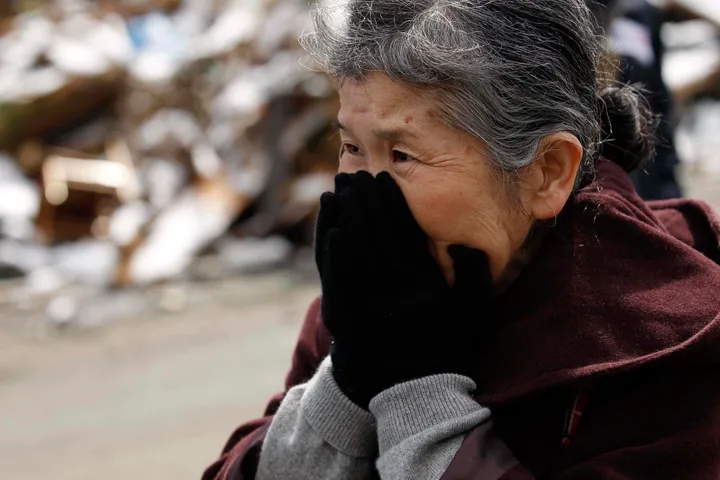
RIKUZENTAKATA, Japan -- The elderly couple fled their home on foot as the warning sirens blared. But they could not keep up with their neighbors and fell behind as the tsunami rushed in.

(SCROLL DOWN FOR LIVE UPDATES)

Nearly a week later, 71-year-old Taeko Kanno and her husband are still missing.

"I think there is no hope," said Katsuo Maiya, Kanno's brother-in-law. "I can't find them. The only thing I can do is wait until the military collects their bodies."

As retrieving bodies increasingly becomes the focus of rescue crews in Japan's northeast, it's clear that Friday's earthquake and tsunami – believed to have killed more than 10,000 – took their heaviest toll on the elderly in this rapidly aging nation, where nearly one in four people is over 65.

Many, unable to flee, perished. Survivors lost their daily medicines. Hospitals lost power and water. Sometimes, the consequences have been fatal.

Friday's twin disasters also crippled a nuclear power plant in the northeast, adding to the region's woes. Fourteen older patients died after being moved to a temporary shelter in a school gym because their hospital was in the evacuation zone near the overheating plant.

Two of the patients died in transit Monday and 12 more at the gym, said Chuei Inamura, a Fukushima government official. It took until Thursday to get all the remaining patients into other hospitals.

"We feel very helpless and very sorry for them," Inamura said. "The condition at the gymnasium was horrible. No running water, no medicine and very, very little food. We simply did not have the means to provide good care."

At least some international rescue teams ended their efforts Thursday, acknowledging there was little prospect left of finding missing people still alive.

"We have no more tasks," said Pete Stevenson, a firefighter heading Britain's 70-strong team. "The Japanese government have told us they are now moving from search and rescue to the recovery phase."

He insisted their departure wasn't related to any fears of radiation from the troubled Fukushima nuclear plant, which lies about 90 miles (150 kilometers) south.

Japan's relatively large elderly population presents a particular challenge for rescue and relief in what is already a disaster of epic proportions.

About 23 percent of Japan's 127 million people are age 65 or over, nearly double the proportion in the United States.

Japan's rural areas have been in decline for years, and many of the small coastal towns hit hardest by the tsunami had seen an exodus of young people moving to cities for work.

Now the low-lying parts of those towns have been flattened, and as much as half the population in some may have been killed. The official death toll climbed over 5,300 Thursday and is expected to top 10,000.

Kanno, the woman who couldn't keep up with her neighbors, comes from one such town – Rikuzentakata, a port city that was home to 20,000 before the disaster.

When the tsunami surged into Rikuzentakata, her 67-year-old sister Masako Maiya rushed down from her home in the hills with her husband, Katsuo.

They only got as far as a bridge. Down below, they saw the town had become a muddy inland sea.

One of Kanno's neighbors told them she saw Kanno and her husband flee, but the couple was slow and had lagged behind.

For five days, the Maiyas went from morgue to morgue, looking for the Kannos' bodies. On Thursday, they decided to visit the site where their home stood.

"The house should be around here," Masako Maiya said, stopping in front of a pile of splintered wood and mud.

A pained moan escaped from her husband's mouth. "There's nothing," he said, taking off his glasses and wiping tears from his eyes. His wife began to sob too. Still crying, they turned and walked away.

In the town of Kamaishi, American and British rescue teams completed their final sweeps, and Japanese mechanical diggers began the task of clearing collapsed homes, offices and stores.

Crews found more than a dozen bodies, some trapped underneath homes flipped on their roofs, another at the wheel of his overturned car. In three days of searching the battered coast, they found no survivors.

"There are probably dozens of bodies we just can't reach," said Heather Heath, a 38-year old British firefighter. "The water can force people under floorboards and into gaps we can't search. It's such a powerful force."

For survivors, in a still-wintry climate, the battle is to keep the elderly healthy and alive.

A hospital in Tagajo was cleaning off muddy medicine Thursday and trying to keep its 90 patients alive without water or electricity. A large generator and two portable toilets were delivered by the Japanese military.

"We've been told we'll get medicine sometime next week," said Daisuke Toraiwa, a physical therapist at the hospital.

The tsunami killed 47 of the 113 residents at a retirement home in the city of Kesennuma. Those who could escaped to the second floor. But many got wet, and 11 more died over the next two days because of the cold, said owner Morimitsu Inawashida.

Today, the 53 survivors live in a basketball gym, some sitting in wheelchairs with thick blankets wrapped around them. A nurse from a nearby hospital checks their blood pressure. With snow falling outside, kerosene heaters help keep them warm, but Inawashida said the fuel is running out.

"They are alone and under high stress," he said.

At a school turned shelter in the same city, a group of older men and women sat in the large drafty gym, warmed only be a single kerosene heater. A few ointment tubes, bandages and boxes of aspirin and stomach and cold medicines were stacked on a nearby table.

"It's freezing, there are people who are sick and injured," Keiko Endo, a 58-year-old nurse at the shelter, said. "People are mostly putting up with whatever's wrong. We're trying to comfort and help them, but we can't do too much."

Doctors Without Borders, the international assistance group, has seen cases of hypothermia, serious dehydration and respiratory diseases in some shelters, said Eric Ouannes, general director of the group's Japan affiliate. The tsunami washed away many people's medications.

"Some don't remember what they were taking, how much, and what was the exact prescription," he said. "So that makes things a little more complicated."

Despite the hardships, many survivors take heart in the cameraderie of sharing a common fate.

"If everyone's got nothing, everyone's got the same," Isao Nagai, 62, said, standing in a cold junior high school gym in Ofunato. About 150 survivors huddled under blankets. Some dozed, others talked or read the newspaper. "There's a comfort we get from each other. It's simple. We've all got nothing. Not half or some. Nothing."

Kinuyo Kojima, whose house in Ofunato was washed away, agreed.

But, the 65-year-old woman said, "We live like animals." The stench of backed-up toilets has made some retch, and they complain of constipation from the diet of rice and little or nothing else.

"You should have seen us when we got a piece of chicken yesterday," Kojima said Thursday. "We were so excited over a tiny piece of meat. It had been so long."

Mineko Ohira, a 63-year-old nursery school teacher in Ofunato, worries about the elderly, and what will happen when they have to leave the shelters and find themselves bereft of friends, family and homes.

"The country should find a way to help support them," she said.

Reuters reports:

The risk of radiation contamination from Japan's damaged nuclear power stations has sparked food bans across the globe and more surprisingly, a buying frenzy from South Korean mothers who fear their favorite Japanese-made diapers may suddenly become unavailable.

Cho Myung-jin, who organizes online group-buying for Japanese diapers, saw her website collapse on Tuesday under the weight of traffic as panicked South Koreans chased brands they believe are better quality than locally-made products.

Read more here.

Share this:

Reuters reports:

Supply chain disruptions in Japan have forced at least one global automaker to delay the launch of two new models and are forcing other industries to shutter plants and rethink their logistical infrastructure.

Toyota Motor Corp (7203.T) said on Wednesday it would delay the launch in Japan of two new additions to the Prius line-up, a wagon and a minivan, from the originally planned end-April due to production disruptions from this month's devastating earthquake.

The world's biggest automaker has suspended production at all of its 12 domestic assembly plants at least through March 26 and has estimated a production loss of 140,000 vehicles until then.

Share this:

Reuters reports:

The towering waves that splintered thousands of Japanese homes and lives has forced the country to rethink one of its most sacred Buddhist practices: how it treats the dead.

Desperate municipalities are digging mass graves, unthinkable in a nation where the deceased are usually cremated and their ashes placed in stone family tombs near Buddhist temples. Local regulations often prohibit burial of bodies.

Share this:

Reuters Reports:

An earthquake with a preliminary magnitude of 6.0 jolted parts of northern Japan near a quake-stricken nuclear power plant Wednesday, national broadcaster NHK said.

Share this:

AOL spoke with Natalia Manzurova, a "cleaner" after the disaster in Chernobyl who suffered many side effects from radiation. Her advice to the people of japan was to leave quickly. She said:

Every nuclear accident is different and the impact cannot be truly measured for years. The government does not always tell the truth. Many will never return to their homes. Their lives will be divided into two parts: before and after Fukushima. They'll worry about their health and their children's health. The government will probably say there was not that much radiation and that it didn't harm them. And the government will probably not compensate them for all that they've lost. What they lost can't be calculated.

Read the rest here.

Share this:

The Japanese tsunami cracked a vault wide open, leaving a perfect chance for an opportunistic thief. The AP reports:

The earthquake and tsunami that pulverized coastal Japan crippled a bank's security mechanisms and left a vault wide open. That allowed someone to walk off with 40 million yen ($500,000).

The March 11 tsunami washed over the Shinkin Bank, like much else in Kesennuma, and police said between the wave's power and the ensuing power outages, the vault came open.

Share this:

HuffPost blogger Simon Saradzhyan writes that despite the nuclear crisis in Japan, Russia presses on with it's nuclear program:

While Russian authorities saw the recent calamities in Japan as a chance to initiate a rapprochement with the country, Moscow's overtures to Tokyo have received a cool reception. However, Japan's nuclear crisis nonetheless represents an opportunity for Russian policy-makers to take a fresh look at the country's nuclear energy policies in order to ensure that both existing and future plants are protected against natural or man-made calamities, even those that may still seem unthinkable.

Read the rest here.

Share this:

While radiation continues to leak from the reactor, the source is known, says the International Atomic Energy Agency. Reports Reuters:

"We continue to see radiation coming from the site ... and the question is where exactly is that coming from?" James Lyons, a senior official of the International Atomic Energy Agency (IAEA), told a news conference.

Share this:

Washington, D.C.'s Cheery Blossom Festival will seek to encourage aid to Japan this year. Reports the AP:

Organizers of the National Cherry Blossom Festival in Washington are urging people to donate to the American Red Cross for earthquake relief efforts in Japan ahead of the festival that honors U.S.-Japanese relations.

Festival spokeswoman Danielle Piacente says they are working on plans to recognize the tsunami tragedy during the festival, which runs March 26 to April 10.

Share this:

Reuters reports:

Japan's crisis will have macroeconomic repercussions beyond the country, the World Trade Organization (WTO) warned Tuesday.

Share this:

Very small amounts of radiation have reached Iceland. Reuters reports:

Miniscule amounts of radioactive particles believed to have come from Japan's crippled Fukushima nuclear power plant have been detected as far away as Iceland, diplomatic sources said on Tuesday.

They stressed the tiny traces of iodine -- measured by a network of international monitoring stations as they spread eastwards from Japan across the Pacific, North America and to the Atlantic -- were far too low to cause any harm to humans.

Share this:

Japan's human crisis is being compounded by an economic one. Reports Reuters:

The tsunami that hit Japan this month took such a huge toll on people, equipment and fish that supplies of some seafood could be cut off for a year or more, industry workers said on Tuesday.

The magnitude 9.0 quake on March 11 and the 10-meter (30-foot) tsunami it triggered are known to have killed more than 9,000 people and more than 12,000 are still missing.

But the damage to the coastline north of Tokyo has compounded the human tragedy with devastating commercial woes.

Read more here.

Share this:

Power lines have been reconnected to all six nuclear reactor units. The AP reports:

The operator of Japan's leaking nuclear plant says power lines have been hooked up to all six reactor units, though more work is needed before electricity can run through them.

The plant's operator, Tokyo Electric Power Company, announced the hookup Tuesday but cautioned that workers must check pumps, motors and other equipment before the electricity is turned on.

Reconnecting the Fukushima Dai-ichi nuclear complex to the electrical grid is a significant step in getting control of the overheated reactors and storage pools for spent fuels. But it is likely to be days if not longer before the cooling systems can be powered up, since damaged equipment needs to be replaced and any volatile gas must be vented to avoid an explosion.

Share this:
@ Reuters : FLASH: Japan econmin Yosano: Power shortages likely to have serious impact on Japan economy

Share this:
@ Reuters : FLASH: Japan nuclear safety agency: White smoke rising from reactor no.2 of stricken plant likely to be steam from spent-fuel pool

Share this:

Details from the U.S. Geological Survey.

Share this:
@ Reuters : FLASH: Official death toll from Japan quake & tsunami now exceeds 9,000 - Kyodo

Share this:

From ABC News:

A top U.S. Nuclear Regulatory Commission official today said the nuclear crisis in Japan is "on the verge of stabilizing," even as Japanese workers were forced to suspend relief efforts temporarily after gray smoke billowed from two reactors.

Full story here.

Share this:
@ BreakingNews : Radiation 1,600 times normal level is detected 12 miles from Fukushima plant, IAEA reports - Kyodo News

Share this:

Reuters reports:

Japanese authorities have taken a major step in managing a nuclear crisis by connecting all six earthquake-damaged reactors to power supply, but it's too soon to say the crisis has reached a turning point, experts said on Monday.

Power has been connected but not switched on to crank up most coolers and pumps, which may have been badly damaged in the quake and tsunami that on March 11 triggered the world's worst nuclear accident since Chernobyl. Only one pump has been activated.

Share this:

Reuters is reporting that the Fukushima plant had a history of safety concerns that are now under review:

When the massive tsunami smacked into Fukushima Daiichi, the nuclear power plant was stacked high with more uranium than it was originally designed to hold and had repeatedly missed mandatory safety checks over the past decade.

The Fukushima plant that has spun into partial meltdown and spewed out plumes of radiation had become a growing depot for spent fuel in a way the American engineers who designed the reactors 50 years earlier had never envisioned, according to company documents and outside experts.

At the time of the March 11 earthquake, the reactor buildings at Fukushima held the equivalent of almost six years of the highly radioactive uranium fuel rods produced by the plant, according to a presentation by Tokyo Electric Power Co to a conference organized by the International Atomic Energy Agency.

Along with questions about whether Tokyo Electric officials waited too long to pump sea water into the plants and abandon hope of saving them, the utility and regulators are certain to face scrutiny on the fateful decision to store most of the plant's spent fuel rods inside the reactor buildings rather than invest in other potentially safer storage options.

Share this:

The first confirmed death of an American in Japan has been announced. Teacher Taylor Anderson was killed in the earthquake, officials say. MSNBC reports:

An American family was in mourning Monday after learning that their daughter and sibling, a teacher and lifelong student of Japanese culture, had been found dead in Japan –- the first known American victim of the March 11 earthquake and tsunami.

Taylor Anderson, a 24-year-old from Richmond, Va., had lived in Japan since August 2008. She was last seen after the powerful earthquake struck Japan on March 11, riding her bike away from the school where she taught after helping to get her students home.

Read the entire report here.

Share this:

Grain cargoes are once again reaching Japan. Reports Reuters:

Grain cargoes are reaching Japanese ports after disruptions at terminals last week due to an earthquake and tsunami that held up shipments, shipping and trade sources said on Monday. Sources said vessels were using other ports that had not been affected to discharge cargoes.

Share this:

The death toll from the earthquake and tsunami has been raised to 21,000. Kyodo reports:

The total number of people killed or reported missing as a result of the March 11 earthquake and tsunami that hit northeastern Japan stood at 21,459 as of 9 p.m. Monday, the National Police Agency said, while growing signs of reconstruction emerged, with access restored to all communities in the disaster-struck coastal prefecture of Iwate.

Read more here.

Share this:

Food radiation contamination is more serious than was originally thought. Reuters reports:

The World Health Organization said on Monday that radiation in food after an earthquake damaged a Japanese nuclear plant was more serious than previously thought, eclipsing signs of progress in a battle to avert a catastrophic meltdown in its reactors.

Engineers managed to rig power cables to all six reactors at the Fukushima complex, 240 km (150 miles) north of Tokyo, and started a water pump at one of them to reverse the overheating that has triggered the world's worst nuclear crisis in 25 years.

Share this:

Some radiation has been found in seawater in Japan. Reports Reuters:

@ BreakingNews : Japan's nuclear plant operator says traces of radiation found in sea water nearby - Reuters

Share this:

Miraculous survivor Jin Abe, who was found with his grandmother nine days after the quake, speaks here:

Share this:

New estimates of the damage put the price tag at $300 billion. Reuters reports:

The Japanese earthquake and tsunami caused a total economic loss of up to $300 billion, about 5 percent of Japan's output, according to an initial estimate from risk modeling agency RMS.

Share this:

The AP is reporting that smoke rising from two reactors caused workers to flee:

Gray smoke rose from two reactor units Monday, temporarily stalling critical work to reconnect power lines and restore cooling systems to stabilize Japan's radiation-leaking nuclear complex.

Workers are racing to bring the nuclear plant under control, but the process is proceeding in fits and starts, stalled by incidents like the smoke and by the need to work methodically to make sure wiring, pumps and other machinery can be safely switched on.

Share this:

The AP reports that Yukiya Amano, the United Nations' nuclear chief, says government reponses to nuclear crisis are flawed:

The United Nations' nuclear chief says Japan's nuclear crisis has exposed serious problems in how governments respond to disasters, and how they must improve their responses.

Yukiya Amano says information must be transmitted more quickly by governments and that international experts must exchange information more rapidly.

He also said Monday in remarks to a 35-nation emergency meeting of the International Atomic Energy Agency that the role of the agency itself may need to be reviewed.

Share this:

FOLLOW HUFFPOST WORLD

RIKUZENTAKATA, Japan -- The elderly couple fled their home on foot as the warning sirens blared. But they could not keep up with their neighbors and fell behind as the tsunami rushed in. (SCROLL DO...
 
 
  • Comments
  • 3,681
  • Pending Comments
  • 0
  • View FAQ
Comments are closed for this entry
View All
Favorites
Bloggers
Recency  | 
Popularity
Page: 1 2 3 4 5  Next ›  Last »  (54 total)
photo
DFL
Liberal and proud of it.
07:55 AM on 03/18/2011
One good thing they have going for them is not having a bunch of rightwing conservative bullies there like we got here, working against anything thats good for their people!
photo
peacekitten
primum non nocere.
06:13 AM on 03/18/2011
today, a video emerged, shot by an aerial crew, of a medium size black dog who was stranded on what looked to be a section of roadway.  he was running frantically as fast as he could, back and forth as the tsunami approached, trying to find an escape, but there was none.  sadly, this poor dog was swept away under the onslaught of the water and debris, and disappeared.

it all happened in the blink of an eye.  it was an incredibly heartbreaking, haunting image, to see that poor animal racing for his life, only to find every path cut off.  

the tsunami and the earthquake on their own would have been bad enough.  the destruction of the nuclear plants was just too much.

yet through it all, the japanese have remained courteous, as calm as they can, and orderly.

i wonder if we would be able to say the same under such horrific circumstances.

my heart breaks for them, and for every living being affected by this.
05:45 AM on 03/18/2011
Clearly there has been a breakdown of the system in Japan, as it occurred here with Katrina. It's as if the officials were totally blind-sided by this level of disaster. Clearly a new and better system needs to be in place for such emergencies. The very fact that they haven't started making air-drops of supplies to the more isolated areas is a clear sign that the people in charge are not thinking clearly on how to get these much needed supplies to the people that are in need of it now...not soon or later...but now. Time is of the essence.
HUFFPOST SUPER USER
ginger42
Just the facts, ma'am--Sgt Friday
03:48 AM on 03/18/2011
I live in Japan (Tokyo). PLEASE read http://pla­inenglishn­uclear.blo­gspot.com/­2011/03/ye­t-another-­japan-reac­tor-post.h­tml#more

to get GOOD information. (I have nothing to do with this site.)

Another site is http://www­.bbc.co.uk­/news/worl­d-middle-e­ast-123076­98
photo
HUFFPOST SUPER USER
Jezreel
Think. Act. Live wisely.
05:09 AM on 03/18/2011
Ginger42, first, I hope that your family and friends are all accounted for and safe and that you have access to all of the resources you need. Please know that I and millions of others people are praying for the people of Japan and that we are doing whatever we can regardless of how big or small to contribute to your country's recovery.

Secondly, the links you posted do not work, unfortunately. If you are able to post the correct links please do so. I'd like to check out the articles.
10:09 AM on 03/18/2011
I got ginger42's links to work by deleting all the extraneous symbols & letters that show up when you copy&paste in the link into your search bar (Just delete the symbol+letter combination '%C2%AD' in all the occurrences from the link & it should work). I guess it's something this website does to prevent links that might be malicious from working? I'm not sure, but it works now :)
This comment has been removed due to violations of our [Guidelines]
photo
HUFFPOST SUPER USER
Aldo Rodriguez
No Trumps need reply.
03:28 AM on 03/18/2011
アイルランド永é ã«
‎... or Éirinn go Brách in Japanese!
Since we were all Irish on St. Patrick's Day, I would like to offer this Irish prayer to the people of Japan:

May God give you...
For every storm, a rainbow,
For every tear, a smile,
For every care, a promise,
And a blessing in each trial.
For every problem life sends,
A faithful friend to share,
For every sigh, a sweet song,
And an answer for each prayer.
photo
HUFFPOST SUPER USER
Jezreel
Think. Act. Live wisely.
05:10 AM on 03/18/2011
That's a beautiful poem. F & F.
08:18 AM on 03/18/2011
F&F
This comment has been removed due to violations of our [Guidelines]
photo
HUFFPOST SUPER USER
SilentSolidarity
So what do you need? Besides a miracle.
02:53 AM on 03/18/2011
I can't explain my sadness for those people. My thoughts are with the families and friends who are missing loved ones.
photo
HUFFPOST SUPER USER
rainkitty
Lively up yourself.
02:33 AM on 03/18/2011
This is all unbearably sad. Why aren't supplies being dropped where needed by helicopter?
HUFFPOST SUPER USER
ginger42
Just the facts, ma'am--Sgt Friday
02:59 AM on 03/18/2011
It is overwhelming the whole system. They ARE trying all options
photo
HUFFPOST SUPER USER
rainkitty
Lively up yourself.
03:11 AM on 03/18/2011
Yes, I'm sure you're right.
04:03 AM on 03/18/2011
I have been about asking the same thing MySelf!
I have yet to get something that makes any Sense AT ALL!
Go Figure. :)
I thot I was goin' nuts!
ValiDaTion!! Thanx :)
photo
HUFFPOST SUPER USER
whyus
San Francisco native
02:31 AM on 03/18/2011
A heart wrenching disaster. There may be a little hope, though: heard they're connecting electricity back to the nuclear plants to get them cooled again. So at the moment it seems better than it did yesterday.
photo
HUFFPOST SUPER USER
robnelsong
Dire Wolfman
02:25 AM on 03/18/2011
My heart is out to the elderly Japanese, some of whom may have been through two rounds of nuclear disasters in their lifetimes. Say what you will about WW II, but no human being should have to deal with this horror twice.
02:19 AM on 03/18/2011
I hope all goes fine.. death rate is increasing day by day.... people are'nt able to find out their loved n closed once.... May God bless all n giv them happiness in there future life................
01:38 AM on 03/18/2011
The Americans should come to the challenge and help with some solution, like the ingenuity shown in the rescue of Chilean miners last October. May it be a humongous cooler in a glass sphere dropped on top or anything else outside the box thinking. May the specialists find inspiration.
This comment has been removed due to violations of our [Guidelines]
12:36 AM on 03/18/2011
Another tragedy...just like Katrina... the frail elderly are not able to evacuate and their families can't manage it either...and they are left behind... another tragedy among so many...and who is helping those that survived? The death rate for elders will be high... it is heartbreaking to imagine the reality of what is happening.