More

How To Get Rid Of All That Space Junk

Space Junk

The Huffington Post   First Posted: 03/26/11 03:42 PM ET Updated: 05/25/11 07:40 PM ET

How about a laser? One that is strong enough to nudge debris out of earth orbit. That's what NASA contractor James Mason wants to do, and his lab simulations suggest that the idea is possible. Mason wants to use a 5kW ground-based laser and a ground-based 1.5 meter telescope to spot potentially hazardous space waste and shove it off, by about 200 meters per day of lasering. It's kind-of like air traffic control for near earth orbit.

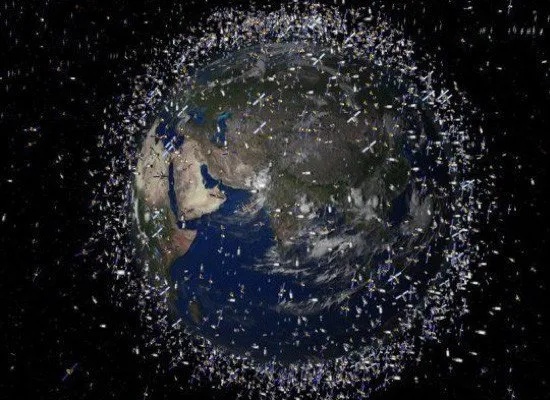
Over 500,000 objects orbit earth. Old satellites, abandoned spacecrafts, and spent rocket stages--all still orbiting after decades of disuse. They are not dangerous in themselves, but there's so much debris up there that it's bound to collide with stuff we need like working satellites, and that's where the trouble begins. Last year, the International Space Station had to kick its engines into high gear and maneuver around an old NASA satellite on a potentially destructive collision course. In 2009, a commercial communications satellite crashed into an obsolete Russian satellite and produced a cloud of metal, creating even more junk to collide with working satellites.

As we constantly upgrade communications technologies, more and more discarded junk is added to near earth orbit so it's not a stretch to think we should figure out a way to keep it safe up there. Mason's laser would not have been able to prevent the 2009 run-in--the first known collision of two larger NEO object--and it's not capable of moving asteroids, but it can nudge lighter debris out of the way.

The proposed laser has another possible use. If a laser can shove off debris, couldn't you use it to shove off enemy satellites? This thing could be a weapon, too, which is why NASA is hesitant to make it: it could damage international relations with countries who mistake it for such. It's all very Star Wars.

Via How to Get Rid of All that Space Junk on WonderHowTo.

FOLLOW HUFFPOST TECH

How about a laser? One that is strong enough to nudge debris out of earth orbit. That's what NASA contractor James Mason wants to do, and his lab simulations suggest that the idea is possible. Mas...
 
 
  • Comments
  • 32
  • Pending Comments
  • 0
  • View FAQ
Comments are closed for this entry
View All
Favorites
Recency  | 
Popularity
Page: 1 2  Next ›  Last »  (2 total)
photo
HUFFPOST SUPER USER
greeneyes51654m
Retired, finally...
04:15 PM on 03/28/2011
Make the laser, start the process before it's even too late for the laser to make a dent in the space trash.
photo
HUFFPOST SUPER USER
Carbon Forteetoo
Not enough characters to say anything clev
03:31 PM on 03/28/2011
We need a space bulldozer to push all the debris down to burn up in the atmosphere. Hopefully, it will be yellow.
photo
TheDodoBird
Registered Voter
03:15 PM on 03/28/2011
how about bringing our space junk back home? I mean, since we have a limited number of total resources on this planet, wouldn't it make more sense to just bring it back, instead of systematically eliminating this stuff? I understand the concern here, but we really need to be thinking long term.
photo
HUFFPOST SUPER USER
fozzi58
I want my country back
04:04 PM on 04/05/2011
Its actually a good idea. But how to do it and at what cost - what expense.

A big orbiting net maybe?
09:08 AM on 03/28/2011
Wherever we go we leave a trail of garbage in our wake.
photo
HUFFPOST SUPER USER
WeCanDoMore
Enjoying a fact based reality.
11:33 PM on 03/27/2011
A giant colander!
photo
HUFFPOST SUPER USER
Henry Owen Creque V
08:01 PM on 03/27/2011
how to get rid of satelites? send me into space with a nice custom war ship loaded with about 50,000 rockets. i will gladly dispose of them.
04:09 PM on 03/27/2011
So, do nothing about the junk, because it will look like "Star Wars" is the right answer?.... Any method to clean up space could be used as a military weapon!!! Sheesh!!! Quite the belly aching and git-er-done, pew-pew-pew, isn't that the sound of a LASER?! PEW-PEW-PEW

http://MontanaBiotech.wordpress.com
photo
HUFFPOST SUPER USER
fozzi58
I want my country back
04:06 PM on 04/05/2011
"Cool! You mean that I actually have frickin' sharks with frickin' laser beams attached to their frickin' heads? "
photo
HUFFPOST SUPER USER
tootsie1
03:32 PM on 03/27/2011
Another problem is there are many satellites up there that are responsible for our media connections. Bloggers are an endangered species...lol
photo
HUFFPOST SUPER USER
tootsie1
03:25 PM on 03/27/2011
that is the most pathetic image....here we are gazing out into the wonders of space and how beautiful it is and then there is us...total garbage ridden...that should take the fear out of aliens coming to visit our planet...yuk. and...we are now polluting other planets with the garbage we leave back...
photo
HUFFPOST COMMUNITY MODERATOR
J0E1
Phil Hill 2012
03:43 PM on 03/28/2011
That's an exaggerated image.  It doesn't actually look like that.  The satellites would have to be miles long.
photo
HUFFPOST SUPER USER
tootsie1
12:42 AM on 03/29/2011
Well that may well be but it still is a growing problem...how do we clean up space?
photo
Lahonda
Bynocent Instander
03:12 PM on 03/27/2011
A "laser beam" to push satellites? Dr. Evil would be as proud as punch.
12:18 PM on 03/27/2011
US, which has the most debris in outer space, does have, accordingly, the tools or technology to "get rid" some of those space junks. THE PROBLEM is those same tools can also be used as weapon ("knock off or disable the enemy's satellite"); the US made noise when China attempted to "destroy" a satellite of its own that supposedly, posed risks to earthlings...
IMHO, the US should lead in a global efforts to get rid or "do something" about those space junks... After all, just like nuclear radiation accidents (e.g. Japan), the space junks could potentially all of us...
12:19 PM on 03/27/2011
I mean, "the space junks could potentially affect all of us..."
05:36 PM on 03/27/2011
Russia has more orbital junk than America does. They've used a lot more small upper stages such as Fregat, Briz, and Blok D which inject the payload directly into orbit and remain on orbit after payload separation, whereas America has depended more on the payload using its own apogee kick motor circularize the orbit after separation from the upper stage (which subsequently reenters).

There are obviously many exceptions in which American upper stages have remained in undesirable orbits, and obviously many disused payloads which did not deorbit or move themselves to a specified graveyard orbit at the end of their lives. And there are various pieces like yo-yo counterweights we've used in the past to de-spin payloads after being boosted by spin-stabilized solid uppers, but we haven't done much of that in the past few decades.
photo
Henk
I like your Christ, I don't like your Christians..
12:01 PM on 03/27/2011
Too bad meth addicts don't have access to space. They are quite good at cleaning city streets of anything even remotely recyclable.
HUFFPOST SUPER USER
jaredbrain
11:55 AM on 03/27/2011
so from now on let's build every satellite with a tiny engine pod or thruster specifically designed to either shoot it off into space or put it into a decaying orbit where it crashes into the earth.
11:42 AM on 03/28/2011
Rather than a small engine, we should require all satellites to have an inflatable mylar balloon that could be deployed as the last act of a dead satellite. The balloon would inflate to some appropriately large size and would add drag to the satellite. It's orbit would eventually decay and cause re-entry. The inflatable balloon would probably be lighter, cheaper and simpler to install. The only problem would be the time it would take to de-orbit. It could be awhile.
HUFFPOST SUPER USER
jaredbrain
12:18 PM on 03/28/2011
I think many satellites already have a few gyros or thrusters for course correction and stuff, maybe they;d just need another small fuel tank and shoot them out or decay their orbit quickly.
01:42 AM on 03/27/2011
I'm concerned that this guy's "computer simulations" show that his system would work. Light exerts only a tiny pressure on matter -- when you turn on a flashlight, you don't feel a "kick" (though there is a very tiny one). The only way this could be efficient would be if the laser were so powerful that it ablated the satellite, boiling vapor off the surface, which would then transfer momentum to the satellite. That would take a _tremendous_ amount of delivered power. So, I'm skeptical.
01:45 AM on 03/27/2011
Yeah, seems an odd claim to make for a system based on a kilowatt level laser beam....
HUFFPOST SUPER USER
William J Unverferth Sr
Snark attack.
09:40 AM on 03/28/2011
Even at the micro level of light pressure he's talking about the accumulation of a few day's work of focused lazing at a satellite. On earth with air resistance it wouldn't make much difference but it will move an object in a vacuum.
07:54 PM on 03/26/2011
They could use the thousands of aging nuclear ICBMs to destroy all that junk. Two birds but one stone.
10:36 AM on 03/27/2011
I think that would make the problem much worse. Some of the worst space junk is from collisions between satellites (intentional or, in one case, not). The fragments continue in orbit, and turn what would have been a bullet, so to speak, into a shotgun blast.