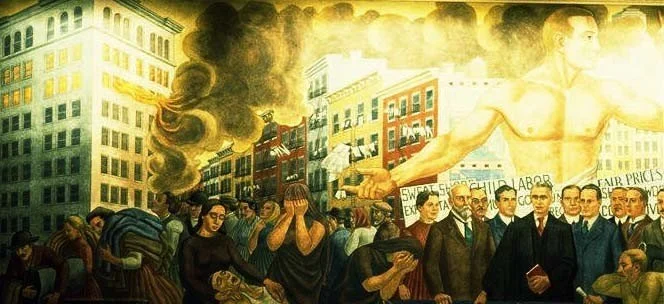
"We have been legislated to death." - James T. Hoyle, Secretary of the Manufacturers' Association, explaining his opposition to new laws proposed in the wake of the Triangle Shirtwaist Co. factory fire, May 19, 1914
"The regulations are killing us" - Congressional candidate George Pendergrass during the Nevada Republican primary, May 12, 2010.
Susan Harris's voice grows hoarse with emotion when she discusses last year's BP oil spill and the Upper Big Branch mine disaster, two of the biggest industrial accidents in the nation's history. But the 62-year-old artist from Los Angeles gets even more passionate expressing her disappointment that the two incidents have not prompted more safety rules, instead lost amid a backlash against government regulations to protect worker safety and health.
"How do people become so hard? It's disgusting," she says. "What are our priorities as a country? It's really ironic that this is happening right now on the anniversary of the fire."
Harris is referring to Friday's 100th anniversary of the Triangle Shirtwaist factory fire, in which 146 workers, mainly young immigrant women, were burned to death or jumped to their deaths. The workplace tragedy, which was caused by dramatically unsafe conditions and blocked exits, inspired dozens of reforms, later helping pave the way for the New Deal, and invigorated the union movement.
That tragedy has a special poignancy for Harris -- her grandfather, Max Blanck, was the owner of the factory and was tried for manslaughter due to the unsafe conditions, which included a locked door that trapped dozens of young seamstresses in the burning ninth-floor room of the Asch building.
Haunted by the tragedy, Harris recalls how she did not even find out about her family's legacy until she was a young teenager and stumbled across her grandfather's name in a book -- the family changed its name slightly in the wake of the accident. "It has affected me deeply. As I grew up, I reflected more on what was going on in my world," says Harris, who has met with relatives of victims and created an art exhibit to honor the victims' memories. "I definitely became more sensitive to workplace conditions -- when I see and hear about young women working in sweatshops in Bangladesh, females who are raped on their way out of work, it has an effect on me. Look at what is happening today -- people are trying to deregulate all these important workplace protections at an exponential rate."
Harris is referring to an assault that has only grown in the first few months of the Republican-led House of Representatives. The GOP's budget proposal includes slashing $99 million from the Occupational and Safety Health Administration, a 40 percent reduction in the budget of the federal agency most responsible for making sure the nation's workplaces are safe -- Democrats claim that translates into 8,000 fewer workplace hazard inspections and 740 fewer whistleblower discrimination probes.
And the new chairman of the House Oversight and Government Reform Committee, Rep. Darrell Issa (R-Calif.), has vowed to take a tough look at regulations that impede job growth, soliciting suggestions from industry groups that included OSHA regulations. Last month, Rep. Tim Walberg (R-Mich.) led a hearing that largely criticized OSHA's impact on business, during which the freshman lawmaker thundered about "needless rules and onerous regulations."
During Walberg's hearing, which was dominated by discussion of the costs of OSHA regulations on corporate bottom lines, one of the most emotional moments came when Tammy Miser, an advocate for worker safety and founder of United Support and Memorial for Workplace Fatalities, undercut the lawmaker's thesis.
Miser said she was there to deliver "a personal story of why OSHA regulations are needed" and cried as she described how her brother, Shawn Boone, was killed in 2003 in an aluminum dust explosion at a factory that produced aluminum wheels, where fires happened on a regular basis and she claimed that workers were instructed not to call the fire department "because it was costing them too much money." Despite Boone's death and the tragic dust explosion at the Imperial Sugar refinery in 2008, which killed 13 and injured 42, OSHA has still not issued a final rule to regulate combustible dust. "Some companies choose to gamble with workers' lives because there are no OSHA standards," said Miser, in discussing the Imperial Sugar disaster.
"The buzz that the regulations kill jobs ... that's just nonsense," said Miser, noting that only two regulations have been passed by OSHA in the past 10 years. And one of them -- applying to cranes and derricks -- came too late for Steven Lillicrap, a 21-year-old construction worker who was killed when he was pulled into the cables of a 100-ton crane in 2009 while OSHA was still revising the standards for the rule. "It was finally issued in July and is expected to prevent 22 deaths and 175 injuries and millions of dollars in property damage per year. The benefits far outweigh the costs of this rule."
Miser paused and added, "There's no price tag that can be put on seeing your husband walk your daughter down the aisle or seeing your baby born. I've talked to family members that have had children and their husbands are gone. Their babies are never going to know their father. It's nothing like seeing your child graduate from college or holding your grandbaby."
Locked Doors, Charred Bodies
On Saturday, March 25, 1911, the end of the workweek, many of the young men and women toiling at sewing machines and cutting cloth at the Triangle Shirtwaist factory near Washington Square Park were getting ready to leave for the day when flames suddenly burst from a trash can on the eighth floor. The fire spread quickly through the factory, which had no sprinklers and where fire drills were not required, consuming the ninth and tenth floors as workers tried in vain to put it out with buckets of water. They quickly unraveled a water hose, but no water came out.
Hundreds of workers raced to an exit door where a young man screamed, "The door is locked? The door is locked!" Dozens made their way onto freight elevators, whose operators risked their own lives to save 150 people, but those who were crowded out jumped down the shaft or out of the windows onto the street below. The wet sidewalks were covered with 146 bodies -- mainly Jewish and Italian women struggling to earn a living making blouses in the sweatshop -- many of them charred beyond recognition.
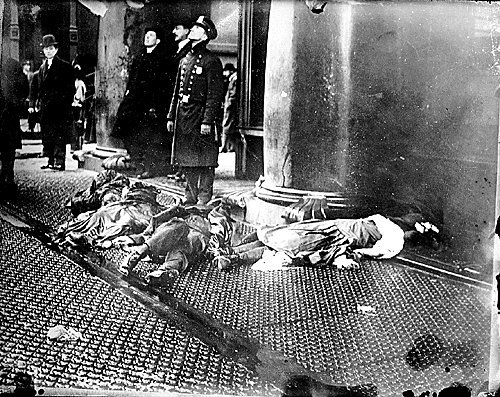
Over 100,000 took part in the funeral procession, which was watched by over 300,000 New Yorkers -- many of them expressing rage at the factory owners, who had put profits before safety and prevented the workers from forming a union.
Two years earlier, a general strike of garment workers, mostly Jewish women, had led to improved wages and working conditions, but that didn't change the union status of Triangle workers. It was still a dangerous time to toil in a labor-intensive industry.
"About 100 workers were killed on the job every day in 1911 -- mine collapses, railroad accidents, steel mill accidents," says David von Drehle, the author of "Triangle: The Fire That Changed America." "If you go back and read the newspapers from that period, it's shocking how common the headlines show up."
At the manslaughter trial of Blanck and factory co-owner Isaac Harris, witnesses were galvanized when one of their employees testified that Harris told him after the fire: "The dead ones are dead and will be buried. The live ones are alive and they will have to live. Sure the doors were locked; I wouldn't let them rob my fortune."
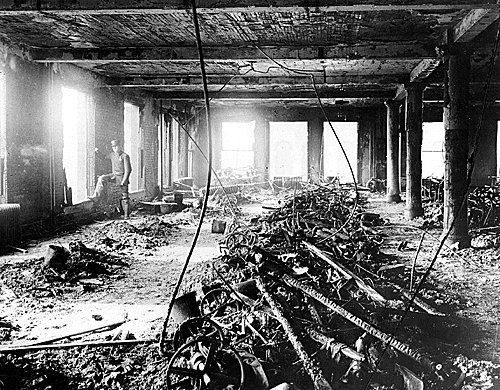
Despite the public outcry, changes were not immediate. A year after the fire, many proposed regulations and laws were clogged in legislative inertia. Though The New York Times's news pages were full of graphic accounts of the tragedy and unsafe conditions at the factory, the paper's editorial page somberly cautioned against excessive regulation, arguing, "Excited persons rarely accomplish anything ... No new laws are needed."
Four years after the tragedy, one letter writer to the Times decried industry-supported amendments that threatened to gut the new laws, including one that would exempt New York City and other cities "altogether from the operation of all safeguards affecting the safety and health of factory operatives."
And factory owners Blanck and Harris were acquitted of manslaughter due to too much conflicting evidence -- two years later, Blanck was fined $20 for having the doors locked at another of his garment factories.
Shocked and outraged citizens demanded better working conditions, and New York state enacted almost 40 labor laws in the following three years. In 1935, Congress passed the National Labor Relations Act to ease union formation and protect collective bargaining and the rights of striking workers.
Though previous tragedies -- from the Great Chicago Fire of 1871 to the fire that engulfed the General Slocum steamboat -- sparked reforms, the political consequences of the Triangle fire were the most widespread, forming a political alliance between labor, liberals and lawmakers that shaped the Democratic Party for decades to come.
"There are a handful of catalytic, galvanizing moments where history really gets a big push to give us the world that we live in today, and the Triangle fire is one of those," von Drehle said. Unlike the sinking of the Titanic, he said, "Triangle led to changes that influenced the way every American lives."
Still Unsafe To Work
A century later -- despite the regulations, laws and a more educated workforce -- such workplace tragedies continue to happen. Within the last two months in the New York City area, these accidents occurred: Limin Min Huang was crushed to death at the dry-cleaning plant in Jamaica, Queens, where she worked, when her scarf got caught in a flatwork ironer, pulling her into the machine. At least six workers fainted and vomited after being overcome by carbon monoxide poisoning due to the lack of ventilation at a warehouse in South Brunswick, N.J. And construction workers Brett McEnroe and Roy Powell died after falling 65 feet in an elevator shaft inside a building site that lacked several safety precautions on Manhattan's Upper West Side.
Among the clothing and garment industries, there remain potentially unsafe working environments, sometimes due to new hazards that didn't exist at the time of the Triangle fire. Last September, OSHA cited New Jersey's Miskeen Originals for numerous workplace safety and health violations, including employee exposure to methylene chloride, a hazardous chemical linked to cancer and adverse effects on the heart.
But the penalties remain paltry. For one willful violation, the company was slapped with a $28,000 fine, along with a $15,150 penalty for 12 serious violations.
"Even a hundred years later, workplace safety concerns are still a problem," says Catherine Ruckelshaus, the legal co-director of the National Employment Law Project, which released a report last year concluding that workplace violations are severe and widespread in New York City's low-wage labor market. "You hear about the locked doors at the Triangle factory and it's shocking. But to this day, we hear about grocery store workers in Brooklyn who are locked in the stores at night and it's a very common practice in retail and the garment industry to lock the doors -- they say it's to prevent theft, which is what the Triangle factory owners claimed."
Ruckelshaus says that though there are much better laws and regulations on the books than there were back in 1911, many of them are not being enforced and there are many parallels between now and then. "In many ways, we haven't made much progress," she says. "The Triangle fire was a mostly immigrant population in a very competitive business. We have that now with janitorial, home health care, security workers, the garment industry -- any labor-intensive industry, you have the same pressures."
Among the NELP report's findings: only 11 percent of injured workers file a workers' compensation claim and 16 percent were fired or told not to file a claim when they told their employer about the injury. Every week in the city, $18.4 million is lost to "wage theft," meaning violations such as paying less than minimum wage.
"It happens all over the place -- unsafe construction sites, sweatshops tucked away in all corners of NYC, just blocks from the Triangle factory site," says Leigh Benin, who worked briefly in the garment industry. "The other part of it is, which is just as shameful, is that 95 percent of garment manufacturing is now offshore. Clothes are being made in Bangladesh, where they have very similar conditions to the Triangle factory, where workers are locked in."
Benin, whose grandmother's cousin Rose died in the Triangle fire, says that "it was routine to lock doors, to search people when they left." For him, the Triangle tragedy was a living memory and he would hear the details from his grandmother's lips. "I felt that deep sadness in her and I felt close to her," he says. "And then it came to me, that there is something I can do, to try and make sure that we will never forget them, that they shall not have died in vain. That they could look back and say, 'They died, but we did something to make sure that won't happen again.'"
Benin, now a professor at Adelphi University, is taking part in ceremonies to mark the anniversary but says he worries that the fire's legacy of workplace reform is under threat, partly because so many people have no memory of the fire. He cites the example of Frances Perkins, a young social worker who was having a cup of tea across the park on the day of the fire when she heard the commotion and saw women jumping out of the windows to their deaths.
"From that day forward, she made the determination to make that tragedy count for something, that those lives were not in vain," he said. Perkins, as a member of the Factory Investigating Commission, helped push through dozens of workplace safety laws that became a model for the rest of the country. She later became President Franklin Roosevelt's first female Cabinet member, serving as Secretary of Labor and helping push through the Social Security Act, laws against child labor, and the Fair Labor Standards Act, which established the first minimum wage and overtime laws.
The factory commission report had an enormous impact, says Kirstin Downey, the author of "The Woman Behind the New Deal," a biography of Perkins. Speaking at a recent symposium on the Triangle fire sponsored by the National Consumers League, Downey held up a volume from the 13-volume report, explaining that it revealed unsafe and unsanitary conditions in numerous factories and led to workplace innovations like fire escapes, sprinklers, lighted exit signs, occupancy limits, regular fire drills and bans on smoking in factories that Americans take for granted.
At the ceremony to mark the 50th anniversary of the Triangle fire, Perkins and Eleanor Roosevelt were at the podium, says Benin. "They could look back and talk about the legacy of reform, at all the progress that had been made in the decades after the fire. But if you look back at what's been going on the last few years, it's been an attempt to undo the reforms and the union movement, to return us to an era before the New Deal, even prior to the progressive era, to some new Gilded Age."
Benin argues that people don't die of excessive regulation. "Was there too much regulation of the mining industry after 29 people died or BP where 11 people died? Let's assume that it's impossible to find a completely reasonable approach to everything and that inevitably we're going to err on one side -- I'd much rather err on the side of too much, because too little ends up harming people or killing people," he said.
Considering the lobbying forces marshaled by corporation and industry groups, Benin says that it's an unequal fight. "The forces arrayed against regulation are the wealthy and powerful, whose vision doesn't extend beyond the bottom line," he said. "The largest question is, 'Who is responsible for the public good? Corporations are only responsible to their shareholders or to their own egos. So, it can only be government officials."
Similar to the anti-regulatory zeal displayed in the industry response to Rep. Issa's recent request for lists of burdensome regulations, there was an "incredible litany of business lobbying groups in New York state and New York City who had the exact same arguments as the Chamber [of Commerce] has today," says Peter Dreier, a professor at Occidental College and HuffPost blogger.
Describing the arguments found in transcripts of the factory investigation commission hearings, Dreier recounts: "'If you make us put fire sprinklers in, if you require fire escapes' and other things we now take for granted, 'industry will leave New York and it will become a ghost town.'"
Dreier is alarmed by today's anti-regulatory climate. "If today's Chamber of Commerce were around in 1912, they would say fire sprinklers are burdensome government regulations that will drive out jobs," he said. "They would call for voluntary corporate responsibilities to fix mine safety and oil rigs. ... What we learned from the Triangle fire is you have to have a set of rules and standards that protect workers."
The Chamber strongly disputes that characterization. The preeminent business lobby's executive director of labor law policy, Marc Freedman, says that the group supports OSHA and that workplace safety is a primary concern of employers.
Freedman argues that there are valid questions about how OSHA spends its money and whether it overemphasizes enforcement at the expense of efforts to work with employers on compliance assistance. "What I seem to be seeing from a number of voices is to connect the Triangle tragedy with some of the contemporary efforts surrounding unionization or other workplace accidents and disasters," he says. "Clearly, Triangle Shirtwaist had a deep meaning and resonates as one of the signature events that triggered workplace reforms, and it's a good thing we've moved on since then."
He adds that companies have made serious investments to achieve the goal of no workplace accidents or fatalities, explaining that "there are going to be employers worthy of enforcement by OSHA, but the question is whether the agency is only going after employers who have truly disregarded the safety of their workers." Freedman argues that the chamber's focus on regulation is more about what the Obama administration is trying to do and not about the rules and regulations that are already on the books, adding that some of OSHA's regulatory ideas are not well-founded.
The legacy of the Triangle fire is palpable to every American, says Benin. "If you're sitting in a workplace right now, you're enjoying safety regulations that came about because of the fire -- sprinkler system, fire drills, clear exits," he says. "Over 30 fire safety laws came about and we are all benefiting from the loss of those 146 lives and what that tragedy did to shake up the country."