iPhone app iPad app Android phone app Android tablet app More

Obama Treasury Celebrates Bailout Profits While Ignoring Costs, Legacy

First Posted: 03/30/11 06:42 PM ET Updated: 05/30/11 06:12 AM ET

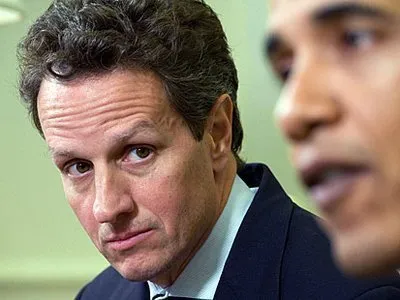
Geithner

NEW YORK -- On Wednesday, the Treasury Department celebrated the fact that its $250 billion investment in the nation's banking system has officially made money. What's more, the entirety of the federal government's efforts to rescue a financial system that sowed the seeds of its own demise will also eventually do the same, according to new Treasury projections.

Treasury did not, however, commemorate the hundreds of billions of dollars in taxpayer aid left to be repaid; the billions the Troubled Asset Relief Program will ultimately cost taxpayers; the extraordinary actions of the Federal Reserve and Federal Deposit Insurance Corporation that made Treasury's bank profits possible; or the fact that the entire enterprise of pumping taxpayer cash into a financial system rife with unrecognized losses will likely be remembered as a "dismal failure," in at least one Nobel Prize-winning economist's estimation.

In other words: not so fast.

The worst financial crisis since the Great Depression spurred an alphabet soup of federal programs designed to calm markets and allow banks to rely on taxpayers as credit froze and investors fled. One of those programs, TARP, became the face of the government's unprecedented involvement in the financial sector.

In the fall of 2008, Congress authorized then-Treasury Secretary Henry Paulson to spend $700 billion to rescue the rapidly-failing financial system. At the time, stock markets around the world were tanking, borrowing costs were skyrocketing and the prices of all but government-guaranteed financial instruments were plummeting as confidence sank. Investors and policymakers feared Armageddon.

Paulson used the money to invest in banks, auto companies and the insurance giant AIG. His Obama-nominated successor, Timothy Geithner, continued that policy, and added a few more programs to spur lending and rescue homeowners.

Only looking at dollars and cents, the bank investment has been the most successful. Treasury obligated $250 billion to support banks like Citigroup, JPMorgan Chase and Bank of America. The agency has now recouped those funds and then some, thanks to fees and dividends. It's officially in the black.

"Today is an important milestone in our efforts to recover taxpayer dollars as we continue winding down TARP," Geithner said in a statement Wednesday.

But that profit figure doesn't acknowledge that of the $475 billion in TARP funds promised to auto companies, insurers and borrowers, about $187 billion remains outstanding, according to Treasury data through Tuesday. In the end, the Congressional Budget Office forecasts that TARP will cost taxpayers about $19 billion.

It also masks the extraordinary lengths the U.S. government took to ensure that its biggest banks did not fail, beginning with the Federal Reserve.

The Fed lowered the main interest rate to nearly zero percent, lowering borrowing costs for banks and other financial companies.

The cheap funds allowed banks to continue lending to creditworthy borrowers at normal rates -- if not higher, given the uncertain economy -- and book easy profits.

Last year, for the first time since 1962, banks paid less than 1 percent for their funds. In 2007, their borrowing costs were about three times higher, at 2.76 percent, FDIC data show.

Banks have been able to weather losses from sour loans thanks to rock-bottom interest rates. In effect, the Fed allowed banks to earn their way out of the crisis with taxpayer money.

The Fed also flooded the financial system with trillions of dollars in guarantees, short-term loans and asset purchases.

It purchased more than $1 trillion in government-backed mortgage securities, allowing banks easy profits off lending fees without having to shoulder any of the risk by simply transferring it to the taxpayer. More than nine out of 10 new home loans are guaranteed by taxpayers.

In addition, the central bank lent banks cheap money at a time when no one else would, allowing them to weather a volatile market, and allowed banks to pledge junk-rated collateral in return.

The FDIC also played a part in the banking industry's comeback, at one point guaranteeing nearly $350 billion in bank debt as investors shunned a weakened industry, according to the agency. If the banks couldn't make their payments, taxpayers would have stepped in.

The taxpayer guarantee gave banks access to cheap funds, lowering their borrowing costs and signaling to investors that many of them simply would not be allowed to fail.

About $267 billion of that debt remains unpaid, according to FDIC data through Dec. 31. The nation's biggest banks, like Citigroup, Goldman Sachs and JPMorgan Chase, are among the biggest beneficiaries.

The FDIC also guaranteed a wider range of deposits, allowing banks to benefit from even more cheap cash as depositors flooded the firms with money.

The average deposit account yielded 0.79 percent at the end of last year, according to Market Rates Insight, a data provider. In 2007, the average rate stood at 4.15 percent. Retail deposits now make up 80 percent of all bank liabilities, up from 72 percent in 2007, according to the firm.

But Treasury didn't acknowledge the factors that enabled it to book a profit from its bank investments. Instead, officials celebrated the extraordinary actions the department took to rescue a teetering financial system.

Those programs will generate a $23.6 billion profit, according to Treasury projections released Wednesday. It'll take another decade to get to that point, the projections show, as taxpayer aid for government-controlled mortgage giants Fannie Mae and Freddie Mac winds down. Meanwhile, trillions of dollars in taxpayer aid and asset guarantees remain outstanding.

Federal overseers, like the departing Special Inspector General for TARP, Neil Barofsky, argue that the cost of that rescue shouldn't merely be measured in dollars and cents. Rather, the cost will manifest itself in other ways, as the nation's largest financial firms will likely continue to make risky bets because they expect taxpayers to bail them out in times of crisis.

"The good financial news should not distract from the careful and necessary assessment of TARP's considerable, non-financial costs that, while more difficult to measure, may be even more significant," Barofsky told a Congressional panel Wednesday. "Those costs include what is essentially at the heart of this hearing, the increased moral hazard and potentially disastrous consequences associated with the continued existence of financial institutions that are 'too big to fail.'"

Earlier this month, Nobel Prize-winning economist Joseph Stiglitz told another bailout watchdog that TARP has been a "dismal failure."

"It was hoped that it would play a pivotal role in dealing with the flood of mortgage foreclosures and the collapse of the real estate market that led to the financial crisis," Stiglitz said March 4 during testimony before the Congressional Oversight Panel.

"TARP and the recovery of troubled assets were not ends in themselves, but means to an end, namely the recovery of the economy," the Columbia University professor said. "In that ultimate objective, TARP has not only been a dismal failure -- four years after the bursting of the real estate bubble and three years after the onset of recession, unemployment remains unacceptably high and our economy is running far below its potential, a waste of resources in the trillions of dollars -- but the way the program was managed has, I believe, contributed to the economy's problems."

The ongoing moral hazard, Barofsky argued, is "precisely the sort of behavior that could trigger the next financial crisis, thus perpetuating a doomsday cycle of booms, busts and bailouts."

*************************

Shahien Nasiripour is a business reporter for The Huffington Post. You can send him an e-mail; bookmark his page; subscribe to his RSS feed; follow him on Twitter; friend him on Facebook; become a fan; and/or get e-mail alerts when he reports the latest news. He can be reached at 917-267-2335.

FOLLOW HUFFPOST BUSINESS
Subscribe to the HuffPost Money newsletter!
NEW YORK -- On Wednesday, the Treasury Department celebrated the fact that its $250 billion investment in the nation's banking system has officially made money. What's more, the entirety of the federa...
 
 
  • Comments
  • 773
  • Pending Comments
  • 0
  • View FAQ
Comments are closed for this entry
View All
Favorites
Highlights
Recency  | 
Popularity
Page: 1 2 3 4 5  Next ›  Last »  (21 total)
photo
joni brit
The road to success is always under construction.
09:50 PM on 04/04/2011
That's exactly what I would like to know. The Obama Bailout, TARP, did absolutely nothing do stem the tide of foreclosures. HAMP was not only a failure, but put people into foreclosure more often than not. At Wells Fargo, within the first month of application for HAMP Modification, you were put into foreclosure, and while you thought you were paying a modified payment, actually, your mortgage was being re-assigned by a robo-signer and default insurance was paid to Wells Fargo 4 months later. The applicant was told to stop paying, they did not meet requirements, and they were put into foreclosure. Of course, now they were 6 months in arrears because none of their HAMP payments were considered mortgage payments. Also Late fees were added, and any other miscellaneous Bank fees they could throw in. The Banks have made and are still making billions.
photo
joni brit
The road to success is always under construction.
03:33 AM on 04/03/2011
If the cost of the Obama Bailout is thousands of homeless children, how is this cause for celebration?
This user has chosen to opt out of the Badges program
07:38 PM on 04/04/2011
The Bailout is joint custody, the proud parents being both Republicans and Democrats. However, Obama is looking more NeoCon by the day via his "compromises". We're being gamed by both sides of the aisle.
photo
joni brit
The road to success is always under construction.
10:06 PM on 04/04/2011
It's so true. Homelessness has become joint custody, how very very sad.
03:23 AM on 04/02/2011
Rob from the poorest of the poor and give to the richest of the rich. Same old philosophy of greed in america.
07:16 PM on 04/05/2011
Greed is an epidemic!
03:00 PM on 04/01/2011
the federal government would be still further ahead if congress didn;t keep caving in terms of repayment. see warren buffet's comments about goldman-sachs.
given that "afghanistan" is about $6 million an hour drain on the us economy, $19 billion to avoid having "hooverville" be the new metroplex is cheap.
01:30 PM on 04/01/2011
I had to sell all my stock to buy gas to look for a job. I am glad you are doing so well. The government numbers fo unemploymet are not correct. I would say that it is at least 3 times higher than what they say. It would not matter who the president is. The corporate execs and Wall Street bankers are running the show.
09:38 PM on 04/03/2011
To The Griff: You hit the nail on the head! Corporate and government greed is what is running the World.
This user has chosen to opt out of the Badges program
07:39 PM on 04/04/2011
I hear the actual number is 25% but not being admitted because we'd be officially in a depression and no one's willing to own that.
07:51 PM on 04/04/2011
I have a very good friend who works for the state employment office and she tells me how bad it really is and they have been instructed by memo not to say anything about how bad it is.
photo
HUFFPOST SUPER USER
billhodges
Self Reliant Yet Charitable
10:54 AM on 04/01/2011
Barack Obama: Losing $84 billion big success when it comes to GM
photo
HUFFPOST SUPER USER
fgbouman
Curmudgeon & Designer
04:24 AM on 04/01/2011
The median Singaporean family income has risen 37% in Singapore Dollar terms in the past decade. You can add another 21% to that to adjust for the decline in the USD vs. the SGD. So the median Singaporean family has seen their income increase by nearly sixty percent in U.S. dollar terms in the past ten years. How did you do? Better yet, how did your net worth fare?
If you are retired or expect to retire any time soon, the world must be looking pretty bleak right now. Thanks President Bush. Poverty builds character and you've done your best to build your nation's character.
This user has chosen to opt out of the Badges program
07:41 PM on 04/04/2011
Now be a sport fgbouman, Bush birthed it but Obama's not been fixing the problem either.
12:56 AM on 04/01/2011
I didn't see anywhere in this article a reference to the sad fact that the value of the dollar continues to sink. This makes measuring success in dollar terms even more deceptive.
Much of the "recovery" of the stock market can be attributed to the decline in the value of the dollar. A DowJones of 12,000 in 2011 is not the same as a DowJones of 12,000 in 2008 or 1998.
HUFFPOST SUPER USER
rboylern
11:44 PM on 03/31/2011
While people are crying for jobs and wondering if they can pay next month's rent these nitwits are dancing around and lining their pockets once again. What reasoning was behind letting us pick up the tab for thieves and robbers who are now rolling in moolah? This is a true WTF situation.
HUFFPOST SUPER USER
RRundbaken
09:30 PM on 03/31/2011
Talk about nitpicking. Even if all those measures wind up costing $19 billion, that's out of a $14 trillion economy. Compare that costs to what would have happened had the banking system collapsed, the auto industry collapsed and unemployment had skyrocketed to 20%.
HUFFPOST SUPER USER
kamact
Market Observer
01:09 AM on 04/01/2011
That's not the point,...save the entities, but punish the executives,..Instead the government used taxpayers' money to reward these financial terrorists,...I would like to see a few thousand publically beaten, their bonuses clawed back, and then have them thrown in jail,...These financial terrorists have done more damage to millions of Americans than any other terrorist group could ever do
This user has chosen to opt out of the Badges program
07:46 PM on 04/04/2011
And Paulson. He instructed that the AIG CDO gamblers be taken care of first. The criminals working in Washington are just as bad as the ones on Wall St. Well, they come from Wall St.
07:54 PM on 04/04/2011
Our elected leaders are the ones who allowed this to happen. They are the ones who need to be procecuted.
Vinkaye
science matters
09:25 AM on 04/01/2011
First of all, understand that real unemployment probably is closer to 20% than 10%... and second, we have allowed TBTF to grow by 20%, to gain a larger slice of the nation's pie, and to go right back to rolling the giant dice... meaning we temporarily propped things up, but with the weight growing the actual crash is going to be much worse!
This user has chosen to opt out of the Badges program
07:48 PM on 04/04/2011
Hence the push to get their hands on the Social Security and pension monies. This round of unemployment is expected to be 3 years but the next one is expected to be 5 years.
07:41 PM on 03/31/2011
So the banks took our money so they could charge us more, of our money. Would someone tell me why we can't change the return per centage, like to 21-24% like the banks can do to us (and do) with their change in rates on cards, bank fees, etc? Obama has greatly dissapointed me. He has sold us out, like all the Politicians have and do. However, to be fair and comprehensive, we should compare the cost of the Iraq Invasion. Like then, the money keeps floiwing into the pockets of 2% of our population at a rate that is greater than most Monarchies charged durring the reign of Kings, Queens, Emporers. Where's Robin Hood when we really need him? Maybe we should start sharpening the guieotimes to overthrow our current Rulers and their well paid politicians.
photo
HUFFPOST SUPER USER
Reno Fickler
Head Lifeguard/Dead Sea Marina
07:31 PM on 03/31/2011
Businesses (banks) that borrow money for 1%, then loan it (credit cards) that charge 20%+ made money????? Go figure.
The bottom line is billionaires made money and that is all that matters in America.
HUFFPOST SUPER USER
mansterEZ
searching for secular humanist fact-based truth
06:28 PM on 03/31/2011
It costs each and every one of us to bail out the banks and financial institutions for THEIR miscalculation while they NEVER lost ANY money? If Geithner and this administration hasn't proven their fasc!st ideals, this is a clear averment. How to identify Fasc!sm? Click below.

http://www.secularhumanism.org/index.php?page=britt_23_2§ion=library
06:14 PM on 03/31/2011
"In the end, the Congressional Budget Office forecasts that TARP will cost taxpayers about $19 billion"

$19 billion/ apx. 300 million people = roughly $65/person

I wasn't around in 1929 but by all accounts it was a situation that should be avoided at all costs... $65/person seems like a bargain.
08:25 PM on 03/31/2011
you are quite correct, especially if that $65 a person is retermed as "less than 2 days at minimum wage." compare with the scario portrayed in "grapes of wrath," or "ironweed"..both of which still glossed to get through the hoops towards publication.
complaints about tarp, etc come from the uninformed listening to those who would have profited buying a "blood on the streets" america.
Vinkaye
science matters
09:45 AM on 04/01/2011
Except for the fact that the forecasts amount to smoke and mirrors and nothing more. You can choose to believe that handing Bank of America $336.1 billion and having them "repay" $45 billion is a great deal for the taxpayer, but the reality is it kind of stinks! Also, keep in mind much of the supposed "profit" from TARP, comes from the fact that HAMP came in way under budget, this happened because only a small fraction of homeowners were helped through HAMP... boom, instant "profit". Read Neil Barofsky's piece about what a great deal TARP was for Main Street, and Robert Reich's piece on the coming 2nd dip, and then decide if it was such a bargain!
06:52 PM on 04/01/2011
I think you may be talking about this? http://www.huffingtonpost.com/robert-reich/why-were-falling-into-a-d_b_600571.html

I respect Reich as much as anyone, however he authored this in June of 2010... While the stock market is not the economy, to this point I would say his prediction has not come to fruition. A broken clock is right twice a day.

I'll check out the other article and HAMP, thank you for sharing. This is the greatest use of social media; the sharing of ideas and open dialogue. I appreciate your comment.
HUFFPOST SUPER USER
jstrate
04:59 PM on 03/31/2011
I suppose TARP accomplished its main goal of retaining the capacity of members of Congress to shake down the real estate industry, the banks, and Wall Street for campaign contributions.