
iPhone app iPad app Android phone app Android tablet app More

Japan Told To Consider Widening Evacuation Zone Around Nuclear Plant

Reuters    
First Posted: 03/31/11 04:05 AM ET Updated: 05/30/11 06:12 AM ET

March 31, 2011 6:30:27 AM

By Chizu Nomiyama and Chisa Fujioka

TOKYO, March 31 (Reuters) - Pressure mounted on Japan on Thursday to expand the evacuation zone around its stricken nuclear power plant while officials said radiation may be flowing continuously into the nearby sea, where contamination was now 4,000 times the legal limit.

In the first data on the impact of the devastating earthquake and tsunami that triggered the nuclear crisis, Japanese manufacturing slumped the most on record in March as factories shut down and global supply chains were broken.

The damage to the world's third-biggest economy from the quake and tsunami alone could cost more than $300 billion, making it the world's costliest natural disaster, and a report from a Wall Street investment bank said nuclear-related compensation claims could reach more than $130 billion.

Both the U.N. nuclear watchdog and Japan's nuclear safety agency said the government should consider widening the 20-km (12-mile) zone after high radiation was detected at twice that distance from the facility.

Opposition politicians have lambasted Prime Minister Naoto Kan for sticking with the original exclusion area, nearly three weeks after the disaster led to the world's worst nuclear crisis since Chernobyl in 1986.

More than 70,000 people have been evacuated from the 20-km ring around the plant. Another 136,000 who live in a 10-km (6-mile) band beyond that have been encouraged to leave or to stay indoors.

The International Atomic Energy Agency (IAEA) said radiation at Iitate village, 40 km (25 miles) from the Fukushima Daiichi nuclear plant, exceeded a criterion for evacuation.

"We have advised (Japan) to carefully assess the situation and they have indicated that it is already under assessment," Denis Flory, a deputy director general of the IAEA, said.

Japan's chief Cabinet Secretary Yukio Edano, however, gave no indication the government was poised to widen the zone.

"At the moment, we have no reason to think that the radiation will have an effect on people's health," Edano told a news briefing when asked about the IAEA's findings at Iitate village.

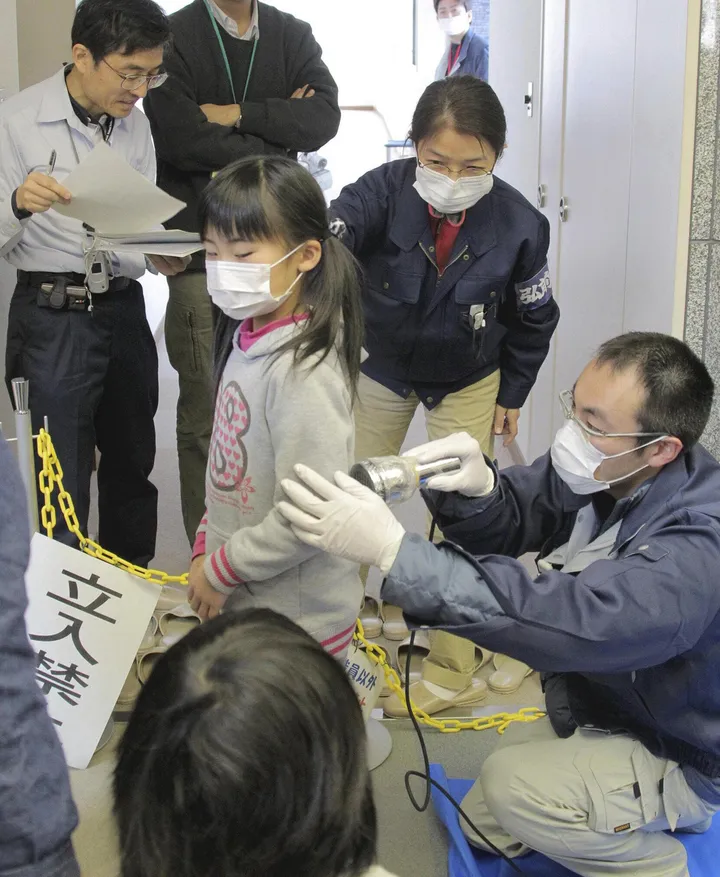
The consistently high levels of radiation found in the sea near the complex could mean radiation is leaking out continuously, Japan's nuclear watchdog said.

"That is a possibility," Nuclear and Industrial Safety Agency Deputy Director-General Hidehiko Nishiyama told a news conference, adding engineers had not found the source of the leaks.

Radioactive iodine in seawater near drains running from the plant was 4,385 times more than the legal limit, the highest recorded so far during the crisis.

FRENCH PRESIDENT HEADS TO TOKYO

In a much-needed diplomatic boost for Japan, French President Nicolas Sarkozy will visit Tokyo on Thursday and hold talks with Kan.

Sarkozy will be the first world leader to travel to Japan since the earthquake and tsunami on March 11, which left more than 27,500 people dead or missing.

France, the world's most nuclear-dependent country, has flown in experts from state-owned nuclear reactor maker Areva , while the United States has offered robots to help repair the damaged Daiichi nuclear plant.

Concern over radiation beyond Japan grew again after Singapore detected radiation nine times the limit in cabbages from Japan, while the United States reported "minuscule" levels of radiation in milk samples on its west coast.

"These types of findings are to be expected in the coming days and are far below levels of public health concern, including for infants and children," the Food and Drug Administration and the Environmental Protection Agency said.

Contaminated milk was one of the biggest causes of thyroid cancers after the nuclear accident in Chernobyl because people near the plant kept drinking milk from local cows.

Several countries have banned milk and produce from the areas near the damaged nuclear plant, 240 km (150 miles) north of Tokyo. Japan has itself stopped exports of vegetables and milk from near the plant. [ID:nL3E7EN0JP]

While food makes up only 1 percent of Japan's exports, the nuclear emergency poses a risk to an economy burdened with public debt twice the size of its $5 trillion dollar economy and a fast ageing population.

Japan has called on World Trade Organisation nations not to impose "unjustifiable" import curbs on its goods.

JAPANESE MANUFACTURING ACTIVITY SLUMPS

The government has said the cost of damage from the earthquake and tsunami could top $300 billion. The 1995 Kobe quake cost $100 billion while Hurricane Katrina in 2005 caused $81 billion in damage.

Japanese manufacturing activity slumped to a two-year low in March and posted the sharpest monthly fall on record as the quake and tsunami hit supply chains and output. [ID:nLHE7EO00C]

"It is a major issue now how the nuclear crisis develops, and stock market players are also closely watching it," said Akeshi Minami, chief economist at Norinchukin Research Institute, Tokyo.

TEPCO could face compensation claims of up to 11 trillion yen ($133 billion) -- nearly four times its equity -- if Japan's worst nuclear crisis drags on for two years, an analyst at Bank of America Merrill Lynch wrote in a report.

A Reuters investigation showed Japan and TEPCO repeatedly played down dangers at its nuclear plants and ignored warnings, including a 2007 tsunami study from the utility's senior safety engineer. [ID:nL3E7EU0HO]

CONTAMINATED SEAWATER

As operators struggle to regain control of the damaged reactors, nuclear experts said the continued lack of a permanent cooling system was hindering efforts to cool down fuel rods.

Workers have been forced to pump in seawater to cool the rods, but this creates contaminated seawater around the stricken plant and is making it difficult to reconnect the plant's internal cooling system which contains radiation.

"There's definitely a conflict now between trying to keep the reactors cool and managing the contaminated waste water being generated by the operation," said Ed Lyman, a senior scientist with the Union of Concerned Scientists, a U.S.-based nuclear watchdog group.

Radiation readings around the evacuation zone vary widely. Daily readings published by the government show that 30 km northwest of the reactors levels are climbing up to 42 microsieverts per hour, about 6 times the cosmic radiation experienced during a Tokyo-New York flight, while elsewhere at that distance around the reactor it is just 1.0-1.2 microsieverts per hour.

A Reuters reading in downtown Tokyo on Thursday showed a radiation level of 0.18 microsieverts per hour. This is still quite low by global standards as Japan has lower levels of natural background radiation than other places.

The World Nuclear Association says average background radiation in most areas globally varies from 0.17 to 0.39 microsieverts per hour. So even with higher-than-usual levels, Tokyo is at the bottom of that range. (Additional reporting by Yoko Nishikawa in Tokyo, Sylvia Westall and Fredrik Dahl in Vienna; Andrew Callus in Geneva; Writing by Michael Perry; Editing by John Chalmers and Dean Yates)

Copyright 2011 Thomson Reuters. Click for Restrictions.

FOLLOW HUFFPOST WORLD

March 31, 2011 6:30:27 AM By Chizu Nomiyama and Chisa Fujioka TOKYO, March 31 (Reuters) - Pressure mounted on Japan on Thursday to expand the evacuation zone around its stricken nuclear powe...
Filed by Adam Goldberg  |  Report Corrections
 
 
  • Comments
  • 1,546
  • Pending Comments
  • 0
  • View FAQ
Comments are closed for this entry
View All
Favorites
Bloggers
Recency  | 
Popularity
Page: 1 2 3 4 5  Next ›  Last »  (22 total)
photo
Kassandra
Your micro-bio is empty
10:20 AM on 04/02/2011
Yeah, widen it to leaving the country altogether
06:58 PM on 04/01/2011
Japan should immediately change the Power Generation from Nuclear to that of GRAVITY CONTROL. No fuel needed after start -up, no pollution, no water . Can be built anywhere at a fraction of a Nuclear plant"s cost. in a few months.
It is based on the technology, used by a Flying Saucer.
06:46 PM on 04/01/2011
Japan should immediately change the power production to the Gravity Control system.
No radiation, no pollution and no fuel needed after start -up.Power at 1 cent per Kilowatt or less.
11:29 AM on 04/01/2011
How is the radiation not a health risk at all when it's been detected as far away as Tokyo? The reports get worse every day and the evacuation zones are getting bigger, yet there is no real concern for anyone? I understand Japan is a long way from the west coast of the US, but if we are seeing radiation in the rain in Michigan, doesn't that have some basis for concern? Can we really rely on these reports?
photo
Kassandra
Your micro-bio is empty
10:21 AM on 04/02/2011
Tokyo? Try this:
Radiation Found In San Francisco, CA Tap Water — Rainwater Radiation 18,100% Above Drinking Water Limit
http://blog.alexanderhiggins.com/2011/04/01/breaking-radiation-san-francisco-18100-drinking-water-limits-13014/
photo
HUFFPOST SUPER USER
Endogenous Light Nexus
There actually is light within you
08:44 AM on 04/03/2011
Radiation from Fukushima is getting everywhere, in addition to other places mentioned radioactivity has been detected in Massachusetts and Florida and even Iceland. More places are mentioned on my blog at http://blog.antinuclearnutrition.com. Ironically radiation is being picked up in many cases by monitoring devices set up around other nuclear plants which are very sensitive.

Of course all the mouthpieces are saying the exposures are "not of concern" or "less than you'd get on an airplane flight" etc., NOT ACTUAL DOSE RATES YET but more importantly what they're NOT saying is much about how several radionuclides of concern (esp. iodine-131, cesium-137, and strontium-85) can be concentrated by moving up the food chain to us. This is going to be a much bigger problem for the Japanese but the drama isn't over yet and it could still wind up affecting us, if you have any friends in Japan please let them know about my ebook for radiation protection at http://antinuclearnutrition.com .
08:20 AM on 04/01/2011
Let's hope the whale meat in storage hasn't been contaminated.
HUFFPOST SUPER USER
hershobr
07:10 AM on 04/01/2011
Japan will never be the same.

One more proving point for the U.S. being the greatest country though, if they had to evacuate Japan, where do you think the majority of those people would come and be welcomed to? The United States.
photo
Kassandra
Your micro-bio is empty
10:22 AM on 04/02/2011
It would get our manufacturing going again, that's for sure
03:31 AM on 04/01/2011
Part 2
This is not a Chernobyl or air burst event, the core did not get blown apart. It going to sit there and happily fission away without control rods, or water or even boron to soak up some thermal neutrons. No moderators can get in between hot spots.It is one big mass, maybe glass like, probably looks like a hunk of metal slag.
There is one out of the box solution, since you can't open it to pull out mass until it's below Criticality, but you can dissolve uranium with an iodine/iodide solution. I use it to dissolve gold out of black sand. Strange fact, reacts with gold, platiium, silver and Uranium. Will not react with steel or iron if there is still some containment there. Acidic it puts metals into solution, basic ( a little lye) metal precipitate out. Run it through a filter, add a little acid, and use it again. Gee, gave away my best secret. See if anybody can double check this and get it to the right ear. You are more then welcomed to take credit for it, just save my ocean.
photo
Kassandra
Your micro-bio is empty
10:24 AM on 04/02/2011
Well, send it to the IAEA asap if you've got the answer. I'm sure someone else will take credit for it. but hurry!
photo
HUFFPOST SUPER USER
Endogenous Light Nexus
There actually is light within you
09:07 AM on 04/03/2011
Seems like a good idea to dissolve uranium in iodine solution but I'd want to check first that the iodine you'd be dissolving the uranium in didn't absorb neutrons to turn into some hideously dangerous reservoir of even more radioiodines than are already being released into the air and water. Plus you've sort of got a problem with a reactor that already isn't holding water, how are you going to get it to hold an iodine solution? I'm thinking maybe they could send in teleoperated robots to dissolve away areas of fuel slag where they could pool or otherwise contain a solution but it's so damn hot wouldn't any water-based solution just flash into steam? It takes a very long time to cool reactor fuel, I believe they store it for years before even thinking about reprocessing the stuff and what you're suggesting is something like an on-site reprocessing to remove the once-molten fuel. Considering what a dirty mess even conventional reprocessing makes with all it's supposed safeguards of containment and filtering, just imagine how dirty reprocessing a reactor open to the air would be! Still, it might turn out to be the least bad of all the options.

BTW if you have friends in Japan or live near a reactor yourself you might be interested in my ebook about radiation protection at http://antinuclearnutrition.com.
03:30 AM on 04/01/2011
From watching IAEA reports, sounds like to me that a coupla' things are happening. Reactor #1 is very warm but cooling. I don't think it is in total shutdown. Control rods melted and floating on top some slagged fuel rods. Not the big problem, just will be hell trying to pull them out.Square peg in Sguare hole is now all one blob.It's cooling so water and boron are getting between rods and arresting cascade or chain reaction if you prefer.
Good news is # 3, MOX (plutonium) seems to be almost cold.
Bad news is # 2, start with breached (at atmospheric pressure) and temp is increasing 4 degrees every day. I think, core is a pile of slag possibly burnt totally through steel containment and sitting on concrete-final-containment shell. Let that sink in.
photo
EcnelisDoogod
B the change you want 2C
03:00 AM on 04/01/2011
The localized criticality causing explosions is most disturbing. Hope that someone is measuring the intervals between explosions. Get out of Dodge if the rate starts to increase like popcorn.
photo
HUFFPOST COMMUNITY MODERATOR
mrJJ
如果你不投票,你不能抱怨
11:23 PM on 03/31/2011
NEWS ADVISORY: Resin to be sprayed Fri. at nuke plant to prevent radiation spread (12:09)
NEWS ADVISORY: Nuke agency expresses 'strong regret' over erroneous nuclide analysis (12:08)
NEWS ADVISORY: Groundwater highly likely polluted with radiation despite TEPCO error (11:58)
NEWS ADVISORY: Part of TEPCO data on groundwater, trench contamination had error: agency (11:58)
NEWS ADVISORY: Edano didn't rule out future gov't involvement in TEPCO management (11:56)

http://english.kyodonews.jp/news/japan_nuclear_crisis/
HUFFPOST SUPER USER
elan4444
11:20 PM on 03/31/2011
It took Sarkozy to finally say that there should be powerful international regulation of nuclear power. Finally! Pres. Obama should have ben in the forefront - milk in Washington State has shown contamination by radiation. Get with it people, it's almost three weeks and Japan is crumbling!
photo
HUFFPOST SUPER USER
Jeffrey Williams
Don't worry ! Nothing is going to be OK !!!
11:13 PM on 03/31/2011
Perhaps this ought to help with our jobless rate here in the states ...

Exclusive: WANTED: U.S. workers for crippled Japan nuke plant

http://ca.news.yahoo.com/exclusive-wanted-u-workers-crippled-japan-nuke-plant-20110331-165506-832.html
photo
SageSpencer
Angel brought Him the leaden heart & the dead bird
11:10 PM on 03/31/2011
They should have widened the evac zone already.
professor
Correkt the Spelling and Pick on the Moniker
11:03 PM on 03/31/2011
Ulp. My "love" was but a snapshot in time. It was one shining moment. Now gone forever. Like the illusion that nuclear power can ever be "safe."