
More

Connectomics: Mapping The Brain's Complexity

Connectomics

First Posted: 04/11/11 12:22 PM ET Updated: 06/11/11 06:12 AM ET

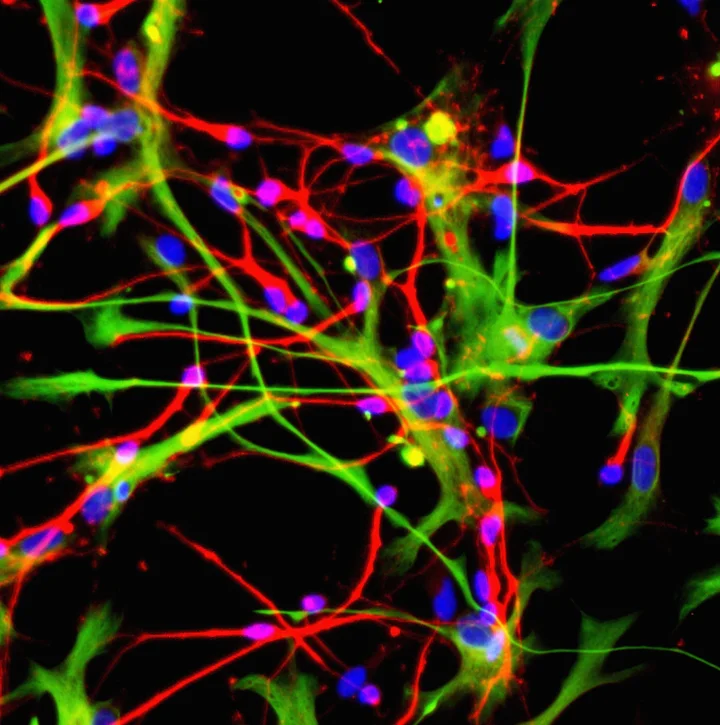
Scientists say they have moved a step closer to developing a computer model of the brain after finding a way to map both the connections and functions of nerve cells in the brain together for the first time.

In a study in the journal Nature on Sunday, researchers from Britain's University College London (UCL) described a technique developed in mice which enabled them to combine information about the function of neurons with details of their connections.

The study is part of an emerging area of neuroscience research known as 'connectomics'. A little like genomics, which maps our genetic make-up, connectomics aims to map the brain's connections, known as synapses.

By untangling and being able to map these connections -- and deciphering how information flows through the brain's circuits -- scientists hope to understand how thoughts and perceptions are generated in the brain and how these functions go wrong in diseases such as Alzheimer's, schizophrenia and stroke.

"We are beginning to untangle the complexity of the brain," said Tom Mrsic-Flogel, who led the study.

"Once we understand the function and connectivity of nerve cells spanning different layers of the brain, we can begin to develop a computer simulation of how this remarkable organ works."

But he said would take many years of work among scientists and huge computer processing power before that could be done.

In a report of his research, Mrsic-Flogel explained how mapping the brain's connections is no small feat: There are an estimated one hundred billion nerve cells, or neurons, in the brain, each connected to thousands of other nerve cells, he said, making an estimated 150 trillion synapses.

"How do we figure out how the brain's neural circuitry works? We first need to understand the function of each neuron and find out to which other brain cells it connects," he said.

In this study, Mrsic-Flogel's team focused on vision and looked into the visual cortex of the mouse brain, which contains thousands of neurons and millions of different connections.

Using high resolution imaging, they were able to detect which of these neurons responded to a particular stimulus.

Taking a slice of the same tissue, the scientists then applied small currents to subsets of neurons to see which other neurons responded and which of them were synaptically connected.

By repeating this technique many times, they were able to trace the function and connectivity of hundreds of nerve cells in visual cortex.

Using this method, the team hopes to begin generating a wiring diagram of a brain area with a particular function, such as the visual cortex. The technique should also help them map the wiring of regions that underpin touch, hearing and movement.

John Williams, head of neuroscience and mental health at the Wellcome Trust medical charity, which helped fund the study, said understanding the brain's inner workings was one of science's "ultimate goals."

"This important study presents neuroscientists with one of the key tools that will help them begin to navigate and survey the landscape of the brain," he said.

(Reporting by Kate Kelland; Editing by Sophie Hares)

Copyright 2011 Thomson Reuters. Click for Restrictions.

FOLLOW HUFFPOST HEALTH

Scientists say they have moved a step closer to developing a computer model of the brain after finding a way to map both the connections and functions of nerve cells in the brain together for the fi...
Filed by Nicholas Miriello  | 
 
 
  • Comments
  • 29
  • Pending Comments
  • 0
  • View FAQ
Comments are closed for this entry
View All
Recency  | 
Popularity
jackstpaul
What am I supposed to write here?
09:37 AM on 04/12/2011
Have moved a step closer to developing a computer model of the brain? It is a computer model of the brain, it's just not very advanced. The models will evolve and develop over time. The question is: At what point will we have developed a fully functioning model of the brain?

Maybe a new, or variation of a, Turing test is in order: When a computer model of a given brain "behaves" like the human brain it is based on, i.e., makes the same decisions, reacts the same way, asks--rather than merely answers--the same questions, produces the same original ideas, etc. we can call it fully developed.
jackstpaul
What am I supposed to write here?
09:43 AM on 04/12/2011
...or can call it artificial intelligence.

No computer model could ever perfectly map a given brain, unless it was continuously connected to and updated by the actual brain, because the brain it is modeled on on is constantly having new experiences, receiving dynamic updates, etc. So some limit must exist re: replicability of real brain behavior.
08:21 AM on 04/12/2011
Brain mapping is assumed to be important because it is assumed that the information processing performed in the brain is primarily responsible for controlling human behavior. If information processing is responsible for controlling or determining behavior, then understanding this information processing could lead to solutions to a wide range of human behavioral problems. The problem is that there is a serious flaw in this starting point assumption.

The path or direction of human behavior is, the evidence would suggest, controlled by decision making and decision making is, the evidence would suggest, largely controlled or determined by information processing. However, when you analyze the information and information processing associated with specific decisions you find that the relevant processing is not performed within the brain of the decision maker. Most of the information processing that controls complex human behaviors, this analysis suggests, involves external cooperative or social information processing. You don’t need any fancy new neuro-technologies to analyze social information processing. The methods for observing and measuring and mapping the information processing that controls behavior have been around for ages.

The interesting and challenging part of the “behavior controlled by social information processing” concept is that there are very strong social pressures working to suppress the concept. The role of social information processing is readily demonstrated experimentally, but most scientists can not and/or will not accept the conclusions of the experimentation.
This user has chosen to opt out of the Badges program
photo
03:13 AM on 04/12/2011
I believe this research will eventually prove the "Massive Modularity" model of the brain, and that consciousness is an emergent property of module coordination.
09:15 AM on 04/12/2011
huh
This user has chosen to opt out of the Badges program
photo
12:00 PM on 04/12/2011
New imaging technologies may allow us to see "arrays" in detail as they are called upon in real-time thought. Fodorian Modularity and Massive Modularity posit that the brain is not only modular in terms of evolutionary structures but also in neural arrays built through developmental phases of a maturing brain. Some researchers speculate that innumerable modules exist while others group them into fewer modules within which innumerable arrays exist. Self awareness and consciousness are believed by some to be the result of a non-localized array that coordinates modules. This network is equivalent to an "executive" function that becomes "self" aware at the point the executive reaches sufficient complexity required to manage a developing brain. Consciousness emerges from complexity and the requirements to manage it.
11:56 AM on 04/12/2011
Yup, from here. I've long thought that emergence is the key rather than a "top-down" executive process. I call it a nexus, thinking of it as processes (modules, if you will) which don't so much handshake or join, as coincide. We are aware of a result which only looks unitary.
This user has chosen to opt out of the Badges program
photo
12:14 PM on 04/12/2011
My sense as well, though an "executive" may be the emergent property that assumes both a managerial top-down role as well as an emergent bottom up developmental trajectory. Not unitary and top-down so much as non-localized and malleable. In other words, an executive function might be the result of neural arrays that traverse the entire brain in order to access all localized modular arrays.
HUFFPOST SUPER USER
Jon Jony
08:15 PM on 04/11/2011
Maybe someone can correct me on this but my understanding is that the main reason for the brains complexity (as opposed to that of a computer) is the fact that a computer generally uses a binary system while the brain uses a base system that is far beyond a binary system...
HUFFPOST SUPER USER
onionboy
Blessed are the Cheese Makers
06:56 PM on 04/11/2011
So...one day...we can finally save the Scarecrow?!
photo
Aquest
No one here is exactly what they appear.
06:48 PM on 04/11/2011
I'm firmly convinced that consciousness is an emergent property of the number of connections there are in the body. These are connections within and among the CNS (central nervous system), the ENS (enteric nervous system) and whatever currently known and unknown messenger chemicals in the body. At some point there are enough of these connections for consciousness to emerge.
photo
HUFFPOST SUPER USER
Tom Hendricks
see wikipedia
01:38 PM on 04/11/2011
Which brain? That's not such an unusual question anymore. Many feel that the ENS, enteric nervous system or gut brain is very important. Think of the ENS as the cake, and the head brain as the frosting. Some think the ENS is the so called subconscious or unconscious mind.
Here's more: There is a new hypothesis that suggests that each infant sets up a 3 part digestion system that may play a key part in every aspect of his life (including both overweight and underweight problems).
He develops, over the first years of his life a pattern of a) breaking down food into usable nutrients - from mouth to stomach, b) absorbing those nutrients - in small intestine, and c) excreting out waste - from large intestine.
Therefore each child sets a 3 part pattern in infancy of how he will digest food. This seems to subconsciously program almost all behavior from then on.
This pattern is in the ENS, or Enteric Nervous System or digestion brain. It is unconscious motivation, and it is very difficult to change.
These three patterns are set up through breast feeding and weaning.
Generally problems with breast feeding will lead to overweight problems, and problems with weaning will lead to underweight problems.
Resetting this 3 part infant digestion pattern in the ENS, solves a vast layer of human physical and psychological problems that seems to be quite extensive.
photo
HUFFPOST SUPER USER
PlayTOE
Morals evolved due to cooperative group living
05:08 PM on 04/11/2011
Interesting point Tom
Most people don't even know the Enteric Nervous System or gut brain even exists, much less wonder how it processes information. Here, understanding the worms brain systems might be a far more helpful model.

All cells from microorganisms to immune response cells to brain cells process information in a similar way, and communicate using similar methods. This results in brains being very complex but built of repetitive simpler steps. Knowing how they are organized may shed a lot of understanding on how they function to provide consciousness.
photo
HUFFPOST SUPER USER
Tom Hendricks
see wikipedia
12:33 PM on 04/12/2011
You mention consciousness. Why would it be selected? When I began looking at the ENS, I saw that digestion is the most important thing to us biologically. I also found that there may be a daily cycle such that we take in and digest food during the day, then sleep , the time to stop eating, and absorb nutrients and prepare waste out. Then wake and repeat. This led to a consciousness idea. We are conscious during the waking period of a daily digestion cycle, to get food in. We need awareness to our surroundings to get food in, and block out dangers. Then during the inner processing of that food, we don't need consciousness and we sleep. There seems to be part of our nervous system that has no consciousness. Our waking head brains has full consciousness. I think the ENS has partial consciousness in between the two. That suggests the order of development. Nervous system, ENS, head brain.
photo
HUFFPOST SUPER USER
PlayTOE
Morals evolved due to cooperative group living
01:05 PM on 04/11/2011
The mouse is a rather complex animal with a very well developed brain. I would have thought that mapping a far simpler brain (such as the fruit fly, or earthworm) would have been an easier first step in mapping brain function.

We know later brains developed from earlier models, so even the simplest of brains will be worthwhile to understand.

However, mapping the brain is a very useful study that will help us to finally understand our thinking processes.
01:38 AM on 04/12/2011
Mapping the brain without understanding whose brain it is, misses the important part that makes our human brain individualized. We need to examine the brain in terms of a real human brain. What were the person's past thoughts, attitudes, feelings, experiences and behaviors that influenced the physical connections/formations in that brain? I would suggest first starting with how the human subconscious (also known as unconscious) mind works, in essence the "cause" and then understand the physicality of the brain, the "effect". Science has shown the brain to have plasticity.There is not just one brain model that applies to us all... Overlooking the intangibles of how the brain works is like dissecting an electrical cord without understanding electricity. Where's the meaning? We have many diagrams of the brain; yet, we still are pondering the question of what is consciousness?
photo
HUFFPOST SUPER USER
PlayTOE
Morals evolved due to cooperative group living
07:27 AM on 04/12/2011
The subconsciousness is also a part of the physical brain, see Enteric Nervous System.
What is consciousn­ess? We have made a great deal of progress on this question
see
http://www.youtube.com/watch?v=WN5Fs6_O2mY
http://www.youtube.com/watch?v=ovHv3yZM4KE