

WASHINGTON -- Jonathan had spent nearly a decade in Louisiana's child welfare system. The safest places, the gay teen discovered, were the moldy homes he squatted in after Hurricane Katrina.
Roofs sagged, floors caved in, mold veined walls and there were always rats. "It was very uncomfortable," said Jonathan. "Old, dark, lots of insects, rodents. ... It was times I cried." Often, he lit fires to keep the rats away.
At 18 years old, Jonathan had just aged out of foster care and was essentially homeless. But those boarded-up dwellings were peaceful refuges compared to the facilities he experienced as a state ward.
Jonathan had logged time in group homes, foster homes, shelters, a secure detention center and even a military boot-camp-style school. It didn't matter where he ended up. He said he always felt the sting of homophobia.
There were very few adults who hadn't given up on him.
His parents had left him with a set of grandparents who then abused him over his effeminate demeanor. On one occasion, Jonathan said, his grandmother attacked him with a two-by-four.
In the system, he didn't fare any better. Group home staff and residents taunted him with anti-gay slurs. At one point, a staffer broke his arm during a restraint. He was jumped at school and left battered and bruised. Foster parents evicted him over his sexuality.
Safety meant being alone with his pens and paper. He'd spend hours drawing lions and tigers or sketching his self-portrait -- his face hidden in a hoodie.
"I felt abandoned because of my sexuality," Jonathan said. "[State workers] weren't trying to help. They were trying to get me out of the way."
No one ever seemed to want him for very long. By his count, he had stayed in dozens of facilities. When Jonathan ended up homeless, he shocked no one.
It has become a typical trajectory for a significant number of lesbian, gay, bisexual, transgender and questioning (LGBTQ) kids in the system.
This all-too-common story is now finding listeners in the White House. In April, the Obama administration sent out a lengthy memorandum calling on child welfare agencies to develop the kinds of interventions Jonathan needed most.
Jonathan, now 21, is still just scraping together a meager existence without much of a fixed address. He said he lives with a transgendered girlfriend. He doesn't have a phone.
Just last year Jonathan tried to kill himself, slashing his wrists with a razor blade. Friends found him and called the police, he said. He spent the night in a hospital.
"I felt like it wasn't worth it -- being in this world," Jonathan recalled. "Like I was nothing, like I was empty inside. It felt like I wasn't meant to live."
THE FEDERAL RESPONSE
The U.S. Department of Heath and Human Services' Administration on Children, Youth and Families sent out a memo on April 6 directly addressing the crisis facing gay teens in the system and encouraging local child welfare agencies to ensure their protection.
"This Information Memorandum (IM) confirms and reiterates my fundamental belief that every child and youth who is unable to live with his or her parents is entitled to a safe, loving and affirming foster care placement, irrespective of the young person's sexual orientation, gender identity or gender expression," wrote ACF Commissioner Bryan Samuels. "I encourage child welfare agencies, foster and adoptive parents and others who work with young people in foster care to ensure that their physical and emotional well-being are protected."
Samuels cited a numbing list of statistics showing just how vulnerable LGBTQ youth are in the system. Although five to 10 percent of the general population is estimated to be gay, anywhere between 20 and 40 percent of homeless youth are gay, according to the National Network of Runaway and Youth services. They are also far more likely to age out of the child welfare system without finding an adoptive family.
"The data demonstrates that efforts to support these youth are warranted," Samuels wrote. "It is the caseworker's responsibility to assess and serve the needs of each child without bias and to ensure the safety of all children in foster care."
Samuels goes on to mention that the U.S. Department of Health and Human Services (HHS) funded several efforts to develop resources for local child welfare agencies that address homophobia.
The Samuels memo explicitly states that LGBT parents "should be considered" as foster and adoptive parents, a sentiment that has been hotly debated by state legislators across the country.
"[LGBTQ kids] need all the protection we can provide," Samuels told The Huffington Post. "That was what the memo aimed to do -- to give people immediate, practical strategies that they could take to better serve this population."
Samuels said he has received no push back over the memo. "We've got nothing but positive reaction. Nothing," he explained. "I have traveled around the country and met social workers who came up to me and shook my hand and said, 'finally, finally, finally.'"
Under the previous administration, advocates couldn't recall the phrase LGBTQ being uttered once. It was as if those kids just didn't exist.
"Literally in the last administration you were not allowed to talk about this," explained Gerald P. Mallon, a professor at New York's Hunter College School of Social Work who began researching LGBTQ kids in the mid-'90s. "If you put 'lesbian' or 'gay' in a workshop, you were guaranteed it wasn't going to be approved. It's night and day."
The feds are intent on making up for lost time -- and not with memos. The Obama administration is spending millions on a pilot program in L.A. County aimed at assisting LGBTQ youth in the child-welfare system, Samuels said.
Congress has taken up the issue as well. On May 3, Rep. Pete Stark (D-Calif.) reintroduced legislation that would ban discrimination of gay parents in adoption and foster care placements. Rep. Illeana Ros-Lehtinen (R-Fla.) signed on as the first Republican co-sponsor of the bill at the end of the month.
"My home state of Florida had discriminatory laws in place that were preventing caring parents from adoption," she said in a statement. "This Federal bill is a step in the right direction so that the proper match between responsible parent and needy child can take place regardless of the parent's sexual orientation."
In mid-May, Sen. John Kerry (D-Mass.) introduced the Reconnecting Youth to Prevent Homelessness Act. More than 40 organizations and nonprofits signed on in support of the legislation.
Tucked into the bill, which calls for stronger supports for state wards, is a provision that HHS must create a five-year pilot program aimed at preventing families from rejecting gay children. The accompanying press release highlighted this angle. "There are common sense reforms we can implement to help make things better for LGBT youth," Kerry wrote.
The traumas facing LGBTQ youth have not been a silent ones. For nearly two decades, researchers have conducted listening forums all over the country and published their findings in dozens of reports. Task forces have been created and seminars have been held.
Caitlin Ryan, the director of the Family Acceptance Project, met with Kerry's staff a year ago to work on the bill. Ryan's research has shown that rejection can cause high rates of depression and other mental health problems in LGBTQ youth. Ryan's work has also proven that rejection rates among parents go way down when they're given proper supports.
"There's a long history of abuse and neglect in the child welfare system," Ryan said. "Really in the last six years, there's been much greater attention and realization that this is a very serious problem."
CITY AND STATE REFORM EFFORTS
Mainstream organizations like the Child Welfare League of America and the American Bar Association have published guidelines for front line workers and lawyers. The National Alliance to End Homelessness recommended a set of best practices.
Some state agencies created "safe zones" like New Jersey or hired staff to focus solely on LGBTQ youth like Illinois and Connecticut. Before Samuels joined the feds, he tailored programs for LGBTQ kids as the head of Chicago's child-welfare system.
But progress has been piecemeal.
"It's great to see at the federal level there's more attention being paid," said Rob Woronoff, the former director of the LGBTQ services with the Child Welfare League of America. "This is a case of the federal government playing catch up."
Despite all the nonprofit advocacy and local reforms, child welfare agencies are only as good as their staff and their pools of foster parents. And as more and more kids are coming out at younger ages, agencies are finding few foster homes willing to take them in.
An advocate in Tampa recalls the gay youth who experienced 48 placements in four years.
Another worker remembers the D.C. foster parent who kicked out a gay teenager because he liked his jeans creased a certain way.
In Connecticut, social workers recall the exorcism performed on a gay teen. In video clips, one preacher can be seen holding the teen to the floor by his neck while another one screams for the "homosexual demon" to "get out in the name of Jesus!" His is not the only exorcism case, the social workers say.
In New Orleans, kids have been placed temporarily behind bars after being rejected by their biological families. With a shortage of traditional foster homes, a detention facility can be their first placement. There just aren't enough traditional options, said BreakOUT! Director Wes Ware, whose Juvenile Justice Project of Louisiana youth organizing group works with Jonathan and other LGBTQ young people.
Ware said Jonathan's story is typical of what he sees. "Every out LGBT kid that I've had has been in nearly every placement in the state," he said, referring to the youths who'd ended up at juvenile detention facilities.
The Kerry and Stark bills could, advocates say, create safer placements for gay kids in the system -- and provide them with a better shot at a permanent home.
"Anything that gets the issue on the map and opened up into mainstream society" is beneficial, said Jill Jacobs, executive director of Family Builders in Oakland which finds permanent families for youth in foster care. More than half the families they work with are LGBT families. "Why are we allowing kids to be discriminated against in schools and institutions and mental health settings and group homes, homeless shelters?"
Cindy Watson, who directs a center for gay youth in Jacksonville, said the Stark bill could be particularly key in Florida. Last year, a Florida appeals court lifted the ban on gay adults from adopting. The implications of the ruling are still being studied.
Watson said it still remains unclear if same-sex couples could adopt. "Any federal laws that can come down is really important in Florida," Watson said. "The reality is that a lot of your young people continue to be rejected and thrown away by their families."
The federal legislation can't come fast enough.
True Colors Executive Director Robin McHaelen, whose nonprofit works to helping gay kids in the Connecticut system, said she fielded multiple calls recently about LGBTQ youths in peril.
One 18-year-old boy had been kicked out of his house by his biological parents over his sexuality. His parents, McHaelen recalled, told their son that "he was dead to them." It was Easter morning.
The youth tried to kill himself, McHaelen said. He had to remain hospitalized for an extended period of time while authorities attempted to find him a suitable home.
AGING OUT
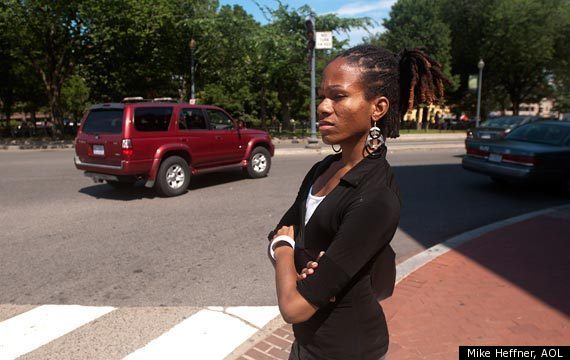
Even kids who are their own best advocates have a difficult time. Kianni Leigh Jones, the transitioning 20-year-old female living in D.C. and pictured above, has starred on teen panels and rainbow-flagged pamphlets. She gave a speech at her high school graduation that preached tolerance. She could be the bravest kid to ever wear lipstick inside family court.
But discrimination, the poor job market, and the District's high rents have all prevented Kianni from finding permanent living arrangements. She turns 21 in September, at which point she will no longer be a D.C. ward and will lose the city's child welfare housing supports.
Kianni is not sure where she will end up. Housing is a constant worry -- one that she has struggled with for years.
Kianni's family shunned her years ago. Before she identified as female, cousins stole her clothes after teasing that they were too feminine. An aunt Kianni was living with threatened her with a pistol and told her that she needed be more thug-like -- to get "scarred up."
After a move to a group home in 2006, a judge ordered that the facility provide Kianni with her own room, citing safety concerns, records show.
High school was even more perilous, according to Kianni's records. After a number of violent assaults, administrators quarantined Kianni in a guidance office for her protection. When school administrators were forced to return her to regular classes, they hired a bodyguard to trail her.
"You don't really know who's going to be there for you," she said. "I've been rejected so many times. I've been through the comments. I've been through the fights in the streets, at home, in school -- whether it was verbal or physical."
Kianni's traumas at home and school were well known. Court records fleshed out her struggles in the flat script of social workers: "Therapist also recommended a self-defense class for the client as a means of building [her] level of safety around intimidating persons."
She has been kicked out of the same foster home twice over her sexuality. Each time, Kianni was able to crash with her godmother. But after a night, the godmother would start complaining about her, and she had to return to the foster home.
Kianni's isolation got so acute that she began calling her cellphone carrier's help line with imaginary complaints, just so she could vent to somebody about something. She would even text herself encouraging messages like "good job," or "damn you so strong."
Social workers rarely understood Kianni's needs. Often her concerns about safety were met with smirks and eye-rolling. Some counselors refused to refer to her as a female. And no amount of self-defense classes could prepare her for navigating the apartment rental market without much, if any, family or government support.
Her social worker and city-appointed life coaches suggested during a recent meeting that Kianni consider living in a shelter for LGBTQ youth.
Kianni instantly rejected the idea of a shelter -- for now. "I don't understand why at 21, I have to deal with a shelter," she said. "I didn't want to look like I was going to cry -- it was in me. I wanted to let them know, and also let myself know, that that might be the worst-case scenario. I did that so I could feel more hopeful."