
More

For-Profit College Regulations: Obama Administration Issues Rules

Duncan

First Posted: 06/02/11 01:01 AM ET Updated: 08/01/11 06:12 AM ET

The Obama administration on Thursday issued a series of highly anticipated regulations aimed at cracking down on for-profit colleges and other career training programs that leave students saddled with unmanageable debts and contribute to an unequal share of federal student loan defaults.

The final rules issued by the Department of Education, however, are significantly less stringent than a draft version released last year, giving college programs an additional three years to come in line before possibly losing access to lucrative federal student aid dollars. The changes come after an unprecedented lobbying and campaign finance offensive over the past year by the for-profit college industry, which derives a vast majority of revenues from federal student loan and grant programs and has sought to protect that income by gaining influence in Washington.

Education Secretary Arne Duncan said the changes came after discussion with "lots and lots of different folks," not just the industry, and he pointed out that the colleges were not unanimous in their suggestions for changes.

"What we really wanted to do was give people a chance to reform ... this was not about 'gotcha,'" Duncan said. "We tried to be very thoughtful, very reasonable and give people every opportunity to succeed, but be very clear where we wouldn't permit ongoing failure."

The rules have been in the making for nearly two years, amid evidence that students at for-profit institutions default on federal loans at a significantly higher rate and pay higher tuition than their counterparts at public universities, despite for-profit schools devoting significantly less money toward instruction.

The rules were derived as a way to bring accountability to the federal student aid system and to protect students from unscrupulous programs that sought only their federally subsidized tuition.

"The for-profit education sector business model invokes much of the same characteristics of what happened with subprime housing and securitization, namely that the schools can capture all of the upside of increased volume while shifting all of the downside risk somewhere else," said Gene Sperling, director of the National Economic Council. "In this case, that somewhere else is to students and taxpayers."

Specifically, the rules will measure student outcomes at such programs in two ways: whether students repay at least a portion of their student loans and whether a graduate has an excessive debt burden compared to his or her income.
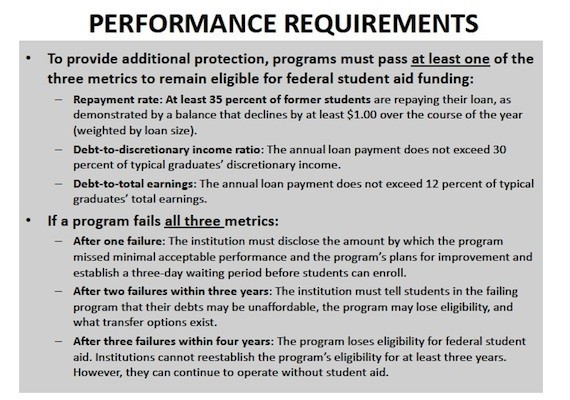

Department of Education slide

In order to be disqualified from the student loan program, more than 65 percent of students would have to be delinquent in repaying their loans, and graduates would need to have loan debts that comprise more than 30 percent of their discretionary income, or more than 12 percent of their total earnings.

A program would have to fail each of those three metrics in three out of four years in order to completely lose eligibility for federal student aid, as opposed to potentially losing eligibility after one year under the draft rules from last year.

That means programs cannot be disqualified from receiving federal student aid until 2015, as opposed to 2012 under the draft rules.

Groups that have criticized for-profit colleges expressed disappointment that the rules did not go far enough in protecting students from harmful programs, but said the reform will still address some of the worst abuses in the industry.

"I think it means that more bad programs that don't serve students well will continue, but that many bad programs will be put out of business, or be forced to reform," said David Halperin, a senior vice president at the Center for American Progress who directs the group's Campus Progress arm. "It would have been better if the rule was stronger or kicked in sooner, but nevertheless I think over time, hundreds of thousands if not millions of students will be protected because this rule was issued."

Sen. Tom Harkin (D-Iowa), who has led a series of hearings probing abuses in the industry, called the regulations "a modest and important first step to protect students and taxpayers from subprime academic programs that have a demonstrated track record of failure."

Groups representing the for-profit college industry largely reserved judgment on the rule. Harris Miller, president and chief executive of the Association of Private Sector Colleges and Universities, said it appeared that the Department of Education listened to concerns they had raised.

But he said his group will bring on a third-party researcher to study the potential effects of the rule on students. Miller's group has sued the Department of Education over a series of other for-profit regulations relating to compensation of recruiters and misrepresentation of a program's benefits.

"The bottom line is not whether the department makes changes or not, but what are the impacts of those changes to student access to higher education?" Miller said.

He did not say whether the group would file a lawsuit over this set of regulations.

Lanny Davis, a former special counsel to President Clinton who has lobbied against the regulations for for-profit colleges, noted that "there appears to have been some second thoughts" by the administration. Davis now lobbies for the National Black Chamber of Commerce, which has argued that the rules would restrict access to minority students who attend such institutions in greater numbers than in other sectors of higher education.

"We hope we can continue to see some changes in what is essentially a targeted regulation that has a disparate impact on low-income and vulnerable students," Davis said.

For-profit schools and their lobbying groups engaged in a vicious fight over the past year, accusing the Department of Education of coming up with the rules as part of a conspiracy with Wall Street short sellers, based on e-mails and a handful of meetings where Department officials viewed presentations. The Department of Education's Inspector General disclosed at a hearing in March that she is investigating any potential improper communications, after Sens. Tom Coburn (R-Okla.) and Richard Burr (R-N.C.) brought up the matter last fall.

The industry also publicly attacked the Government Accountability Office, Congress' investigative arm, over a series of corrections made to an undercover report that found widespread abuse and deception among recruiters at for-profit schools. The industry spent more than $8.1 million on lobbying in 2010, more than doubling spending of $3.3 million from the year before.

In addition to increased government regulation, the industry is facing a joint probe by attorneys general in at least 10 states, and the Justice Department has intervened in a lawsuit filed against Education Management Corp., a Pittsburgh corporation that owns numerous colleges across the country.

The original draft of the rules would have restricted growth at certain programs that failed loan repayment and debt burden measurements. The rules released Thursday require schools that fail to meet all standards to provide disclosures to students.

For example, although it takes three years of failure for a program to be ineligible for student loans, after one year of failure a school must tell students how the program failed to meet the regulation. And the school is required to give students a three-day waiting period before they are able to enroll.

After two years of failing to meet standards, a school must warn students that they may be unable to afford their debts and explain transfer options.

The regulations apply to individual degree programs, not entire schools. Although the rules are expected to have the most impact on for-profit colleges, there are more than three times as many public and non-profit vocational programs also subject to the new regulations.

FOLLOW HUFFPOST BUSINESS
Subscribe to the HuffPost Money newsletter!
The Obama administration on Thursday issued a series of highly anticipated regulations aimed at cracking down on for-profit colleges and other career training programs that leave students saddled with...
 
 
  • Comments
  • 1,165
  • Pending Comments
  • 0
  • View FAQ
Comments are closed for this entry
View All
Favorites
Highlights
Recency  | 
Popularity
Page: 1 2 3 4 5  Next ›  Last »  (20 total)
  1 of 2  
COMMUNITY PUNDITS
photo
ResearchtheFacts 12:19 PM on 06/02/2011
One of three, not all of three, to meet performance requirements. So it can exceed 12% of your expected income as long as 35% of students are repaying their loan and it doesn't exceed 30 percent of typical' graduates discretionary income.What if you are not typical? Some aren't working because of lack of jobs. So if you went to a school or live in a region where there is little or no employment  Read More...
photo
HUFFPOST SUPER USER
Siebenstein
99% -Don't do what they tell you !
06:03 AM on 06/06/2011
Department of Education and Sallie Mae , now serving and svcking American students together. One of the biggest "for profit" organizations in the US.
photo
HUFFPOST SUPER USER
Siebenstein
99% -Don't do what they tell you !
05:53 AM on 06/06/2011
The Dept. of Edu recently teamed up with sallie mae, the very company, yes, company they so wagged their finger at when they changed loans from being serviced by private banksters to the Dept. of Edu (NOW TEAMED UP WITH BANKSTERS).

That's the Obama administration and Arnie for you !
photo
HUFFPOST SUPER USER
Siebenstein
99% -Don't do what they tell you !
05:49 AM on 06/06/2011
Duncan is a fluke.
What does he do?
Anyone? Buler?

Another slick Obama appointee who "pretends" to get something done.
Education doesn't mean much in this country. Sad, but true.
photo
HUFFPOST SUPER USER
structurequity
structurequity not oppression
10:17 PM on 06/03/2011
Duncan you missed your moment the moment you were appointed... Stop catering to privateers and profiteers, let education be ruled by an egalitarian supply and demand system regulated to the extent of its quality and availability and a principled stand against indentured servitude to a debt unpayable...
03:53 PM on 06/03/2011
colleges and universities need to get rid of all the B/S requirements for someone to graduate. A science major does not need 2 semesters of gym. cut it to the core requirments and reduce the amount of credits needed to graduate.
07:34 PM on 06/03/2011
If they cut all of that BS then they would not be able to afford paying all of those liberal professors their high six figure salaries.
photo
HUFFPOST SUPER USER
Jambala99
A GOP vote is a character flaw at this point.....
08:34 PM on 06/03/2011
You mean in comparison to Wall Streets 7,8, and 9 figure salaries........FAIL......
photo
HUFFPOST SUPER USER
Siebenstein
99% -Don't do what they tell you !
05:47 AM on 06/06/2011
jealous?
photo
HUFFPOST SUPER USER
Siebenstein
99% -Don't do what they tell you !
05:47 AM on 06/06/2011
shows you did not go to college, otherwise you would not post untrue stuff.
photo
HUFFPOST SUPER USER
tmf1977
The middle is a really sane place to be in!
01:08 PM on 06/03/2011
I have been following the school-scam bloggers for over a year now. It should not only stop at on-line institutions such as U of Phoenix. There are a great number of low ranked,4T schools which have opened in vast numbers since 1970.

I'll use law school as example. From 1970 – 2009, the ABA accredited nearly 200 law schools. At this time, only 45% of law grads are expected to find full time employment after graduation and passing the state bar. The legal field in the US is completely flooded due to the high number of law schools, and a majority of these schools are low ranked, 4T institutions. There is an epidemic in the legal community with over 50% of law grads not finding employment and being stuck with a massive student loan to pay off. However this certainly has not stopped law schools in continuing to accept applications. Quality of legal representation has also greatly faltered in this country thanks in part to the ABA in allowing far too many 4T law schools to exist in the first place.

I
04:12 PM on 06/03/2011
Good point. Also, there should be a requirement for all colleges to give you a seminar about the realities of student loans, how realistic it is to get a job in your chosen field, and how much you can expect to make right out of college. These things don't have to be exact, but a ball park would be nice. Perhaps if law schools did this then fewer people would go to law school, thus making jobs more available for those who have huge bills to pay afterwards.
photo
HUFFPOST SUPER USER
Retrofuturistic
see things as they really are
10:00 AM on 06/03/2011
So--- if the for-profit concept doesn't work to educate people on the college level and enables robbery, why do people like John Kasich think it will work any differently as a replacement for public schools?
HUFFPOST SUPER USER
jstrate
11:24 PM on 06/02/2011
This regulation looks like a renewal of these corporations' licenses to steal--both from their students and the U.S. taxpayer. As always, prospective students, it's buyer beware! I directed a graduate program at a public university where 90% of the graduates were employed professionally within a year of graduation. When we took a chance and admitted graduates from the University of Phoenix with high grade point averages, they all flunked out of our program in the first semester. You don't always get what you pay for.
photo
HUFFPOST SUPER USER
tmf1977
The middle is a really sane place to be in!
01:22 PM on 06/03/2011
You can't blame people in enrolling in these types of programs. Not everyone is an academic, however academia has brainwashed the American masses since 1970 that in order to have a better job, way of life, etc. you need to get a degree. It's unfair to students enrolled at these schools.

I was in an assistant management position in NYC and my department comprised of recent college grads. There was a tremendous difference between grads from 1T schools (such as NYU, Pace, Fordham and Columbia) in comparison to those who had graduated from low ranked private schools no one even heard of. It was heart wrenching to say the least when you give a chance to some kid who was a graduate from a For-Profit school and he thinks he is capable in handling writing and research because he made it out of college. I cannot begin to express how stressful it was seeing these kids fall behind because they struggled to meet deadlines due of the poor quality in education received from these types of colleges.
04:14 PM on 06/03/2011
Sad but true. Accreditation should not be as easy to get! You see that the school is accredited by the Dept of Education, so you think you're getting a good (or reasonably good) education.
08:19 PM on 06/02/2011
Love it when the Government starts talking about RATES! Government writes the rules for Pell Grants=FOR STUDENTS= Government decides who gets the grants=WHICH STUDENTS= Government complains about the private for profits,= not the students=These students who would not be going to school ANYWHERE else because of Schedule,grades,overcrowding! Government at work protecting the the public schools at all costs! Ohio 2006 638,000 college students=29,000 (4.5%) enrolled in private for profits! Maybe these dems could do a like study of the public colleges! Maybe the taxpayers need to investigate the governmentt loans if 44% (as some source claim) of money goes to !0 to 15% of STUDENTS!
07:11 PM on 06/02/2011
We are very fortunate to live in the USA!
We are free to choose not to go to a for-profit college!
God Bless America
11:10 PM on 06/03/2011
Most people are "free" to choose to not go to college at all because they're stuck behind a McDonalds drive through window.
09:11 AM on 06/04/2011
I know you may feel that way - but there are programs out there that offer financial help for folks that have the desire to go to college - it may be a community college and not an elite private school - or maybe they might prefer a trade school ! I am just saying we live in a wonderful country that does have a lot to offer!

Or at least did offer a lot - after the economic report yesterday and the direction our country has been going -things are changing fast in the wrong direction! Beginning to think you have a good point !
06:45 PM on 06/02/2011
These rules are so week that nothing is achieved by them. The for-profit colleges only have to follow 1 in 3 rules which are all week enough to allow even the worst offenders to continue receiving taxpayer dollars to rip-off young people’s future for trying to get somewhere in life.
My niece who got ripped off why one of these places offering ACE auto-tech certification. No, not misspelling, it’s not the same ASE technician certification that mechanics need and community college can get students for 1/20th of what this place charges, students have to test for the ASE in the community college after ‘graduating’ this place or their degree is meaningless. This place solicits students at jails, youth shelters, etc. and harasses them with how the program can start tomorrow and how they will get a $3000.00 check after they go 6 weeks. Anyways, they have a brochure about how they are sooooo sure they will find you a job that they will make your first student loan payment if you can’t find work in 1 year of graduation, and they do this. I’ve found out this helps them trick the statistics so their repayment rates don’t look criminal. However, this school would pass the new rules, meeting 1/3 of the conditions that “35% of students repay, as defined by balances that go down at least $1.00 over the course of a year). I bet other for-profits will institute this practice.
This user has chosen to opt out of the Badges program
photo
greysells2
grey cells matter
05:00 PM on 06/03/2011
One thing "for profits" probably are weak on is helping studends realive that a "week" is a unit of time comprised of seven days. And "weak" loss of energy or an inability to perform. It is often characterized by a lack of mental or physical strength. The two words sound the same but are spelled differently and mean entirely different things. Just for the record.
08:24 PM on 06/03/2011
Yes, I suppose my typo of "week" vs. "weak" would probably be accepted without discounting grading points on a for-profit school paper. Typos are also not discounted points on a grading matrix on quick comments made on this message board, either; so I don't proof-read for accuracy. Most people don't either, as they are looking at comments on news articles for purposes of learning others' opinions or making one of their own, not proof-reading of scholarly dissertations...Just to add to your record of pointing out others obvious errors...Did you disagree with my point and thus decide to distract from it or is this just a record you keep as a hobby?
This user has chosen to opt out of the Badges program
06:41 PM on 06/02/2011
Well, I guess it's a start. I'm totally on-board with the idea of giving the schools a healthy timeline to get their ducks in a row-- you have to remember we want them to succeed because it means our citizens are succeeding. However, after reading the regulations I'm a little dismayed.

First, while I understand that the concept of student loan defaults as an abstraction meant to represent success, we should be mindful that it is just that-- an abstraction and not necessarily indicative of reality. There will be plenty of students who pay their bills because that's what they're supposed to do, especially when we consider that we're actually requiring a pretty low bar-- 35% paid $1 last year towards their debt? It certainly seems this would be better served by a ratio closer to 50% that never default over the lifetime of their loan if this is the metric we're really going to use.

Secondly, are we really going to just encourage the predatory schools to favor even longer loan periods with lower monthly and annual payments? Is this really going to accomplish what we want? I don't think so.

Are there provisions to ensure that schools don't just pay $1 annually to all student loans and then offset the losses by other provisions with longer loans?
HUFFPOST SUPER USER
themodernleader
06:13 PM on 06/02/2011
I have discovered that the leadership performance-outcomes can be predicted as I have done almost from day one. This president governs from the side of naked economic, political power. Any consideration of the Constitution or the common people is a coincidence and quite accidential.
photo
HUFFPOST SUPER USER
vobox3343
Each day is a new day - make the most of it
11:06 AM on 06/03/2011
Yeah, tell us about the Consititution. You know, that document that born-again-Bush referred to as just a G' D' piece of paper
HUFFPOST SUPER USER
Visionary Excellence
06:11 PM on 06/02/2011
An education is free at the library. The gov needs to overhaul the out moded GED system so it can verify associates degrees and offer online testing. Face identification software is very sophisticated these days. Initiative should be encouraged and rewarded. Verification is needed for commodification. A degree (the piece of paper) will put you into debt for a decade - but theres an increasing number of free classes online. Its absurd and dysfunctional.
photo
HUFFPOST SUPER USER
Retrofuturistic
see things as they really are
10:02 AM on 06/03/2011
I love how you said "An education is free at the library". The problem is that so many people don't understand that they can learn something from a book, all by themselves.
HUFFPOST SUPER USER
Visionary Excellence
03:41 PM on 06/03/2011
I think people get caught up in the market for certificates. They dont value knowledge as an independant commodity.

Even Ivy League classes are undervalued independant to an Ivy League diploma. There are tons of free Ivy League classes online that have a view count of 4-600. Of course, you can get the info ten times faster by reading - but I appreciate academic lectures as a type of theater.
03:56 PM on 06/02/2011
Rules? - ON PROFIT?!?!?

The world is going to end in fire and ash.
This user has chosen to opt out of the Badges program
06:43 PM on 06/02/2011
as a metric for student success no less ;]

im sure there will be wind in there somewhere as well.
07:54 PM on 06/02/2011
Its not rules on profit, its rules for government subsidy ( federal student loans). If they don't obey by the rules they aren't eligible for federal student loans, but they can still operate and thus still make profits. There should be more rules for businesses receiving government subsidies!