iPhone app iPad app Android phone app Android tablet app More

U.S. History Test Scores Stagnate As Education Secretary Arne Duncan Seeks 'Plan B'

Naep Us History

First Posted: 06/14/11 11:59 AM ET Updated: 08/14/11 06:12 AM ET

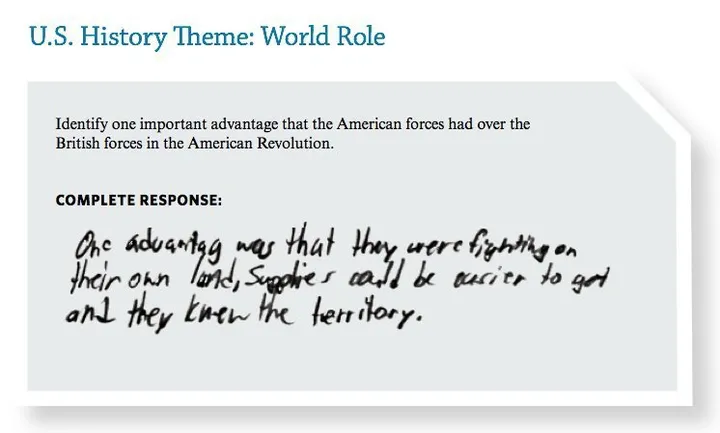
If you can identify one advantage American troops held over the British in the American Revolution, chances are you know more U.S. history than most eighth graders.

Only 32 percent of the eighth graders tested on the National Assessment of Educational Progress U.S. History exam completely answered that question. Only 9 percent of fourth graders could identify a photograph of Abraham Lincoln and state two reasons for his importance.

But that's not what has history education advocates so upset about the overall dismal NAEP scores.

"People tend to think that history is only memorizing facts," said Linda Salvucci, vice chair of the National Council for History Education. "More importantly, it's a way of thinking and organizing the world."

The NAEP report, released Tuesday morning, provides a snapshot of U.S. history education in public and nonpublic schools in the fourth, eighth and twelfth grades. The 2010 test assessed 30,000 students in a sample designed to represent the U.S. student population by race, socioeconomic status, parents' education levels, language barriers and disabilities.

NAEP tests are administered in several subjects -- including math, science, civics, history and reading -- at different intervals. Students sat for the history test in 1994, 2001, 2006 and 2010. According to Tuesday's release, eighth graders earned the highest grades to date; fourth and twelfth grade scores showed no significant change since 2006. Overall, performance has been largely stagnant.

Where there was improvement, the bottom-level students moved the score. Fourth graders ranking in the bottom 10th percentile increased performance between 1994 and 2010.

The test divides students into three categories based on performance: basic, proficient and advanced. Proficient, according to NAEP materials, "represents solid academic performance" for students who "have demonstrated competency over challenging subject matter."

In 2010, only 20 percent of fourth graders tested proficient; 17 percent of eighth graders and 12 percent of high school seniors made the mark.

"I'm not surprised," said Salvucci, who is also a professor at Trinity University in San Antonio. In her eyes, the scores are a result of both a lack of experience on the part of history teachers and a curtailed history curriculum due to a No Child Left Behind-driven focus on testing in reading and math. A Center for Education Policy report released in March 2006 showed that 71 percent of America's school districts had reduced time spent on subjects that were not reading and math -- including history -- since the passage of No Child Left Behind.

A May report from the National Research Council concluded that a decade of education policy grounded in high-stakes testing has yielded little learning. That report and the NAEP results come as President Barack Obama pushes for Congress to overhaul No Child Left Behind, the law that governs those tests.

"They've narrowed the curriculum to teach to the test. History has been deemphasized," said Lee White, executive director of the National History Coalition. "You can't expect kids to have great scores in history when they're not being taught history."

Few are happy with NCLB and its strictures, which demand a rigorous focus on reading and math but little else. The law requires 100 percent "proficiency" by its own standards by 2014. That goal has been described as utopian, one reason why U.S. Secretary of Education Arne Duncan and others stress the importance of revamping the law. But legislative efforts seem to have stalled recently.

That's why, Duncan said in Monday conference call with reporters, his office is seeking to develop a "plan B" for saving schools from the impending "slow-motion train wreck" of NCLB. Duncan has shied away from giving specifics aside from noting that the plan would offer states flexibility in achieving NCLB standards in exchange for "accountability"-focused reforms. "We will not, we will never abandon accountability," Duncan said.

When HuffPost asked for details on the reforms required by states that desire NCLB flexibility, Duncan said they're "the kinds of reforms ... emphasized in the blueprint for re-authorization. Those remain our values."

Finding a way to reform NCLB is urgent for the study of history, said Ted McConnell, executive director of the Campaign for the Civic Mission of Schools.

"They'd better come up with a fix, since nothing is passing soon," McConnell said. "It's this concentration on a few subjects over all others that leads away from high-quality instruction in these areas."

Speedy reform, Duncan said, is his intent.

"To be clear, this would not be an a la carte menu where folks can pick and choose [reforms]," he added. "I'm continuing to talk to governors on a daily basis," he said, to develop the plan.

"A well-rounded curriculum is key to preparing students for success in school and life," Duncan said in a Tuesday statement bemoaning the low NAEP scores. "That's why we're putting a greater emphasis on courses like history, art, drama and music in our efforts to fix No Child Left Behind."

Still, history education advocates worry about funding for studying the subject. Obama has called for a specific grant for studying history to be consolidated into a larger fund for the humanities. But as part of NCLB re-authorization, Rep. Duncan Hunter (R-Calif.) last month introduced a measure that would scrap 43 NCLB-funded programs entirely, including one that sponsors U.S. history education.

The lack of emphasis on U.S. history knowledge displayed by public officials sends a bad message to students, said Jim Grossman, executive director of the American Historical Association.

"I'd like to see the full Congress take the test," he said. "People use these tests quite reasonably to lament the poor history education in our schools. But history education is a much larger issue in relation to civic culture."

Though NAEP administrators stressed to reporters that scores are not comparable between subjects, education historian and former Assistant Secretary of Education Diane Ravitch mentioned history's ranking.

"It's worth noting that of the seven school subjects tested by NAEP, history has the smallest proportion of students who score Proficient or above in the most recent assessment available," Ravitch said in a statement. "The results of this assessment tell us that we as a nation must pay more attention to the teaching of U.S. history."

Ravitch wrote that 12th graders' dismal scores particularly concern her -- because those students are about to become voters.

To be deemed proficient on the NAEP exam, a fourth grader had to explain things like why cities grew where they did and why Europeans sought new trade routes in the 1400s. Proficient eighth graders had to explain changes in colonial slave practices and identify products shipped along the triangular trade route. Twelfth graders were expected to explain a trend in U.S. population and interpret a Henry David Thoreau quotation.

While these matters may seem trivial in the digital age, when a date or fact is just a click away, Lee said searchability does not compensate for learning.

"Duncan Hunter said we don’t need history because we'll all have iPads," Lee said. "But what about a kid in Nebraska who has no broadband access? We can't just throw them to the wolves and let them fend for themselves."

"It's hard to win the future, as Barack Obama says he wants to do, if we lose our past," Salvucci said.

This article has been updated to include comment from Secretary of Education Arne Duncan on the NAEP results.

FOLLOW HUFFPOST EDUCATION

If you can identify one advantage American troops held over the British in the American Revolution, chances are you know more U.S. history than most eighth graders. Only 32 percent of the eighth gr...
 
 
  • Comments
  • 237
  • Pending Comments
  • 0
  • View FAQ
Comments are closed for this entry
View All
Favorites
Recency  | 
Popularity
Page: 1 2 3 4 5  Next ›  Last »  (7 total)
photo
HUFFPOST SUPER USER
PELAGIUS2
Justice belongs to all, or it belongs to none
12:32 PM on 06/22/2011
I'm not sure I could have identified Abe Lincoln in the fourth grade either. Fourth grade was world geography and as I recall my partner and I didn a killer diorama of a Peruvian farmyard or something like that. Fifth grade was US history in our district, and again in the eighth grade and again as a junior in high school.
photo
HUFFPOST SUPER USER
PELAGIUS2
Justice belongs to all, or it belongs to none
10:29 PM on 06/21/2011
The most interesting story is the link to the real story. How the emphasis on reading and math to teach to the No Child Left Behind tests has pushed almost everything else out the door. I've been researching our family tree and to be honest to properly cover US history from the beginning of the colonies to the writing of the constitution would take almost a year anyway. President Washington to the modern era would take another year. Now what do we get rid of to make room for that extra year? A combination of US history and civics maybe?
01:06 PM on 06/22/2011
Yep. Social studies is an afterthought at the E.S. level in the new NCLB world, and it is completely disregarded in states that are pursuing a standardized testing utopia (as in FL). Many of those 8th graders are likely hearing the fundamental elements of AmHist for the first time.
photo
HUFFPOST SUPER USER
Gregj
08:37 PM on 06/21/2011
Even fewer politicians are proficient at american history. Tell me which is more important.
photo
HUFFPOST SUPER USER
mtn gurl
to the left in WNC
03:17 PM on 06/21/2011
The Christian right plays a big part in this through their banning of materials and re-writing history to support their belief system look up David Barton and be scared, very scared.
06:32 PM on 06/20/2011
I always had a love for history, but looking back - my school curriculum was only a basis. My parents fortunately took us to museums, Washington D.C., kept a newspaper in the house and encouraged reading of history and historical fiction.

Honestly, most high schools only require one year of U.S. History which isn't enough time if you want to get past WW2. Best thing schools could do would be to require two years and make certain holidays more meaningful. Few kids today regard Veteran's Day or Memorial Day for their intended purposes. Last year, my husband (who teaches science btw) read letters home from my Vietnam Vet uncle - little things like that can arouse curiosity of history.
05:12 PM on 06/20/2011
Most elementary schools were forced to stop teaching history and science because of NCLB. District, state, and federal experts thought children were not learning to read unless it was from a "reading" book. Two hour reading programs painfully stretched into five hour programs. Do not blame teachers for this one.
historian1960
Conservatives: always on the wrong side of history
02:30 PM on 06/20/2011
If history is taught correctly, it also teaches the student to think critically, read critically and write well. None of the three aforementioned skills are deemed important anymore. George Carlin was right, sadly. Education is just to make people smart enough to run the machines and do the paperwork but not able to realize they are being scre wed.
HUFFPOST SUPER USER
P Alan Greene
07:34 AM on 06/20/2011
We don't value history as a culture, and our collective ignorance is on display daily. Why would school students be any different.

The "everyone will have ipads anyway" argument is so many kinds of stupid, but even if we skip over those layers of dumb, we still arrive at the sad fact that having access to historical facts is of little use if one has no understanding of how to apply historical perspective to them.

In short, we not only don't know any history, but we don't even know why we should care. How can it be a surprise that this attitude and ignorance have leached down into schools?
11:31 PM on 06/19/2011
Its so sad this is true one of my friends didn't understand what I was talking about when discussing the civil war, nor could she tell me the difference between a NAZI and the KKK! She is a freshman in college after staring open mouthed at her for several minutes I asked her how she didn't know these things, she said she never paid attention in history class. The civil war, slavery, Nazi's, the KKK and many other topics, I was taught repeatedly in different grades, each year more in depth. As far as I know thats how most children are taught, you start out simple when young, and then go more in depth on subjects as you get older and can comprehend. How she missed these things over 15 years of school, just shows me how, the things we learn in America, we are not held accountable to remember. It makes me sad to think people are going through their lives ignorant of our own nations history and the worlds
photo
collettethehedgehog
My micro-bio is So running on empty
02:05 PM on 08/02/2011
I began learning history in the 3rd grade and agree with you. The worst thing is she is a college freshman. How can someone get into college wo knowing anything about the world around her. No wonder Glenn Beck University gets away with so many lies.
04:26 AM on 08/09/2011
Ya its really sad, but I talk about history, world issues and politics around her all the time, so maybe something will sink in. Personally I think there needs to be a history portion on the ACT, and I don't feel that schools emphasize how important history is. Its all about math, science, english, and reading.
photo
HUFFPOST SUPER USER
Victor Villarreal
01:31 PM on 06/19/2011
as a history major and volunteer... im having a harder and harder time justifying my time spent helping this country... most people i meet are proud to be dumb and im watching history repeat itself... when bad things happen to this country, the people will have no one to blame but themselves. (fat chance of that happening)

its more tempting day after day to prey on the public by taking a job with a big firms that make money off american's stupidity, they'll gladly hand over their money if you put something shiny in front of their faces.. i haven't given in yet.. but its tempting..
HUFFPOST SUPER USER
healthanalyst
Banned from commenting, so?
07:06 PM on 06/18/2011
Politicians and education majors aren't much better.
photo
HUFFPOST SUPER USER
LisaCACO
someone ate my micro-bio!
01:16 PM on 06/18/2011
adults don't know jack either. that said, testing isn't going to make it any better. you've actually got to stop testing to teach. shred NCLB.
photo
mlaiuppa
Pres. Sarcasm Society. Like we need your approval.
09:44 PM on 06/17/2011
Teachers are being pressured to teach to the test to raise test scores for NCLB. When history is not on the test, it's not taught. History is taught in sporadic grades.

When I taught sixth grade self contained I taught all of the ancient histories according to our state standards. I was told they would not have history on the NCLB tests and the next time they'd have any sort of test on sixth grade history would be the high school exit exam and that would only be Egypt, Greece and Rome.
photo
collettethehedgehog
My micro-bio is So running on empty
02:07 PM on 08/02/2011
What the... Seriously?
HUFFPOST SUPER USER
jparso3
photo
HUFFPOST SUPER USER
medic628
10:15 AM on 06/16/2011
It is going to get worse with all the revisionist history that the right is pushing.
This user has chosen to opt out of the Badges program
photo
adcan49
Lone Star Liberal
02:56 PM on 06/16/2011
Man, I know that you are right about that, and it worries me. Look what is happening here in Texas, now Arizona, etc...
photo
mlaiuppa
Pres. Sarcasm Society. Like we need your approval.
09:46 PM on 06/17/2011
Why bother to teach it at all since we're doomed to repeat it?