iPhone app iPad app Android phone app Android tablet app More

'Citizen Scientists' To Help Gauge Wild Bee Population

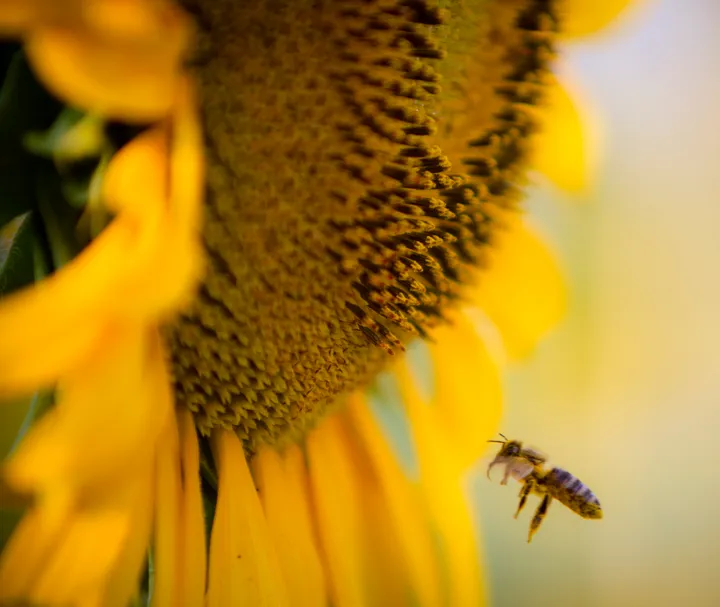
Sunflower

First Posted: 07/15/2011 10:00 am Updated: 09/14/2011 5:12 am

Scientist Gretchen LeBuhn is trying to save the nation's wild bee population. But to achieve her goal, she's resorting to some unconventional means, namely the help of ordinary citizens from across the country.

On Saturday 100,000 'citizen scientist' volunteers will spend about 15 minutes counting the number of bees that visit "lemon queen" sunflowers they've planted following instructions on LeBuhn's website, www.greatsunflower.com. Participants will monitor the flowers for bees twice monthly through the end of the summer, uploading the information into a central database.

Studies have shown that pollinators affect 35 percent of the world's crop production, but climate change and a little-understood phenomenon called "colony collapse disorder" are threatening honey bees, a key pollinator. Though researchers have reported a drastic decline in the populations of domesticated honeybees since at least 2006, the statistics on wild bees have remained more elusive.

LeBuhn hopes the new data will help scientists identify where native bee populations are doing well and where they’re doing poorly. Hopefully, the hundreds of thousands of sunflowers planted by volunteers will have the added benefits of providing wild bees with an enriched and expanded habitat.

"We’re really leveraging science dollars to do a survey we could never do using traditional methods," said LeBuhn, an associate professor at San Francisco State University. "It would just be incredibly cost prohibitive. I was thinking of sending my grad students up to Napa [County] and having them count bees," she added. "But to do that at any bigger scale than one county would be impossible. So it’s amazing to get all these people participating."

Participants don't need to know whether the bee they're watching is a bumblebee, a carpenter bee or a honeybee, LeBuhn said, though a guide available on her website can help with identification.

There are more than 4,000 different species of native bees in North America, according to Science Daily, but many of them have already disappeared. LeBuhn says that of the nine species of bumblebees known to live in the San Francisco area, researchers have only been able to find four of them in recent years.

"The Western bumblebee disappeared from all over the Western U.S. and nobody noticed," she told HuffPost in an interview Thursday. "I find that amazing that you can have the biggest, fuzziest, most common, cute bee disappear and people didn’t even know."

FOLLOW HUFFPOST GREEN

Scientist Gretchen LeBuhn is trying to save the nation's wild bee population. But to achieve her goal, she's resorting to some unconventional means, namely the help of ordinary citizens from across th...
 
 
  • Comments
  • 104
  • Pending Comments
  • 0
  • View FAQ
Comments are closed for this entry
View All
Favorites
Recency  | 
Popularity
Page: 1 2 3  Next ›  Last »  (3 total)
03:15 PM on 09/12/2011
Is "royal jelly" what we call in Croatia matična mliječ: http://www.pip.hr/home-izdvajamo-maticna.asp
10:07 PM on 08/08/2011
hello i have a oak tree on my land that has had honey bees in it for the past ten years i have kept my eye on them ever since i heard they were disappearing but they seem healthy
photo
HUFFPOST SUPER USER
Sister Bluebird
01:14 PM on 07/22/2011
Monitoring native pollinators can be and should be done year round: Here are some links for interested parties.

North American Pollinator Protection Program
http://pollinator.org/nappc/index.html

Urban Bee Gardens: http://nature.berkeley.edu/urbanbeegardens/general_why.html Focuses mostly on California, but still good material here that can be modified for your area.

It's not just the US that is having this issue: http://news.yahoo.com/s/ap/20110516/ap_on_sc/eu_europe_threatened_species

Related story: http://www.grist.org/article/food-2010-12-10-leaked-documents-show-epa-allowed-bee-toxic-pesticide-

If you want to participate year round go to Discover Life http://www.discoverlife.org/pa/ph/ And check out these albums. Discover Life does have the Bee Hunter program.

The best book out there I have read so far: Fruitless Fall by Rowan Jacobson about CCD, but it also covers the decline in Bumble bees and other indigenous pollinators as well. And here is what S. Colbert has to say about pollinators: http://pollinator.org/colbert2011.htm
photo
HUFFPOST SUPER USER
Chris 1
12:29 PM on 07/19/2011
Odd, "Citizen Scientists" in climate science are attacked routinely as unqualified for not going along with bought consensus leaders.

Irony.
photo
gallon
Those who fail to remember history are, um
02:45 PM on 07/20/2011
It is a simple story about the disappearance of bees, and yet confirmed serial denier Chris1 feels the need to make a conspiracy theory out of it. How typical of the funded denial campaign.
photo
HUFFPOST SUPER USER
Sister Bluebird
12:51 PM on 07/22/2011
Too True Chris. Some of keep careful journals and photographic records of our finds and observations. Not only of the bees, but whether there are dearths or droughts, cold snaps, and other hazards or obstacles for bees and other animals. It will be like it is now--500 years from now our journals and records will be considered important for this or that paper when studying this particular extinction event. Assuming that is we are still around as a species or in the very least, a literate civilization.
photo
HUFFPOST SUPER USER
getsit
good morning, I'm here
02:26 PM on 07/18/2011
I still see lots of carpenter bees around, but bumblebees are getting rarer and rarer. We all should be trying to encourage the wild populations. Please don't exterminate them.

I saw a bumblebee just yesterday. Probably not the Western, but it was yellow and black among the carpenter bees. Just one. In California.

My neighbor had a colony of honey bees in her wall. She was going to call an exterminator and I told her to please don't. She called a bee guy who came and took them away. Please remember your food supply depends on these useful creatures. Find someone to remove them for you.
This user has chosen to opt out of the Badges program
photo
Counterintuitive
We'll steer by the beacon of our 100 year forecast
09:01 AM on 07/18/2011
Hmmmm, it looks like bees need a safe atmosphere too.
tonybfine
fractional reserve lending is counterfeiting
02:16 AM on 07/18/2011
Sad about the bumblebee. My recollection is they were not that common and chances of seeing one fluctuates quite a bit depending on weather. So their disappearance without being noticed could be due to this variability in observation chances. Could also be we spend too much time indoors. I like bumblebees although have been freaked out (surprised) a few times when I have seen the legs of one on my sleeve and thought it a big spider. I hope they are surviving somewhere.
photo
HUFFPOST SUPER USER
Sister Bluebird
12:53 PM on 07/22/2011
Bumble bees are becoming domesticated for greenhouse operations regarding pollinator services. They are the best pollinators for plants in the nightshade family, which includes tomatoes and peppers. Unfortunately a form of Nosema from UK bumble bees was introduced here in the states back in the mid 1990s. This is believed to have helped decimate certain wild populations when those greenhouse bees escaped and encountered their wild counterparts.
01:05 AM on 07/18/2011
"...a little-understood phenomenon called 'colony collapse disorder...'" From what I understand, it's understood plenty, much more than Bayer and the EPA care to admit. But, I would expect better from a journalist.
http://www.i-sis.org.uk/requiemForTheHoneybee.php
http://money.cnn.com/2010/10/08/news/honey_bees_ny_times.fortune/index.htm
http://www.grist.org/article/2011-01-21-top-USDA-bee-researcher-also-found-Bayer-pesticide-harmful
http://www.grist.org/article/food-2010-12-10-leaked-documents-show-epa-allowed-bee-toxic-pesticide-
12:53 PM on 07/18/2011
Most would agree that honeybees are suffering dearly from pesticides but CCD has specific symtoms and timing that do not jive general poisoning. CCD has also occurred long before modern pesticides were invented.

http://www.americanbeejournal.com/site/epage/79414_828.htm

Scroll down to Proceedings of the American Bee research Conference 8-9 for a rather interesting explanation of CCD.
09:22 PM on 07/20/2011
9. Ferrario, T.E. & A.B. Cobbo - HONEY BEES, MAGNETORECEPTION AND COLONY COLLAPSE DISORDER - CCD has afflicted honey bees for decades, if not centuries. The disorder predates most pesticides, diseases, pests and management protocols. Scientists have searched - unsuccessfully - for chemical and biotic causes for this scourge.
Behavioral scientists have established that many organisms extract directional information from Earth's ambient magnetosphere. Anomalous magnetic fields have also been shown to alter a honey bee's orientation behavior (Winklhofer, M.J., 2010 J. Royal Soc. Interface 7: S131-S134; Johnson, S. and Lohmann, K.J. 2008, Physics Today 61: 29-35). Their "magnetoreception" sense is controlled by magnetite (Fe3O4) in adult bee abdomens (Hsu and Li, 1993 J. Exper. Biol. 180: 1-13). Linked together, magnetite crystals act like a compass needle and orient bees in magnetic fields. Discovery of magnetoreception in foragers resulted in astonishing interrelationships between the sun's explosive eruptions, geomagnetic perturbations they produce to Earth's magnetosphere and why they disrupt a bee's homing ability. Our theory is that solar storms interfere with Earth's magnetic fields, a forager's perception of it and consequently its homing ability.
photo
HUFFPOST SUPER USER
Sister Bluebird
12:55 PM on 07/22/2011
Well of course not--if you ignore the importance of Acetylcholine in Honey Bee Physiology, and the fact that both Organophosphates and NeoNicotinoid pesticides bind with and disrupt this neurotransmitter that is so incredibly important for the nervous systems of animals [humans] as well as insects. The strong links to Parkinsons disease in humans exposed to pesticides says a lot.... And Royal Jelly is the only source of pure, natural Acetylcholine.
04:04 PM on 07/17/2011
It would be really cool to have citizens aid the bee population by creating local bee farms. Our first step is increasing awareness and knowledge on Earth's cycles and most of its processes. We are consumed by our fascination with technology, currency and commodities but the beauty of life is underneath our feet; to which we give little respect towards.
photo
HUFFPOST SUPER USER
Sister Bluebird
12:59 PM on 07/22/2011
You can do that. You can make your yard into a pollinator island. Here are some sites that might interest you: http://xa.yimg.com/kq/groups/16508553/436903448/name/PBN+Wkshop+Manual.pdf
and
http://www.internationalpollinatorsinitiative.org/uploads/9-003.pdf

If you wish to contribute to citizenscience, join Bee Hunter at Discoverlife.org
http://www.nbii.gov/portal/server.pt?open=512&objID=222&mode=2&in_hi_userid=2&cached=true

Contact the org and request an album and get your camera out and get cracking. :) Good luck.
01:05 PM on 07/17/2011
This spring I converted my lawn to a rock garden full of perennials. I have lots of bees and bumblebees now. Had not seen a bumblebee in a long time. Have been trying to master deadheading, which works, so there are tons of blooms and they are busy bees.
photo
HUFFPOST SUPER USER
getsit
good morning, I'm here
02:29 PM on 07/18/2011
Try "bat faced cuphia". Not only is it gorgeous, but is low water, likes full sun and bees just LOVE it. A friend planted a couple of plants among her lavender and those plants had more bee activity than the lavendar which bees also love.

Good on you.
photo
HUFFPOST SUPER USER
Moose Luck 99
GEOENGINEERINGWATCH DOT ORG
04:42 PM on 07/17/2011
Hi Toxicity check this out!

Maui Update
http://farmwars.info/?p=6098

Mohave Minute Men
Extreme Levels Of Barium in Blood (Chemtrails?)

http://www.youtube.com/watch?v=CZ06xT_vFao

Alucha County Florida
Chemtrail complaints heard by County Environmental Protection Committee -Wake Up!-
http://www.youtube.com/watch?v=BmsCqiuo2pk
This user has chosen to opt out of the Badges program
07:47 AM on 07/17/2011
Believe me, our government knows the bees are dying and are intentionally ignoring it because it is bad for the mega businesses like Monsanto. Pesticides, GMOs etc. are the obvious culprit but our government does not regulate for the common good anymore.
HUFFPOST SUPER USER
mzrecycle
a very subtle micro-bio
07:11 AM on 07/17/2011
I live in N.C. Again this year, MANY carpenter bees, as a neighbor had them in their back porch. I've noticed at least one bumble bee (don't know the species) at one of the bushes in my yard that attract all sorts of bees, hummers, etc. These bushes just HUM with insects all summer. I also have huge plantings of marjoram and oregano that I let go to seed, just to enjoy all the bees/insects that come to the flowers. Each year I say I'm going to cut them back so they look "better", but can't bring myself to do it once the bees start visiting.
I HAVE noticed no viceroy butterflies around, however. Previous years, they were all over all sorts of flowering plantings in my garden. Last year, on a hike to a "bald" on a mountain top, I was delighted to watch both forms of viceroy butterflies feasting on thistle in great numbers. I had them at my bee balm and butterfly bush among others. None so far this year...
photo
HUFFPOST SUPER USER
observingstupiditydaily
Nice to be important,but more important to be nice
07:17 PM on 07/16/2011
Noticed the decline in bumble bees this year in SW Pennsylvania. Last year we had so many it was great shooting photos. This year we had a scant one or two for the whole season. Something definitely wrong.
photo
HUFFPOST SUPER USER
Roadrun
In Financial Theocracy we Trust
04:58 PM on 07/16/2011
After reading this earlier I went to Home Depot. I noticed a display for wasp and hornet spray and it made me cringe as usual. When I can get wasps to live in my yard it is a very good year. I never use chemicals in my yard but when I can attract wasps I have the best roses and other plants that aphids attack because the wasps feed on aphids. Also by not using chemicals I get the birds who feed on critters that eat my flowers.

There are some pretty big benefits from not using chemicals, besides not contributing to the destruction of insects we depend upon to grow food.