
iPhone app iPad app Android phone app Android tablet app More

Eat Less Meat And Cheese, Environmental Group Recommends

Meat Consumption

First Posted: 07/18/11 12:55 PM ET Updated: 09/17/11 06:12 AM ET

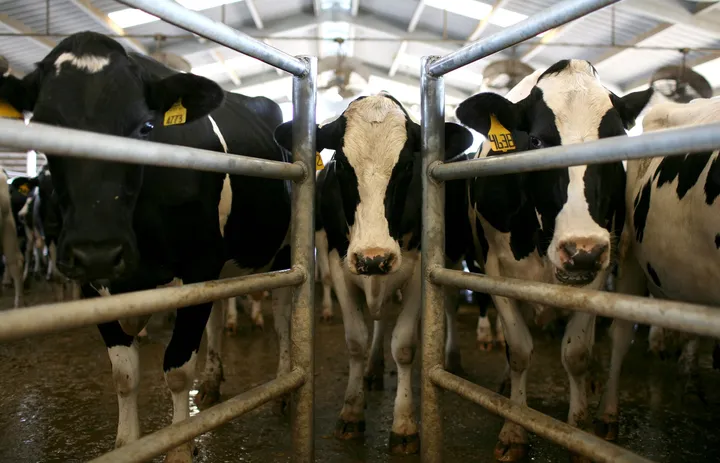
Gidon Eschel, a professor of climate physics at Bard College in New York, spent much of his youth in Israel with cows — tending to a dairy farm as a boy and his own beef cattle farm years later. “I loved it,” he said. “It’s too bad it is so unequivocally bad for the environment.”

That message is not all that new. From the documentary Food, Inc. to Michael Pollan's bestselling books to the cautions of many doctors, meat — red meat in particular — has gotten a bad rap in recent years. A report published on Monday by the Environmental Working Group (EWG), a Washington, D.C.-based advocacy organization, adds to the criticism, providing a comprehensive "cradle-to-grave" assessment of 20 popular protein-packed foods.

The group took into account the environmental impact of production, processing, transportation, cooking, and waste (20 percent of edible meat winds up in landfills), before reaching a relatively familiar conclusion: people should eat less meat and dairy. In particular, the EWG points to lamb, beef, pork, cheese and farmed salmon as the protein-packed foods that take the largest toll on the environment.

“Although this issue has been reported on for a long time, Americans continue to have really high rates of meat consumption, particularly children,” said Kari Hamerschlag, senior analyst at EWG and author of the new report. "As a country, we're producing and consuming 60% more meat per person than Europeans.”

Such splurging has had detrimental effects on human health, including increased rates of heart disease, cancer and obesity. But we aren't just harming ourselves when we choose a hamburger and milkshake, noted Hamerschlag. The production of meat and dairy requires the use of large amounts of pesticides, fertilizer, fuel, feed and water, and it releases greenhouse gases, manure and a range of toxic chemicals into our air and water.

While the environmental consequences of eating meat are frequently discussed, the fact that cheese is also one of the top climate culprits may come as a surprise to many. But it takes 10 pounds of milk to make one pound of cheese, Hamerschlag explained. That equates to a lot of methane and manure from dairy cows.

“We’re not advocating that people stop eating meat and cheese, we’re just suggesting that people consider eating less,” said Hamerschlag. "Ultimately, we need better policies and stronger regulations to reduce the environmental impacts of livestock production. But personal shifting of diets is an important step."

Fortunately, even small changes can have a significant impact. The report estimates that if each American cuts meat and cheese from their diet for one day a week it would be equivalent to taking 7.6 million cars off the road. Indeed, neither Hamerschlag nor Eschel are proposing that we get rid of cattle altogether.

“The world is better off with than without cattle,” said Eschel, who was not involved in the new report. He explained that optimal land use includes predominantly plants — "foods that feed people directly rather than indirectly through animals." But cattle, he added, are key for cycling the nutrients in the soil and maintaining long-term crop fertility.

As it stands today, cattle are also eating a large portion of those crops. Production of feed for the animals takes up nearly 150 million acres of U.S. land.

"Even if you don't directly clear land to grow feed crops, you are using land that could otherwise go to other purposes like food or biofuels. Somewhere forest or grassland will be cleared and carbon will be released into the atmosphere," added Simon Donner, a climate and agriculture expert at the University of British Columbia in Canada, who was not involved in the report.

Biology can also be partially blamed for the large environmental footprints of sheep and cows. During the digestive process, the ruminant animals naturally generate methane, a greenhouse gas 25 times more potent than carbon dioxide. Still, Donner thinks a lot can be done to mitigate the methane issue. "We can grow our meat more efficiently," he said. "More grass-feeding and the use of less processed feed would be one way."

But what if we could grow meat without the need for any fields, fertilizers or feces? That may be a reality within the next five years, according to a team of European researchers who recently studied the use of tissue engineering togrow meat in a lab.

"The climate impacts, water use and land use are substantially lower compared to conventionally produced meat," Hanna L. Tuomisto, a Ph.D. student in zoology at the University of Oxford and lead researcher on the report, told The Huffington Post in an email. "However, greenhouse gas emissions from cultured meat production are higher compared to many crops."

She added that when the impacts are allocated per unit of protein, the greenhouse gas emissions become only slightly higher than crops. Further, if the land released from livestock production were put into greenhouse gas mitigation, the overall climate benefits of the lab-grown variety would be even greater.

Donner is a bit skeptical of the concept, given the energy required to run a lab, but he didn't dismiss the possibility of some slaughter-free meat in our future.

In the meantime, there are still a few other natural meat options. Pound-for-pound, chicken requires far less feed than cows and produces about an eighth of the greenhouse gas emissions. (The processing of the birds, however, uses more energy and water than beef.)

The environmental impacts of consuming fish vary widely; wild local species are typically best, according to the report.

"Farmed salmon, as much as we love it, is probable one of the least environmentally-friendly," said Donner, noting that since salmon live at the top of the food chain, fish farmers must trawl the oceans to collect fish for their feed. He recommends opting instead for plant-eating species such as tilapia.

"There is a reason we chose to farm cows hundreds of thousands of years ago," said Donner, noting their diet of grass. “We’re now at the cusp of domesticating fish, and some of the ones we've chosen are frankly quite stupid."

What's more, the report found that 44% of farmed salmon are thrown away by retailers and consumers.

The EWG promotes the increasingly popular idea of meatless Mondays. Eating local and grass-fed meats, they suggest, can also trim your diet's environmental footprint. Still, Donner noted that eating less meat in general will have a bigger impact climate-wise than simply eating meat that was raised nearby.

When asked what he recommends people eat for a healthier body and planet, Eschel, who has been a vegan since leaving his cattle farm 27 years ago, simply looked outside at his garden and listed the foods ripe for picking: oats, lentils, chickpeas, beans, cabbage, onion, garlic and kale.

“If there were 9 billion people eating like me," he said, "the earth would look real big."

FOLLOW HUFFPOST GREEN

Gidon Eschel, a professor of climate physics at Bard College in New York, spent much of his youth in Israel with cows — tending to a dairy farm as a boy and his own beef cattle farm years later. “...
 
 
  • Comments
  • 654
  • Pending Comments
  • 0
  • View FAQ
Comments are closed for this entry
View All
Favorites
Recency  | 
Popularity
Page: 1 2 3 4 5  Next ›  Last »  (9 total)
09:39 PM on 07/22/2011
The EWG study compares "four ounces" of various foods rather than comparing foods on the basis of their nutrients. They rate 4 oz. milk better for the environment than 4 oz. cheese, even though the cheese contains seven times the protein per ounce as the milk. I'm no advocate of meat eating, but believe this study is deeply flawed, and will ultimately prove embarrassing to environmentalists.
12:54 PM on 07/22/2011
Eating too much meat and cheese is bad for your health.

What's bad for the environment is too many people.
photo
HUFFPOST SUPER USER
William Brock
09:59 AM on 07/21/2011
Terrible stuff, packed with hormones and cancer causing chemicals ...yuk!
HUFFPOST SUPER USER
Anne Mccormick
02:19 AM on 07/21/2011
i like my apple and cheese. it's my favorite snack. so won't be giving up cheese or meat, for that matter.
photo
HUFFPOST SUPER USER
arimoore
let's be nice
07:44 PM on 07/20/2011
I loved animal products and somehow managed to go vegan in 2000; my only regret is that I didn't make the change sooner. Great to see everyone talking about this so seriously these days!
photo
SteveDenver
Progressive and liberal, just like Jesus Christ.
07:05 PM on 07/20/2011
Watched FOOD INC and cut factory dairy and non-organic beef: those cows have infected udders and mucus leaks into the milk, and the meat comes from animals that if they weren't slaughtered in a timely fashion, would die of toxicity.
05:58 PM on 07/20/2011
NUNYA! It's NUNYA bidness what I choose to consume.

I once tried Smart Dogs, the soy based imposters, I couldn't even swallow a single bite and even worse was that our dog refused to eat the discarded garbage.
08:59 AM on 07/20/2011
Only someone extremely uneducated can look at the way chickens are raised versus the way ruminants like sheep and cattle are raised and determine chickens are better for the environment than cattle. Only a dummy would believe cattle eating grass are worse for the environment than cars burning gas. But hey, it's hip on Huff post to bash cattle, so don't let me spoil the party.
photo
HUFFPOST SUPER USER
jumbotron16
a slight improvement over jumbotron15
02:33 PM on 07/20/2011
When studies come out that tell us things that are counter-intuitive, such as "margarine is healthier than butter" or "eggs are bad for you" or "cars are better for the environment than cattle on pasture," they are invariably proven false a short time later. Natural things are better for us and for the environment than man-made things. Cattle on pasture are natural--cars are not. :)
02:48 PM on 07/20/2011
What about cars on pasture? :)
http://wallpaperjunctiondownload.blogspot.com/2011/04/cadillac-ranch.html
mothergrace
If they knock you down, bite 'em on the ankle.
11:31 PM on 07/20/2011
Except those studies are the same as the undead in horror movies.

No matter how many times you "kill" them, they come back. (cue ominous music)
08:22 AM on 07/20/2011
This is all about large factory farms. I buy my meat from local small farms who grass feed. Far better for the environment than even a gigantic spinach farm. These local farms have recreated grass and prairie lands full of wildlife. Buy the way, time to plant the fall garden that includes spinach! Easy to grow until November.
This user has chosen to opt out of the Badges program
photo
elcerritan
My bio is not micro
02:56 PM on 07/20/2011
Try kale, too, if you haven't already. Will actually last all winter, even after snow (well, maybe not if you live where it gets 40 below).
photo
HUFFPOST SUPER USER
Sir Guy Grand
A little bit of the old pause...
01:44 AM on 07/20/2011
Ain't nobody come between me and my cheese.
photo
HUFFPOST SUPER USER
deckercat
change the world
07:10 PM on 07/19/2011
i quit eating dead mammals because it's mean. i don't care what you eat.
photo
HUFFPOST SUPER USER
Moose Luck 99
GEOENGINEERINGWATCH DOT ORG
12:16 AM on 07/20/2011
Look I am the head Vegan on this thread I have four stomachs to prove it!

http://www.youtube.com/watch?v=BmsCqiuo2pk
photo
HUFFPOST SUPER USER
Dede Eagleburger
Beauty is in the eye of the makeup brush holder
08:26 AM on 07/20/2011
so live ones are fine then?
photo
HUFFPOST SUPER USER
riverdivine
06:26 PM on 07/19/2011
I've read many pages of this blog, and as usual......wonder why it is that Banner-Car­rying Proud Meat Eaters can be so aggressive and defensive in their promotion of tortured animals (i.e, factory farms).

Sure, there are a teeny tiny minority who support humanely-raised cattle, pigs, and poultry. (To those individuals, I salute you!)
In truth, though, most are "conventional" meat eaters- fighting for their freedom to continue a lifestyle that asks no self-examination or reflection. Because like most of us, we don't like to be "inconvenienced" or deviate from familiar routines and eating habits- it takes too much energy; its too much of a "hassle". So, much easier to defend a sadistic and cruel industry, because what they can't see, they can deny exists- and they can deny what they are actually personally funding with their purchasing choices.

Yes, meat "tastes good". I grew up eating meat, like most people.
However, after doing a bit of reading about what goes on in these CAFOs, and travelling the country, and SEEING the torture and horrific conditions that factory farmed animals must endure...they are imprisoned and tortured for OUR "benefit"- was a reality too much to bear. I have no interest in funding torture camps for other living beings, so I changed my eating habits.

Conventional meat eaters, please consider what you're funding .http://www.meat.org/
Your choices make a difference; what you choose DOES matter to the evolution of OUR species.
07:57 PM on 07/19/2011
I haven't seen anyone defend CAFOs here.
photo
GODSWILLFIRST
Truth is always the strongest argument.~Sophocles
09:14 PM on 07/19/2011
klbrz, you are a small minority and you know this to be true. As this person clearly alluded to, "conventional" meat eaters couldn't care less. The evidence doesn't lie.
mothergrace
If they knock you down, bite 'em on the ankle.
01:26 AM on 07/20/2011
I beg to differ. Most of the posters who seriously comment are all in favor of buying their meat from smaller operations that pasture raise their animals.
photo
HUFFPOST SUPER USER
Moose Luck 99
GEOENGINEERINGWATCH DOT ORG
06:17 PM on 07/19/2011
Is silver iodide toxic to cows?

http://www.youtube.com/watch?v=3BjNBbSnawU
08:23 AM on 07/20/2011
OK, I'll bite, what does silver iodide have to do with cows?
photo
HUFFPOST SUPER USER
Moose Luck 99
GEOENGINEERINGWATCH DOT ORG
10:41 AM on 07/20/2011
what is wrong with the time the sunsets?? , page 3
www.abovetopsecret.com/forum/thread704235/pg3 - Cached
17 posts - 11 authors - Last post: May 16
The most common seeding material, silver iodide, is used in very ... Many regions have much higher concentrations of silver in the soil than are found in .... moving from an extreme NE position when first coming up, ...

Morgellons and silver iodide toxicity from cloud seeding at ...
curezone.com › Forums - Cached
Oct 29, 2010 – The harmful effects of silver iodide are insidious. ... cloud seeding with silver iodide and runoff have adverse effects on the water, soil,
photo
HUFFPOST SUPER USER
sunshine saguaro
for you, a thousand times over
02:02 PM on 07/19/2011
I'm a vegetarian. I totally get the desire to eat in a way that's environmentally friendly, and I can appreciate the ethical questions raised by taking a life to sustain your own. I have nothing but respect for people who choose to eat in a way that reflects their values, whatever those may be. But I have no respect for people who proselytize and propogandize a certain way of eating. I grow weary of people insisting that it's disgusting and immoral and unnecessary to eat animal products, and I also get tired of people insisting that you absolutely must eat meat to be healthy (although I hear that one a lot less often). I pass no judgements regarding what people eat. I realize that there are no diets that come as "one size fits all"-everyone's body is different. I encourage people to eat healthy, local, sustainable foods- but you're not going to convince anyone to change by being self-righteous and puritanical. If everyone would just realize that we are all, in fact, on the same side, we would get a lot more accomplished. I don't think there's anyone commenting here that wouldn't like to see food produced in a more sustainable way. Animals always have been, and always will be, a vital part of sustainable ag. The dialogue, then, should be about how we can make everyone's lives better-including animals-and transition to a more local food economy, rather than who is "right" and who is "wrong."
TomP100
Got elk?
04:36 PM on 07/19/2011
Thank you for being a voice of reason and sanity in a sea of militant vegan ideologues and conscience-lacking " I don't care" meat eaters. There is a happy medium between extremes and it's called sustainable, organic, locally-based, small farm-oriented agriculture. Great post.
04:54 PM on 07/19/2011
It is true sustainable and locally-based are best, and we should make an effort to save every ounce of energy we can, but the real crux of the issue is not the transportation phase, it's the production phase. There just a lot more energy produced and consumed in producing meat. HuffPo had an article about this not too long ago:

http://www.huffingtonpost.com/2011/05/20/eating-local-does-it-matter_n_864809.html
10:46 PM on 07/19/2011
the funniest thing is that the article is not telling anyone to completely cut out anything at all - eat meat, raise it, kill it yourself, work for a CAFO if you must! THE POINT is to try to consider maybe possibly, perhaps if you could even dare to cut back a little on consumption. it's good for the body, it's good for the planet. no one is trying to TELL ANYONE WHAT TO DO...not trying to TAKE YOUR JOBS (chorus from South Park ringing in my ears) Moderation folks. Look it up.
photo
HUFFPOST SUPER USER
Dede Eagleburger
Beauty is in the eye of the makeup brush holder
12:58 PM on 07/19/2011
can somebody explain this paragraph?

"There is a reason we chose to farm cows hundreds of thousands of years ago," said Donner, noting their diet of grass. “We’re now at the cusp of domesticating fish, and some of the ones we've chosen are frankly quite stupid."
01:52 PM on 07/19/2011
maybe read it aloud...it's not that complicated.
photo
HUFFPOST SUPER USER
Dede Eagleburger
Beauty is in the eye of the makeup brush holder
01:58 PM on 07/19/2011
I did! Is he calling the cows stupid, or the fish, or something else?
photo
HUFFPOST SUPER USER
Sir Guy Grand
A little bit of the old pause...
01:48 AM on 07/20/2011
They should have said "some of the choices are, frankly, quite stupid."
02:59 PM on 07/19/2011
Happy cheese comes from happy cows and makes people happy. Stupid filets come from stupid fish and therefore make people stupid. Cows that eat green grass make people green and environmentally responsible.
photo
HUFFPOST SUPER USER
Dede Eagleburger
Beauty is in the eye of the makeup brush holder
03:52 PM on 07/19/2011
oh wow! thank you for explaining it! :)
photo
collettethehedgehog
My micro-bio is So running on empty
02:14 AM on 07/20/2011
HA! Yeah, thanks. I was confused where they were going with the stupid. If you think cows are stupid-try trying to get them back in to a pasture they've just broken out of. Wily comes to mind.