iPhone app iPad app Android phone app Android tablet app More

The New Space Biz: Companies Seek Cash In The Cosmos

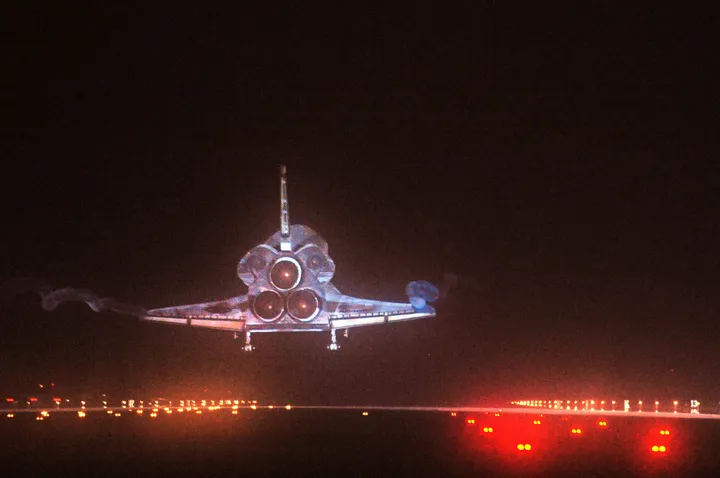
Atlantis

First Posted: 07/22/11 06:25 PM ET Updated: 09/21/11 06:12 AM ET

Early Thursday morning, Naveen Jain switched on his iPad and watched the Atlantis space shuttle glide onto the runway of the Kennedy Space Center in Cape Canaveral, Fla.

The landing elicited "mixed emotions" from him, he said. On the one hand, he was watching a thirty-year chapter in the history of space travel come to a close. Never again would a NASA space shuttle take flight.

On the other hand, the end of the NASA space shuttle program means the dawn of a new era of space travel -- one that may prove very lucrative to him.

Jain is the founder of Moon Express, a company that specializes in what it describes on its website as "lunar transportation." It's developing a system that will allow an unmanned spacecraft to land on the moon. Such a spacecraft could be used to gather platinum and other rare and valuable minerals for consumption back on Earth, said Jain.

"The moon has never been explored from an entrepreneurial perspective," he said.

So far, Jain added, his company's progress has given him cause to believe it may be the first. Hardly had the shuttle landed in Florida when Jain threw a party for employees and members of the press at the company's headquarters in Mountain View, Calif. They raised glasses of "nitrogen-infused" champagne to what he described as a successful test of the company's "Lunar Lander" system.

But Jain's company is by no means the only for-profit company in the space business. With NASA's space shuttle program over, the future of space travel, now more than ever, is in the hands of the private sector. A company called Astrobotic Technology is creating a lunar lander of its own, which it says could touch down on the moon's surface by 2013. And Richard Branson, the founder of Virgin, is at work on a project that will allow tourists to orbit the earth for $200,000 a trip.

Other companies are taking over some of the NASA shuttles' less glamorous duties. Orbital Spacecraft, a manufacturer of satellites and rockets for military and commercial uses, is one of several businesses that NASA has contracted to deliver food, scientific supplies, and other cargo to the International Space Station.

The deliveries are set to begin next year. Barry Beneski, a spokesman for the company, said, "In a much bigger and higher-tech sense, it's very similar to how you would hire Federal Express to deliver a package from New York to L.A."

Another company taking over some of NASA’s delivery responsibilities is Space Exploration Technologies. Elon Musk, the company’s CEO and chief rocket designer, and the founder of PayPal, started the business in 2002 with 100 million dollars of his own money.

Musk has said that it was his passion for space that inspired him to start the business. If he cared only about making profits, he said, he would have done something else.

But the business is proving to be successful anyway -- it has posted profits for the last four years. NASA recently awarded the company 75 million dollars to make upgrades to its Falcon 9 rocket, so that it will eventually be able to carry astronauts into space.

Boeing, one of NASA’s partners throughout the space program’s history, is developing another spacecraft designed to send astronauts to the International Space Station. The company says it expects to send people to the station by 2015.

The spacecraft -- which visually resembles the Apollo spacecrafts -- will also send crew members to a private space station being built by Bigelow Aerospace, a private startup based in Nevada.

As NASA shifts the weight of what are known as “lower-orbital” space missions onto the shoulders of commercial companies, the agency is also working on new projects that will allow it focus on “deep-space” exploration. Orion, a project headed by Lockheed Martin, is testing a new series of spacecraft capable of traveling distances previously limited to unmanned ships. Larry Price, a project manager for Orion, said the world’s first “human interplanetary spacecraft” could carry out its inaugural mission in 2015.

Price said that by 2019, the Orion project may be used to send astronauts to a nearby asteroid. Crew members would be able to gather scientific information by drilling into the asteroid -- sort of like Bruce Willis in “Armageddon,” except without the fate of humanity hanging in the balance.

As Price pointed out, NASA is shifting its focus away from space station deliveries and other fairly monotonous jobs as well as redoubling its commitment to scientific inquiry, a difficult undertaking that Price feels may have fallen by the wayside.

There’s a widespread feeling in the space travel industry, Price said, that NASA should “consider science and exploration again and get out of the day-to-day operations after 50 years."

“Other companies could pick up that business,” he said, while NASA could concentrate on “the harder job: supporting science.”

FOLLOW HUFFPOST TECH

Early Thursday morning, Naveen Jain switched on his iPad and watched the Atlantis space shuttle glide onto the runway of the Kennedy Space Center in Cape Canaveral, Fla. The landing elicited "mixed...
 
 
  • Comments
  • 52
  • Pending Comments
  • 0
  • View FAQ
Comments are closed for this entry
View All
Favorites
Recency  | 
Popularity
Page: 1 2  Next ›  Last »  (2 total)
This user has chosen to opt out of the Badges program
photo
12:35 AM on 08/22/2011
Yuppers, as Heinlein said, it's gonna rain soup :3
This user has chosen to opt out of the Badges program
02:22 AM on 07/25/2011
Following the example of colonies on Earth, I think it is fair to say that any colony established on Mars or elsewhere is going to eventually revolt against Earth. This would be especially true of anywhere there is a colony that discovers a valuable resource that it can own by simply declaring its independence. Not much that Earth can do about that one.
photo
HUFFPOST SUPER USER
Lane Campbell
Say what?
12:31 AM on 07/27/2011
Science fiction writers have put out a huge body of work on just that subject, exploring it from a number of angles. Lots of potential drama there, as with any colonial independence movement, the first and primary pre-requisite is self-sustainability. There was a period of (what?) 50-100 years during which colonies in the New World required periodic resupply or help from Europe before they became truly self-sustaining. Who knows how long that might take for space colonies? Sky's the limit...
photo
HUFFPOST SUPER USER
Lane Campbell
Say what?
11:56 PM on 07/24/2011
Oops typo in that last. S/b "...as Earth-bound resources are LIMITED"
photo
HUFFPOST SUPER USER
Lane Campbell
Say what?
11:54 PM on 07/24/2011
I hope -- and pray -- that in the long run, we can see the long-term payoff from investments in access to space. People keep asking -- is there anything of value out there? Yeah, there is, if you can see beyond the next paycheck, the next election, or the next hot party night...
Consider:
1) Virtually unlimited solar energy potential (whereas, solar energy potential on Earth is limited in the sense all other Earth-bound resources are unlimited).
2) Manufacturing, crystal-growth, bio-mechanical and bio-medical processes/materials that can only be enabled/manufactured in a micro-gravity environment.
3) Virtually unlimited mineral resources in the Asteroid Belt. Perhaps also huge resources of water-ice.
4) Reservoirs of methane, hydrogen and ammonia (that's two important fuel gases and a primary source of nitrogen for fertilizer) that could swallow several Earths whole without a ripple. Otherwise known as the upper atmospheres of Jupiter and Saturn.
Yeah, the technologies to fully exploit these and other resources may be 100, 500, maybe 1000 years out. So ... who was it? Sun Yat Sen? who said "A journey of a thousand miles starts with a single step." To my way of thinking, it's time to start steppin'.
More power to those who are willing to start steppin' and take the initial risks. Succeed or fail, they deserve our respect.
02:27 PM on 07/24/2011
Mining Mars or the Moon isn't going to happen because that in effect would render the Outer Space Treaty invalid.
11:15 PM on 07/24/2011
I'm sure the first country that manages to put enough enough resources to embark on a project of such scale would ignore any existing treaty. For example, the USA has never ratified the Law of the Sea.
photo
HUFFPOST SUPER USER
Lane Campbell
Say what?
11:18 PM on 07/24/2011
Treaties that stand in the way of human need are easily broken.
02:14 PM on 07/24/2011
NASA has had huge bureaucratic problems, but the reality is that the amount of energy needed to send a manned vehicle into a journey farther than the near orbit and *bring it back* is huge, requiring lots of investment and day-to-day operations cost. Space is much more intolerant than the oceans during the exploration era. Ships could be sunk; crews could be decimated by diseases; but a starving crew could scavenge for food in strange lands, and manage to bring the ships back (as the Magellan surviving crew did). Not the case with space.
photo
HUFFPOST SUPER USER
Lane Campbell
Say what?
11:23 PM on 07/24/2011
No? Consider the Apollo 13 story. Not starving, perhaps, but a crew in a desperate position that managed (with help & advice from the ground) to survive and return. And, if we're going to compare/contrast our baby-steps in space to the early explorations of Columbus, Magellan & contemporaries, consider the fate of the first Virginia Colony. From the standpoint of those first settlers, the so-called "New World" was just as harsh and unforgiving of THEIR technology as space seems to ours.
ThinkCreeps
Seriously, it's time.
02:00 AM on 07/25/2011
I reckon your ideas and sentiments are sound, but it was about thirty-six hours to earth for apollo 13. Mars is nine months away. With different winds, the virginia colony would simply have been the north carolina colony instead; miss mars and there's nowhere else to make landfall. Space is not a place for our bodies, but our machines do very well there.
photo
HUFFPOST SUPER USER
politicky
just follow the $$$
03:04 PM on 07/23/2011
I wonder if these nifty new toys have components assembled by prison (slave) labor?

"...The majority of UNICOR’s products and services are on contract to orders from the Department of Defense. Giant multinational corporations purchase parts assembled at some of the lowest labor rates in the world, then resell the finished weapons components at the highest rates of profit. For example, Lockheed Martin and Raytheon Corporation subcontract components, then assemble and sell advanced weapons systems to the Pentagon..."
http://www.globalresearch.ca/index.php?context=va&aid=25376
photo
hypnotoad72
Real democracy = living wages.
05:58 PM on 07/24/2011
In which case, "astronaut" is now a profession that is made far more unsafe than what it might otherwise be.

No ownership, slave labor, parades to try to build happiness, no-suicide pacts, and all the rest = lower quality products and services.  A worker meets their quota or gets punished and preferring death.  What a horrible way to live, if that is "living"...
photo
HUFFPOST SUPER USER
Lane Campbell
Say what?
11:26 PM on 07/24/2011
Is this bushwa really relevant? With the exception of Boeing, the firms discussed in the article are relatively small startups residing in THIS country and subject to OUR labor laws. The real subject is the entrepreneurial opportunities in space.
photo
HUFFPOST SUPER USER
Ramkshrestha
Welcome to Nepal - the birthplace of Buddha
11:01 AM on 07/23/2011
There could be thousands of millionaires, however; how many of them would be ready to pay $200,000 for the trip and some of the interested could not go due to their health. So I am not sure about the viability of the project.
photo
HUFFPOST SUPER USER
Lane Campbell
Say what?
11:30 PM on 07/24/2011
Dude, based on simple probabilities and distributions, if (what?) three, four(?) people have already seen fit to pay $20 million, that translates into dozens, perhaps hundreds, of people willing to fork over $200K (a hundredth of that) for the ride of a lifetime. And, if the numbers of people willing to pay the ticket get big enough, economies of scale will bring the price down. Lest we forget, air travel started out as a pastime for the thrill-seeking idle rich. Today, anybody with a job can afford to fly...
This user has chosen to opt out of the Badges program
photo
12:39 AM on 08/22/2011
'The future is here, it's not not evenly distributed yet'
-- Bruce Sterling
photo
planetjeffy
On the other hand, you have different fingers.
01:30 AM on 07/23/2011
As President Obama has established...
NASA should be focused on research (telescopes, rovers, exploratory missions...)
not commercial heavy lift capacity, launching satellites or stocking the space station.
We must acknowledge that the shuttle and even the space station was a poor investment.
photo
hypnotoad72
Real democracy = living wages.
06:00 PM on 07/24/2011
Agreed.

Unfortunately, your post also made me think of the opening to that dismal movie, "Species II".  A ship hauling 4 large crates - each crate having a brand label prominently displayed.  (It looked stupid, even if the reason for it was for a lame "product placement" ad.)
12:39 AM on 07/23/2011
Sometimes private enterprise does a better job than the government and sometimes not. Let's hope this does not turn into a "Halliburton" situation where a company overcharges and under delivers.
02:10 AM on 07/24/2011
Great things have always come from the government investing huge amounts of money in research over years and even decades. Once an area matures enough that it becomes clear that it makes business sense to invest in it, then private enterprise starts getting in on the action and takes over.
06:31 PM on 07/24/2011
how about an even scarier thought---do you realise you could conquer a country by throwing rocks at them from space?---
a private company can now be a superpower any time it decides to take action--and how do you fight back? A piece of real estate (country) is subject to counter attacks, but a paper person?
This user has chosen to opt out of the Badges program
12:36 AM on 07/23/2011
Considering that no private venture has reached the 1961 level of even one lousy manned orbit of the earth, I'd say that things have quite a mountain to climb.

NASA couldn't land a manned mission to Cleveland and bring them back alive.

The Russians now own space all by themselves.
ThinkCreeps
Seriously, it's time.
02:02 AM on 07/25/2011
Russia and china are the only countries with the ability to send people into space, but that's a relatively daft game. In terms of ownership, the US airforce's space command has a good claim.
photo
HUFFPOST SUPER USER
Holly Smoke
Humor is the best defense for absurdity.
12:28 AM on 07/23/2011
In the bygone days, we built temples and cathedrals that last hundreds and thousands of years.
Nowadays, we builds stuffs that just go poof.
I guess that is progress, huh? or regression?
photo
hypnotoad72
Real democracy = living wages.
06:04 PM on 07/24/2011
Neither, IMHO.

"Planned obsolescence".

Keeps the economy going.

Right down to unexpected places - such as drywall.  http://www.usatoday.com/money/economy/housing/2009-03-16-chinese-drywall-sulfur_N.htm
From failing electronics to allergies, both TV stores and pharmacists stand to rake in a lot.

Fanned and faved.
06:38 PM on 07/24/2011
you want to go back to the "stone" age?
12:21 AM on 07/23/2011
Branson's $200,000 flights will not "orbit the earth".
Virgin would be doing short suborbital hops.
photo
Rude Monk
No God can stop a hungry man
11:40 PM on 07/22/2011
Can someone explain the benefit of sending humans on Mars,Moon or an asteroid?
Is going to cost at least ten times more than the simpler version of replacing manned mission with robotic probes and automated vehicles.
Oh,I see,nasa is going to start big.It likes to put on shows for the little people.
Then the whole thing will go over the budget so much that it will be cancelled.The money went to a few individuals or well connected contractors.
Meanwhile the russians or the chinese will have yet another way to get ahead of us,because the americans are more concerned with the propaganda value than the practical applications.
photo
HUFFPOST SUPER USER
uncc49er
12:14 AM on 07/23/2011
I think it would be more about the technologies and the inventions that are going to be created on the side to make such missions possible. After all, if humans have to go beyond the solar system and travel to other worlds, it has to start from somewhere , it might be now.
12:32 AM on 07/23/2011
***Can someone explain the benefit of sending humans on Mars,Moon or an asteroid?***

There are no benefits for the forseeable future.

Probes and robots will suffice.

Unmanned rockets will be enough for satellite launches.
This user has chosen to opt out of the Badges program
photo
loki
cheap politicians for sale
11:30 PM on 07/22/2011
oh joy, capitalization of Space.
This should work out well

NOT