
iPhone app iPad app Android phone app Android tablet app More

Latino Health Paradox: Latinos Boast Low Infant Mortality, Long Lives Despite Risk Factors

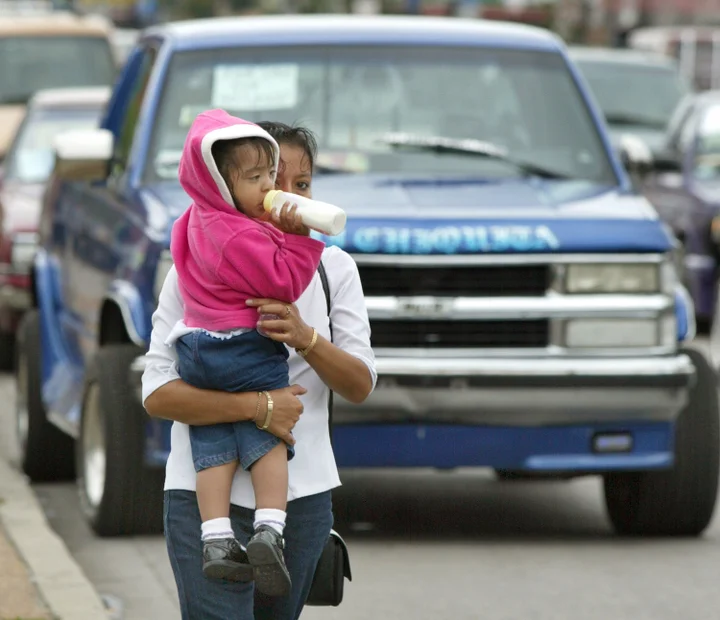
Hispanic Mother With Baby

First Posted: 08/11/2011 11:15 pm Updated: 10/11/2011 5:12 am

Jonah Garcia is a social worker with what may be one of the toughest gigs in the country.

Garcia is a program director at La Clinica de Familia Doña Ana Healthy Start in the U.S.-Mexico border community of Las Cruces, N.M., where she helps mothers deliver healthy babies. In the county the program serves, about 5 percent of children arrive after their mothers have received no prenatal care, according to an agency report.

A little more than half of the children born in the county have mothers who have not graduated from high school, and the median income there was just $35,541 last year, according to Census data. That combination of low income and little formal education creates what many public health experts would describe as the conditions for elevated infant mortality. But in Doña Ana County, the number of children who die before age one is lower than the national average. And in the 11 years that Garcia's program has worked with some of the county's highest-risk cases, she says just one client's child has died.

"I'd like to say that we just work darn hard," said Garcia.

In the United States, the prevailing wisdom is that people with better education and higher incomes have better health. But when it comes to several key indicators such as infant mortality and longevity, Latinos in the United States defy this paradigm. A researcher first uncovered the phenomenon, sometimes called the Latino Health Paradox, 25 years ago. Nearly three decades later, the concept and its potential causes remain largely unknown to the general public and the subject of very limited research.

The Latino health paradox might hold some answers about health and effective health care for the entire population, but some public health advocates and researchers think that information has instead been obscured by immigration politics.

"As soon as you start talking about Latino birth outcomes and infant mortality then you have people start screaming about anchor babies," said David Hayes-Bautista, a professor of medicine and director of the Center for the Study of Latino Health and Culture at the UCLA School of Medicine. "There are all these knee-jerk reactions about Latinos that lead too many people to equate the whole group with the illegal and undocumented. Once that happens we miss out on what could be some very useful information."

Hayes-Bautista points to the debate over President Obama's health care reform package, much of which focused on the question of health insurance coverage for undocumented immigrants and the possibility that they might strain or drain the nation's health care resources. What ultimately passed was a law that created a waiting period for all immigrants and banned adult undocumented immigrants from reaping any of the reform's benefits. Yet almost no one was talking about the fact that Latinos, on average, use fewer health care services than other populations, Hayes-Bautista said, or that immigrants -- documented and some undocumented -- also pay income taxes.

"What health insurance pool doesn't need healthy people who won't require or seek a lot of services?" Hayes-Bautista said. "Everybody is wringing their hands about health care costs, and the [Latino health] paradox and some of its implications for cost savings, for efficiencies, aren't even considered."

Hayes-Bautista said Latinos' positive health profile is likely due to cultural, rather than genetic, factors. That means there may be things that other Americans could do to "Latinize," and have healthier babies or live longer lives, he said.

WHAT THE DATA SHOW

In October, the National Center for Health Statistics published its first report that included distinct average lifespan measures for white, black and Latino Americans. What it revealed was so surprising that it merited a story in the Wall Street Journal. Latinos -- despite reporting lower-than-average income and education -- had the nation's longest average lifespan. On average, Latinos outlive white Americans by 2.5 years and black Americans by nearly 8 years.

But the exact reasons why are unknown because Latino longevity hasn't been widely researched, said Hayes-Bautista.

Infant mortality has received a bit more attention than lifespan because the data has long been available, and because the United States' infant mortality rate ranking is 177th in the world, worse than the United Kingdom, Slovenia and Monaco.

Nationally, the white infant mortality rate was 5.6 per 1,000 births in 2007, the most recent year for which data are available. White Americans also have the nation's highest average income and education levels, markers usually associated with good health.

Average Latino education and income levels are closer to those of African Americans. But the difference between the infant mortality rate for most Latinos (Puerto Ricans are the exception) and the black rate is vast. There were 5.5 per 1,000 Latino infants born in 2007 who died before their first birthday. That same year, 13.3 per 1,000 black children died in their first year.

When the Doña Ana County clinic staff analyzed their highest-risk clients' files a few years ago, they found one of the few things they had in common was a high level of social isolation or a weak support network. Garcia said the clinic staff now try to recreate the kinds of bonds that are common in Latino families. The agency set up low-tech social networks -- the kind where people talk face-to-face about their life challenges, potential solutions and learn about various aspects of child, reproductive or women's health.

"I don't want to call it a support group, but it almost is," said Garcia. "Sometimes they bring the food and do like a pot luck. Sometimes we provide the food. But what we really do is try to facilitate those social connections in addition to providing access to medical care."

In 2007, 5 children per 1,000 born in Doña Ana County died before the age of one. Nationally, about 6 of all children per 1,000 born died before their first birthday.

But of the $326 million in infant mortality and low birth rate research funded by the National Institutes of Health in 2010, none of the study descriptions indicate that the causes of the Latino health paradox are being examined, nor are theories about its causes tested against other populations. NIH is the nation's largest public research funder.

Representatives of NIH's Office of Minority Health were not available to comment on the agency's funding priorities.

"In this country, we do set research agendas through a combination of public interest, political responsiveness and scientific interest," said Arthur Caplan, director of the University of Pennsylvania's Center for Bioethics. "It's a dance between all those things."

Caplan questions the existence of the Latino health paradox because of the difficulty defining who is and who is not Latino. But he does not question the idea that public sentiment may have limited the amount of research on Latino health that has followed since the idea was first put forward in the 1980s.

That lack of research could be a function of many things, Caplain said: There is no celebrity face or powerful interest group calling for research; there may not be any money-making opportunities that can come from what research may show; Latinos do not have a particularly large presence in the geographic areas where most medical research is conducted.

Caplan added the combination of public sentiment about immigrants and some lawmakers' assumptions about what share of the population consists of undocumented immigrants might also limit pressure to fund more research.

MORE RESEARCH NEEDED

Back in the early 1980s, Kyriakos Markides, a Cypress-born researcher and doctor was working in South Texas and noticed something interesting. There was a high number of Mexican Americans in the area -- particularly first-generation Mexican-American immigrants -- who lived long lives despite having some of the lowest incomes and education levels in the country. By 1986, Markides and his research partners had the data to support his observation. Markides called it the Hispanic Epidemiological Paradox.

"We went out on a limb," said Markides, who is now a professor of aging studies at the University of Texas Medical Branch in Galveston. "This was contrary to all the thinking about health at the time."

In the early years, questions about the veracity of the paradox were common, Markides said. Some centered around problems related to how often Latinos may be misclassified as white, black or some other ethnicity in health data.

Others suggested more fantastic explanations, such as the idea that Latino average life expectancy might be inflated by large numbers of ill Hispanic immigrants returning to their home countries to die. These deaths would then not be recorded in the United States. On the other end, there was also a theory that large numbers of Latino immigrant mothers gave birth in the United States then returned to their home countries with in the first month after birth -- the period at which children are at the greatest risk of death. Any resulting deaths were likewise simply not recorded in the United States.

Just last year, a new study was published questioning the existence of the paradox. It found that Latinos disproportionately suffer from certain diseases. But it did not examine infant mortality or life spans.

Markides did add a caveat to his notion of the paradox: "You always run the risk that people who do hear about what we found will walk away with too rosy a picture."

The nation's Latinos may be living long lives, but Latinos aren't keeping pace with the decline in disability during old age that is happening in the rest of the population, Markides said. Diabetes and late-in-life cognitive impairment are also more common among Latinos than the general population, he said.

And the positive aspects of Latino birth and death data decline and then disappear among Latinos whose families have lived in the United States for several generations. "This suggests, that there may be some aspect of culture," at workon health outcomes, said Markides.

Medical research into the Latino health paradox has remained limited. But some social scientists have taken an interest, Markides said.

A number of demographers who study birth death and other important life statistics have found that both the number of elderly immigrants returning to their home countries to die and the number of mothers who do the same with newborns are not large enough to sufficiently explain the Latino Health Paradox.

In a forthcoming study, Dan Powers, a University of Texas demographer, found that the mortality rate among infants born to Mexican-immigrant and Mexican-American women under age 25 -- who on average have both low incomes and limited education -- falls below that of infants born to white women in the same age range. But that Latino health advantage seems to disappear among Mexican-immigrant and Mexican-American mothers over age 30.

"What that suggests is that the lower overall infant mortality that we observe may be due to [the fact that] the bulk of the child bearing among Mexican Americans takes place primarily among younger, healthier women," said Powers.

That is big news in a country where nearly 15 percent of children are born to mothers over age 35. An important area for future research will be to understand why younger women of Mexican origin have such positive birth outcomes. That could provide important clues about how to reduce white and black infant mortality in the United States, Powers said.

FOLLOW HUFFPOST LATINO VOICES

Jonah Garcia is a social worker with what may be one of the toughest gigs in the country. Garcia is a program director at La Clinica de Familia Doña Ana Healthy Start in the U.S.-Mexico border com...
 
 
  • Comments
  • 525
  • Pending Comments
  • 0
  • View FAQ
Comments are closed for this entry
View All
Favorites
Recency  | 
Popularity
Page: 1 2 3 4 5  Next ›  Last »  (7 total)
photo
HUFFPOST SUPER USER
assumetheopposite
Capitalism is sin. Acts 4
09:44 PM on 08/23/2011
Darlings, there's no paradox. Most diseases are iatrogenic, caused by the medical industrial complex itself and its witch hunts going back to the turn of the 13th century. Yep, you heard right, the 13th century. Good bet is that the undocumented are also uninsured & not subjected to the witch hunts disguised as "screenings." Regardless of immigration status, most likely they have not been brainwashed into depending on doctors every time they skin a knee or run a fever, and still remember how to take care of themselves.
This user has chosen to opt out of the Badges program
photo
12:05 AM on 08/16/2011
Hispanic (Spanish: hispano, hispánico) is a term that originally denoted a relationship to Hispania, which is to say the Iberian Peninsula. During the Modern Era, Hispanic sometimes takes on a more limited meaning, relating to the contemporary nation of Spain, one of the successor states of Hispania.

The term has also been used to denote the culture and people of countries formerly ruled by the Spanish Empire, usually with a majority Hispanophone population. Collectively known as Hispanic America, this region includes Mexico, the majority of the Central and South American countries, and the Spanish-speaking island-nations of the Caribbean, including the Philippines which may not have Spanish as the language of the majority, but also possesses a strong Hispanic cultural heritage and traditions despite of being geographically far away from the rest of the Hispanic World.

"Hispanic" is also used by people in the United States who are of Hispanic American origin (Hispanic and Latino Americans). Cultural elements (Spanish names, the Spanish language, Spanish customs, etc.) and people known as Hispanic can also be found in other areas that were formerly part of the Spanish Empire, such as in Equatorial Guinea in Africa or in the Philippines in Spanish East Indies.

I do not know where this person got his imformation. I like to ask him if Mexican are not hispanic what are they " Nativos Indigenas"?
photo
Minister X
I'm fine, thanks. Don't mention it.
01:17 PM on 08/13/2011
Mexicans and Hispanics are not the same, talking about the Latin American health paradox while quoting statistics on Mexicans would be like talking about the European health paradox when you really meant the French.

Still, for anyone with any direct knowledge of the Latin American culture, whether through family or travel, this would come as no great surprise.

In much of Latin America, fresh food is the norm and processed or fast food is considered expensive and unhealthy. A staple in half the continent is rice and beans, with the use or either red, black or pinto depending on where you are, and as a side dish is infinitely healthier than french fries. Fresh fruit juices or water is what you drink at the dinner table, not soda, though I believe this may be changing.

Another big cultural difference is the tight family bonds that you don't see in the US, where kids move out of state at 18 and old people are institutionalized instead of allowed to live their last days surrounded by their children and grand children.

I'd love to see statistics for the US pre-1950, before processed foods became the norm and families still lived together. I'd bet they'd be more in line with the Latin American ones, and as the article alludes the inverse is probably true for second and third generation Latin Americans.
05:36 PM on 08/13/2011
I think you're mising the point. They aren't talking about all of Latin America. They are talking about Latino/Hispanic Americans in the US, the majority of whom are of Mexican descent.
photo
HUFFPOST SUPER USER
Pleneras
12:58 PM on 08/14/2011
THANK YOU!!!! If the subject is Mexican THAN SAY MEXICAN. Latino is not a group of people nor is it an ethnic group. It's original usage was for used in art and music and is being misapplied by people who don't know the history of the term. In addition the term Hispanic means anyone who is born in the new world who is not a SPANIARD and that UMBRELLA TERM is also being misused to imply an ethnic group that does not exist! Then non-hispanics misuse the terms in their articles and reports during the last 20 years and contribute to this ball of confusion with the new generation who knows absolutely nothing about the origins and usage of the terms and adopt it as their ethnic group. And let's not forget to mention the government forms adding these terms as an ethnic group.

Why are certain hispanic ethnic groups afraid to use their real ethnic background when they need to be specific because they are the majority in subject matter?
photo
HUFFPOST SUPER USER
Pleneras
08:55 AM on 08/13/2011
Latino health doesn't help. Please be specific when discussing a group and identify them in the headline or else you will help in misleading information.
06:40 PM on 08/12/2011
For all that are talking about the immigrants PLEASE take a history course. The only Real americans are the native americans. While everybody is ranting on about how much they affect our economy they fail to see that they work for the low wages the we wouldn't. Yes, I am a White woman. Facts are facts crimes are commited by all races, our economy is in the dumps beacuse our politicians are self intrested, and we as a country live off of NON AMERICAN products. So instead of blaming others for issuses EDUCATE yourselves. Dedicated your time to finding missing children and sex offenders and stop talking b/s. WE ARE ALL IMMIGRANTS even us the blond haired,blue eyed people. DO SUM REASEARCH ON ALL YOUR FAMILY HISTORY.
photo
GravitonX
10^300 bosons could care less.
09:35 PM on 08/12/2011
Thank you!
photo
HUFFPOST SUPER USER
Andre Fabre
Seth speaks, and I listen...
12:35 PM on 08/13/2011
I agree with you.
HUFFPOST SUPER USER
dctackett
04:25 PM on 08/12/2011
5.5 per 1000 births vs. 5.6 per 1000 births??? this is what they're calling a "Latino Health Paradox"? 5.6 vs. 5.5 per 1000 is NOT a very big difference­... then read the "MORE RESEARCH NEEDED" section of the article...

judging by most comments, people didn't bother to read the article... but that's not knew I suppose.
This user has chosen to opt out of the Badges program
04:57 PM on 08/12/2011
I guess this article does not explain the hispanic paradox very well. The hispanic paradox refers to the observation that after you control for age, income, education, location and other variables hispanics have lower mortality rates and consequently higher life spans than non-hispanics in the US.

The article mentions the infant mortality rate because this is probably the most important determinant of life expectancy. In fact, in some developing countries the estimation of life expectancy is almost entirely based on the infant mortality rate.

If you see my comment below you will find that the differences in age-adjusted mortality rates between hispanics and non-hispanics are huge. For example, blacks have about 80% higher age-adjusted mortally rates and non-hispanics whites 42% higher. Once you control for other characteristics (no just age) this difference decreases but there are still important differences.
photo
HUFFPOST SUPER USER
CrestedSparrow
08:57 PM on 08/12/2011
It is a big difference when you factor in the lower standard of living and lack of healthcare and education that most Americans enjoy and take for granted. It is probably due to the fact that historically Mexicans still eat healthy like their ancestors who were basically very healthy and free of diseases that plagued most of Europe before the Americas were colonized; they also are more inclined to use holistic medicine also passed on from their ancestors.
02:07 AM on 08/14/2011
I am a 3rd gen Mexican American and there is a lot of lard and fat in the flour tortillas and how they prepare food; however, I think it may have something to do with the "la familia" or having a strong family bond and community bond. I think having social support is the key in any species survival! Side note: Interestingly, I have adjusted the fat content in preparing Mexican food a lot by making it tasty and healthy!
HUFFPOST SUPER USER
Mark Knudsen
04:24 PM on 08/12/2011
I don't think most Anglo women are willing to do what it takes to raise children in the Latino style..their too busy staying up with the Jones ..so you see there are limits to technology...and living an inward looking life can't be nullified by electrons either..the old viking
This comment has been removed due to violations of our [Guidelines]
This user has chosen to opt out of the Badges program
04:15 PM on 08/12/2011
To Luis M Perez: People look at life spans, life expectancy or longevity because: 1) it is easier to measure than quality of life and 2) research shows a strong positive correlation between quality of life and longevity (i.e. if you have a better quality of life you are most likely to live longer). Also, if you look at the census data for the US there is a clear correlation between the family size and income. That is, people reproductive decisions are definitely tied to their financial situation, there is plenty of research on this area.

I have always found the use of the word "paradox" somewhat offensive when addressing this issue. A paradox has many definitions but the one applied to this case is most likely "a belief that conflicts with common belief". Then, is the common belief that, after controlling for all other variables, hispanics in the US should not live longer? That is, why is that a paradox? If serious research shows that white non-hispanics live longer than the rest of the population (after controlling for income and other characteristics), will it also be called a paradox?

Another issue not mentioned in this articles is that even when you look at simple age-adjusted mortality rates there are huge differences. Hispanics rate is 546 per 100k of population, non-hispanics whites is 776 and non-hispanics blacks is 978.
photo
GravitonX
10^300 bosons could care less.
09:34 PM on 08/12/2011
I think it's called a paradox because despite all the hostility against Hispanics, we still have low infant mortality and long lives.
05:39 PM on 08/13/2011
It's called a paradox because they expect us to die before they do.
HUFFPOST SUPER USER
dctackett
03:32 PM on 08/12/2011
5.5 per 1000 births vs. 5.6 per 1000 births is NOT a very big difference... one would expect variation in groups and the overall average... and it will fluctate... not to mention what is mentioned in the "MORE RESEARCH NEEDED" section of the article...

you're also not dealing with a stable population for accurate statistics... I really don't see anything in this article worth of awe...
03:48 PM on 08/12/2011
"I really don't see anything in this article worth of awe... "

Unlike which other articles?
HUFFPOST SUPER USER
dctackett
03:57 PM on 08/12/2011
good point... one article making up a story, amongst others that do the same... though there are plenty of stories that actually provide information that isn't actually trying to present a story where one doesn't exist...
This comment has been removed due to violations of our [Guidelines]
03:11 PM on 08/12/2011
Read Jean Liedloff's "The Continuum Concept: In Search of Happiness Lost". Her description of living with the Yequana indians of South America is at the polar opposite of the spectrum from the U.S. as to how children should be reared and how this contributes to adult health. Most Latin cultures will fall in the middle of the spectrum and those from these cultures that have lived in the U.S. the longest will have adopted more of a US approach to planning, having, and nurturing a child. Telling a Latina mother to "get a job" is the very antithesis of leading her to give the best care possible for her child, which much of her culture is already informing her to do.

Truly, there is no mystery here......just a new batch of researchers who are clueless at what to consider in such studies. For them, I would recommend a re-reading (first reading for most?) of John Bowlby's "Attachment", "Separation", and "Loss" trilogy, only about 40 years since their publication. (Do a wikipedia on John Bowlby for the Cliff Notes version.)
02:49 PM on 08/12/2011
Many latinas like my mom have their babies right after puberty. Why waste time and risk the onset of older age and its complications. Better, healthier babies are the result and you can also have many more child bearing years in which to produce multiple offspring! Big huge families of six or seven children are a blessing from God!
02:58 PM on 08/12/2011
They should be getting an education to get out of their self imposed poverty instead of creating MORE poverty.
03:13 PM on 08/12/2011
They dont need no edumacation because we gots entitlements!
HUFFPOST SUPER USER
dctackett
03:26 PM on 08/12/2011
"Big huge families of six or seven children are a blessing from God!"???

No, they are not the result of a magical entity using it's magic powers on you... it's called s.e.x... it's how babies are made and if you keep doing it without birth control, you end up having a lot of babies...

it's also called selfish... every additional child means the previous children get even less care and attention... and you are creating more replicas of yourself to use more resources than everyone else... overpopulation, it's an actual problem
08:17 PM on 08/12/2011
dctackett

No, see, the blessing is from the government, not God, it's the welfare check and the food stamps! They just confuse the two!!!!!
photo
HUFFPOST SUPER USER
CrestedSparrow
09:27 PM on 08/12/2011
I don't really think over population is a real problem; I think it is propaganda spun by elitest and eugenicists who want all the resources for themselves or select groups. Think about this: by 2050 78M mostly Caucasian baby boomers will be dead or near death and will not be replaced with enough Caucasian offspring; this birth control may have dire effects for those who actually practice and believe the hype. Japan has a population declining crisis and instead of increasing birth rates by allowing immigrants in they prefer to create robots to take the place of humans--no kidding.
This comment has been removed due to violations of our [Guidelines]
02:42 PM on 08/12/2011
My buddy just married a beautiful Latina. He met her six (6) months ago and they got married 1 month ago. She is so healthy and vibrant with tremendous fertility. She presented him with a brand new baby of his own just last week! That's proof of the Latinas birthing prowess! He is so proud.
02:47 PM on 08/12/2011
Can you count???? If he met her 6 months ago....the baby is NOT his! She's probably just looking for a way to stay here!!!! Get a clue!
judithelise
I believe that robots are stealing my luggage.
07:56 PM on 08/12/2011
kengault's goofing with you sayber.
HUFFPOST SUPER USER
dctackett
03:29 PM on 08/12/2011
hahaha... met her 6 months ago and last week she gave birth?... nice... either he baby is about 3 months premature or it's another man's baby, not his own...

by the way, having babies is not proof of any group's "birthing prowess"... humans of all groups have babies.
03:33 PM on 08/12/2011
dctackett

Well said!

Also....animals have babies too!
photo
Soule23
Anti-micro-biol
05:48 PM on 08/12/2011
Ken just needs to let us know that he is aRagingRacist.
wsdave
Abusive or Insulting? I won't be responding.
02:42 PM on 08/12/2011
I wonder how many $Billions will be spent by researchers trying to discover what a 10 minute conversation with a real, live Latino would tell them: Familia, extending into the whole community, and not stressing so much about keeping up with the neighbors. Just enjoy life.

Gringos have become so isolated in their nuclear families, that they've lost touch with that. The simple joys of human connection, of laughing out loud, of taking a siesta.