iPhone app iPad app Android phone app Android tablet app More

U.S. Students' Low Math Test Proficiency Could Have Consequences For GDP

Math Proficiency

First Posted: 08/17/11 04:16 PM ET Updated: 10/17/11 06:12 AM ET

U.S. students rank poorly in proficiency on both domestic and international math exams, a problem that could cost the country $75 trillion over 80 years, according to a new study.

U.S. students fall behind 31 countries in math proficiency and behind 16 countries in reading proficiency, according to the report released Wednesday, titled "Globally Challenged: Are U.S. Students Ready to Compete?"

The relatively low performance should sound a warning, said study author, Paul Peterson, a Harvard government professor who directs the school's Program on Education Policy and Governance and edits the journal Education Next.

"If we're going to grow at the rate that we hope to grow at to address the many issues that exist in our society, we need to have a powerful educational system that is producing a highly proficient workforce," Peterson said.

He pointed to President Obama's recognition of this fact: "We need to out-innovate, out educate, and out-build the rest of the world," Obama has said.

The report looked at the performance of students who graduated high school in 2011 on two tests: the 2009 Programme for International Student Assessment (PISA), the exam administered by the Organization for Economic Cooperation and Development, and the 2007 National Assessment for Educational Progress (NAEP), a national exam considered the gold standard in testing.

The analysis focused on mathematics, Peterson said, because "math skills are the most significant for economic growth."

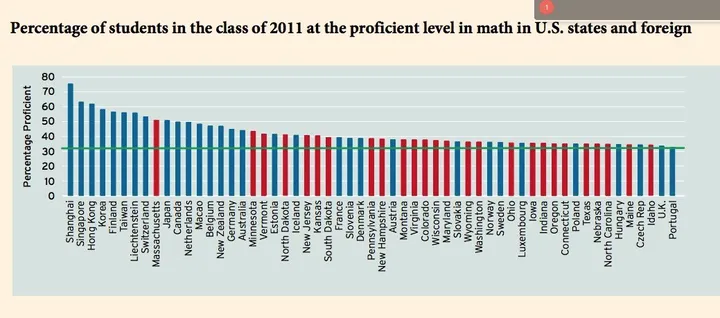
Instead of simply ranking the countries by mean PISA scores, the report was able to compare countries by the percentage of students deemed proficient by NAEP's standards.

The report hypothesized that since 32 percent of American students performed at the "proficient" level on NAEP's math exam, the same would hold true for PISA. So the authors calculated the score on PISA that would determine proficiency by NAEP standards and then calculated the percentage of students in each tested country that performed at or above that level.

Korea, Finland, Switzerland, Japan, Canada and the Netherlands all performed at a rate higher than 50 percent proficient by NAEP standards. The U.S., with its 32 percent proficiency rate, ended up ranking 32nd out of the 65 tested countries.

Of all 50 U.S. states, only Massachusetts had half or more of its students performing at or above the NAEP proficiency mark. Mississippi ranked lowest.

"If all the students in the United States were educated" at the same level as Massachusetts' students, Peterson noted, "this would not be such a problem."

Analyses of PISA scores show that white and economically privileged students in the U.S. outperform all other groups internationally -- a fact that is often used to claim that the consequences poverty and diversity are keeping many American students behind, and dragging down the country's composite scores. But Peterson said that while controlling for these factors boosts the U.S.'s relative standing, it still doesn't put the country's students close to the top.

For example, Peterson pointed to the difference in performance between the U.S. and Canada, which had 49 percent of its students test proficient in math. "It's a dramatic difference ... for two countries that appear to be at the same level of economic development," Peterson said.

When the report looked at the performance of white U.S. students in isolation, it found 42 percent them proficient -- still 25 percentage points lower than the proportion of all students in Finland and Korea deemed proficient.

Selecting for only the percentage of proficient U.S. students who came from households where at least one parent held a Bachelor's degree would have boosted the country's ranking to 16th place.

"There's a serious problem here, and it's not just [because of] some families [with] parents that aren't that well educated; it's not just that we have a minority population," Peterson said. "There's a much more general problem than that."

The purpose of the report, Peterson said, is to raise the alarm on the U.S.'s educational standing.

"It's unfair to our own students not to give them the skills required to compete in our modern society," he said.

The report concluded the U.S. could increase GDP growth per capita by enhancing its students' math skills. According to the report, over an 80-year period, gains from increasing the percentage of proficient students to Canadian or Korean levels could yield $75 trillion:

Increasing the percentage of proficient students to the levels attained in Canada and Korea would increase the annual U.S. growth rate by 0.9 percentage points and 1.3 percentage points, respectively. Since long-term average annual growth rates hover between 2 and 3 percentage points, that increment would lift growth rates by between 30 and 50 percent.

"Those who say that student math performance does not matter are clearly wrong," the report concludes.

FOLLOW HUFFPOST EDUCATION

U.S. students rank poorly in proficiency on both domestic and international math exams, a problem that could cost the country $75 trillion over 80 years, according to a new study. U.S. students fal...
 
 
  • Comments
  • 774
  • Pending Comments
  • 0
  • View FAQ
Comments are closed for this entry
View All
Favorites
Bloggers
Recency  | 
Popularity
Page: 1 2 3 4 5  Next ›  Last »  (17 total)
11:51 PM on 08/20/2011
Let me sum up:
As a people, you can still make great movies about Thor, but when it comes to actually wield or teach how to wield hammer and anvil with knowledge, this is so communist that you are afraid of. ;)
*kidding a bit*
04:54 PM on 08/19/2011
"US students do badly in world international maths competitions" and similar news headlines draws wrong conclusions to most people. I also thought not so highly of the maths ability of US students. But I personally know of my nephew's math ability at 14 at one of the nations elite private schools (this one in the Silicon valley). If you look at the ability in Maths and Science of students in places like Harker and Andover-Phillips academy and the caliber of US students going to MIT and Caltech, not to mention graduate school at Berkeley (science and engineering), you would also be sure that given the right salaries to teachers to retain and attract the best talent and given the right importance to academics, American students are second to none to anyone in the world.
12:25 AM on 08/20/2011
I absolutely agree that it's not about the kids. These kinds of tests must not be seen as a statement about "national, inherit intelligence".

They are just - and your example, IMO/ IMV points that out all too clearly - about allocation of resources. Of equal opportunity. The system, like you describe it and if I read in between the lines, depends on parents' achievements and economical status (even more than in my country Germany for example where this is also an issue of constant debate and political struggle to improve). As if kids were smarter just because their parents did make a small fortune.
So, I believe if you would pool all the money spent on public AND private school and invest that equally among all pupils (in well educated teachers, small classrooms, state-of-the-art books and equipment), the result on average will improve greatly. Overall, you will have more innovations.
07:37 PM on 08/21/2011
Kids are better able to do well in school when they're fed, not tired and have parents that talk to them. They do better in school when their parents make education a priority. They do better in school when they are exposed to museums and historical sites.
12:00 PM on 08/19/2011
Just to make clear, this study required a mapping of NAEP scores to PISA scores. Both tests are only representational (not taken by all students). One test was given to a subset of students while they were in 8th grade, the other was given to a different set of students (from the same graduating class) while they were in 10th grade. A couple points to make about that: first off, the difference in proficiency between the 8th and 10th grade can be enormous, even for the same kids, let alone from different representational samples. Second, about 30% of kids entering high school dont graduate with their peers. About a third of those (ie 10% overall, drop out before 10th grade). In theory that should have a positive impact on 10th grade scores, however, the flip side is that two-thirds of students who will eventually drop out are still there to be tested in 10th grade. It seems clear that would have a net depressant effect on scores.
cont'd..
12:02 PM on 08/19/2011
..cont'd..
I also find it concerning that there is an statement in the report that 'even the richest' states dont do well, and some examples of the 'richest' are New York, California and Florida. These states have some of the highest levels of minority and poverty concentrations around and have increasing charter populations, which is leading to increased segregation and poverty/minority concentrations. The report uses white scores as a way to try to dispel the claim that US subgroups score well. Despite the fact that whites are correlated to high income in many areas, there are many others where the exact opposite is true. I question why the Asian subgroup was not examined and I question why the word 'poverty' does not even show up once in this report.
Regardless, the report is descriptive more than prescriptive, so at least it is trying to identify the cost associated with some reality. Many of these same scholars have written studies that blame virtually all of this on teachers. I think it would be interesting to have a study of the impact of poverty on our education system, and thus our GDP. Having a good grasp of the input to our education system is necessary if we're going to try to assess why the output of that system is not as we would like.
This user has chosen to opt out of the Badges program
11:39 AM on 08/19/2011
IT IS NOT THAT OUR KIDS ARE TOO STUPID: IT IS THAT THEY DON'T CARE.

NOBODY LISTENS TO THE TRUTH. Our society is BUILT LIKE CRAP. It GLORIFIES IDIOCY. So STOP BLAMING "the kids" because they "are lazy" and start blaming the GIANT APPARATUS THAT TEACHES OUR CHILDREN TODAY: THE MEDIA.
photo
HUFFPOST SUPER USER
pukkita
some bio student
04:29 AM on 08/20/2011
you're so right :\
08:55 PM on 08/18/2011
A math problem to solve - High US birthrate + uncontrolled immigation - jobs = _____
07:47 PM on 08/18/2011
I notice some people posting that H1-B visa, issued for foreign national workers, is for driving down average wages and benefits.

I myself am a foreign national who received a Ph.D degree (materials science) in the states and have been working under the H1-B visa for some years (I am in the process of becoming a permanent resident), and the suggested notion sounded very alien to me. Especially I felt so since I have a good salary close to $100K with good benefits.

Another thing that I couldn’t help but comment on is the cost of higher education that some people perceive in some posts. Take my example (science/engineering major), during my 5 years at the graduate school, I didn’t pay any tuition but received yearly stipend over $20K, which is not much but still enough for a student to live with.

If you look at any decent research-oriented university in the states and their science/engineering Ph.D. programs, it is pretty much the same. American and foreign students alike, they will provide the tuition waiver and stipend if students are good enough.

But the situation is, in those science/engineering graduate programs, more than 50% of students are foreign nationals. I have noticed less and less American students over the years and the quality of incoming American students becoming somewhat not so good as before as well (at least in my program)...

Anyway, I just wanted to give some better information.
photo
Ayla87
Don't Delete Me Bro!
11:12 AM on 08/19/2011
I have to agree. I work in an IT staffing company that hires H1-B's as well as US citizens. The two H1's we have on payroll are currently paid upwards of $50/hr and they're superior to most of the other candidates (US or otherwise) in their field.
photo
Djay0252
America needs to Bless God
06:09 PM on 08/18/2011
Our social net work is breaking down along with family values. This country is on the way down.
HUFFPOST SUPER USER
cdecisneros
my micro bio is empty because I went to the micro
05:42 PM on 08/18/2011
The problem is that it is people who are good at math becomes teachers and the ones that I have had are not really good at teaching math. Doing great. Teaching not so much. It is like when Ted Williams was a manager. He was a great hitter but when it came to managing and having his players hit well they could not do it. He just expected them to be as great as he was. And math teacher expect their students to just understand math as easily as they did. I actually had a math teacher question a student about why he was taking notes. If you understand this you do not need notes. See, he wanted the student to be like him, Needless to say by the end of that semester there were only about 5 students left in that class. And no one dared ask him a question after the first few weeks because he would just embarass you instead of helping you.
photo
BeautifulOnDaOutside
I ♥ Huffington Post
04:33 PM on 08/18/2011
But isn't testing evil? Doesn't it just make the teachers teach to the tests, and cheat and stuff?
photo
HUFFPOST SUPER USER
Benjamin Sisko
Fortune favors the bold.
03:45 PM on 08/18/2011
This news should be shouted from every mountaintop. With the debt crisis over for the moment, it's time to look at some of the other factors -- which fly far below the radar -- that are placing this country in serious economic peril.
photo
HUFFPOST BLOGGER
Steve Nelson
03:16 PM on 08/18/2011
Perhaps this issue is a red herring. Many reports indicate that America produces a glut of highly trained mathematicians and engineers. This notion - that we are squandering our economic future by virtue of poor math scores - would be valid if, and only if, there were abundant jobs requiring those skills. We don't have enough jobs for young Americans with or without math skills. Although other nations may report higher scores, these statistics are misleading, as acknowledged in the article and by other comments. Our problems are poverty and lack of commitment to education, not poor teaching or pedagogy. Some of the nations that boast high math scores are sending those skilled young people into low paying vocations that make no use whatsoever of the allegedly strong mathematical ability they've acquired.
photo
BeautifulOnDaOutside
I ♥ Huffington Post
04:41 PM on 08/18/2011
I'm a physicist, and I do math as entertainment, but mediocre math scores for most of the public are just not that big a problem. Certainly not a trillion dollar a year problem as this article claims.
photo
cmmerkel
If cars could run on cognitive dissonance ...
03:27 PM on 08/19/2011
I think the issue is more related to analytical thinking than "math skills". I am a chemist and I do math every day (both for fun as well as for work). Mediocre math scores are indicative (not a complete correlation but it is probably strong) of ability to analyze a problem and think your way through to an answer. Of course analytical skills are also indicated by the ability to read, analyze and formulate a response to something written.
photo
HUFFPOST SUPER USER
Gary Libby
02:44 PM on 08/18/2011
We need to seriously look at math instruction in other countries and ask ourselves why we keep doing the same ol' same ol'. State governments need to seriously review the PISA. We are one of the few countries that still emphasize the procedure over number sense and reasoning. Time to move out of the early twentieth century.
photo
HUFFPOST SUPER USER
pukkita
some bio student
04:27 AM on 08/20/2011
perhaps it's the xbox and facebook
02:22 PM on 08/18/2011
In the US we keep people who might otherwise drop out of high school, in high school even if they are not good at math. We still produce outstanding math students in line with our international competition. For example, Massachusetts students score just as high as the top international scores. Because MA invests in its students' education. Places like Mississippi don't care about their kids and spend a pittance and their scores drag the rest of us down.
photo
HUFFPOST SUPER USER
pukkita
some bio student
04:28 AM on 08/20/2011
... and texas.. rick perry cuts funds for education.. that sakdfjsdwbdsgbsdjghbsdjgb ucker. sorry :|
12:23 PM on 08/18/2011
Teach people HOW to think, not WHAT to think.
HUFFPOST SUPER USER
kidcat24
Capital is only the fruit of labor. Lincoln
01:37 PM on 08/18/2011
I do that when I help my children with their homework
photo
HUFFPOST SUPER USER
Gary Libby
02:39 PM on 08/18/2011
Well said. The PISA test mathematical reasoning, not just arithmetic.
HUFFPOST SUPER USER
kidcat24
Capital is only the fruit of labor. Lincoln
12:03 PM on 08/18/2011
Here is a comparison of public and private school. Both of my children go to public school and my daughter's boyfriend goes to private school. Both of my children have summer homework in Math, Science, and Language Arts. My daughters boyfriend, no homework at all.
photo
BeautifulOnDaOutside
I ♥ Huffington Post
04:48 PM on 08/18/2011
Wait. Somehow you are claiming that private schools are to blame for poor US math tests?