iPhone app iPad app Android phone app Android tablet app More

Sea Lice From Farmed Salmon Infect Wild Salmon After All, Says New Study

Sea Lice Farmed Salmon

The Huffington Post   First Posted: 08/24/11 06:07 PM ET Updated: 10/24/11 06:12 AM ET

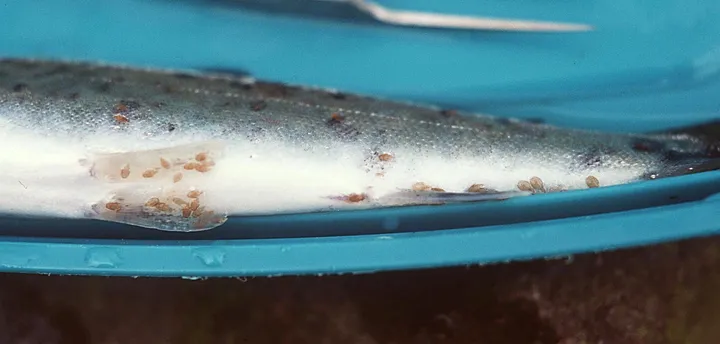
Farmed salmon present a serious threat to the survival of wild salmon stocks in the form of tiny sea lice, according a new study by Martin Krkosek of the University of Otago in New Zealand. He and his team of researchers have been studying sea lice and salmon for years, and have made headlines in the past for demonstrating the link between sea lice in farmed salmon and spillover infection of wild salmon -- and the latest study is their most unequivocal yet.

That link is much-disputed, but the stakes are high. Some have said that, if sea louse infections continue to spread, they could lead to mass extinctions among wild salmon. A fully grown salmon can survive a sea louse infection with relatively superficial injuries to gills, fins and skin. But just two or three of the critters can cause enough damage to kill a juvenile salmon. Infestations have been known to result in 80% mortality in stocks of wild juvenile salmon.

Wild salmon do naturally get sea lice. But it is rare, in the wild, for their prevalence to be high enough to cause a mass outbreak. It's only in the close quarters of aquaculture that sea lice often grow exponentially. As one paper on the topic puts it, "crowded conditions facilitate parasite and disease transmission within the farm, and enable exponential population growth of pathogens and release to the surrounding environment."

The fish farming industry has been slow to accept the idea that its activities could be harming wild salmon. But even if the industry, biologists and regulators all agree that the threat is real, it's a unclear what the solution would be.

There is a drug, Slice, that is an effective antidote to sea lice, but some believe it could be environmentally deleterious and encourage drug resistance among sea lice. (According to Krkosek, many sea lice have already developed resistance to Slice in Norway and New Brunswick.) One helpful change would be the universal adoption of closed containment systems for salmon farming, and the tapering-off of net farming. But that could drive up the price for the farmed meat and present technical challenges.

More globally, as Krkosek told the Huffington Post in an e-mail, it may be necessary to shift aquaculture away from carnivorous fish like salmon and towards vegetarian fish like tilapia. "Carnivores like salmon yield a net loss of fish supply because they require large inputs of wild fish in the feed," he said.

News stories like this, on the challenges and risks presented by, it seems, every kind of fish, can make it seem choosing sensible seafood daunting. But the Monterey Bay Aquarium Sustainability Guide, though it has its detractors, remains generally reliable. It acknowledges the difference between salmon farmed in nets, which it recommends avoiding, and those farmed in tanks, which it endorses.

FOLLOW HUFFPOST FOOD


  • Comments
  • 31
  • Pending Comments
  • 0
  • View FAQ
Comments are closed for this entry
View All
Favorites
Recency  | 
Popularity
Page: 1 2  Next ›  Last »  (2 total)
07:13 PM on 08/30/2011
My way of putting it is to say: any reasonable person who Googles fish farm science will find it is ten feet deep saying that farms need to be on-land in closed containers. I have made this opinion directly to a major Norwegian derivative fish farm, Cermaq/Mainstrean, and there was nothing they could say in return.

Look at www.catchsalmonbc.com for an uptodate article on fish farm disease in BC, Canada. I have written on fish policy issues for almost two decades.

DC Reid
11:17 PM on 08/27/2011
Stop treating this like some sort of revelation. This is nothing new. Scientists have been telling us this for years. Governments have just chosen to ignore the facts.
photo
Iam12Vote
Now With MORE Micro Bio!
09:26 PM on 08/27/2011
Another failure of mono crop farming. It doesn't work. Period.
photo
artleads
Let's have a national retreat.
09:26 PM on 08/28/2011
Best thing is to not deplete or mess up the wild in the first place. I had hoped that farming could be a solution to depleted wild stock (a desperate measure), but it appears not to be the case.
photo
Iam12Vote
Now With MORE Micro Bio!
09:53 PM on 08/28/2011
Exactly so. We already have a perfect solution developed at no cost to us over millions of years if we just live within our means.
This user has chosen to opt out of the Badges program
photo
kareemachan
watashi ha tororu ga oroka da to omoi masu。
04:55 PM on 08/27/2011
This is nothing new, but still very important. I don't buy farmed seafood. Ever.
02:59 PM on 08/26/2011
Presently, over 84% of the seafood consumed in the United States is imported (about half of which is farmed) and more than HALF OF ALL SEAFOOD CONSUMED GLOBALLY is the product of aquaculture. Because of global demand, aquaculture is an essential source of protein for most of the world. Aquaculture can be done properly or improperly, but please don't throw out the baby with the bath water. Also, if everyone "only ate wild salmon," there would be no wild salmon or it would be $50/pound. What do you tell the working mother of three who would like her children to benefit from omega-3 fatty acids? "Sorry, you're not rich enough to enjoy wild salmon, but we won't allow it to be farmed either."

Read statistics from NOAA (http://www.st.nmfs.noaa.gov/st1/fus/fus09/index.html) or the United Nations (http://www.fao.org/fishery/sofia/en). Learn about the huge benefits that properly-sited, managed, and monitored aquaculture offers or most everyone on the planet.
photo
HUFFPOST SUPER USER
BuckoForce
07:30 PM on 08/25/2011
Sounds appetizing. Farmed fish are hugely problematic. Anybody who has owned an aquarium knows that if the water and filters are not maintained, things get bad quickly. Also, countries like China and southeast Asian countries have sub-par standards. China was recently caught putting melamine in fish feed, which means the flesh of the fish is basically toxic. There is a fish being sold as Swai and Basa in the US, that is grown in the filthy waters of the Mekong river. Sure it is cheap, but always remember "garbage in, garbage out."
photo
Newfoundlander
I'm a pessimist, an optimist with experience!
03:42 PM on 08/25/2011
I remember fly-fishing for salmon back home 30 years ago, and catching fresh-run fish with a few sea-lice on them, but if the fish had been in fresh water for a while the sea-lice would drop off.
09:25 PM on 09/01/2011
i can only imagine how sublime it is/was to hook into an atlantic salmon on the fly in newfoundland
photo
HUFFPOST SUPER USER
Karl Wilder
Chef Stirring The Pot Harlem
02:34 PM on 08/25/2011
I have never been a fan of fish farming. I would only eat wild salmon or fresh caught Tilapia.
photo
HUFFPOST SUPER USER
BuckoForce
07:32 PM on 08/25/2011
It is always wise to look where the seafood is from. I wouldn't trust much outside the US and Canada. It is cheap for a reason.
09:26 PM on 09/01/2011
wow, I thought all commercial tilapia was farmed
photo
HUFFPOST SUPER USER
Max Shaw
My micro-bio is no longer empty.
01:14 PM on 08/25/2011
Eww. I had no idea that sea-lice was a real thing and am quite disgusted by the notion.
photo
HUFFPOST SUPER USER
Robert Turner
News? I hurt the news.
11:02 AM on 08/25/2011
Oh, yeah. I remember when my little minnow had sea lice. Got to stay home a whole week from school and play Wii.
08:34 AM on 08/25/2011
another reason why they should not farm pacific strains of salmon in the or near the ocean.
photo
HUFFPOST SUPER USER
pepper1311
POGS are dirt
08:13 AM on 08/25/2011
I'm a farmer and this greed. You just need simple math to know your maximum of anything to raise. Farm raised fish are fine as long it used for dog food.
photo
Parkite
Still haven't found what I'm looking for
09:23 PM on 08/27/2011
I have more regard for my dog than to feed her farmed fish.
06:30 AM on 08/25/2011
Man does not need to try and improve on mother nature. Mother nature has been taking care of the world better than man will ever do. Man is a destructive force, every time man tries to improve on anything in nature, something bad ALWAYS happens. Salmon are born wild, let them be wild.
Wild salmon works in other ways in the scheme of mother nature. Wild salmon give nutrients to the streams and lakes when they come to spawn and die off. They feed other wild life, like bears, eagles, fox and other animals. For me, personally, I never, never, eat a farm raised salmon, catfish, shrimp, talapia. I always ask the grocer where their seafood comes from and if they say farm raised, i tell them "no thanks".
This user has chosen to opt out of the Badges program
photo
TaurusRose
just gimme some truth
02:25 AM on 08/25/2011
Try getting to that pending!
photo
HUFFPOST SUPER USER
KennytheRTiger
01:09 AM on 08/25/2011
Just shave it off.