iPhone app iPad app Android phone app Android tablet app More

For Recent Graduates, Starting Salaries Declined Over Past Decade

First Posted: 09/02/2011 1:37 pm Updated: 11/02/2011 5:12 am

NEW YORK -- For Kate Johnson, any job felt better than no job at all.

Shortly after graduating from the University of Wisconsin-Madison, Johnson opened up her laptop and began a months-long quest to find work.

Over the course of the summer, while Johnson applied to nearly 50 different jobs, she only ever heard back from eight potential employers. Of the eight, seven rejected her on the spot.

But more difficult than the chronic rejection, Johnson learned to steel herself against the more likely response of no response at all. By the time an Ivy League university offered Johnson an entry-level editorial position, she leapt at the opportunity.

While the starting salary paid less she had originally envisioned, it was an offer Johnson couldn't afford to pass up.

"Searching for a job in this climate was like living through a vast wasteland of rejection," said Johnson, 22, who majored in English and now owes about $22,000 in student loans. "No one understands how truly bad it is out there."

Even with a job, Johnson is hardly the only recent graduate now suffering a wage shock.

A study released earlier this week by the Economic Policy Institute, a liberal research and policy center, found that entry-level wages for 2010 college graduates were about a dollar per hour lower than what their peers were earning a decade prior after adjusting for inflation.

"Entry-level wages of college graduates have fallen," said Lawrence Mishel, a labor market economist and president of EPI. "People coming out of college now are getting jobs that pay less than what older brothers and sisters got when they finished college."
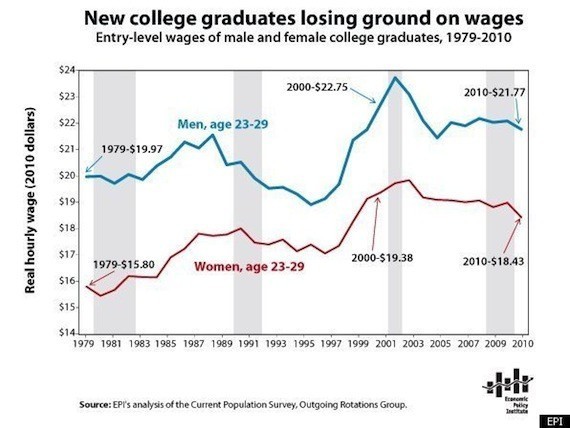
Although entry-level hourly wages saw gains during the 1980s and 1990s, the past decade was far less kind to younger, college-educated workers. Since 2000, the report found that wages for recent graduates have deteriorated, despite national policies advocating for greater numbers of college graduates to fill an overabundance of positions requiring at least a college degree.

"As everybody knows, when there's a shortage, the price goes up," said Mishel. "The claim that there's been an increased shortage of college graduates is not borne out according to the lower wages they've earned."

Further, between 2000 and 2010, gaps according to gender persisted. In 2010, the report found that college-educated men made an average hourly wage of $21.77, down 4.5 percent from the $22.75 they would have made in 2000. For college-educated women, entry-level wages averaged $18.43 in 2010, while the same women might have expected to make 5.2 percent more, or $19.38, a decade prior. (All wages are in 2010 dollars.)

But despite recent wage stagnation, college educated workers have weathered the Great Recession far better than their lesser-educated peers.

Carl E. Van Horn, a professor of public policy and director of the John J. Heldrich Center for Workforce Development at Rutgers University, still sees a "huge premium" for college-educated workers when compared to young workers clamoring for a job with only a high school diploma.

"In an economy like the one we're living in, there really are no safe havens -- even for college graduates," said Van Horn, who sees even recent graduates falling victim to the same wage stagnation now affecting many Americans. "Everyone needs to calibrate, to readjust their expectations to meet the harsh realities that show little sign of letting up."

For rising seniors starting their final year of college, Van Horn suggests that students pursue internships related to their major and chosen vocation, in addition to taking courses that might contribute to their future employability.

"Now's definitely not the year to decide to slack off, or to enroll in a class based on the fact that you don't want to go to any morning classes," said Van Horn. "You have to be careful and thoughtful in an economy like this one. The competition is really very tough."

While the EPI report hardly indicated that it's no longer worth going to college, Mishel cautioned that a college degree is increasingly looking like less of a guaranteed ticket to the middle class.

In terms of duration, the report's conclusion didn't mince words: "With unemployment expected to remain above 8 percent well into 2014, it will likely be many years before young college graduates -- or any workers -- see substantial wage growth."

Mishel mentioned that graduates who finish college during periods of economic recession tend to earn less not just in their first jobs out of school, but over the duration of their entire working lives.

"Given the high, persistent unemployment rate, this is going to create a permanent scar for these young people," said Mishel. "We're looking at a whole generation beset by these problems."

FOLLOW HUFFPOST COLLEGE


  • Comments
  • 96
  • Pending Comments
  • 0
  • View FAQ
Comments are closed for this entry
View All
Favorites
Recency  | 
Popularity
Page: 1 2 3  Next ›  Last »  (3 total)
HUFFPOST SUPER USER
CaliforniaMitch
09:32 PM on 09/05/2011
Do you really think I need an article to tell me this? Wages, if you can even get a job, are down for everyone. The boys at the top have hitched their wagons to a very rich star and are keeping the lions share of the profits for themselves. The American worker, and that is stating a disappearing fact, had better get used to the lower wages because the corporations have got the country in their back pocket.
photo
Scholastica8
RINOS & Bull-Mooses UNITE! People Matter!
02:50 AM on 09/05/2011
I really have to comment on those entry level salaries of college graduates in 1979. Those figures are averages. First, are those only graduates with BAs or BSs? Do they include MAs, PhDs?.. if it was the graduates 1st real job?

Even if it is Bachelors, there are degrees that get very high entry level salaries. Those counter a far higher number much lower entry salaries

I graduated with a BA in 1976. My starting salary after college was minimum wage... $3.50/hr. I entered my field at the bottom... my degree got me in the door. That was all. I worked minimum wage for 2 years. Then jumped up to $7.50/hr. By the late 1980s, I was $27/hr. My last job, same type position... I was back down to $23/hr.
07:24 PM on 09/04/2011
I graduated with an English major 10 years ago and made $35K as a receptionist in NYC.
I went to college a second time, to be in the medical field, and am earning about double that now as a "new grad" in my new field.
11:10 AM on 09/04/2011
I graduated in 2009, I volunteer at two places and I am hoping to go to graduate school. I wish I was making a salary...
07:12 PM on 09/03/2011
almost all of our relationships begin and most of them continue as forms of mutual exploitation, a mental or physical barter, to be terminated when one or both parties run out of goods.
11:09 PM on 09/02/2011
Students are leaving college knowing less and less about anything practical and more and more about why society is unfair and needs to be rebuilt. Maybe they deserve less. Oh, and women are graduating at greater rates than men so according to college knowledge they obviously would get paid as much as they use to.
photo
HUFFPOST SUPER USER
rda1911a1
God Bless John Browning
09:43 PM on 09/02/2011
All I can say is my income this year is on pace to be the highest I have ever earned pacing 150K so far this year due to the lack of trained staff at work. getting waaay big overtime
09:40 PM on 09/02/2011
"Remember graduates, this is all your fault! You were told all your life to stay in school, and you would succeed. You were told to go to college and finish. And you listened! Its all your fault.You want a job so you can buy a house and start a family? How entitled are you?

You should have followed the baby boomer model. Have the good fortune to be born during America's golden age, and then spend the rest of your life making the world cater to your whims. And then, call everybody before you a conformist, and everybody born after you lazy."

-Anybody born between 1945 and 1960
photo
Scholastica8
RINOS & Bull-Mooses UNITE! People Matter!
02:58 AM on 09/05/2011
I was born in 1953 and my parents were far from conformists. I consider those born before me to have been creative and frugal (they survived the Depression), brave and stubborn (they slogged through WW2)... if they wanted to be conformist after what amounted to 3 decades of hell, then all power to them.

As for those born after me. I sometimes wish they understood the importance of writing well... and the confusion that email and texting can sometimes cause.... but they are far from lazy. My young neighbor has worked since he was 16... put himself through college, while working 2 jobs. Because he's such a reliable, good worker, jobs came easily until last year. Now he is in a job he does not like, so what is he doing? He's starting a photography business on the side.

Therefore.... it is not wise to stereotype either those whom you judge to be conformists or lazy or suppose what all Boomers may think.
This user has chosen to opt out of the Badges program
06:29 PM on 09/13/2011
u mad?
photo
Justtheobvious
Res-erected.
08:36 PM on 09/02/2011
If only we gave corporations more negative taxes, this wouldn't be a problem.
HUFFPOST SUPER USER
bgofca
07:56 PM on 09/02/2011
of course, that is how the repugs planned it all; making a cheaper workforce for their real base, the wealthy and corporations.
11:38 PM on 09/03/2011
I agree. The Republicans told people to major in areas like Gender Studies,Sociology,and English.That's because they didn't want their kids to have competition when they tool double e and petroleum engineering.I'm sure people like you could have taken intellectually tough majors,but 'clouds got in your way'
How's the weather in your parents' basement?
11:39 PM on 09/03/2011
COrwin. ONly being cruel to be Kind.
photo
HUFFPOST SUPER USER
pepper1311
POGS are dirt
06:44 PM on 09/02/2011
I would say, go t trade school. It's not bad getting your hands dirty. Benefit ?
Money
photo
44jupiter
Okay, where's the damn ice?
05:56 PM on 09/02/2011
Is that Warner Huntington III from Legally Blonde?
This user has chosen to opt out of the Badges program
photo
05:36 PM on 09/02/2011
This article omits mention of that 1995-2000 upswing on the charts. Those are the years of the Dot Com Bubble. Remember that? Fresh college grads were benefiting. Veteran job holders left good jobs for better jobs and Beamers and Porsches prevailed in the Dot Com parking lots.

For the past thirty years or so, college students have graduated into a world that didn't exist when they began their freshman year. Technology has been on an accelerating curve that has outpaced the ability of undergrad curricula to address. Generally, high tech/biotech industries are looking for qualifications that require grad school products, not undergrads. What's left is a workplace that's increasingly optimized by computerized, automated systems that replace many human jobs or simplify the entry-level jobs enough to avoid high wages.
HUFFPOST SUPER USER
koelschwolf
05:02 PM on 09/02/2011
Those sheep skins were overrated anyhow, to wit: some time ago I talked to a soon-to-graduate-student who majored in Geology and was looking around for job. I asked him what he could expect
as a starting salary and he replied "75000$". Mind you thats only theoretical experience no hands on expertise.
...... DUH
This user has chosen to opt out of the Badges program
photo
05:41 PM on 09/02/2011
Earth Sciences, aside from Petroleum Engineering, hasn't ever been that lucrative for fresh undergrad sheep skins. Grad school has been the track toward that income level. Entry-level faculty might get that much--after a Ph.D.
06:56 PM on 09/02/2011
But,diffidently, I point out,he learned something of value when in college.75 k is far below the average starting salary in petroleum fields.
Sorry
This user has chosen to opt out of the Badges program
photo
loco48
TRUTH trumps ideology!
04:55 PM on 09/02/2011
The signs are every where. The republicans and thier owners, the corporations, will drive down wages for all working americans. The goal is to lower wages to india , china levels or close. All of these average americans who keep voting for them will see the effect on their livleyhood in the near future. First out source the jobs over seas, then bust the unions, then next take this wage or leave it. There are plenty of americans waiting in line if you don't want this minimum wage job. I have been seeing this same comment on RW post.
09:00 PM on 09/02/2011
Hernnstein and Murray postulated the most important factor in the 21 st century would be IQ.There is a split between the population based on brain power.This is why the collapse of gov't jobs is so frightening to so many
When one has no leverage or job skills ("I've been in the private sector,Venkman.They expect results there." ) ,a gov't /unionized job is by far the best paying one can have.One can't deny it's sad.Still,it's evolution in naction
This user has chosen to opt out of the Badges program
photo
loco48
TRUTH trumps ideology!
10:26 PM on 09/02/2011
I have worked in the private sector all of my life and IQ ain't worth a dime if you are not capable of critical thinking. Brain power has always been a gate for success long before the 21st century. But sucessfull smart people some times can let their ego and arrogance overide thier humanity. And union jobs are not by far the highest paying jobs. Before I retired, I would have to take a pay cut to work for any union, einstein.