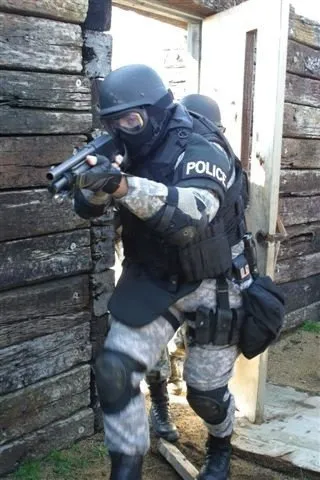
New York magazine reported some telling figures last month on how delayed-notice search warrants -- also known as "sneak-and-peek" warrants -- have been used in recent years. Though passed with the PATRIOT Act and justified as a much-needed weapon in the war on terrorism, the sneak-and-peek was used in a terror investigation just 15 times between 2006 and 2009. In drug investigations, however, it was used more than 1,600 times during the same period.
It's a familiar storyline. In the 10 years since the terror attacks of September 11, 2001, the government has claimed a number of new policing powers in the name of protecting the country from terrorism, often at the expense of civil liberties. But once claimed, those powers are overwhelmingly used in the war on drugs. Nowhere is this more clear than in the continuing militarization of America's police departments.
POLICE MILITARIZATION BEFORE SEPTEMBER 11
The trend toward a more militarized domestic police force began well before 9/11. It in fact began in the early 1980s, as the Regan administration added a new dimension of literalness to Richard Nixon's declaration of a "war on drugs." Reagan declared illicit drugs a threat to national security, and once likened America's drug fight to the World War I battle of Verdun. But Reagan was more than just rhetoric. In 1981 he and a compliant Congress passed the Military Cooperation with Law Enforcement Act, which allowed and encouraged the military to give local, state, and federal police access to military bases, research, and equipment. It authorized the military to train civilian police officers to use the newly available equipment, instructed the military to share drug-war–related information with civilian police and authorized the military to take an active role in preventing drugs from entering the country.
A bill passed in 1988 authorized the National Guard to aid local police in drug interdiction, a law that resulted in National Guard troops conducting drug raids on city streets and using helicopters to survey rural areas for pot farms. In 1989, President George Bush enacted a new policy creating regional task forces within the Pentagon to work with local police agencies on anti-drug efforts. Since then, a number of other bills and policies have carved out more ways for the military and domestic police to cooperate in the government's ongoing campaign to prevent Americans from getting high. Then-Secretary of Defense Dick Cheney declared in 1989, "The detection and countering of the production, trafficking and use of illegal drugs is a high priority national security mission of the Department of Defense."
The problem with this mingling of domestic policing with military operations is that the two institutions have starkly different missions. The military's job is to annihilate a foreign enemy. Cops are charged with keeping the peace, and with protecting the constitutional rights of American citizens and residents. It's dangerous to conflate the two. As former Reagan administration official Lawrence Korb once put it, "Soldiers are trained to vaporize, not Mirandize." That distinction is why the U.S. passed the Posse Comitatus Act more than 130 years ago, a law that explicitly forbids the use of military troops in domestic policing.
Over the last several decades Congress and administrations from both parties have continued to carve holes in that law, or at least find ways around it, mostly in the name of the drug war. And while the policies noted above established new ways to involve the military in domestic policing, the much more widespread and problematic trend has been to make our domestic police departments more like the military.
The main culprit was a 1994 law authorizing the Pentagon to donate surplus military equipment to local police departments. In the 17 years since, literally millions of pieces of equipment designed for use on a foreign battlefield have been handed over for use on U.S. streets, against U.S. citizens. Another law passed in 1997 further streamlined the process. As National Journal reported in 2000, in the first three years after the 1994 law alone, the Pentagon distributed 3,800 M-16s, 2,185 M-14s, 73 grenade launchers, and 112 armored personnel carriers to civilian police agencies across America. Domestic police agencies also got bayonets, tanks, helicopters and even airplanes.
All of that equipment then facilitated a dramatic rise in the number and use of paramilitary police units, more commonly known as SWAT teams. Peter Kraska, a criminologist at the University of Eastern Kentucky, has been studying this trend since the early 1980s. Kraska found that by 1997, 90 percent of cities with populations of 50,000 or more had at least one SWAT team, twice as many as in the mid-1980s. The number of towns with populations between 25,000 and 50,000 with a SWAT team increased 157 percent between 1985 and 1996.
As the number of SWAT teams multiplied, their use expanded as well. Until the 1980s, SWAT teams were used almost exclusively to defuse immediate threats to the public safety, events like hostage takings, mass shootings, escaped fugitives, or bank robberies. The proliferation of SWAT teams that began in the 1980s, along with incentives like federal anti-drug grants and asset forfeiture policies, made it lucrative to use them for drug policing. According to Kraska, by the early 1980s there were 3,000 annual SWAT deployments, by 1996 there were 30,000 and by 2001 there were 40,000. The average police department deployed its SWAT team about once a month in the early 1980s. By 1995, it was seven times a month. Kraska found that 75 to80 percent of those deployments were to serve search warrants in drug investigations.
TERROR ATTACKS BRING NEW ROUND OF MILITARIZATION
The September 11 attacks provided a new and seemingly urgent justification for further militarization of America's police departments: the need to protect the country from terrorism.
Within months of the attacks on the Pentagon and World Trade Center, the Office of National Drug Control Policy began laying the groundwork with a series of ads (featured most prominently during the 2002 Super Bowl) tying recreational drug use to support for terrorism. Terrorism became the new reason to arm American cops as if they were soldiers, but drug offenders would still be their primary targets.
In 2004, for example, law enforcement officials in the New York counties of Oswego and Cayuga defended their new SWAT teams as a necessary precaution in a post–September 11 world. “We’re in a new era, a new time," here,” one sheriff told the Syracuse Post Standard. “The bad guys are a little different than they used to be, so we’re just trying to keep up with the needs for today and hope we never have to use it.” The same sheriff said later in the same article that he'd use his new SWAT team “for a lot of other purposes, too ... just a multitude of other things." In 2002, the seven police officers who serve the town of Jasper, Florida -- which had all of 2,000 people and hadn’t had a murder in more than a decade -- were each given a military-grade M-16 machine gun from the Pentagon transfer program, leading one Florida paper to run the headline, “Three Stoplights, Seven M-16s.”
In 2006 alone, a Pentagon spokesman told the Worcester, Massachusetts Telegram & Gazette, the Department of Defense "distributed vehicles worth $15.4 million, aircraft worth $8.9 million, boats worth $6.7 million, weapons worth $1 million and 'other' items worth $110.6 million" to local police agencies.
In 2007, Clayton County, Georgia -- whose sheriff once complained that the drug war was being fought like Vietnam, and should instead be fought more like the D-Day invasion at Normandy -- got its own tank through the Pentagon's transfer program. Nearby Cobb County got its tank in 2008. In Richland County, South Carolina, Sheriff Leon Lott procured an M113A1 armored personnel carrier in 2008. The vehicle moves on tank-like tracks, and features a belt-fed, turreted machine gun that fires .50-caliber rounds, a type of ammunition so powerful that even the military has restrictions on how it's used on the battlefield. Lott named his vehicle "The Peacemaker." (Lott, is currently being sued for sending his SWAT team crashing into the homes of people who appeared in the same infamous photo that depicted Olympic gold-medalist swimmer Michael Phelps smoking pot in Richland County.) Maricopa County, Arizona, Sheriff Joe Arpaio also has a belt-fed .50-caliber machine gun, though it isn't connected to his armored personnel carrier.
After 9/11, police departments in some cities, including Washington, D.C., also switched to battle dress uniforms (BDUs) instead the traditional police uniform. Critics says even subtle changes like a more militarized uniform can change both public perception of the police and how police see their own role in the community. One such critic, retired police sergeant Bill Donelly, wrote in a letter to the editor of the Washington Post, "One tends to throw caution to the wind when wearing ‘commando-chic’ regalia, a bulletproof vest with the word ‘POLICE’ emblazoned on both sides, and when one is armed with high tech weaponry."
Departments in places like Indianapolis and some Chicago suburbs also began acquiring machine guns from the military in the name of fighting terror. Massachusetts Governor Deval Patrick actually suspended the Pentagon program in his state after the Boston Globe reported that more than 80 police departments across the state had obtained more than 1,000 pieces of military equipment. "Police in Wellfleet, a community known for stunning beaches and succulent oysters, scored three military assault rifles," the Globe reported. "At Salem State College, where recent police calls have included false fire alarms and a goat roaming the campus, school police got two M-16s. In West Springfield, police acquired even more powerful weaponry: two military-issue M-79 grenade launchers."
September 11 also brought a new source of funding for military-grade equipment in the Department of Homeland Security. In recent years, the agency has given anti-terrorism grants to police agencies across the country to purchase armored personnel carriers, including such unlikely terrorism targets as Winnebago County, Wisconsin; Longview, Texas; Tuscaloosa County, Alabama; Canyon County, Idaho; Santa Fe, New Mexico; Adrian, Michigan; and Chattanooga, Tennessee. When the Memphis suburb of Germantown, Tennessee -- which claims to be one of the safest cities in the country -- got its APC in 2006, its sheriff told the local paper that the acquisition would put the town at the "forefront" of homeland security preparedness.
In Eau Clare County, Wisconsin, government officials told the Leader Telegram that the county's new APC would mitigate "the threat of weapons or explosive devices." County board member Sue Miller added, "It’s nice, but I hope we never have to use it." But later in the same article, Police Chief Jerry Matysik says he planned to use the vehicle for other purposes, including "drug searches." It may not be necessary, Matysik said, "But because it’s available, we’ll probably use it just to be cautious."
The DHS grants are typically used to purchase the Lenco Bearcat, a modified armored personnel carrier that sells for $200,000 to $300,000. The vehicle has become something of a status symbol in some police departments, who often put out press releases with photos of the purchase, along with posing police officers clad in camouflage or battle dress uniforms.
HuffPost sent a Freedom of Information Act request to the Department of Homeland Security asking just how many grants for the vehicles have been given out since September 11, how much taxpayer money has been spent on them, and which police agencies have received them. Senior FOIA Program Specialist Angela Washington said that this information isn't available.
The post-September 11 era has also seen the role of SWAT teams and paramilitary police units expand to enforce nonviolent crimes beyond even the drug war. SWAT teams have been used to break up neighborhood poker games, sent into bars and fraternities suspected of allowing underage drinking, and even to enforce alcohol and occupational licensing regulations. Earlier this year, the Department of Education sent its SWAT team to the home of someone suspected of defrauding the federal student loan program.
Kraska estimates the total number of SWAT deployments per year in the U.S. may now top 60,000, or more than 160 per day. In 2008, the Maryland legislature passed a law requiring every police department in the state to issue a bi-annual report on how it uses its SWAT teams. The bill was passed in response to the mistaken and violent SWAT raid on the home of Berwyn Heights, Maryland mayor Cheye Calvo, during which a SWAT team shot and killed his two black labs. The first reports showed an average of 4.5 SWAT raids per day in that state alone.
Critics like Joseph McNamara, who served as a police chief in both San Jose, California, and Kansas City, Missouri, worry that this trend, now driven by the war on terror in addition to the war on drugs, have caused police to lose sight of their role as keepers of the peace.
"Simply put, the police culture in our country has changed," McNamara wrote in a 2006 article for the Wall Street Journal. "An emphasis on 'officer safety' and paramilitary training pervades today's policing, in contrast to the older culture, which held that cops didn't shoot until they were about to be shot or stabbed." Noting the considerable firepower police now carry, McNamara added, "Concern about such firepower in densely populated areas hitting innocent citizens has given way to an attitude that the police are fighting a war against drugs and crime and must be heavily armed."
In 2009, stimulus spending became another way to fund militarization, with police departments requesting federal cash for armored vehicles, SWAT armor, machine guns, surveillance drones, helicopters, and all manner of other tactical gear and equipment.
Like McNamara, former Seattle Police Chief Norm Stamper finds all of this troubling. "We needed local police to play a legitimate, continuing role in furthering homeland security back in 2001," says Stamper, now a member of Law Enforcement Against Prohibition. "After all, the 9/11 terrorist attacks took place on specific police beats in specific police precincts. Instead, we got a 10-year campaign of increasing militarization, constitution-abusing tactics, needless violence and heartache as the police used federal funds, equipment, and training to ramp up the drug war. It's just tragic."