NYR More

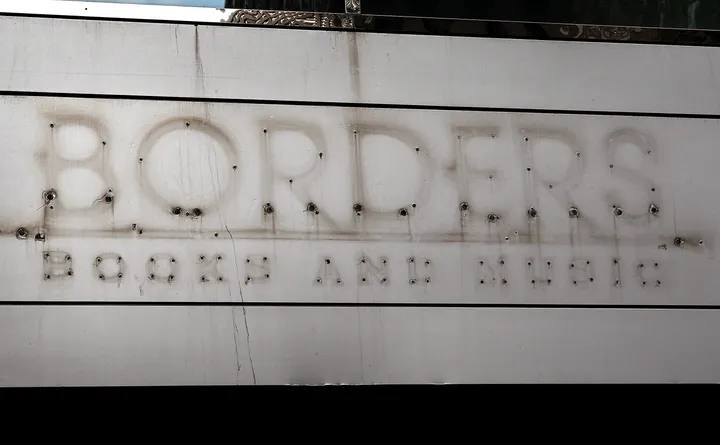
As Its Final Stores Close, We Ask: What Happened To Borders?

What Happened To Borders

First Posted: 09/16/11 10:29 AM ET Updated: 09/16/11 11:04 AM ET

The final 31 Borders stores across 18 states will close on Sunday, ending the story of what was once one of the largest book retailers in the world.

Six years ago, according to Bloomberg, the Ann Arbor-based company had more than 1,200 stores, including branches in the UK, Australia and Singapore. At the time of its announced closure in July of this year, 399 stores were still in operation, providing work for approximately 10,700 employees.

Borders was founded in 1971 by Tom and Louis Borders, University of Michigan graduates who took over an 800-sq foot used bookstore. Publisher Peter Osnos wrote on The Atlantic website that part of their unique offering was that they had developed "an inventory tracking system that, by the standards of the time, was as sophisticated as computers allowed." Ironically, it was the company's inability to adapt fast enough to the growth of online commerce that contributed to its downfall.

In 1991, Borders was sold by its founders to Kmart, who already owned the book chain Waldens, for $125m. The group was later spun off from the firm and floated on the stock exchange in 1995.

The company's final CEO, Mike Edwards, told the Detroit News that "I thought we'd acquire Barnes & Noble or they'd acquire us. I didn't think the two stores could operate independently."

Edwards, who walked away with a severance check worth $125,000, said that working at the company in it final days "was like finding out your best friend has cancer and there's nothing you can do. We were in perpetual crisis."

He cited many of the company's problems as stemming from decisions by previous CEOs, of which there were several in its final decade, to expand its network of stores while not focusing enough on the growing appetite of consumers for online shopping. According to the Wall Street Journal, its own online business was even being run by its leading competitor, Amazon, right up until 2008.

Although the company is all but dead, the name "Borders" may not disappear. Various assets, including the name itself, were sold at auction on Wednesday for $15.775m, subject to bankruptcy court approval.

While the bankruptcy has been distressing for the book and magazine publishers who lost money, many of them small operations, and the thousands of people who lost their jobs, a small good-news story has emerged from the closure of Borders book stores. GOOD's website reports that more than 8,000 "academic quality" books have been donated to Chicago's public schools by Hilco Trading, one of the two companies handling the bankruptcy.

With 717 stores currently in operation, Barnes & Noble is currently the largest bookstore chain in the country. A USA Today report in February this year quoted research by Prof Albert Greco of Fordham University that stated that "Amazon ha[d] 22.6% of the book market - ahead of Barnes & Noble (17.3%), Borders (8.1%), Books-A-Million (3%) and independents (6%)."

Over recent months, the closing-down offers at Borders have affected sales figures at Barnes & Noble, though the retailer is expected to benefit overall from the demise of Borders.

Meanwhile, Amazon's online sales figures continue to rise, as the Seattle-based firm consolidates its position as the country's leading retailer of both physical and e-books. With Borders gone, the future of mainstream, Main Street book retailers is more uncertain than ever.

FOLLOW HUFFPOST BOOKS

Filed by Andrew Losowsky  | 
 
 
  • Comments
  • 602
  • Pending Comments
  • 0
  • View FAQ
Comments are closed for this entry
View All
Favorites
Recency  | 
Popularity
Page: 1 2 3 4 5  Next ›  Last »  (17 total)
11:57 AM on 09/20/2011
I wonder how many of those old spaces will become massive yoga and hair salons? Lets not forget, by the way, the death of 1000s of used bookstores across the country over the years. I live in San Francisco and I don't think there are anymore used bookstores at all left in this city. Berkely has lost most of its used bookstores as well.
03:16 PM on 09/19/2011
Any time any bookstore closes is a sad time....................
09:05 AM on 09/19/2011
I loved going to Borders. I was sad when they closed their doors in Miamisburg, Ohio this year by the Dayton Mall. I went in there all the time. The problem with them was that they overextended their brand by opening a lot of bookstores around the country.

http://www.reverbnation.com/robertwatson
11:53 PM on 09/18/2011
I liked Borders a lot. Nevertheless over the last ten years I have bought no more than a dozen books there and at least 200 on Amazon. I just wish I had bought Amazon stock.
06:26 PM on 09/18/2011
I am not sure what the closing of Borders and other book retailers means in terms of the future. Yet, I do know there are still small bookstores alive and well in San Francisco. Green Apple Books on Clement Street and West Portal Books on West Portal Ave are still popular with customers. How technology will continue to influence publishing in the future will be interesting to see unfold.
photo
HUFFPOST SUPER USER
Sethj8888
The GOP Motto: Vote For Us And Nobody Gets Hurt
03:56 PM on 09/19/2011
Right now, if you are an "indie"-something (bookstore, record store) in a downtown city-yuppie-hipster area, you might be doing OK, especially since you probably also have an online presence. (Maybe through Amazon or Ebay)

The death of the Towers and the Borders is your gain. If your customer base remains loyal, (and those in SF usually are) and the rents dont' choke the life out of you, you have strengths where the big chains had weakness.


But 10, 20 years from now we could very well see a world where most reading is done on tablets and e-readers.
05:42 PM on 09/18/2011
I'm sad to see Borders go, but I don't know how bricks-and-mortar book retailers will be able to compete with Amazon. When I was in college (very recently), buying textbooks from the campus Barnes and Noble was not feasible... a used book there would often cost twice the price of a new copy on Amazon. I saved hundreds of dollars a semester ordering online. I really didn't have an extra thousand bucks to spend just to support the concept of a bookstore.

After having a conversation about the book, I wanted to buy Overhaul, the book about the government's efforts to save the American auto industry. I thought I'd buy it at the bookstore, but it was $27 at B&N, and $15 on Amazon (I actually wound up getting it for a dollar at the Border's going-out-of-business clearance).

I've talked to some managers at the major book chains, and to the owners of some small independent bookstores about this. They don't know what to do. One indy bookstore owner told me that since she could only buy in a small volume, the wholesale cost for her was more than Amazon charges their customers. She admitted that she often just resells the books from Amazon because that's the cheapest way for her to get them.

If bookstores are going to survive, they're going to have to find a completely new business model.
12:47 PM on 09/19/2011
I've been discussing this with my agent and publisher in regards to my own book. Both are of the opinion that over the next decade, as generally consumable books continue to move exponentially toward electronic sales, physical books will split into two categories. One will be inexpensive, mass-produced 'beginner books' for children of preschool age for whom an e-reader is not yet practical. The other will be very expensive, high-quality, bound books which will become a collector's item or status symbol as they were a century ago.

I'm not sure I share their opinion on 'beginner books', but the idea of printed books becoming collectible luxuries makes a good deal of sense. Following this logic, smaller independent bookshops would likely do well to begin operating in this vein and intentionally stock 'finer' copies of the titles they carry (rather than filling shelves with paperbacks) and presenting them to their potential customers in this fashion to justify the extra cost. Otherwise, if my associates are correct, I see little hope for the survival of independent bookshops in the short term aside from very modest shops which could weather the transition to electronic media and subsequently survive on the nostalgia factor, in much the same way some fortunate independent record sellers still subsist on vinyl sales.
photo
HUFFPOST SUPER USER
kinogod
word farmer
11:56 AM on 09/18/2011
What happened to America?
05:23 PM on 09/19/2011
Electricity.
photo
HUFFPOST SUPER USER
Ampoliros
Semper Fidelis Tyrannosaurus!
11:46 AM on 10/11/2011
This is all Benjamin Franklin's fault!
photo
kerriberri
Let's Obviate Obfuscation!
10:54 AM on 09/18/2011
Yet another hedge fund casualty.
medialv2
Capitalism = liars & thieves
12:58 AM on 09/18/2011
Ebooks are nice, but I would like a better more physical way to skim the pages and jump around throughout the book.
medialv2
Capitalism = liars & thieves
12:56 AM on 09/18/2011
I remember walking into a Borders a year or two ago. They actually had those fabled "print on demand" kiosks in the store. I wanted to print a book, but the system was unusable and nobody in the store knew how to get it to work.

It was so strange to see all this expensive equipment lying around useless.

They also had a burn your music to a custom cd. I tactic that I find to be at least 15 years too late for the music industry to redeem itself.

The same will happen with movies. Studio greediness will eventually kill the theater, streaming business.

People will just eventually file share, once the theaters are killed off.
08:48 AM on 09/18/2011
Theatre hasn't died, despite movies being so popular. Unlike books, the going someplace experience won't be surplanted; people want a place to date or make out.
photo
HUFFPOST SUPER USER
Sethj8888
The GOP Motto: Vote For Us And Nobody Gets Hurt
04:00 PM on 09/19/2011
Movies have proved to be somewhat immune from file sharing mainly because it's relatively few people who have room for several movies on a hard drive. I mean crap, first it takes an hour to download, and then it takes up who knows how many MBs., and you've got to have super fast memory in order to watch it the whole way through without it doing the "pause" on you.

Watching movies that have been downloaded or are even streaming stinks for many of us.
photo
HUFFPOST SUPER USER
JayMonaco
07:36 PM on 09/19/2011
When did you get your computer, 2001??
11:01 PM on 09/17/2011
There's nothing better than browsing a book store. Amazon hasn't replicated that experience, and until it can, it can't capture my business unless it drives the book store out of existence. And then I'll miss the book store like I miss ice cold glass bottles of Coke.
photo
kerriberri
Let's Obviate Obfuscation!
10:58 AM on 09/18/2011
You're not too familiar with Amazon, are you?

You can browse books, you can see what others think/see/feel about a book, you can download samples if you have a Kindle.

Life changes. The key to staying young at heart is re-learning flexibility.

P.S. You can get glass bottles of Coke (made with REAL sugar) at Target. Put 'em in the fridge, one problem solved.
10:37 PM on 09/17/2011
"If folks would stop illegally downloading copyrighted material off the Web, maybe legitimate suppliers of quality text-based infomation could stand a chance at making something of themselves" - Homer S.
photo
HUFFPOST SUPER USER
writeon1
Pundit in my own mind
09:27 PM on 09/17/2011
Barnes and Noble better watch themselves. I was in one of their stores the other day and a book I wanted was on their own web site for half the price. When I inquired why their was such a huge difference a really snippy clerk said "Well, we have a brick and mortar store to pay for, and our salaries..." I said salaries for the two people that couldn't help me find what I was looking for so I found it myself? Oh yeah, that it surely worth double. This woman was really jerky.
12:01 AM on 09/18/2011
Maybe you should take five minutes to look around the store, see where the separate genres are stored, and familiarize yourself with the place. A new concept, I know.
photo
HUFFPOST SUPER USER
writeon1
Pundit in my own mind
12:48 PM on 09/18/2011
Did you miss the point? I found the book that two paid employees couldn't find. One said they didn't have the book and the other said "I think we are out of it." The customers are the people that pay their salary through the purchase of their high-priced books. If the staff doesn't know their stock, even though all they have to do is look it up on a computer, I guess they are there to just ring up sales. Which doesn't evidently require book knowledge. Stores like this used to employ "book" people who knew a lot about the book business.
photo
HUFFPOST SUPER USER
mochaview
Big Money Talks Too Much...OCCUPY!
07:28 PM on 09/17/2011
I will miss Borders since they were the only bookstore in downtown Manhattan financial district and closest to me. They were once in the World Trade Center near Tower 1 but after the tragedy they opened up at 100 Broadway. Now all that's left is a shell of a store, a homeless artist (quite talented) and some guy who will accept $5 to listen to your problems. That's it. So for all the broke 99ers out there who need a bit more than the library full of loud teens, nutty people with problems or other jobless broke individuals who use the library as a substitute for Starbucks w/o the coffee (can't afford it), a free commute to Borders helped tremendously.
Now the closest bookstore is B&N at Union Square/14th street. When I can spare the subway fare I'll check it out especially if I lose my internet access. I'm sure many others are in the same bind but it's too taxing to mention it. I've shopped at B&N for ages but I like Borders and I still miss Waldenbooks. The thing that creeps me out the most is that using ereaders means someone's watching what you read. I like to just buy a book with no loyalty card, no credit/debit card and that's that. I love Amazon prime however, I just like to be able to buy a book w/o computers involved.
HUFFPOST SUPER USER
amd02148
07:04 PM on 09/17/2011
Honestly it's terrible. Borders didn't jump on the e-book market fast enough. Barnes and Noble with it's Nook isn't going anywhere. The Amazon Kindle was a brilliant move.Amazon will be doing well for decades to come. Borders came along a day late and a dollar short with it's Kobo. There was a limited selection of books and an e-reader is only as good as it's selection and speed of delivery. They missed the boat. So sorry to see them go. It's always terrible to see a bookstore go bankrupt.
photo
klroutt
Micro-bio? Am I not small enough to the Universe?
06:09 PM on 09/21/2011
Borders actually tried to team up with Amazon in the early days of Amazon. [(I guess it was the "if you can't beat 'em, join 'em" philosophy.) How is this advantageous? Go online to a local Wal-Mart or other retailer and search their stock for a few items. You'll note that they will offer to ship to you or said items may be shipped for free to your local store. This is not unlike the partnerships Amazon has today across the country. Somehow, this never completely worked for Borders. Someone should write a book about its demise it would be an excellent case study.]

Then a bunch of people who supposedly understood retail, but had no background in books, began to run Borders. And this happened over and over in the past several years ( like 7 CEO's in 8 years, or some number close to that.)

I agree the lack of innovation mortally wounded Borders; but if your leadership has no love of the product they are selling, they will have no vision for it either. The vision was "grow the brand", not innovate the industry. A shame too, because some brilliant booklovers worked for Borders.

Now the brand exists for the most part in name only....
HUFFPOST SUPER USER
amd02148
07:42 PM on 09/21/2011
Fanned/faved kiroutt excellent thought provoking article.
photo
HUFFPOST SUPER USER
Ampoliros
Semper Fidelis Tyrannosaurus!
11:53 AM on 10/11/2011
I have to disagree, as a BN employee, the nook saved BN. Physical Books aren't going anywhere and the market (and Amazon) has made sure that only one bricks & mortar chain can survive.

Even then, I miss Borders. As someone above said its a sad thing when any bookstore closes.