iPhone app iPad app Android phone app Android tablet app More

Widening Income Inequality Bad For Economic Growth: IMF Report

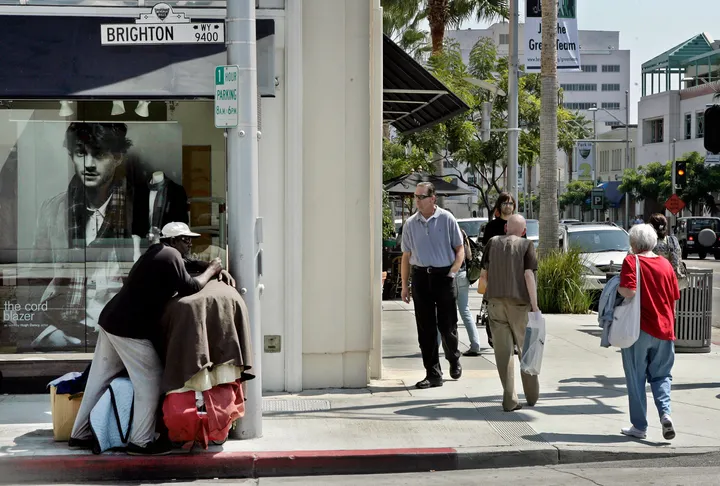
Homeless Man

The Huffington Post   First Posted: 09/20/11 10:34 AM ET Updated: 09/20/11 10:34 AM ET

The widening gap between the wealthy and everyone else in the United States may be hindering a broader economic recovery, according to a new study.

The study out of the International Monetary Fund found that greater income equality positively correlates with stronger economic growth. Released in September, the study more specifically concluded that a 10 percent decrease in inequality increased the expected duration of economic growth by 50 percent.

The IMF paper, which studied a sample of countries around the world between 1950 and 2006, found that in countries with more income inequality, such as Jordan and Cameroon, the economy more frequently plunged into deeper recessions, while economic growth lasted much longer in more equal societies.

Indeed, greater levels of income equality corresponded more strongly to sustained economic growth than other economic factors, including lower debt levels, according to the report. "Sustainable economic reform," the authors write, "is possible only when its benefits are widely shared." The United States

Income inequality has grown in the United States over the past four decades and now more closely compares to the income distributions of Russia and Iran than many other developed economies.

And some U.S. corporations are coming to grips with providing for a society with more rich and poor, and fewer middle class. The household-goods manufacturer Procter & Gamble, for example, has reduced its emphasis on middle-market items, instead focusing on developing luxury and bargain items, according to The Wall Street Journal.

Yet mushrooming income inequality isn't exclusive to the United States, rising 0.3 percent every year between the mid-1980s and mid-2000s in OECD countries.

Some economists have attributed stagnant wages for most Americans over the past four decades in part to growing inequality, as the rich have mostly benefitted from the country's recent economic gains.

And so long as Americans don't spend like before, the economy may not be able to fully recover. Historically the backbone of the U.S. economy, the eroding middle class has created an anemic economy, Berkeley labor economist Robert Reich recently wrote. He emphasized that the spending of the richest people alone is not enough to lead to "a virtuous cycle of more jobs and higher living standards."

Nobel Prize-winning economist Joseph Stiglitz agrees. "An economy in which most citizens are doing worse year after year -- an economy like America's -- is not likely to do well over the long haul," he recently wrote in Vanity Fair.

FOLLOW HUFFPOST BUSINESS
Subscribe to the HuffPost Money newsletter!
The widening gap between the wealthy and everyone else in the United States may be hindering a broader economic recovery, according to a new study. The study out of the International Monetary Fund...
 
 
  • Comments
  • 90
  • Pending Comments
  • 0
  • View FAQ
Comments are closed for this entry
View All
Favorites
Recency  | 
Popularity
Page: 1 2 3  Next ›  Last »  (3 total)
photo
MarsAmbassador
Per angusta ad augusta
05:09 PM on 11/17/2011
"Idealism is fine, but as it approaches reality, the costs become prohibitiv­e."
- William F. Buckley, Jr.
photo
MarsAmbassador
Per angusta ad augusta
05:07 PM on 11/17/2011
Millionaires, billionaires and corporations don't create jobs, demand creates jobs. Putting money in the hands of the Middle Class and Poor that live in the Real Economy creates demand. Addressing our income inequality will put money in the hands of people living in the Real Economy (we're 45th in income inequality, nestled right in between the Ivory Coast and Uganda). Wages being stagnated over the past 40 years while inflation rises is also a huge part of the problem. A single person had more Real Purchasing Power in 1973 than a dual-income family had in 2003. And things have gotten a LOT worse since 2003. Wages haven't effectively risen in 40 years, but expenses and inflation have. We got by on credit for the last 10 years and now our system has gridlocked. People don't have money, thus no spending, thus no demand, thus no jobs.
photo
SolarPowerGuy
Ph.D., Immunology; Solar power @ home; Green Party
07:40 PM on 09/22/2011
But but but... giving rich people EVERYTHING creates jobs! Rush told me so!
This user has chosen to opt out of the Badges program
03:51 PM on 09/21/2011
It's bad for your health too as a man with nothing left to lose is a dangerous man, as we will learn first hand soon enough!
06:31 PM on 10/02/2011
I agree. The 2012 election looks like a GOTP sweep right now. And when/if that happens, the gap will continue to grow.

And, of course the GOTP will still be playing the victims. That won't change.
photo
HUFFPOST SUPER USER
pandag
A false tale often betrays itself. Aesop 620 BC
03:10 PM on 09/21/2011
In the real world we are hunkering down, canceling any expense where possible, coupons, sales, little to no frills and yet the TP wants more, spontaneous bleeding out maybe?!
02:44 PM on 09/21/2011
Are they saying people need money to buy things and companies need customers to prosper? This would only be a revelation to republicans. They think if the rich have it all prosperity will then spring out of a vacuum. As the economic spiral downward continues.
02:07 PM on 09/21/2011
30 years of decreasing taxes on the wealthy, reducing protections of the people, and increasing deficits to pay for it. Now we have a crumbling infrastructure, massive unemployment, huge debt, and increasing poverty.

Only idiots keep on voting conservative supply side economics and hoping if they just go far enough it will suddenly become better...even though it hasn't. What is the definition of insanity again, doing the same thing over and over and expecting different results?
photo
SolarPowerGuy
Ph.D., Immunology; Solar power @ home; Green Party
07:40 PM on 09/22/2011
"Only idiots keep on voting conservati­ve supply side economics and hoping if they just go far enough it will suddenly become better..."

Why do you think that the GOP went after public education first?
11:02 PM on 09/20/2011
It took a report to state the obvious. Wonder how much that cost to put together. On the bright side maybe it gets some people employed.
photo
HUFFPOST SUPER USER
Reiner-von-Sinn
Fol de rol de rolly O
08:28 PM on 09/20/2011
The GOP policy answer to widening wealth and income disparity:

1 - Give the rich another tax break

2 - Further obstruct the president's jobs and recession recovery plans

Voila

Simple
photo
hewhowaits
If ignorance is bliss, you must be very happy.
07:11 PM on 09/20/2011
DUH,YA THINK....
07:07 PM on 09/20/2011
Do you really need a research to prove that when the majority is poor, the economy as a whole suffers?
11:04 PM on 09/20/2011
Many of the teabaggers and repubs supporters can not read so they have yet to be informed. I do not see how a report would help them. Then of course they would say it is lies and not care..
iam99
To know what you prefer...
05:25 PM on 09/20/2011
...said the primary creator of disparity between nations.
photo
cue
Ichi-go, ichi-e
03:45 PM on 09/20/2011
Our elected representatives of both parties have failed (or perhaps chosen) for the last several decades to understand the economic reality ­that the well being of ALL participan­ts in our economy depends on the vitality of our working and middle classes. They are the engines of economic activity, not the wealthy.

It's one of several principles that Adam Smith (the often referred to but seldom understood patron saint of conservati­ves) that is overlooked today...th­e paramount standard by which we should judge economic activity is NATIONAL welfare, not the wealth of individual­s.

A more equitable distribution of income is not simply a moral issue, it is an issue of economic enlightened self interest.
HUFFPOST SUPER USER
Ashok Hegde
04:50 PM on 09/20/2011
Do you really believe people with low skill are the "engines of economic activity".

This sounds like populist BS. The reality is, the skill level of the US middle class workforce is not globally competitive at the wages they require. Capital is simply reacting by moving production offshore, and keeping product costs low enough to engineer further global consumption. That, in essence, is their duty.

"Equitable Distribution" is quite problematic. The system rewards those who acquire skill.
This user has chosen to opt out of the Badges program
photo
whirlybird
Time's a-wastin'!
07:28 PM on 09/20/2011
The system is not rewarding anyone but themselves. It goes where labor and supplies are cheapest, plain and simple. Begone...I don't like most of what you are peddling anyway. I can't wait for the dwindling oil situation to hit folks like you hardest of all. When the going gets really tough, you will be quite unprepared.
04:01 PM on 11/16/2011
Very few people champion 'equitable distribution' - if by that you mean that everybody gets an equal share of the country's total wealth. Most people (and economists) think that the ideal income or wealth distribution is a right angle with the lowest level being subsistence level. We have never come close to that right angle, but we currently further from it than we have been since just prior to the great depression. The reason this spurs growth is because it incentivizes many people to work just a little harder or gain a skill set to get to the next stage up. In addition, you have many people who have some disposable income - which means they are more likely to take risks with that income (starting a new business or going back to school) etc.

You're correct that a capitalistic system rewards those who acquire skill - to a point. A completely free market capitalistic system ALWAYS results in virtually all the money concentrated in the hands of a few & the rest at a very low level (the point we're getting to now). The reason is pretty clear - money makes money and is handed down generationally. Once the divide widens - the people at the bottom can't compete with those at the top. You simply can't compete if you have $100 and somebody else has $100,000. Particularly when the person with $100,000 leverages their money (at a 40 to one ratio). They will 'outcompete' you every time.
photo
HUFFPOST SUPER USER
Christopher Hull
Democratic Socialist
03:36 PM on 09/20/2011
Well this was the most obvious story of the day.
You know things are bad when a criminal organization like the IMF starts to say something about income inequality.
HUFFPOST SUPER USER
Silverwolf72
Are We There Yet?
03:34 PM on 09/20/2011
Unless the top 5% buy 95% of the goods then of course it is bad for the economy.