iPhone app iPad app Android phone app Android tablet app More

Jeremy Rifkin: The 'Democratization Of Energy' Will Change Everything

First Posted: 09/26/2011 8:00 am Updated: 11/26/2011 4:12 am

Rampant unemployment, rising food prices, a collapsed housing market, ballooning debt -- to Jeremy Rifkin, the American economist and president of the Foundation on Economic Trends, these are not simply symptoms of a temporary economic malaise. Rather, they are signs that the current world order -- long infused with and defined by fossil fuels -- is collapsing around us.

In its place, decentralized systems of advanced, clean-energy production and digital power distribution are already starting to rise, Rifkin suggests, and they will reorder not just the way we turn on our lights, but how whole economies -- indeed, whole societies -- operate. Why? In a nutshell, Rifkin argues that as the ability to tap, generate and distribute power shifts from the exclusive province of governments and lease-holding corporations toward individual actors and communities armed increasingly with solar panels and wind turbines and smart grids, so too will bedrock relationships between producer and consumer, the government and the governed, be forever changed.

In such a world of democratized energy, cooperation trumps control, and the drive toward productivity is replaced by a quest for sustainability.

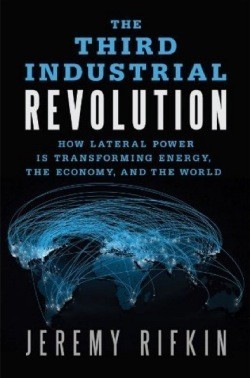
Such are the central themes that animate Rifkin's new book, the The Third Industrial Revolution: How Lateral Power Is Transforming Energy, the Economy, and the World, which hits bookstores and eReaders on Tuesday. This week, The Huffington Post is hosting two excerpts of Rifkin's tome -- the first of which is available here.

Of course, revolutions imply conflict by their very nature, and Rifkin concedes that the transformation he envisions is by no means guaranteed. Americans, for example, lag well behind Europeans in recognizing what Rifkin considers to be the waning, carbon-driven world order, and in taking steps to embrace and implement the new one.

"One of the reasons an overarching new economic game plan has never been rolled out is not just because we need to cut back public spending and reduce government deficits," Rifkin said in a two-part Q&A with HuffPost, "but because the administration is missing, to quote former president George W. Bush, the 'vision thing.'"

"What Obama is lacking," he added, "is a narrative."

The full first installment of our Q&A is below.
You suggest that the Third Industrial Revolution will be the last of the great industrial revolutions. Why?

The Third Industrial Revolution is the last stage of the great industrial saga and the first stage of the emerging collaborative era rolled together. It represents an interregnum between two periods of economic history -- the first characterized by industrious behavior and the second by collaborative behavior.

If the industrial era emphasized the values of rigid discipline and hard work, the top-down flow of authority, the importance of financial capital, the workings of the marketplace and private property relations, the collaborative era is more about creative play, peer-to-peer interactivity, social capital, participation in open commons and access to global networks.

The Third Industrial Revolution will move apace over the next several decades, probably peaking around 2050, and plateau in the second half of the 21st century. Already, in the shadow of its ascending bell curve, we can see a new economic era that will take us beyond the industrious mode that characterized the last two centuries of economic development and into a collaborative way of life. The metamorphosis from an industrial to a collaborative revolution represents one of the great turning points in economic history.

In your book, you introduce the notion of "lateral power," suggesting that it will soon displace traditional top-down power relationships and pave the way for a more distributed form of capitalism. What’s a shorthand way for understanding your notion of lateral power?

The democratization of energy has profound implications for how we orchestrate the entirety of human life in the coming century. We are entering the era of distributed capitalism. To understand how the new Third Industrial Revolution infrastructure is likely to dramatically change the distribution of economic, political and social power in the 21st century, it is helpful to step back and examine how the fossil fuel–based First and Second Industrial Revolutions reordered power relations over the course of the nineteenth and twentieth centuries.

Fossil fuels -- coal, oil and natural gas -- are elite energies for the simple reason that they are found only in select places. They require a significant military investment to secure their access and continual geopolitical management to assure their availability. They also require centralized, top-down command and control systems and massive concentrations of capital to move them from underground to the end users. The ability to concentrate capital -- the essence of modern capitalism -- is critical to the effective performance of the system as a whole. The centralized energy infrastructure, in turn, sets the conditions for the rest of the economy, encouraging similar business models across every sector.

The emerging Third Industrial Revolution, by contrast, is organized around distributed renewable energies that are found everywhere and are, for the most part, free -- sun, wind, hydro, geothermal heat, biomass and ocean waves and tides. These dispersed energies will be collected at millions of local sites and then bundled and shared with others over an energy internet to achieve optimum energy levels and maintain a high-performing, sustainable economy. The distributed and collaborative nature of the TIR energies and infrastructure favors lateral rather than hierarchical command and control mechanisms. This new lateral energy regime, in turn, establishes the organizational model for the countless economic activities that multiply from it. In the new era, providers and users aggregate nodally in vast networks and carry on commerce and trade in commercial arenas that function more like commons than markets. A more distributed and collaborative industrial revolution, in turn, invariably leads to a more distributed and collaborative sharing of the productive wealth generated by society.

You argue that the "single most important factor in raising hundreds of millions of people out of poverty is having reliable and affordable access to green electricity." But nascent economic powerhouses in the developing world -- China, India, and others -- are largely following the Western model of fueling and growing their economies with cheap, fossil-fuel based electricity. How does that dynamic get altered?

Universal access to electricity is the indispensable starting point for improving the lives of the poorest populations of the world. Because renewable energy -- solar, wind, geothermal, hydro and biomass -- is widely distributed, a Third Industrial Revolution is ideally suited to take off in the developing world. Although a lack of infrastructure is often viewed as an impediment to development, what we are finding is that, because many developing nations are not saddled with an aging electrical grid, they can potentially "leapfrog" into a Third Industrial Revolution. In other words, by building a new, distributed electricity system from scratch -- rather than continuing to patch up an old and outworn grid -- developing countries significantly reduce the time and expense in transitioning into a new energy era. Moreover, because of the distributed nature of the Third Industrial Revolution infrastructure, risk can be more widely diffused, with localities and regions pooling resources to establish local grid networks and then connecting with other nodes across regions. This is the very essence of lateral power.

Other parts of the globe, particularly Europe, appear to grasp the trends and solutions you suggest in your book. Why are Americans lagging in this regard?

One of the reasons an overarching new economic game plan has never been rolled out is not just because we need to cut back public spending and reduce government deficits, but because the administration is missing, to quote former president George W. Bush, the "vision thing." Whenever President Obama mentions his green economic recovery, he rattles off a laundry list of programs and initiatives his administration is either doing or proposing. The president also takes every opportunity to visit a solar or wind turbine park, a factory manufacturing solar panels or a car company testing electric vehicles to demonstrate his sincere commitment to a green economic future.

What Obama is lacking is a narrative. We are left with a collection of pilot projects and siloed programs, none of which connects with the others to tell a compelling story of a new economic vision for the world. We’re strapped with a lot of dead-end initiatives, wasting billions of dollars of taxpayer money with nothing to show for it. If President Obama clearly understood the underlying dynamics of the five-pillar infrastructure of the next great industrial revolution and how the parts connect, he might have been able to sell the American public on a comprehensive economic plan for the country’s future.

Another series of questions and another excerpt from Jeremy Rifkin's new book will be available on Thursday.

FOLLOW HUFFPOST GREEN


  • Comments
  • 205
  • Pending Comments
  • 0
  • View FAQ
Comments are closed for this entry
View All
Favorites
Bloggers
Recency  | 
Popularity
Page: 1 2 3 4  Next ›  Last »  (4 total)
03:51 PM on 10/05/2011
I like. Check out GreenSpanTheGlobe.com this is kind of what I promote... I am partnered with EFAZ.org and we have a coalition of 29 organizations geared towards integrating more sustainability and corporate responsibility into the workplace. We have silent vertical axis wind turbines, micro water turbines, solar fashion, solar art projects for the community, vertical window farms for the community, living walls and soon green roofs.

Alan Greenspan
GreenSpanTheGlobe.com
photo
charlesfrith
Allegedly Bright. Empirically Stupid.
05:48 AM on 10/02/2011
I've written about this subject too because energy technology suppression is the legacy of the oil companies. When it breaks (and it will) it's questionable whether brands will survive in their current framework.
11:03 PM on 09/28/2011
I wish they could just freeze me until the industrial era is over and wake me up to a more friendly collaborative era.
10:03 AM on 09/28/2011
It's funny that he talks about a new "Cooperative Behaviour" and counter-poses that to the bad old top down way of doing things then turns around and blames it all on Obama. There are a lot of things to blame on Obama, but the privatisation of energy production is not one of them.

Capitalism is to be blamed for that.
12:27 PM on 09/27/2011
Perhaps it is true that Obama does not yet comprehend the dynamic of this new world order, or he understands that politically he is constrained absolutely by the oil barrons of the old world order, who are willing to use their enormous wealth to purchase congressional seats to assure them their continuing control of energy in the US.

It would be a big mistake to vote Republican and expect to get more support for an ordered transition to our clean energy future. We have to vote out the science-deniers and entrenched antiquated politicians who would be barriers.
photo
Aryeh Melaris
Put our government back on its leash!
11:34 AM on 09/27/2011
Just a reply to all of the green Kool-aid drinkers who are falling for this garbage, I want to draw you attention to the following:

Rifkin proposes:

"In the new era, providers and users aggregate nodally in vast networks and carry on commerce and trade in commercial arenas that function more like commons than markets. A more distributed and collaborative industrial revolution, in turn, invariably leads to a more distributed and collaborative sharing of the productive wealth generated by society."

Enron called Jeremy. They want their business model back...

Energy and commodities services:

Enron Clean Fuels (biofuel wholesaling)
Enron Coal and Emissions (coal wholesaling and CO2 offsets trading)
Enron Weather Risk Management (Weather Derivatives)
Enron Wind Power Services (wind turbine manufacturing and wind farm operation)

(Wiki)

And don't try and sell the idea of "more distributed and collaborative sharing of ...wealth", we already know how this one ends as well, Comrade.
HUFFPOST SUPER USER
kori77
09:53 PM on 10/09/2011
Well the second part of this whole decentralization equation, is the decentralization of the banks. When Wall Street got bailed out, they should have mandated the banks be split up into bio-regional banks to serve certain areas of the country, that would become re-invested in their communities; instead the Wall Street banks hoarded all the cash and started up their casino games again. In Canada, banks were never allowed to merge commercial operations with investment banking (thus giant hedge fund zombie banks) to the degree they have in the US in Europe, and that has helped saved Canada's economy up until now that is. The New Economy Working Group has a great report everyone should read here: http://neweconomyworkinggroup.org/report/how-liberate-america-wall-street-rule
If we do even half the things the report calls for and continue to implement ideas in Jeremy's book, I think we'll back on track for building this new wikinomics/third industrial revolution for the 21st century.
11:00 AM on 09/27/2011
Soooo, let's adopt the lateral energy approach, but keep the top-down political approach to get us there.
photo
HUFFPOST SUPER USER
lw1
Jobs! Jobs! Jobs!
10:43 AM on 09/27/2011
Great Article - Some Great responses too! Thanks HuffPo!
HUFFPOST SUPER USER
neuromantic
09:03 AM on 09/27/2011
One aspect of our society that will have to change with this transformation is the role of the consumer. For too long, people have been passive consumers of energy, paying whatever rates are imposed, with little thought about sources and waste products.

In the next two years as PECO starts installing smart meters (phase 1 --> 600000 meters or half their market), these consumers will learn about time-of-use billing. I hope they also learn that some "smart" appliances can be programmed to operate when rates are low (a benefit of smart meter technology, if you upgrade your appliances). Perhaps more people will install PV panels on their roofs, or install wind turbines, to offset the high-priced midday energy demands, too. Once energy is produced locally, the ridiculous losses inherent in long-distance transmission will become less significant, and the threat of multistate blackouts should also be lessened.
03:42 PM on 09/27/2011
Hopefully they're not too sick from smart meter wireless radiation to benefit on day.
HUFFPOST SUPER USER
neuromantic
04:07 PM on 09/27/2011
Yes, I hope so. Based on an expert assessment, evidence suggests that won't be a problem (http://www.ncbi.nlm.nih.gov/pmc/articles/PMC1849947/), but they really should put fake smart meters in some houses, and measure the rate of psychosomatic reactions.
photo
HUFFPOST SUPER USER
Ron Shook
09:40 PM on 09/27/2011
We could get that all rolling very smartly with feed in tariffs like the Germans did and Japanese are starting to do. For those who don't know, feed in tariffs are payments to the individual or business at 2-3 times the normal rate for any excess electricity that your system can send back to the grid. The meter runs backwards. It turns any on-site solar and/or wind system of sufficient capacity into a mini energy producer. You, too, could be a power company.
photo
HUFFPOST SUPER USER
john geary
03:23 AM on 09/27/2011
The 'Democratization Of Energy' Will Change Everything, INDEED!
HUFFPOST SUPER USER
kori77
12:16 AM on 09/27/2011
Look up Living Buildings at www.ilbi.org
09:09 PM on 09/26/2011
the post important sentence: In such a world of democratized energy, cooperation trumps control, and the drive toward productivity is replaced by a quest for sustainability.
08:50 PM on 09/26/2011
It is sad when it is so simple to poke a great big hole in such a theory. Energy whether from solar or gas will NEVER be free. Who is he kidding? Greed is one of the most influential of human emotions and behaviors, and by ignoring that fact is just stupid.
HUFFPOST SUPER USER
kori77
HUFFPOST SUPER USER
Fred Smith3865
07:39 PM on 09/26/2011
Rifkin is an idiot with dystopian ideations. "Democritization of energy" is another way of saying "socialization of energy" You think the world has it bad now? Wait until a privileged few have the power (no pun intended) to dictate who deserves what energy and at what cost. The price of energy is cheap and available right now in comparison to the past.
Just think of water, how precious and expensive a comodity it was. The free market has made it ready, treated, relatively healty and available. The free market does the same with energy. Technology and innovation is driven by demand. The greatest cost right now for production and use of energy is overreaching regulation. We have enough natural gas and coal in America to meet our energy needs for several generations. In the meantime, new technologies are being developed based on need. Solar, wind geothermal and other renewable enrgy sources are unreliable and too expensive to rely on to a great extent.....right now that is.
Fusion will be the source of most energy in the future, but necessity is the mother of all invention. The free market will drive these alternative sources, deliver them much more efficiently and cheaper than any short sighted government program can ever achieve. Most importantly, energy will be controlled by the free market and not as some tyranical political tool.
photo
HUFFPOST SUPER USER
silverwolf13
I know that I do not know.
08:30 PM on 09/26/2011
Unfortunately, we do not now have a free market in energy. Oil gets large tax subsidies, and coal, oil, gas, and nuclear are all allowed to push off much of the costs they cause onto taxpayers. We all pay for pollution-caused diseases like asthma; the fishing industry pays dearly for oil spills; drinking water is contaminated by oil spills, mountaintop removal, wastewater spills at coal mines, and the chemicals used in fracking. Many lives have been lost in coal mines and on offshore drill rigs. And the energy companies do not pay anywhere the full cost; a lot falls on those injured, but much of it gets dumped on the general public in the form of higher costs for public health and health insurance. And even with all of these subsidies, the prices of oil and coal have gone up steeply in the past few years.
HUFFPOST SUPER USER
Fred Smith3865
09:51 PM on 09/26/2011
Large subsidies? 4 billion compared to a trillion dollar industry? ushing off cost on taxpayers? You mean energy consumers bearing the cost of production as consumers of other goods do. I am in favor of removing ALL subsidies.
Many lives are lost in coal mines and oil rigs? Compare it with lives lost in other industries.
Mining is much safer that construction, fishing, lumber and quite a few more.
ublic health benefits from cheap reliable energy. Our lifespan has increased dramatically with the increase in technology and tranpsortation.....all fueled by chea reliable energy.
I am a well driller. Do you know what the main chemicals in hydrofracting are?..
Water and clay! There are very few but overdramatized incidences where fracking was done irresponsibly. It is very safe and effective
Air quality has improved dramatically with catalytic converters, scrubbers, greater efficiencies etc.You obviously never lived in urban areas in the 70's. There is no comparison.
The higher costs for public health can not be linked to actual IMPROVEMENTS in water and air quality since the 1970's.Your argument fails the test of logic
This user has chosen to opt out of the Badges program
photo
08:51 PM on 09/26/2011
you are misinformed. around the world there are more cell phones than indoor toilets. there are no power grids in those areas. how do they charge their cell phones? solar. how do they power their one indoor lightbulb. solar. right now solar is cheaper than fossil fuel in australia. the desert areas of the usa have similar conditions. and prices are dropping thanks to super competition in the area including china throwing tens of billions into the industry. solar is projected to pass grid price parity with fossil fuels in the usa within 5 years. you can choose centralized power where energy markets juke your prices or you can grow your own power.
HUFFPOST SUPER USER
Fred Smith3865
09:19 PM on 09/26/2011
I am very informed! You have proven my point! In areas away from the grid, there is a demand for solar. (It doesn't work at night or on cloudy days) There is a free market insertion there. I have a 17KW solar system in my back yard. I am foryunate enough to have the capital to invest in it. Still, I rely on the grid at night and it will take me 6+ years to recou my investment. If I had the means, I would hydrolyze water with solar and use a fuel cell 24/7. Still, we depend on the grid. Rechargeable hybrids are nice too, but they are not cost effective yet. I will buy a new one when the unit cost id under 20K, it still will not relace my truck and still consumes gasoline after 40 miles. The free market will bring these innovations to market better and cheaer than any government.
Not only am I well informed, I am quite an exert. The only reason China can produce solar panels cheaper is because their labor costs are 1/3. The best panels as far as efficiency are still roduced in the USA but at a much higher cost. My panels were produced in Colorado.
Mochilero
Have backpack, will travel
06:47 PM on 09/26/2011
Even if fossil fuel production could be easily increased (as in "drill baby, drill"), it is still a terrible Idea. To do so simply feeds our addiction to and over-dependence on resources that are destroying the environment as well as being one of the biggest causes of international tensions, while hastening the day they will be exhausted. If mankind were rational, we would all join together to reduce consumption and put all efforts into the development of any and all alternative technologies. How much of the US military budget is devoted to keeping our armed forces and secret intelligence armies scattered all over the planet in order to protect our access to oil? Much of that money would be far better utilized to replace our decaying infrastructures and on energy R & D.
08:54 PM on 09/26/2011
it only feeds dependence on other nations because our idiots in office will not allow us to obtain the many energy resources at our disposal. They talk about how our economy is being crippled by regulation? look no further than how we limit exploration and production of natural resources in North American. Just wait till China thru Cuba begins to drill and tap the oil under the US. You think the spills in the gulf have been bad so far? You aint seen nothin yet!