More

Vesta Mountain: NASA Dawn Spacecraft Discovers Asteroid Peak Taller Than Everest (PHOTO)

First Posted: 10/05/11 06:31 PM ET   Updated: 12/05/11 05:12 AM ET

NASA's Dawn spacecraft, currently orbiting the massive asteroid Vesta, has sent back stunning images revealing that Vesta is home to a mountain larger than any on earth and among the largest in our solar system, according to Space.com.

The spacecraft, which was launched in 2007, traveled 1.7 billion miles before it reached Vesta's orbit in July. It's equipped with a framing camera and visible and IR mapping spectrometer to image Vesta and, eventually, Ceres, the largest asteroid in the main belt.

The latest findings from the Dawn mission were announced at the EPSC-DPS Joint Meeting 2011, a planetary sciences conference, on Monday in France.

PHOTO BELOW

“We are learning many amazing things about Vesta, which we call the smallest terrestrial planet,” Chris Russell, the Dawn Principal Investigator, said in a statement. “Like Earth, Mars, Venus and Mercury, Vesta has ancient basaltic lava flows on the surface and a large iron core. It has tectonic features, troughs, ridges, cliffs, hills and a giant mountain. The south polar mountain is larger than the big island of Hawaii, the largest mountain on Earth, as measured from the ocean floor.”

Russell added that the mountain on Vesta is almost as high as Olympus Mons on Mars, which at 16 miles tall, is the highest mountain in the solar system.

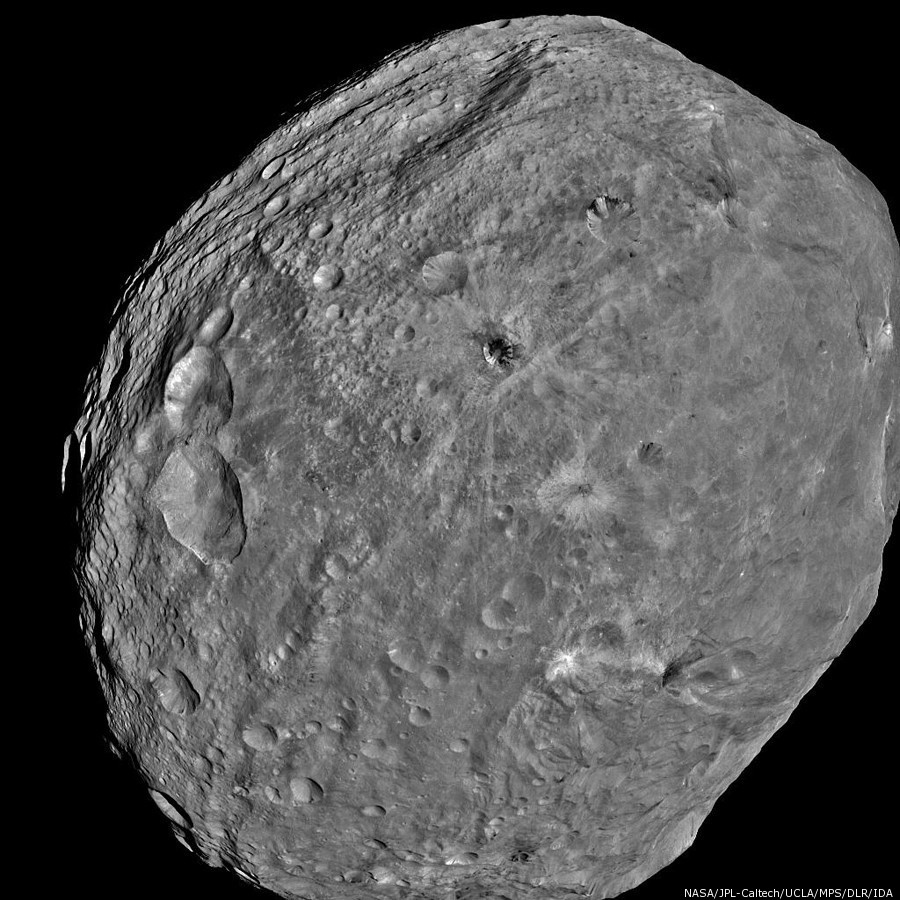
The images sent back also show the variation in the terrain between the planet's southern and northern hemispheres. The crater-filled northern hemisphere contrasts with the smoother terrain in the southern hemisphere, both of which can be seen in the image below. Researchers speculate that "an enormous impact altered the earlier cratering record in the south," according to the statement.

The Associated Press reports that Vesta is 330 miles in diamater and is the second-largest object in the asteroid belt. Newsy cites a CNN report that says that it's the only asteroid that can be seen from earth without the aid of binoculars or a telescope.

It takes 12 hours for the Dawn craft to orbit Vesta, according to Sky & Telescope,

The spacecraft took four years to reach Vesta and will spend a year capturing images of the asteroid, getting as close to 110 miles from the surface. After that, Dawn will travel one billion miles to orbit Ceres.

From the Associated Press:

The craft is powered by ion engines instead of rocket fuel, making the trip more fuel-efficient and allowing it to cruise between the asteroids and lower itself to about 120 miles above the surface to study them in depth.

LOOK: This image, taken from the Dawn spacecraft while 3,200 miles above Vesta on July 24, 2011, shows the difference between the smoother southern hemisphere (lower right) and the crater-filled northern hemisphere (upper left).
FOLLOW HUFFPOST TECH

NASA's Dawn spacecraft, currently orbiting the massive asteroid Vesta, has sent back stunning images revealing that Vesta is home to a mountain larger than any on earth and among the largest in our so...
Filed by Timothy Stenovec  | 
 
 
  • Comments
  • 18
  • Pending Comments
  • 0
  • View FAQ
Comments are closed for this entry
View All
Favorites
Recency  | 
Popularity
photo
HUFFPOST SUPER USER
LiberalBuzz
Voting republican is voting against America.
11:05 PM on 10/05/2011
What about Olympus Mons at 14 miles high.

I bet mountain climbers would give their eye teeth to climb that bit of extraterrestrial rock.

Of course we have to get a regular shuttle service between here and Mars first.

Which we would already have except for the dark ages which lasted hundreds of years from around the 5th Century to the 15th Century. Can you imagine where we would be except for the religious influences that kept science down to the point of torture, maiming, and widespread execution.
10:31 PM on 10/05/2011
HuffPost Editors: Another useless, excuseless FAIL with your headline, "Solar System's Tallest Mountain Discovered In Unexpected Place." Article makes it plain and clear this is NOT the solar system's tallest mountain. Geez Louise who is writing headlines these days???
This user has chosen to opt out of the Badges program
08:11 PM on 10/05/2011
How long before we put ion engines onto a medium-sized asteroid, bring it into high earth orbit, and then turn it into a space habitat?
09:53 PM on 10/05/2011
Probably a little while, I'd guess.
This user has chosen to opt out of the Badges program
10:17 PM on 10/05/2011
Very soon after a reliable spectral line detection for large quantities of gold or another valuable element is found in a particular asteroid.
This user has chosen to opt out of the Badges program
08:07 PM on 10/05/2011
An amazing photo!
This user has chosen to opt out of the Badges program
08:04 PM on 10/05/2011
I think that large mountain is the central structure or peak of a huge impact crater in the southern hemisphere of Vesta.
MRITechnologist
your micro bio is empty as a GOTPers soul
07:30 PM on 10/05/2011
Ah I feel like a real dummy not knowing that ion drive engines are a reality and have been apparently since 2007. Thanks NASA for once again reminding me what the phrase "it's not rocket science." really means. I think I'll go and pick out new names for my toes now.
08:17 PM on 10/05/2011
>Ah I feel like a real dummy not knowing that ion drive engines are a reality and have been apparently since 2007.

Sorry if this makes you feel like a dummy again but the first spacecraft to use an ion drive was Deep Space 1, launched in 1998. ^^
MRITechnologist
your micro bio is empty as a GOTPers soul
09:21 AM on 10/06/2011
Doh!
photo
HUFFPOST SUPER USER
Nerdiac
07:15 PM on 10/05/2011
"The craft is powered by ion engines instead of rocket fuel" This just reminded me of how great it is that NASA is using our tax dollars to play Annie Leibovitz in space instead of doing something useful for us Earthlings, like using their oh-so-smart brains to help out with the energy crisis, or at least doing a better photoshop job on those moon landing pictures.
09:54 PM on 10/05/2011
Oy.
photo
HUFFPOST SUPER USER
LiberalBuzz
Voting republican is voting against America.
11:13 PM on 10/05/2011
Don't have a clue about anything do you.
06:47 PM on 10/05/2011
Well asteroids are the ones that form into Planets,Dwarf planets, and etc, and besides they have a small atmosphere, and they also have tectonic plates and their geology is acually not that different from any other planet like earth or mars.
10:41 PM on 10/05/2011
Sorry, but you are mistaken.

Vesta does NOT have an atmosphere, and with so little gravity and no magnetic field, never could have had an atmosphere, not at any time in its history. Given Vesta's proximity to the sun, the solar wind is more than powerful enough to quickly strip away an atmosphere before one can even form around such a small body.

You've also made a wild leap from a comment about Vesta having "tectonic features" to the mistaken conclusion that Vesta has tectonic plates.

Even among the terrestrial planets, only Earth has tectonic plates, generally regarded as a result of the combination of internal tectonic forces, the silicate chemistry of Earth's crust, and vast amounts of standing water on Earth's surface.

While it was hoped (or imagined) that the other terrestrial planets might show signs of plate tectonics, that has not panned out at all.
photo
HUFFPOST SUPER USER
bccmeteorites
Don't believe everything NASA says.
01:28 PM on 10/07/2011
Thanks. :>}