Late Wednesday night, just as groups of Occupy Wall Street protesters were launching efforts to invade Wall Street, a middle-aged black man stopped and stuck a sign in the wrought iron gate that surrounds a Lower Manhattan church, and then scurried away.
The placard left by the man at St. Paul’s Chapel carried an unusual message in a crowd protesting corporate greed and rising income inequality. It was not aimed at corporations or CEOs. It spoke to the protest movement itself: DECOLONIZE WALL STREET – stand up for more BLACK + BROWN LEADERS in this MOVEMENT.
With so many African Americans and Latinos out of work and bearing a disproportionate share of the recession's impact, it would seem that Occupy Wall Street might have particular appeal to people of color. But even Wednesday night, when the Occupy Wall Street movement brought together its original organizers, students and union members who do everything from drive the city’s buses to mop its hospital floors, the crowd remained overwhelmingly white.
“Listen, I love these protests, “ said Julianne Malveaux, an economist who is also African American and is a self-described progressive and veteran of many movements and political gatherings. Malveaux is the president of Bennett College, a historically black women’s college in North Carolina, and a member of the United Negro College Fund Board. “Who can’t be mad at Wall Street right now? But I haven’t heard anyone talking about this protest in HBCU (historically-black college and universities), and I think some of us are wondering what these protests are really about.”
Wall Street is a business district where a physical barrier once stood to keep Native Americans out and where one of the country’s most active slave markets once facilitated the trade of human beings. Today, there are many protesters who blame Wall Street for the country's current economic state -- and the recession's unequal impact.
Nearly 40 percent of the nation’s unemployed are African American or Latino. Together, the two groups make up only about 29 percent of the county’s total population but more than 60 percent of the people who live in New York, according to federal data. Nationwide, African Americans and Latinos have also disproportionately lost their homes to foreclosure since the economic downturn began and have seen their assets decline sharply, creating the largest black-white wealth gap in 30 years, according to the Economic Policy Institute.
The small number of black, Latino and Asian protesters involved in the Occupy Wall Street movement -- which began in New York -- speaks volumes about how the movement took shape and was publicized, Malveaux said. It also hints at how poorly understood the economic struggles of non-white Americans remain, she added.
“I think that what we see in this movement is really not much different than what you see in a lot of progressive causes,” Malveaux said. “Progressives frequently are so convinced of their cause and its merits that they don’t do enough to reach out. The problem is if we aren’t there, everybody’s concerns ultimately won’t be addressed.”
Protesters will have to identify some concrete economic goals if they want to attract more of the people who have suffered the most in the recession and have any real impact, Malveaux said.
“People who are concerned with survival want to know about outcomes,” she said. “What is it you want? Our protests have always been very targeted. You know, don’t put this person to death. We deserve to sit anywhere that is available on this bus. Protesting something like globalization? That is like saying that you are protesting electricity.”
Occupy Wall Street’s core organizers are aware of the movement’s demographics. One of the standing committees working on the group’s recruitment, strategy and action plans has been dubbed, “Communities of Color.” The group has plans to reach out to churches, celebrities, politicians and existing organizations concerned with issues like the living wage and housing.
Occupy Wall Street organizers did not respond to a request for comment about their efforts by deadline.
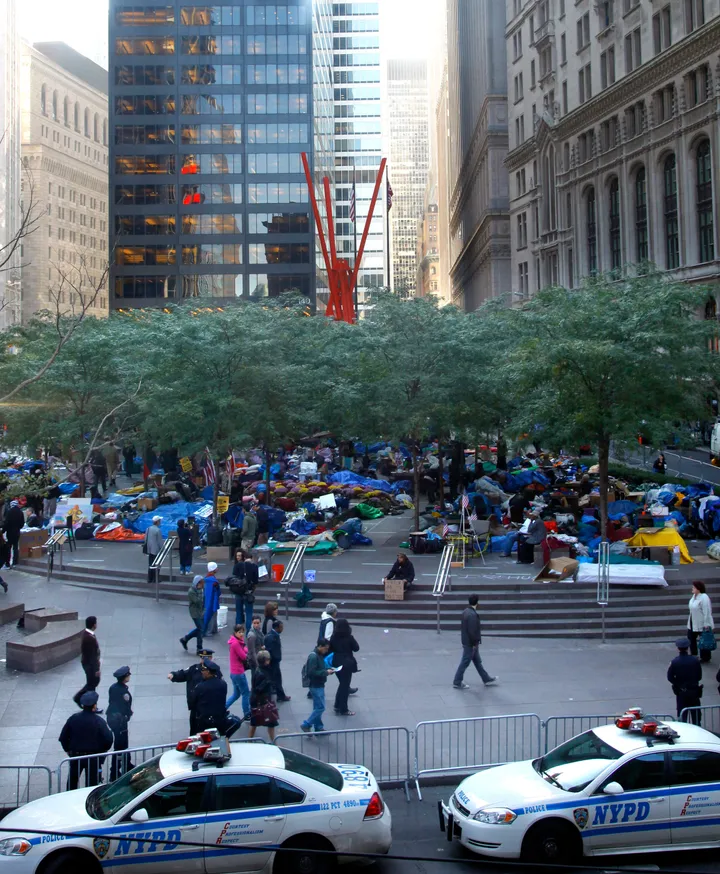
On Wednesday night, signs or at least symbols of ethnic and racial diversity were visible in Zuccotti Park. At the corner of Liberty Street and Trinity Place, three people wearing SEIU (Service Workers International Union) T-shirts stood discussing in Spanish the widening gap in pay between CEOs and average workers. Another group carrying a sign identifying them as students and faculty of Union Theological Seminary sang two verses of “We Shall Overcome.” Only one person in the group appeared to be black. Around the park, there were also some black and Latino people who weren’t affiliated with unions, as well as a trio carrying a sign identifying themselves as the “Native American Contingent.”
Nationwide, black workers are slightly more likely than whites, Latinos or Asians to hold a union card, according to the most recent federal data. The same is true of workers over age 55. So getting the unions involved in the protests will go a long way to help broaden the movement, said Chuck Zlatkin, the legislative and political director for the New York Metro Area Postal Union.
“The 99 percent isn’t just a bunch of white kids,” said Zlatkin, who is white, in a reference to Occupy Wall Street organizers' most frequent claim that 1 percent of Americans are benefiting from the economic status quo while the rest suffer.
There are a variety of reasons why people of color who have been deeply affected by the economic downturn have not showed up in large numbers in Zuccotti Park, said Andrew Grant-Thomas, deputy director at the Kirwan Institute for the Study of Race and Ethnicity at Ohio State University. Among other things, the Institute produces research on the role that race plays in shaping the economic condition of individuals and families.
The Occupy Wall Street movement got its start with an ad in an alternative publication called Adbusters. The computer hacking collective known as Anonymous also spread the word on Twitter. And in cities around the country, Facebook has also played a significant role. People of color -- particularly African Americans -- use Facebook and Twitter as much or more than whites do, said Grant-Thomas, who is black. But electronic social networks are largely a reflection of the people that we know, he added.
“Our real life networks are rather closed,” said Grant-Thomas, who is also a political scientist. “Segregation is a problem still in terms of where people live and with whom and how most people socialize.”
The organizers of Occupy Wall Street need to tap into the spaces where non-white people organize and discuss political and economic matters if they want to broaden the movement, Malveaux said. That means going on talk shows like the "Tom Joyner Morning Show," which airs every weekday morning on radio stations across the country that have large black audiences, and approaching groups like LaRaza, the NAACP and the Urban League. NAACP President Ben Jealous has dedicated a lot of time and attention to making the NAACP a tech-savvy organization that uses Twitter and Facebook, Malveaux said.
“Have the young people behind this movement asked the NAACP to send a message to its list?” Malveaux asked. “The alleged post racial society that so many white people were so excited about doesn’t exist because we haven’t built it.”
Then there is the fact that different people have widely disparate experiences confronting authority and interacting with the police, Grant-Thomas said.
“Think about the average 19-year-old college student at NYU who is white, and a 65-year-old African American bus driver,” Grant-Thomas said. “What it means to protest, the consequences and challenges and opportunities that a protest represents can all be very different.”
Some African Americans have vivid, even personal, memories of police batons, dogs, and water hoses making contact with protester flesh. And even today, the prospect of police brutality is not something easy for many people of color to dismiss. For immigrants -- legal and illegal -- contact with police can lead to deportation. And, in a city like New York where there are many immigrants who hail from countries where challenging authority can be a fatal decision, visiting Zuccotti Park is a big deal, Grant-Thomas said.
“It wouldn’t be accurate to say that every white kid that’s out there has nothing to lose or somehow relishes the idea of maybe getting popped in the head by police,” Grant-Thomas said, “and every person of color who is not there as simply afraid. But it's also true that memory and experience don’t leave people. They shape us and our actions.”
This is not the first time that the potential economic and social consequences of interacting with police have shaped who protests are and how they protest, Malveaux said. During the Vietnam War, the details of the draft and how people qualified for an exemption left a disproportionate share of black and Latino men to actually fight the war. But the protesters calling for the war to end were almost all white, she said.
Julie Rweyemamu, who is black, was in Zuccotti Park on Wednesday night. She had come to the city from suburban Westchester County, N.Y., but had only been able to convince one friend, another black woman, to join her.
“I think a lot of them don’t think it matters,” said Rweyemamu. who lives in a largely-black section of Westchester County and was carrying a sign that mirrored one that Princeton University philosopher Cornel West displayed during a visit to Zuocotti park this week, decrying the underfunded “war on poverty.” “They don’t think their voice can really have any impact. So why take the risk or the time?” Rweyemamu asked.
There are people of color who are organized and vocal about concrete things such as the prison industrial complex -- the way that private companies make money off of mass incarceration -- and immigration, said Caro Muñoz, who was also in the park Wednesday night. “But people on the left don’t really know where to go to find them, besides churches," she said. "There is organizing and activism outside of this park. There is just a lack of social fabric between the people involved. “
Muñoz is a foreign student from Chile studying social psychology at the City University of New York. The end of publicly-funded higher education in Chile has made school virtually unaffordable, she said. Students, teachers and other union members in Chile are engaged in a six-month strike right now to protest the huge volume of debt that most students have been forced to take on, Muñoz said.
“This is my first night here,” said Claudie Mabry, a student at the New School who is African American and originally from Detroit. “I think it’s a beautiful thing happening here.”
Mabry and a few of her friends carried a sign that read, “I’ve got 99 problems and Wall Street is #1,” a reference to a Jay-Z song and the list of injustices that Mabry said concern her. Until this weekend, Mabry was involved in protests to stop and decry former Georgia inmate Troy Davis’ late September execution.
On Saturday, a group of seven students at Malvauex’s college drove to Georgia to attend Davis’ funeral, she said.
Not long after the recession began, Malveaux read a lengthy profile of a white man who had earned about $100,000 a year before being laid off. The man had been forced to take a job at the Gap. His wife had asked him to start sleeping on the couch.
“I thought okay, this is a profile in The New York Times?” said Malveaux. “How many black men could tell this same story? How many sisters have been frustrated with a man who can’t find a decent-paying job and all the problems that brings? Throw a stone in Southeast D.C. and you could tell a version of that same story 50 times.”
More than three years after the start of the recession, many more Americans have lost their jobs, but many of the ones who have been disproportionately affected have not yet shown up in Zucotti Park.