More

HuffPost Social Reading

Chicago's Great Migration: Blacks Leaving Historic Neighborhoods To Return South

First Posted: 10/17/2011 5:12 pm Updated: 12/16/2011 4:12 am

This is the first installment in "The Great Return," an occasional HuffPost BlackVoices series about the shift of African Americans toward the South after the Great Migration to the North.

CHICAGO — Nearly seven decades ago, James Middleton was just a toddler when he watched a white man shoot and kill a black man in the little town of Lambert, Mississippi.

He had tagged along with his father to run errands and, giddy with excitement, sat in his daddy's Ford as they pulled up to a local restaurant. There was a commotion out front —a family friend arguing with the eatery's white owner, who had a pistol in his hand.

"You nigger!" Middleton recalls the white man shouting. "I'll kill you!"

The friend ran. Gunshots followed.

"I looked down and I could see this man, still trying to breathe, and blood was coming out of his chest," says Middleton. "I don't like to remember bad things. But it seemed like bad things were always happening to black folks."

Middleton's baptism in Southern violence was a consequence of being black at a time and place of cradle-to-grave segregation and senseless death. The specter of violence and inequality that his family endured eventually drove them more than 600 miles north to Chicago, making them a ripple in the wave of millions of blacks who fled the South in search of a better life.

They moved into a little place on Chicago's West Side with other working-class blacks. (The South Side, he said, was reserved for the more well-to-do and professional set). They joined a network of relatives, friends and other migrants.

The Middletons were among an estimated six million blacks to flee the South between 1915 and 1970, to northern cities like Chicago, Philadelphia, New York City, Detroit and Los Angeles in the west. They found work on automobile assembly lines or in manufacturing plants and factories in the industrial North. They laid roots, raised families and gave their children opportunities that many could never have imagined for themselves back home.

But today, generations later, amid higher costs of living, concerns over crime and what many perceive as too few job opportunities in those same cities, African Americans are returning to the South in the largest numbers since the first Great Migration, according to sociologists and those who have studied the new migration. During the 1940s, roughly 1.5 million blacks migrated to the North. Between 2000 and 2010, an estimated 1,336,097 blacks moved to seven major southern cities alone, according to the Brookings Institute, which compiled the most recent data from the U.S. Census.

THE NEW DEMOGRAPHICS

Former magnets for black migrants, including Illinois, Michigan, New York and California, all have had black population declines. Atlanta has even overtaken Chicago as the city with the second-largest black population behind New York City. The black population in Atlanta has grown in the past decade by 473,493. In Dallas it grew by 233,890, and in Houston by 214,928 over the same period. Today, 57 percent of the country's black population lives in the South, a 50-year high, according to the most recent census data.

Today's migrants are chasing the same things their forebears sought decades earlier, according to those who have studied the return migration. Others are retiring or returning to familial homesteads, reclaiming land their relatives never let loose.

"There are places like Harlem that no longer have majority black populations because many of the black folks who have lived there for the last 50 or so years have decided to cash in, and they are going to live somewhere more affordable, places that don't come with the urban baggage that maybe we didn't ever want but put up with because this was our best chance at a solid economic future," said Khalil Muhammad, director of the Schomburg Center for Research in Black Culture, part of the New York Public Library and renowned for its collections of historic artifacts. "Those people are going to places that look just the way they want them to look. They are not going to be shackled by a political nationalism or the segregation of the past."

Meanwhile, Chicago has lost about 181,000 African Americans over the past decade, a drop of 17 percent. Many have fled to the Chicago suburbs. But to a greater extent, who is leaving and where they're going is difficult to determine, according to demographers. But Brookings Institute reports that these new migrants tend to be financially stable and more educated. Many are students, professionals or retirees.

James Middleton, who is 72, and his wife of 53 years, Barbara, have a grown son, now living in Houston, and a granddaughter in Chicago who is considering moving to the South or West, they say -- an indicator of just how much less promise many see in what was once the "promised land" of the North.

"At that time there wasn't a lot of differences between there and here, in terms of the way people took care of their families," Middleton says of Chicago when he first arrived. "It was simple. We stayed with relatives, and other relatives had relatives, so you were always around people that was concerned about you."

"It was a vast difference between how things are today and how things were then," he adds. "Then it was like that saying, it took a village to raise a child. Everyone chipped in, whether they were neighbors or not. Now the professionals, the school teachers ... they are trying to get away."

THE END OF EXILE

During the summers of her youth, Sherry Williams and her siblings relished the trips back "home" from Chicago to Inverness, Miss., where they ran free and spent lazy summer days by the local fishing hole, living, if only for a few weeks, an idyllic country life.

Those connections still run deep in Williams' family and in other families whose roots stretch back to the South.

"For the most part, most of the people who I know that have started to return to the South, their mindset is that they never were Chicagoans," says Williams, 51, who was born in Chicago but whose mother left Inverness in 1942. "They physically lived here, but really, they truly believe the South is home, and that this is just the place that they moved to seeking work and absolutely for the opportunity to vote, attend better schools and just better themselves."

She said that many of the children of those migrants found themselves financially strapped. "But back home, the family has always had that land, that 'heir property' that many people find themselves going to," Williams says. Her family still owns a home and some land in Mississippi, which a revolving cast of cousins has occupied off and on.

Williams' daughter, Joi Tucker, 20, a third-year student at Alcorn State in Lorman, Miss., said she chose to leave Chicago because life is "definitely a lot easier" in the South. She said she plans on staying there after she graduates to attend graduate school and find work there. She says she's "courting" Alabama, Tennessee and Atlanta.

"It's kind of like a sci-fi movie," Tucker says. "You go home and see people just disappearing."

"AIN'T GOING BACK"

Quinn Chapel A.M.E church is Chicago's oldest black congregation. During the Civil War era it played a pivotal role in the abolitionist movement and Underground Railroad. On a recent afternoon, more than a dozen men and women, many with graying hair, met for Bible study. Many were born in the South, in Mississippi, Georgia or Tennessee.

"Oh, I've seen the change, people moving back," says Dorothy Cunningham, 83, who was raised in Memphis but moved to Chicago with her family when she was 13.

Her church has seen its ranks dwindle amid generational and geographic shifts, as well as the closing of nearby public housing complexes. Cunningham has spoken with family or friends, and she says that they've told her that one downside to moving South is culture shock for the younger children and teens unused to the social mores and the slower pace of life there.

Still, while many African Americans have opted to return "home" to the South, there are still some who intend to stay in the North. They say they have left the Old South behind, and they're unconvinced the New South has much more to offer.

"I left a long time ago," says Mack Sevier, owner of Uncle John's Barbecue, a little no-table joint on the south side of the city. Sevier moved from Augusta, Ark., on May 18, 1962, the day he graduated from high school. "I ain't going back," he says.

Sevier says he found exactly what he was looking for: the opportunity to be his own boss. He occasionally goes back down South, he says, usually to pick up favorite foods, like the southern-grown sweet potatoes he uses to make his pies.

Bronzeville is a South Side neighborhood in Chicago that historians cite as the city's first black neighborhood, founded by former and fugitives slaves in the 1840s. On an unseasonably warm evening recently on Martin Luther King Jr. Drive, Arlander Wade, 63, stood on the sidewalk outside of his recently purchased condo in one of the area's huge, historic "greystone" homes.

He pointed across the street to a parking lot where the Regal Theater once stood, a place where jazz and blues greats once sang or played. The street, running through the heart of historic Bronzeville, once was Grand Boulevard, a gem in the black community and home to people like Robert S. Abbott, the founder of the Chicago Defender, Daniel Hale Williams, one of the nation's first black surgeons, and Oscar Stanton De Priest, the first post-Reconstruction African American elected to Congress.

"It took me 63 years, but I finally made it to Grand Boulevard," says Wade, a retired postal worker whose mother was born in Georgia, his father in New Jersey. "I don't know why people are going. All these young people are moving because they don't know what they have right here. They are hoping for something better, but what they're running from, they're running to. Everyone they saw on 43rd Street last week will be waiting for them in Atlanta by the time they get there. They can have that. I finally made it."

However determined Wade is to stay, he is surrounded by a fast-flowing ebb tide of African-American migrants leaving Chicago behind -- people like Joi Tucker, the Alcorn State University student.

"A lot of people are going back to their mother's home, grandparents' home and going back to their land," she says. "People down here show black people love."

1  of  13
PLAY
FULLSCREEN
ZOOM
SHARE THIS SLIDE 
James and Barbara Middleton have been married for 53 years. James Middleton and his family migrated from the small town of Lambert, Miss., to Chicago in 1944, not long after James and his father witnessed the killing of a family friend by a white business owner. Barbara Middleton moved with her family from New Orleans to Chicago when she was less than a year old, in the early 1940s.

The Middleton's are among the estimated six million African Americans to migrate to the North from the South between 1915 and 1970, during what historians call The Great Migration. Now, a new generation of northern blacks are headed back to the South in search of new opportunities.
FOLLOW HUFFPOST BLACK VOICES


  • Comments
  • 2,477
  • Pending Comments
  • 0
  • View FAQ
Comments are closed for this entry
View All
Favorites
Bloggers
Recency  | 
Popularity
Page: 1 2 3 4 5  Next ›  Last »  (34 total)
05:46 PM on 11/19/2011
Photo 2: Barbara's Mom was gorgeous!
09:44 PM on 11/04/2011
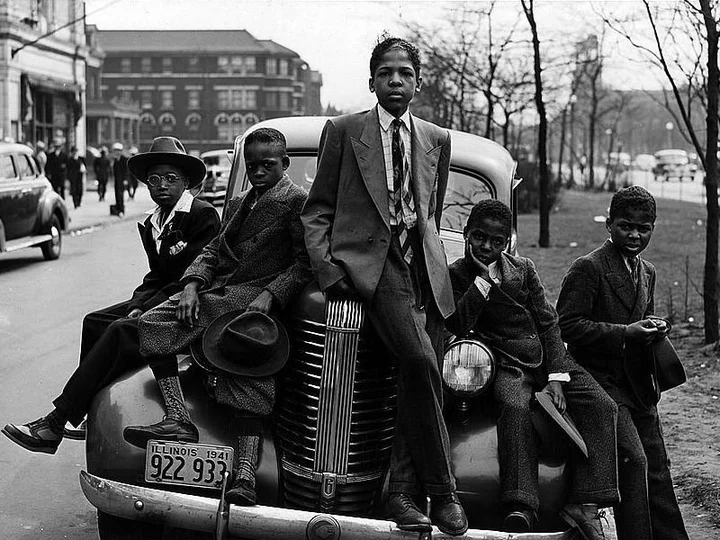
I have been following the article on the Chicago Migration. I have a photograph of the five boys that Tymaine Lee used in his article. Since then I have been trying to find more information about the photo .I have written the Library of Congress and found that it is on file there. If there is anymore information out there please post it for me. The photo can be viewed on the Huff Post .com. Under the Chicago Migration.
12:33 PM on 11/04/2011
They are migrating westward as well. Small communities in Iowa are seeing a major influx of black migrants from inner city Chicago. My community is doing much to get them jobs, training, and otherwise helping the town's new citizens to adjust to a very different environment. The biggest divider, as I see it, is that since my community is home to a major university, there is a huge class, cultural, educational, and values gulf between the existing black population (mostly educated professionals and college students) and the newcomers, some of whom would readily return to Chicago but that bridge has been burned (public housing in Chicago is being demolished and not replaced) so they have no choice but to adjust to the new setting and demographics and some are angry about it, feeling that the world they once knew has been yanked out from under them. This is, of course, not true of all new black arrivals. Those who came here in the wake of Hurricane Katrina have done very well, some even managing to open small businesses.
11:56 AM on 10/29/2011
Stop running build way you have.
08:39 PM on 10/27/2011
I can truly understant the migration back south. Chicago police kill blacks everytime they see them or so it seems. If I could move south I would too. It used to be quiet in the rural communities in Georgia.. I would never move to Atlantaa but my family has some property in Baxley and I am trying my best to get ther eto see what I can do with it. I remember going there as a child ..BUT wait as I remember, maybe I don't want to go to Georgia. Might as well stay in Chicago and get shot at. I am just sick and tired of snow.
photo
HUFFPOST SUPER USER
tchoupitoulav1
08:20 AM on 10/27/2011
Please don't move back, especially to Atlanta. We already have enough traffic.
09:02 PM on 10/23/2011
This is just a natural part of urban life.

I grew up in London, in the UK, of completely Irish working class roots. When I was a kid, Kilburn (in London) was a quarter of a million Irish. Today Kilburn is a mix of North African, Irish, and Asian. The old districts change. It's sad in a way, but it's the way it goes. Just as a century ago the poorest districts were once Irish, then Jewish, then Asian, and not they're home to north African Muslim communities.

What I don't see much of in this article is that a lot of urban Black migration is due to moving UP the social ladder, not just down. Maybe this article could have been blessed with a little more positive input?

It'll be sad to see my Kilburn in London lose its Irish identity that it's had for a century, but there was a time when Brooklyn was Irish too...and that's just the way it goes, folks. Hell, Chicago was once utterly dominated by the Irish!! Where have THEY gone?!

Still, knowing there's a Black Irishman in the White House is a very pleasing thought. Obama 2012!!
http://todayfreedom.blogspot.com/
12:21 PM on 10/21/2011
The northern cities used every resource they could feasibly and legally get away with to sabotage life for its black citizens, and now many blacks are giving up. The threat of gang violence, a threat undoubtedly condoned and even encouraged by those in power, has removed any possibility of a pleasant life in a predominantly black area. If a black person moves to a non-black area, they are subject to humiliating stops and searches by police officers. More diverse, hipster areas of downtown are too expensive for most black families.
05:38 AM on 10/20/2011
The old & new migration from one generation to generation x is different in it's own way. Yes, our ancestors of the south move to the north & midwest because of the economic situation that black people were facing as well as the harrassment going on down south before the civil rights era. My grandparents (on my mother's side) were from Virginia (Appomattox & Tide Water) but wanted to move to the east coast due to black people were able to get descent jobs while giving their children a descent education. My grandfather was in the construction business in the Washington, DC area where the construction company he worked for built 2/3 of DC public schools from the 30's - 60's. Most of his siblings as well as my grandmother's sibilings move from Virginia to DC, NY, Philly, Trenton, Baltimore & Newark. I will admit some of my relatives who were born & raised on the east coast have decided to move down south but a few came back because it didn't turn out to be a successful move because of our economic situation in the US or family tension with their children not being used to the country life vs city life they have experienced too long. Family must take in consideration about making a move from one part of the USA to another part of the USA.
10:09 PM on 10/22/2011
When I listen to Black Americans speak of their history, I feel lost, a little, as I have no Black history in the US. All I can do is try to understand. I can see where the children would hate the country life of the South if they were from the City. The South has some Metropolitan cities that would be a better blend for them, but if families who migrated to the North have land in the country areas of the Southern states, it would only make sense that they return to build on their lands.
photo
HUFFPOST SUPER USER
califson
He who throws dirt loses ground
09:46 AM on 10/19/2011
Without question becoming a "sucess" in America, and catching the American dream is certainly not the easy path as it once was. We have lost much of our industrial base. THere are many reasons, government regulations and taxes on business, unions, foreign competition, and our educational system. The opportunities in the south do appear to be greater than other parts of the country, the "New South." As a whole the people are more open, and willing to be of help to people in need. It comes down to personal ideology, attitude, and willingness to use what God gives you to make it in this world. Pointing fingers at history, a political party, or personal shortcomings is not going to move you toward what ever goal you have in life. THere are those who will suceed in spite of diffculties, and there are those who sit in the projects and cry for help from faceless government.
HUFFPOST SUPER USER
Dianne Jarreau
10:58 AM on 10/19/2011
"government regulation­s and taxes on business, unions, foreign competitio­n," were brought to you by one specific group: the Bush Menage, father and son. Poppy's idea and which his son obeyed by nonchalance when Poppy turned out to be a one-term president and ordered his son into office lest he not inherit what his father had to leave along with one of the biggest debts ever incurred to a really different nation:the People's Republic of China. From whom Poppy borrowed in order to fight his wars. The Bushes never paid it back but left it for you. The Chinese work with a unique system of employment producing products that we have to buy in order to pay the debt; which means we do not have jobs producing similar products because we owe on an outstanding debt.
photo
HUFFPOST SUPER USER
califson
He who throws dirt loses ground
11:49 AM on 10/19/2011
Dianne, you give the Bush family far too much credit (blame) The EPA and government regulations, taxes, unions, failure of our education system, and foreign competition was in play long before they took power. I was in business for over 40 years and saw it first hand. If we are to ever recover and rebuild our industrial base, its going to take a sweeping change in the way we see industry, (new and different kinds) government, education, trade, taxes, spending, and regulations. As you see now people with jobs who want to work are usually happy people. Far too many today just dont wish to work, and many of those who do are unskilled, under educated, or there is no job for them. We can fix it if we pull together as a nation and stop the finger pointing.
This user has chosen to opt out of the Badges program
photo
michelleobamaok
Are Racial and Religious Intolerance the New Gay?
09:42 AM on 10/19/2011
WOW! How's Obama working out for ya?
photo
Morena
¡Diga toda la verdad. Siempre!
09:32 PM on 10/19/2011
What intelligent person blames a president for decades of elements leading to gentrification in a particular city?
12:25 PM on 10/21/2011
Oh, we get it. You're just not smart enough to come up with an argument more intelligent than, "derr derrr, how's that hopy changy thing working out, duh, duh, derrr, derrr, derrr..."
photo
HUFFPOST SUPER USER
David Danio Jr
Breaking the barrier to share and sell..
04:18 AM on 10/19/2011
One of the saddest thing that will happen to human life is to leave his adapted habitat.
photo
HUFFPOST SUPER USER
billw8017
Obama/Biden 2012
01:40 AM on 10/19/2011
According to state prison records and the proportion of Blacks compared to the rest of the population, the worst states to be Black are Iowa and Wisconsin. Both states have a relatively small Black population in one or a couple cities, and some of the bias is due to countryside or suburban vs urban enmity. The Milwaukee suburbs are the state's Republican base.

The South is relatively mild in this regard.
HUFFPOST SUPER USER
Dianne Jarreau
11:26 AM on 10/19/2011
But shall not remain so. Some of my best friends worked to secure both the integration of education and housing in the so-called suburban Republican base. Until you understand who the actual people are who are calling the shots in Milwaukee and have never hired non-white workers in their family's industrial inheritance of family share-holders, you will not grasp the problem. Attorney Lloyd Barbee fought for half a century in Wisconsin to do away with educational segregation which Republicans are now fostering throughout the United State.The Koch brothers began the return of segregation in North Carolina which shocked both the white and black community who have been attending the same schools for some time. Not so Wisconsin. But then the Koch brothers own considerable paper production in Wisconsin timberland that once produced merely German language newspapers. There are Democrats lately seen at Lady Gaga's concert who further muddied the waters in Wisconsin in favor of NAFTA
HUFFPOST SUPER USER
Dianne Jarreau
11:40 AM on 10/19/2011
The reason's for "enmity" getting away with this stuff in Wisconsin can be seen in the U.S. Congress where you have Southerner Eric Cantor misbehaving like the subject of one of Harper Lee's novels, that little lost boy who gets treated like a genius surviving with his aunts in the Deep South until all the spoiled boy genius unravels from the inside out. Likewise pseudo-nazi in small caps by the name of Ryan although this is not the first time that has happened in history. He starts out by looking down on "old people" in his district whom he talks to like they are children and then he uses his Police Powers to demonstrate what he truly is. Have them throw the old man to the ground, handcuffed behind his back for showing disrespect to the Irish boss of a District from Rock county to the Lake Michigan shoreline.
11:02 PM on 10/18/2011
This article about the exodus of northern blacks to their southern roots, or "home." reminded me of the many young blacks I've met in my travels, who sat in dejection and lost after returning from their flight "home." What went wrong,I would ask.. They all sang the same sad song; the folks "down home" weren't welcoming; jobs were scarce; their contemporaries behaved in an aloof manner--snobby. And racism was rampant. Most of the young, 20/30 somethings were NOT PROFESSIONALS. Most were semi-skilled and skilled labor force. How the least are treated is a good indicator of the living/working environment. I listened sympathetically. Keep looking., was part of my advice. Also find out what is lacking in your skills and fill it before moving on. The
young black women, for the most part, were hoping to find a " good man." So many expectations, based mostly on hearsay and nostalgia have been dashed by the young black pilgrims going "home." In my heart I say to all of them, as did THOREAU, "Go confidently in the direction of your dreams...Live the life you have imagined." And too, it IS a big world with three other directions,
as well as oceans and rivers to cross..
photo
HUFFPOST SUPER USER
Jondrea Smith
untied dog in a dogmatic society
11:40 AM on 10/19/2011
I think one of the things they have to be cognizant of is that there is a reason their relatives left in the first place. And if things haven't improved since then, then there's really no reason for them to look back. The other thing is that the adaptations that once served them well living in the urban centers up north may not be as effective once they're back home. I think there has to be an evaluation of whether or not conditions are really better, as well as a re-acclimation to their new-old surroundings.
09:08 PM on 10/23/2011
There's a beautiful elegance about your prose; a reflection of a deep soul with a wise heart.

I'm a British-Irish Bobby Kennedy obsessive and I love how you managed to quote Thoreau in this commentary.

You should google "Ulysses by Alfred Lord Tennyson" - the Kennedy boys were all obsessed with that poem. They constantly quoted it. Bobby in particular has a very special place in my heart.

God bless you, madame.

David.
http://todayfreedom.blogspot.com/
10:09 PM on 10/18/2011
When I moved to New Hampshire. I had two Black supervisors and a number of white supervisors. Even though there are civil rights laws we have a lot of "old guard" "cult like" mentalities around with a little "situational influence strategy", "creative script" "fear and reward like the threat of burning your "social and networking bridges", propaganda and political genius one can creatively circumvent the laws and policies. Sad. The "Old Guard is well distributed in this country. Minorities would fair better if they understood it rather than reacting to it- good luck.