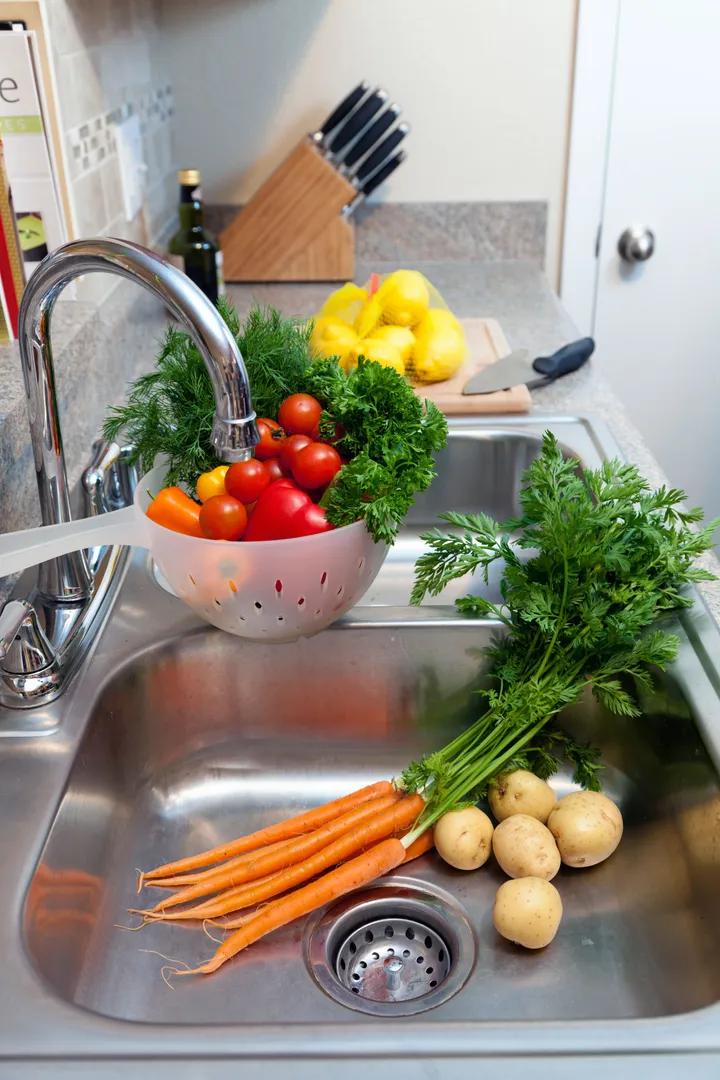
After my last column, a reader asked how to wash fruits and vegetables, specifically. Great question, and one that I find that many of us take for granted -- and we cannot afford to take food hygiene practices for granted. Why? Good food hygiene that you and I practice at home, every day, can have a significant impact on our public health. Yup, it’s true. You and I can help prevent the spread of food-borne illnesses just by taking time to wash not only our hands, but also our fruits and vegetables.
It’s essential that we know how. This is a great example of the ripple effect: what you do in your kitchen affects all of those around you, and they in turn affect those around them, and so on ... et voila, before you know it, your everyday practices have affected the public health of untold individuals!
So, let’s get down and dirty. How do you actually keep your kitchen safe, and thus ensure that you and your family stay healthy? Let’s pick up where I left off last time: after you’ve washed your hands (and in case I wasn’t strong enough in my last column … wash, wash and wash some more!), be sure to always do the following.
1) Clean your work surface, i.e. counter-tops, cutting boards. You can wash the surfaces with warm water, or a commercial preparation specifically made for countertops. Remember, sponges harbor bacteria, so if you use them be sure to clean them frequently. (I prefer paper towels)
2) Let your inner decorator out: invest in several cutting boards, maybe a blue for chicken and a red for vegetables. Using different cutting boards for raw meat, fruits and vegetables is an easy way to cut down on the risk of contamination. You can run them through the dishwasher, as well, to get them good and clean.
3) Invest in a good food thermometer (stocking stuffer, anyone?). Don’t just go by time, or color, when checking to see if your chicken or meat is cooked. Many recipes advise how hot the meat should be when it’s done, and when it doubt, you can always look it up as well.
4) And while you’re out buying multiple cutting boards, purchase some more storage containers (I just got glass ones with all different color lids that I can microwave in as well as use for storing leftovers in the fridge). You can store food in plastic (check for BPA-free!) or glass containers, but it isn’t recommended to microwave in some plastics. Rather than try to remember what I can and cannot reheat in, I prefer just to use glass containers whenever possible.
Ok, now on to the fun stuff: the food itself.
Lots of research has been done looking at the best way to wash fruits and vegetables. Does tap water suffice? Should we use vinegar, should we use specific vegetable wash solutions?
In their article, Kilonzo-Nthenge et al. evaluated multiple methods for washing vegetables, including presoaking the vegetables, running them under tap water, brushing them, using paper towels, and also using vinegar and lemon preparations.
All in all, they concluded that soaking in cold tap water was not significantly different than using other preparations, such acidic solutions (think vinegar or lemon). In addition, they found it helpful to rub or brush the vegetables.
So, whether you are just eating an apple (and aren't they great right now?) or making home-made soup or stir-frying vegetables, be sure to scrub them under water to get them good and clean before you eat them.
Our 2024 Coverage Needs You
It's Another Trump-Biden Showdown — And We Need Your Help
The Future Of Democracy Is At Stake
Our 2024 Coverage Needs You
Your Loyalty Means The World To Us
As Americans head to the polls in 2024, the very future of our country is at stake. At HuffPost, we believe that a free press is critical to creating well-informed voters. That's why our journalism is free for everyone, even though other newsrooms retreat behind expensive paywalls.
Our journalists will continue to cover the twists and turns during this historic presidential election. With your help, we'll bring you hard-hitting investigations, well-researched analysis and timely takes you can't find elsewhere. Reporting in this current political climate is a responsibility we do not take lightly, and we thank you for your support.
Contribute as little as $2 to keep our news free for all.
Can't afford to donate? Support HuffPost by creating a free account and log in while you read.
The 2024 election is heating up, and women's rights, health care, voting rights, and the very future of democracy are all at stake. Donald Trump will face Joe Biden in the most consequential vote of our time. And HuffPost will be there, covering every twist and turn. America's future hangs in the balance. Would you consider contributing to support our journalism and keep it free for all during this critical season?
HuffPost believes news should be accessible to everyone, regardless of their ability to pay for it. We rely on readers like you to help fund our work. Any contribution you can make — even as little as $2 — goes directly toward supporting the impactful journalism that we will continue to produce this year. Thank you for being part of our story.
Can't afford to donate? Support HuffPost by creating a free account and log in while you read.
It's official: Donald Trump will face Joe Biden this fall in the presidential election. As we face the most consequential presidential election of our time, HuffPost is committed to bringing you up-to-date, accurate news about the 2024 race. While other outlets have retreated behind paywalls, you can trust our news will stay free.
But we can't do it without your help. Reader funding is one of the key ways we support our newsroom. Would you consider making a donation to help fund our news during this critical time? Your contributions are vital to supporting a free press.
Contribute as little as $2 to keep our journalism free and accessible to all.
Can't afford to donate? Support HuffPost by creating a free account and log in while you read.
As Americans head to the polls in 2024, the very future of our country is at stake. At HuffPost, we believe that a free press is critical to creating well-informed voters. That's why our journalism is free for everyone, even though other newsrooms retreat behind expensive paywalls.
Our journalists will continue to cover the twists and turns during this historic presidential election. With your help, we'll bring you hard-hitting investigations, well-researched analysis and timely takes you can't find elsewhere. Reporting in this current political climate is a responsibility we do not take lightly, and we thank you for your support.
Contribute as little as $2 to keep our news free for all.
Can't afford to donate? Support HuffPost by creating a free account and log in while you read.
Dear HuffPost Reader
Thank you for your past contribution to HuffPost. We are sincerely grateful for readers like you who help us ensure that we can keep our journalism free for everyone.
The stakes are high this year, and our 2024 coverage could use continued support. Would you consider becoming a regular HuffPost contributor?
Dear HuffPost Reader
Thank you for your past contribution to HuffPost. We are sincerely grateful for readers like you who help us ensure that we can keep our journalism free for everyone.
The stakes are high this year, and our 2024 coverage could use continued support. If circumstances have changed since you last contributed, we hope you'll consider contributing to HuffPost once more.
Already contributed? Log in to hide these messages.