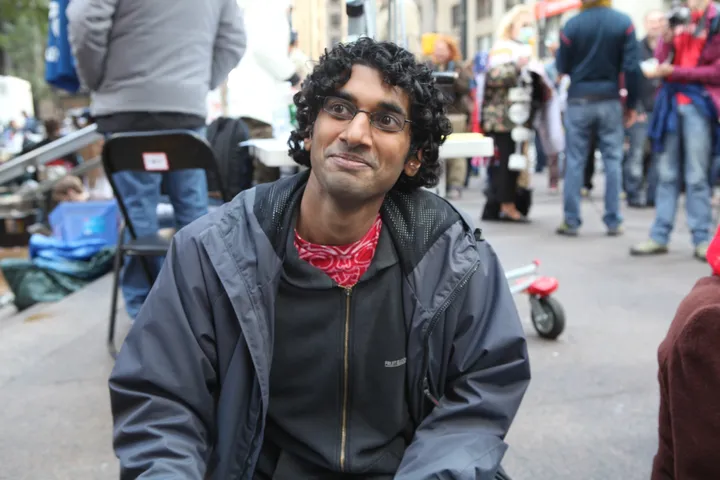
This is the seventh piece in a series profiling the protestors at Occupy Wall Street.
Even before it became clear that the economy was streaking toward disaster, Suresh Naidu figured something like this would happen. "It's been no secret in economics that inequality has gone up,” he said recently. Naidu is a professor of economics at Columbia University, and it seemed obvious to him that high inequality plus a high unemployment rate would result in political turmoil.
Then, one day in September, Zuccotti Park filled with protesters, and soon, Naidu was leading a free Sunday morning seminar on economics in the park’s southeast corner.
His seminar usually draws about 20 people, and topics vary from "what the banks actually do,” to “the problems and promise” of co-ops, credit unions, and alternative currencies -- when might they be a good idea, when might they be a bad idea."
At first, he said, he wanted to keep his Occupy Wall Street role separate from his work as an economist. Then he started hearing calls to 'end the Fed,' and to bring back the gold standard.
"There were a lot of bad ideas floating around down there," he said. "When you actually push people on those ideas, it turns out it's based on a not-so-perfect understanding of what they're really upset about and what the economics look like."
Naidu is not the only academic aligned with the Occupy Wall Street movement, nor is he the most well-known by a long shot. His Columbia colleague Joseph Stiglitz makes occasional appearances at the park, and Cornel West has become a tuxedoed star of the media coverage.
[Click here to watch a video of Naidu participating in a Columbia panel on the protest.]
What sets Naidu apart is the extent to which he's involved in the day-to-day activities of the Zuccotti community. You won’t find him sleeping in the park, but few who know him would question his commitment to the protest. He spends long hours there, and to save time, occasionally asks his students to meet him in the park to discuss their papers.
Does he worry about how that commitment might affect his academic work? "All the time," he said.
Eric Verhoogen, a colleague of his in Columbia's economics department, said the other professors tend to view his involvement with a mixture of curiosity and amusement. "There is a general acceptance of quirkiness and general eccentricity among academics," he said. "And so I think in Suresh's case it's chalked up to eccentricity."
One recent evening, Naidu sat in a stuffy high school cafeteria on Pearl Street with about 200 other protesters, who had arranged themselves in a circle on the floor. At 33, Naidu is young for a professor, and with his slight build and his propensity to break into laughter at the tiniest incitement, he could pass for 10 years younger.
The protesters gathered that night for the debut of a controversial decision-making body called the "spokescouncil." Some of them were worried that the new system would lead to the emergence of a hierarchy within the movement, but its supporters insisted that it would preserve the movement’s "horizontal and directly democratic" structure while allowing the protesters to make decisions more efficiently.
Naidu was one of the idea's supporters. In addition to leading his Sunday morning seminars, he's been active in the structure working group, which crafted the spokescouncil proposal over three intense weeks of debates and meetings.
He first participated in a spokescouncil meeting in 1999, at the World Trade Organization protests in Seattle. He remembers sitting in a warehouse, the rain falling on the sidewalk outside, and being amazed to realize that "you can actually have all these people making consensual decisions, making sure that everyone's voices were heard."
It was in Seattle that he first decided to go into economics. "You realized, 'There're not very many economists coming out of our political movement,' and so I thought I could be one of those," he explained.
He studied at the University of Massachusetts at Amherst and then at Berkeley before arriving at Columbia, focusing on political economy, economics history and labor economics. His first research paper, which he wrote with Michael Reich and Arin Dube, showed that an increase in the minimum wage did not, as many economists assumed, necessarily lead to an rise in unemployment.
He grew up in Newfoundland, where, he says, dinner occasionally meant moose curry. His parents came from, in his words, "small villages in the middle of nowhere, India." He said his visits to those places made a lasting impression on him.
"You're a 6-year-old and you see your counterpart, who's another 6-year-old, having blond hair from malnutrition," he said. "That will stay with you."
A few days ago, Naidu reflected on his experiences in the anti-globalization movement that emerged from Seattle in 1999. "It was exciting and exhilarating -- and it felt like we were winning," he said. "I think for like two years we were winning -- and I think we did win. Now, as a professional economist, I look back on that and think, ‘Wow, that was a great thing we did -- changing the terms of the debate on free trade and exposing the politics that were underlying what was supposed to be win-win for everybody and in fact might not have been."
"Even now that I'm teaching economics," he continued, "so many of the people that I hang out with, that I associate with, are people that I hung out with in that period."
"And that is what I think will happen with the Occupieds," he said. "Even if the movement goes away, the social networks that have formed will hang around. People will be friends, even if they're no longer camping together in the camps, and when strangers meet in whatever venues, they'll be like, ‘You were there,’ and there will be an immediate rapport. In the long run that will have a big political impact."