iPhone app iPad app Android phone app Android tablet app More

Middle School Transition Affects Future Academic Setbacks, Study Says

Middle School Students

  Kathryn Baron First Posted: 11/30/11 11:54 AM ET Updated: 11/30/11 12:17 PM ET

This story comes to us courtesy of Silicon Valley Education Foundation's Thoughts On Public Education blog, TopEd.org.

The idea that hormonally-challenged young teens need a school of their own between elementary and high school turns out to be bad academic policy, according to a new study from Harvard University. Compared with students who attended kindergarten-through-eighth-grade schools, middle school students did worse on math and English language arts in high school, and were more likely to drop out.

Researchers analyzed data for all 3rd through 10th grade students in Florida public schools from the 2000-2001 academic year to 2008-2009 - more than 450,000 students. They used Florida because the state"s student data system is the most extensive in the nation, following students from kindergarten through college, using unique identifiers to protect privacy.

The report poses a noteworthy juxtaposition to "Gaining Ground in the Middle Grades," a large 2010 California study by EdSource and Stanford University that examined the practices and policies of top-performing middle grades programs, whether they"re within a K-8 school or in a separate middle school. "Gaining Ground" studied 303 middle grades schools and surveyed more than 4,000 principals, superintendents, and math and English language arts teachers. It found "no clear association between grade configuration ... and higher school performance on standards-based tests."
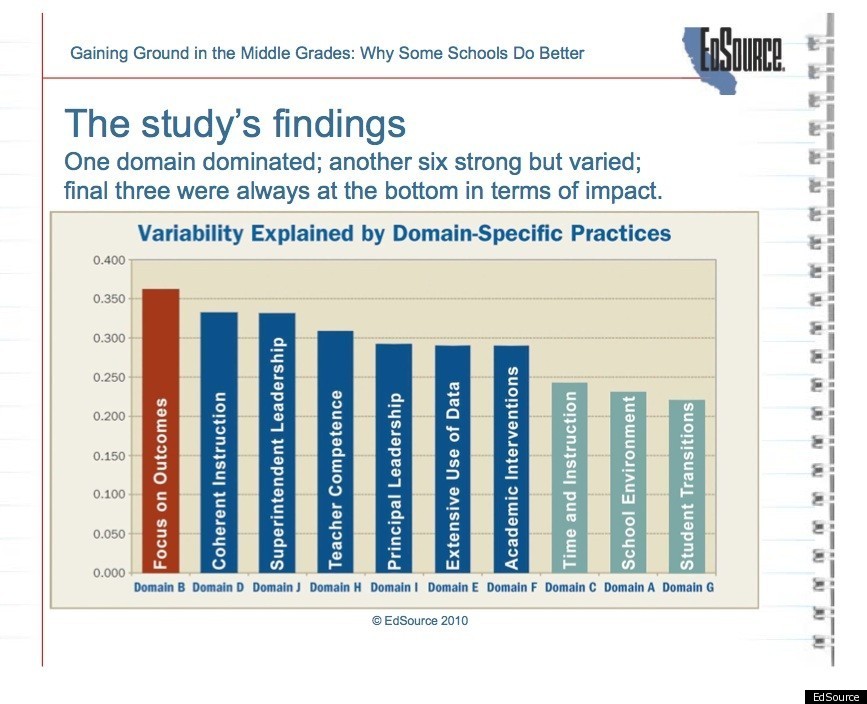

Most significant policies and practices for middle school succes.

Matt Rosin of EdSource, the senior research associate on the project, said the findings painted a clear picture of what sets apart higher performing middle schools. "In everyday ways they were more intense and intentional about accepting and sharing accountability for results and setting measurable achievement objectives," said Rosin.

But results of the Harvard study seem to suggest that the best middle school reform would be to close them down and put the students into a K-8 environment.

"We know there are high performing middle schools that are doing a great job, but that doesn"t mean that the choice of grade configuration is irrelevant," said Martin West, an associate professor at the Harvard Graduate School of Education and co-author of the Florida study. "We find pretty compelling evidence that the transition itself does have substantial costs in terms of student achievement."

That evidence is disquieting.

  • Students who finish elementary school in 5th grade and move to middle school experience a significant decline in math and English language scores that continues into high school.
  • Even though middle school students enter 6th grade doing better than their K-8 counterparts, that advantage is reversed by 10th grade.
  • Florida students who attended middle schools were 18 percent more likely to drop out of high school than K-8 students.
  • High school absenteeism is higher for middle school students than K-8 students.
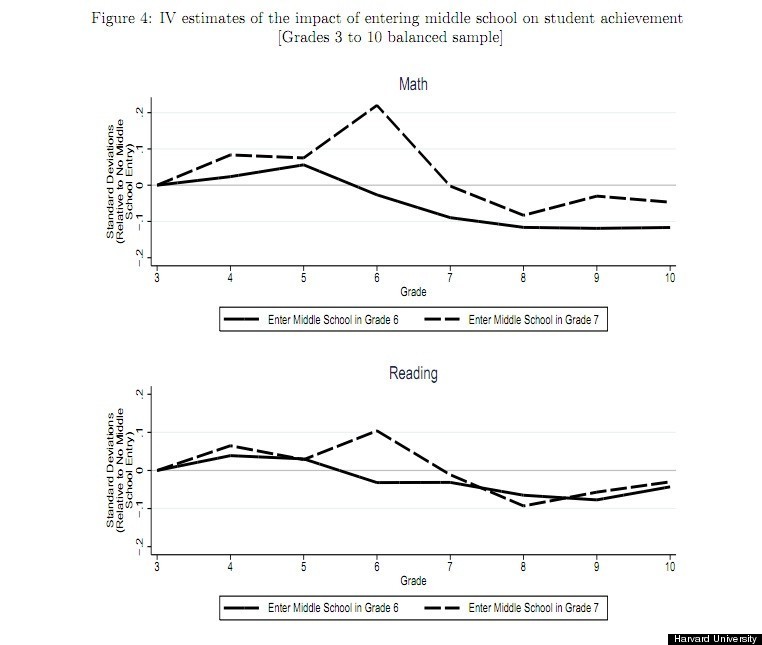

Impact of middle school on student achievement to grade 10.

The Harvard study doesn"t have all the answers. One of its conclusions is that "more research is needed to explain the negative effects of middle schools." Few people disagree with that. Just last summer, at the National Forum"s Schools to Watch Conference, U.S. Education Secretary Arne Duncan remarked that "the middle grade years have sometimes been called the "Bermuda Triangle" of K-12 education" because too often they"re a time where students "sink or swim."

At the same meeting, however, Duncan had strong praise for the EdSource/Stanford study for providing clear direction for improving middle schools. Stanford Professor Edward Haertel, the study"s technical director, said the Harvard evidence seems credible, and he doesn"t see a contradiction or connection between the two. "We didn"t look at movement to high school at all, and we weren"t focusing on transitions," Haertel said.

Harvard"s West acknowledged that it"s still not clear what it is about the transition to middle school and the middle school environment that"s causing student achievement to fall. So he had some slightly equivocal advice for middle schools.

"I don"t think we understand what"s causing the problem well enough to mitigate it," said West. "That being said, they should make efforts to actively do things."

Kathryn Baron is a co-writer of TOPed.org, a blog on California education policy. Read more of her work and more at www.toped.org.

FOLLOW HUFFPOST EDUCATION

This story comes to us courtesy of Silicon Valley Education Foundation's Thoughts On Public Education blog, TopEd.org. The idea that hormonally-challenged young teens need a school of their own bet...
 
 
  • Comments
  • 40
  • Pending Comments
  • 0
  • View FAQ
Comments are closed for this entry
View All
Favorites
Bloggers
Recency  | 
Popularity
foresure
Brash and Harsh
12:09 AM on 12/04/2011
Great:

Another effort to eliminate any standards and any boundaries in school. Can you imagine parents suing in Federal Court so their hormonal daughter can where a sexually suggestive bracelet.

Good for them.

Did you see the really helpful teacher who brought a transexual male student a used dress that had been her daugter's. (See Huffington Post).

For sure. There should be no authority structure or structure or boundaries.

The fact that countries that set standards for their teachers and their students are producing students way ahead of our own students, shouldn't concern us, as long as our children are completely "self actualized".
08:11 PM on 12/03/2011
here is a study if you keep allowing non educated business jerks to play around with the USA educational system, then all students will be failing out. no need for teachers, buildings, and all the staff.... a better approach is to get business out of education and let the educators educate.. better to put a teacher in charge of the stock market than a hedge fund operator in charge of education
08:03 PM on 12/03/2011
it depends on how the middle school reinforces growth, hormones, emotions, and assisting these students to become more independent thinkers. Teaching a student to beocme an independent thinker is learning, teaching a student to take a test gets a student that can take a test but is not necessarily an independent thinker. Business wants the results in black and white statisitcs to shove in your face see the student [asted the test. We as parents want independent thinkers . Do not let the Dept of Ed or anyone else try to sell you this bs snake oil . it is bogus
09:07 AM on 12/01/2011
Parents "giving up" has a lot to do with middle school failure. As a teacher who moved from 3rd to 6th grade, I was shocked how concerned 3rd grade parents couldn't be bothered by the time their child was in 6th grade. Schools also need to start separating the lows and slows from those who can. Too many academically strong students stop working because teachers have to waste so much time trying to remediate the low students. There is such a significant difference between students who can and want to learn and students who can't and don't want to put in the time and effort.
foresure
Brash and Harsh
12:15 AM on 12/04/2011
SoCalifTeacher:

We can solve this problem. It shouldn't cost more than about $35 million in research grants, and five years of reports. After that we have the basis to go further.

It might cost a bit more, if you consider the interruptions in actual teaching that would be entailed in the research.

Its really a shame that no one has done any useful educational research in the last fifty years. Maybe in the next fifty years.

Either that or a school district could ask the local Catholic School system how they do it. But that would spoil so, so many special summer school programs for teachers
photo
HUFFPOST SUPER USER
Michael D Ballantine
Texas Justice Party - Chairperson
11:49 PM on 11/30/2011
Packing all the students into one K-8 program would create bigger schools, so if we move all of them to K-8 programs, we will need smaller schools on average to accommodate the additional grades. Why not get rid of grades all together and go to subject mastery. Students work in three year increments with the same teachers and develop subject mastery. K - 2, 3 - 5, and 6 - 8. At the end of 8th grade, everyone takes a test and then based on merit, students are tracked into vocational programs, technical programs, or academic ones. Instead of a one-size fits all everybody goes to college program, let's start offering education students want and give them three choices.
HUFFPOST SUPER USER
Conuly
12:32 PM on 12/01/2011
No, it wouldn't necessarily make bigger schools.

Let's say that your local public school has grades k-5, three classes per grade. That's 18 classes of children, 3x6.

If you add three grades, but only have TWO classes per grade, you still have 18 classes of children - 2x9. The school is the same size, and has the same number of students, it just has a larger spread of ages.
photo
HUFFPOST SUPER USER
Michael D Ballantine
Texas Justice Party - Chairperson
05:47 PM on 12/01/2011
Middle schools are usually centralized and not convenient for all elementary students. That would require sending elementary students away from their neighborhoods. They may be a negative unintended consequence that would affect their performance.
foresure
Brash and Harsh
12:16 AM on 12/04/2011
Michael:

Why not introduce order and standards for both students and teachers. Give the teachers actual authority.

Of course that would wipe out much of the academic study of "education".
photo
HUFFPOST SUPER USER
Michael D Ballantine
Texas Justice Party - Chairperson
06:31 PM on 12/04/2011
Educators are limited to researching things they can define and measure. Motivation is one of the key issues in poor performance but you can't measure it so no one studies it directly. Like the common cold, medicine focuses on symptoms but not the cure. Academic research focuses on the symptoms of poor motivation but not the direct cause. If students listen to their parents and their parents talk about how America is going down hill and the future is not very bright then why would students be motivated to learn? If someone cannot relate work effort to direct positive outcomes, then most people will not make the effort. Educators think that because education was important to them that it should be important to everyone. They never stop to ask the question does the cost equal the benefit. If there are no jobs and education is not a ticket up, then what is the point. Most people would rather have a few bucks in their pocket than put in a lot of effort and have empty pockets. We cannot improve education until we improve the way we employ people or until we have real jobs to offer them.
This user has chosen to opt out of the Badges program
08:17 PM on 11/30/2011
continued:

Another reason why middle school students may not do well in middle school is the teachers in elementary school tend to coddle students by giving them many opportunities to turn in late assignments instead of sticking to a due date. Teachers in middle school and high school are much less lenient about that and it comes as a shock to many students. They are used to having their hands held and being treated like children instead of young men and young women, and some rebel by refusing to work or increasing other bad behavior. This usually lasts until about winter break when they realize the teachers mean what they say and then most accept it and adjust. They also get less extra help. Many middle schools do not have the number of aides in elementary schools, so the students in middle school have to be more independent, and if they goofed off during elementary school then those lacking skills really hurt them.
09:16 AM on 12/04/2011
I've been a middle school teacher for 9 years. I absolutely love teaching middle school. I also happen to really dislike teaching high school. I agree with you completely. There have been so many times where I've told a student, "No, it is past the due date. You can't turn it in." Then, mom calls the principal, complains and I'm forced to accept the assignment. You then end up with kids who don't actually learn anything. They just cram to get everything done during the last week of the quarter.
This user has chosen to opt out of the Badges program
08:17 PM on 11/30/2011
If there is a return to K-8 schools, then they need to be kept separate from the younger students anyway--maybe in a different part of the building--simply because their behavior and language is not something the younger children should be subjected to. Profane language in elementary schools is pretty rare among most young children. Profane language in middle and high school is very common in that age group. Too, most parents do not want their young children on a school bus with much older students; we have come up against that in trying to make bus schedules that are efficient and cost effective.
HUFFPOST SUPER USER
Warhammer Jones
05:26 PM on 11/30/2011
Why would it matter? The 7th graders would still all be together, both in and out of class, regardless of whether they attended a K-8 school or a 6-8 school. Does the mere proximity of younger kids somehow change the behavior and attitude of the adolescents? Very interesting.
03:46 PM on 11/30/2011
Very interesting article. I work for Los Angeles Unified School District and we also conducted a study to analyze academic scores for middle grade students over time while looking at school configurations. Ours were never published of course.

Overall, like Harvards study, ALL scores significantly dropped for students who transitioned to 6th and 7th grade. Some school configurations were better then others but they still all dropped. It's funny how the researcher claims more research is needed to understand why. To be honest, I doubt more research is needed.

Discussing with other people who have middle school direct experience, and having worked and taught in Elementary and Middle School myself, the only explanation I can come up with is "puberty" or another way to look at it is, "growing up." At this age, these kids start challenging authority, wanting to be cool and hook up with each other, as well as school work becomes a lot more challenging. Every tried raising a teenager? What a nightmare!!! LOL. When you combine this with a minority population that is poor with other serious issues, it makes sense what is happening.

I hope nobody uses this as reason to attack unions or public schools because I guarantee you Charters would do no better. Isn't turnover highest amount middle school teachers?
foresure
Brash and Harsh
12:19 AM on 12/04/2011
Cain:

I am glad the the Los Angeles Unified School District conducted a study. Of course it wasn't published. That wasn't the point.

Its part of the whole waste of time associated with the "education industry".

Too bad no one ever heard of the success of the Catholic education system.
03:43 PM on 11/30/2011
a few things:
- i would not be surprised to find out that parents who make a point of getting their children into k-8 programs are more likely to succeed anyway (eg due to home environment) -- stability is an important factor for those parents.
- it is not clear whether the decline in middle school is a result of a shift of demographics. for example, children are most likely to leave lower performing districts at the middle school level, often leaving the resulting middle school with the lowest performers. I could not tell from the study whether that shift was taken into account.
04:00 PM on 11/30/2011
1) Your right on the first part. Parents who actively play a role in getting their children in certain programs/schools would most likely have "some stability" at home.
2) At my district, we followed the same group of students from 6th to 7th. All scores dropped, regardless of school configuration. We didn't look at demographics specifically but most of the students are minority anyways.
04:43 PM on 11/30/2011
interesting. i noticed recently that the rates of students with disabilities seemed to climb significantly at the 6th grade and middle school in general, level. i guess if you followed the same group of students one wouldnt expect any kind of shift like that, but i guess that could have an impact on the other kids. in our district, the middle school environment is utter chaos in comparison with elementaries. one likely factor is the sheer size of those middle schools.
03:29 PM on 11/30/2011
By 6th grade, the different rates that students learn is creating a really diverse class. My 6th grade son skipped to 7th grade math. He has a friend who skipped to 8th grade math. Some of the math teachers spread the younger students out among the older students to serve as tutors for the older students. The divergence in reading levels is even greater.

It is difficult enough to manage such a diversity in levels in a Middle School, where students can be spread among grade levels as well as among honors and remedial classes, but how is an elementary school going to handle such variation without simply neglecting one or another group?
HUFFPOST SUPER USER
Conuly
03:39 PM on 11/30/2011
You do know that k-8 schools have existed since the beginning of the school system, right? And that in most middle schools, students stay in one group for all their academics instead of being switched around. They change teachers, but not levels.
06:02 PM on 11/30/2011
I suspect that such schools fail the students who are not in the middle then.

By 6th grade you are going to have at least a 4 year variation in math level and probably a 8 year variation in reading level. I don't know how a teacher in a single class can appropriately teach such a variation. You will have some 7th graders still doing arithmetic, others who have mastered algebra1 and are doing geometry. Some will be reading at a 4th grade level (or lower) and others who are reading at a 12th grade level. How do you give appropriate classwide reading and writing assignments to such a class?

My 14 year old daughter is now in 10th grade. She is taking calculus for college credit and AP/IB courses. She is off to college next year. And she knows other students at the high school who are at least as advanced as she, one who is a year younger.
06:32 PM on 11/30/2011
It appears my earlier reply was lost.
I am not convinced that keeping all the kids in the same class works for all the kids.

By 6th grade you probably have kids spread over 4 math levels - arithmetic through algebra. You probably have reading levels spread over 8 levels - 4th grade or lower through 12th grade. And it gets worse as they get in higher grades- some kids are moving a lot faster than others (and the movement can be subject specific).

My 6th grade son, who is not very studious, is taking 7th grade algebra and has a 6th grade friend taking 8th grade algebra. Some of the 6th graders have 12th grade reading levels.

My 14 year old daughter (officially 10th grade) skipped 8th and 10th grade classes. She is taking calculus for college credit and a full load of AP/IB courses. She will go to college next year. And she knows a number of students who are roughly as advanced as she. She knows of one 9th grader who is 12, following a similar path.

K-8 programs do not deal with such children well.
03:51 PM on 11/30/2011
I don't know about you but trying working in a minority (non-asian) middle school. Nightmare!!!!! At this age, kids challenge authority like you wouldn't believe. Suspensions don't work and when parents are called, most don't speak English or know how to discipline. Kids are sent back in and they know their parents and the system won't do anything about it. Plus, school work becomes very challenging and just not cool for them to do it anymore. Middle school is where you start to see gangs start to form. That is where they start experimenting.
05:52 PM on 11/30/2011
I went to junior high school in DC. I was lucky to get out with my hide still intact. I would never wish that on anyone. But I am not sure that it is that linked to the school - I started seeing strong group / clique development at my eldest daughter's 6 th grade class in Princeton. She spent the next 2 years in an all girls Catholic school.

I doubt that keeping them in a K-8 school will prevent such issues.
01:52 PM on 11/30/2011
No, first grade is. Send them in reading, speaking English and knowing how to behave and half our battles will be won.
03:51 PM on 11/30/2011
Exactly!!!!
photo
HUFFPOST BLOGGER
Lori Day
Educational psychologist and consultant
12:33 PM on 11/30/2011
Earlier in the last century, there were no separate middle schools. Children attended “primary” or “grammar” school from Kindergarten through eighth grade, and then went on to “secondary” or “high” school. Moving into the middle of the century, the Junior High movement came about and some primary schools started to end after sixth grade, with seventh and eighth graders grouped in two-year-only buildings. In the 70’s middle schools began to emerge with the grade 6 – 8 configuration. The new model was based upon the belief that children in this age group have unique needs that can be best met if they are separated from both older and younger children.
We do need to re-think whether this age group should remain separate in any configuration at all, or should return to its original home in the K – 8 primary school model. A consensus is beginning to develop among educators and other professionals that middle schools are not only “the weak link in the chain of public education,” as they are often called, but they represent a completely failed experiment. I think K-8 groupings absolutely make the most sense.
03:55 PM on 11/30/2011
My work conducted a study based on school configurations and for the most part, concur with the Harvard study. Students who transitioned to 6th and 7th grade, all dropped in performance. I believe outside factors played more of a role in student performance then school configuration, since they all dropped.