
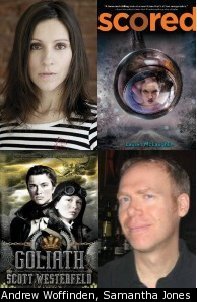
You know that bad dream? The one where you’re taking a test that you haven’t prepped for? And you wind up with the night sweats and an extreme case of sleep-eating? Somehow, our friends at Figment.com managed to convince two of our favorite authors to actually LIVE that nightmare. Lauren McLaughlin (Scored) and Scott Westerfeld (Leviathan) agreed to subject themselves to the essay portion of the SAT—and to have their responses scored for the whole world to see. (Cue a fresh bout of the night sweats.)
So how’d they do? Click over to the next page to see their graded essays – with our scorer’s comments in bold and italics. Boomie Aglietti, a writer and tutor for Revolution Prep (who claims to have scored four billion on the SATs) assessed the authors’ essays, using the real SAT grading rubric.
On December 8 at 7 p.m. ET, Scott and Lauren will be joined by David Levithan (Will Grayson, Will Grayson) and Robin Wasserman (Cold Awakening ) to take questions from young writers about what they learned about writing when they were in high school. Click here to find out more.
The GuidelinesThe essay gives you an opportunity to show how effectively you can develop and express ideas. You should, therefore, take care to develop your point of view, present your ideas logically and clearly, and use language precisely.
Your essay must be written on the lines provided on your answer sheet — you will receive no other paper on which to write. You will have enough space if you write on every line, avoid wide margins, and keep your handwriting to a reasonable size. Remember that people who are not familiar with your handwriting will read what you write. Try to write or print so that what you are writing is legible to those readers.
You have twenty-five minutes to write an essay on the topic assigned below. DO NOT WRITE ON ANOTHER TOPIC. AN OFF-TOPIC ESSAY WILL RECEIVE A SCORE OF ZERO.
Think carefully about the issue presented in the following excerpt and the assignment below.
All communities and groups have reliable rules of right and wrong in the form of laws, values, and social standards. It is therefore generally assumed that most people know the difference between right and wrong and that they usually know the right thing to do. This view is simplistic, however. People often find themselves in complex situations for which no rule provides adequate guidance and the right course of action is unclear.
Assignment: Is it often difficult for people to determine what is the right thing to do? Plan and write an essay in which you develop your point of view on this issue. Support your position with reasoning and examples taken from your reading, studies, experience, or observations.
Click to the next page for Lauren and Scott's essays.
Lauren’s essay
The Golden Rule teaches us to “do unto others as you would have others do unto you.” Very few people would disagree that this is a solid and defensible basis for a universal morality. [Nice hook to introduce complexity of issue.] Despite this, however, we often find ourselves at odds with each other on moral issues. How can this be? How can one group of people, for example, believe that abortion should be outlawed as murder, while another group believe that a woman’s right to control her body must always be protected? Further, how is it possible that still another group of people find themselves somewhere in between these two views? Is it because we don’t agree on the basic principle of doing unto others as you would have others do unto you? Or is something else at work here? [Good topic sentence]
I believe there are several factors at work. For one thing, how a person frames the issue is of paramount importance. Those who believe the unborn child is the principle agent in need of protection, are likely to find it acceptable to inconvenience—and even jeopardize the health of–a woman. The unborn child, being defenseless, this line of reasoning goes, is more deserving of protection. For those on the other side of the debate, the framing is different. Since it is possible, and indeed common, to believe that an embryo or fetus is morally different from an actual baby, there is no unborn “person” to protect. Therefore, the only person whose rights must be protected is the woman. Both frames, though completely at odds with each other, are more or less logically consistent. [Good closing sentence to a well-constructed paragraph.]
The third position — the great middle ground — is less logical and, therefore, less defensible. It is interesting, therefore, that so many people find themselves in this position on the subject of abortion. The middle ground position holds that abortion should be legal in some cases, but not in all cases. For example, in the case of rape or incest, or to protect the life or health of the mother, abortion should be legal. In all other cases, this position holds, abortion should be illegal. Supporters of this middle ground often consider themselves the moderate voices of reason and tend to characterize people on both the pro-choice and pro-life side as “extremists.” But upon further analysis it becomes clear that the middle ground position is completely indefensible. If abortion is, indeed, murder, why should it ever be legal? It’s not the fetus or embryo’s fault that it was conceived through rape or incest. Nor is it the fetus or embryo’s fault that its existence is causing harm to the mother. If a fetus conceived through consensual sex has rights that deserve protecting, why doesn’t the fetus conceived differently have those rights? [Strong logical analysis.]
The middle ground position, in fact, is not a moral position at all. Rather, it is a position of emotional and intellectual convenience. It allows people, who tend to be apolitical or moderate in their thinking, to elevate themselves above what they consider an ugly and needlessly combative fray. In the absence of a solid underlying value on which to base their position, they simply disqualify the whole debate as an invention of “extremists.” [Keep in mind the topic question: “Is it often difficult for people to determine what is the right thing to do?”; in the previous paragraph, you do a good job explaining why people should not hold this “third” position, but the more topical issue seems to be why, then, do so many hold it? It would be great if you could connect the prevalence of this “third position” more explicitly to people’s concerted efforts (yet failure) to interpret morality correctly.]
The amoral nature of this “compromise” highlights an interesting feature of public morality. Often, our public statements about morality have less to do with an underlying value system and more to do with the expression of our public identity. Middle-of-the-roaders in the abortion debate, like middle-of-the-roaders in so many debates, are staking out a space for themselves separate from the impassioned “extremists.” That their position is ultimately indefensible only highlights the extent to which people can shape and massage their so-called “morals” in order to suit their emotional needs. [Good conclusion, and I’d love to see a bit more on the intriguing “public identity” idea—in making moral choices, do people complicate matters by subordinating their otherwise inviolable values to considerations of how others will view their decisions?]
Lauren’s Score: 6 out of 6. Boomie says: “This essay challenges a natural assumption about basic morality and thoroughly examines a real-world issue to suggest that people arrive at moral positions in various ways, some of which may be based more on pragmatics than on core values.”
Scott’s essay
The problem with hard-and-fast rules for complex situations is that they can provide cover for moral cowardice. They can excuse people from making hard choices, by rendering everything in black and white. But in other cases, being excused from questions of huge importance in everyday life might be a good thing. [Good opening, though the final sentence moves slightly away from the topic question about whether people actually have trouble determining the right thing to do and towards an evaluation of whether people should have to make that determination.]Take for example a college professor whose student has barely failed a test. Normally, the right thing to do would be to fail the student, regardless of the student’s personal circumstance. The overriding rule here is “Don’t be unfair to your students based on personal concerns.” [Good set-up.]
But what if it’s the 1960s and the student is on a draft-deferment program from the Vietnam War? Failure would result in his (“his,” because only males were drafted) expulsion from school, and his participation in an unjust war.
Here, the hard-and-fast rule (“Be fair to all your students”) clearly fails to address all the issues. Perhaps there is another rule (“Don’t support unjust wars,” or simply, “Don’t get the students in your community killed”) that should be considered to have higher moral value. [Good introduction of a competing rule as complication.]
Of course, to make this determination, the teacher has to weigh many other questions. Is the war really unjust? [Rhetoric points for surprise questioning of the “unjust” premise! ] And does the teacher have the right to make that call? Will another draftee be taken in the student’s place, perhaps one who hasn’t had the opportunities that the student has had (and has failed) to escape the draft? What if white students are overwhelmingly using college deferment as a way to escape the draft?
What if the student thinks the war is just, but simply doesn’t want to fight in it? Does that change things?
Facing all these questions, one might understand if the professor throws up his or her hands and says, “This isn’t my problem anymore. I’ll just fail the student. That’s my job, after all.”
Sometimes hard-and-fast rules are a way to do this—to throw up one’s hands and avoid responsibility. Certainly, teachers should feel responsible for the students in their community. Thus, a college professor in this position should consider all these questions when making a decision. But they still may be unable to come to a decision, simply because they don’t have all the facts. (Does the army really draft an exact number of men each year? Or would one less not be noticed? There may not be a way to answer a question like this.) [Good job linking the conclusion of this scenario back to the topic question.]
So in some cases, retreating to the hard-and-fast rule isn’t moral cowardice. It’s simply the recognition that not everyone can make the larger choices. Not because they aren’t moral people, but because they can’t see every consequence of their actions. [Nice, simple connection back to the first paragraph hook.]
Scott’s Score: 6 out of 6. Boomie says: “This essay presents an underlying dilemma in the calculation of right from wrong and effectively and creatively explores a hypothetical scenario to demonstrate that rules—constructed expressly to remove doubt as to the proper course of action—can, in fact, produce it.”
So how did these two fancy-pants famous authors do in comparison to the countless SAT victims Boomie’s tutored?
A final note from our grader:
Content-wise, both essays are well-conceived and well-executed pieces of argumentation; style-wise, both are fluid and sophisticated. Both exhibit a tight, self-contained structure—albeit different from the formulaic one we teach. The writers of these essays clearly possess that mastery of structure that sublimates the appearance of structure and so can engage the reader to think about the argument. High school students often don’t have trouble talking about an SAT essay topic—it’s getting them to say something. To help them find their footing in argumentation, we encourage them to 1) explicitly state their thesis as a direct response to the topic question and 2) use two specific examples (a figure from history, a character from literature, personal experience, etc.) to support their position. But, while we emphasize a focused argument with concrete support in a defined structure, these samples expertly demonstrate that SAT essays certainly don’t have to rely on formula.