iPhone app iPad app Android phone app Android tablet app More

'Lesson Study," Japanese Strategy For Improving Teachers, Catching On In U.S.

Lesson Study

  Linda Lutton First Posted: 01/10/12 02:07 PM ET Updated: 01/10/12 02:25 PM ET

This piece comes to us courtesy of The Hechinger Report.

In the sunlit library at Jorge Prieto Elementary on Chicago's northwest side, an experiment is under way.

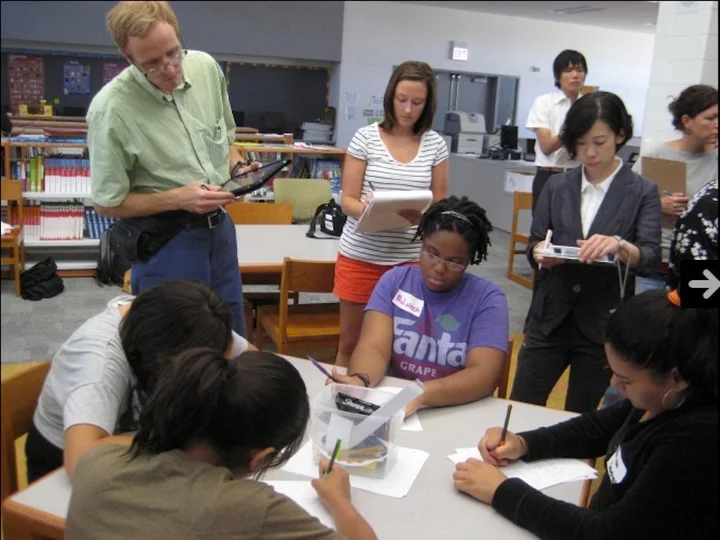
A provisional classroom has been set up. A white board sits at the front of the room, and 20 eighth-graders are seated at library tables. Math teacher Michael Hock is giving a lesson about the distributive property.

Scattered throughout the room are some 30 other teachers. They aren't wearing lab coats—but they might as well be. They clutch clipboards and carefully monitor kids' reactions to the teacher's explanations, peering over students' shoulders as they write answers.

"What is the area of the garden?" Hock asks students as he points to an illustration on the white board. "Nestor, I haven't heard from you today."

Listen to the audio story

Nestor answers the question, and the 30 adults, including visiting teachers from Japan, scribble notes.

The exercise is called "lesson study." It's a professional development strategy used extensively in Japan that essentially dissects a teacher's lesson and the way it's delivered.

Here's how it works: teachers come up with a detailed lesson plan and explain ahead of time to colleagues the goals of the lesson. Then, one teacher tries the lesson out on a group of students, while dozens of other teachers watch what happens.

Finally, the observers offer feedback and ideas for improvement."[We've been] doing lesson study more than 100 years in Japan," says Toshiakira Fujii, a premier professor of math education in Japan who was among those teachers observing at Prieto. "But lesson study in the United States is quite new."

Fujii says Japanese teachers see lesson study as a proving ground, a way to shine in front of their colleagues.

"You can see [it] everywhere in Japan," says Fujii. "In Tokyo in the case it's Wednesday. Wednesday [we] usually finish at lunch time. Then one class stays, and the other classes dismiss. And then every teacher comes to that one class and observes. Even the school nurse and school counselor also join to watch the lesson—that's our traditional way."

There's been lots of talk about how Chicago should evaluate teachers. Lesson study is being billed as a way to help teachers improve.

The strategy is one both teachers unions and school districts say they like. The head of instruction in Chicago Public Schools says she's a fan of lesson study. The Chicago Teachers Union helped organize the lesson study at Prieto—and convenes other sessions on holidays like Pulaski Day, when students and teachers volunteer to participate.

Florida included lesson study in its winning Race to the Top proposal.

After a lesson is taught and students dismissed, teachers analyze what happened. They're like scientists looking back at their experiment, figuring out what went right, what went wrong.

"Possibly you forgot—or you chose not to—ask the students to draw a model of the equation," one teacher tells Hock after students at Prieto have left the library.

"I didn't see much evidence that they felt challenged," adds another, citing his extensive notes. "I know there was some discussion at two of the tables, but there didn't seem to be very much discussion at three of them."

The teachers discuss whether it was more successful to use concrete examples or abstract ones and whether the illustration Hock used helped students understand the concept being taught.

"I really love it because it's all about constructive feedback," says Hock. But he admits it can require some thick skin at times. "Because you're going to hear some things. I mean, some people like that constructive feedback and some people are like, ‘Whoa, I hate that. It kind of points out all the things we did wrong.' I don't look at it that way."

Hock was criticized the day prior for talking too much while teaching.

"But today when you were walking around between desks—you stopped talking," Fujii told him during the feedback session. "You can change your behavior by one day. That's amazing."

Margaret O'Sullivan, who teaches sixth-grade science at Armstrong Elementary in Rogers Park, says participating in lesson study has changed her whole thought process as a teacher.

"Now I'm thinking before I start the lesson, ‘OK, these are the questions I'm going to ask.' And not just questions where they give you back facts. But questions that are going to lead them to more deeper thinking."

O'Sullivan says it's difficult for teachers to get thoughtful feedback on their day-to-day work. Many principals observe teachers just once a year.

"When you're in the classroom, you're only limited to what you see, so you may miss out on a lot of what's going on," says O'Sullivan. "So after doing a lesson to step back and have people point out things that you may not have noticed is incredible feedback that you just don't get."

Lesson study advocates in Chicago hope to spread the practice further. As Chicago shifts to new "common core" learning standards, advocates hope lesson study might play a role in helping teachers teach to the more rigorous standards.

Chicago has its own lesson study guru. DePaul University education professor Akihiko Takahashi is known internationally for promoting lesson study. Here, he's co-founded the Chicago Lesson Study Alliance, and he's on a mission:

"Traditional American professional development is somebody outside comes and then does for teachers," says Takahashi. But he argues there is a lot that teachers can do on their own. "My goal is in every school teachers gather and then find a new way to improve lessons by themselves."

And what do students think of lesson study?

It feels "weird" having all those adults milling about, peering over students' shoulders, says Prieto eighth-grader Hector Figueroa. But, he adds, "you get used to it."

Hector's teacher told kids they should just think of the adults as "flies on the wall."

"But that would be even freakier," Hector says. Still, he gets the point: "I think they're just trying to make our teachers better."

This story aired on WBEZ on January 9, 2012. It was produced with support from The Hechinger Report.

Also on HuffPost:

FOLLOW HUFFPOST EDUCATION

This piece comes to us courtesy of The Hechinger Report. In the sunlit library at Jorge Prieto Elementary on Chicago's northwest side, an experiment is under way. A provisional classroom has bee...
 
 
  • Comments
  • 108
  • Pending Comments
  • 0
  • View FAQ
Comments are closed for this entry
View All
Favorites
Recency  | 
Popularity
Page: 1 2 3  Next ›  Last »  (3 total)
photo
HUFFPOST SUPER USER
pprice9748
The reward of labor is life
02:58 PM on 01/15/2012
It is way to help teachers improve all the power too this. It sounds good!
Satirist1
All 4 d best in the best of all possible worlds
12:17 PM on 01/15/2012
The best way to improve American schools is to improve American parents.
Those who doubt it --look at Chinese, Korean, Japanese Hindu "tiger moms."
This current obsession with improving teachers ( oh by the way, aslo destroying teachers unions and tenure) is a srtawman.
photo
HUFFPOST BLOGGER
Nelson Montana
Artist, Author, Composer
12:45 PM on 01/15/2012
I agree it's more a matter of parenting than what the teachers can do. But the "tiger mom" mentality tends to produce robotic, socially inept, uncreative and angry offspring. Like you.
This comment has been removed due to violations of our [Guidelines]
Satirist1
All 4 d best in the best of all possible worlds
01:12 PM on 01/15/2012
Brilliant contribution to world of creativity and good will towards man.
http://bodybuilding.elitefitness.com/injectable+steroids+painless+injections
Satirist1
All 4 d best in the best of all possible worlds
01:52 PM on 01/15/2012
I was expecting a few responses from educated posters. alas.. it is not to be.
08:41 PM on 01/14/2012
I really wish somebody in America would assist teachers by improving our students' parents knowledge of the content being taught to their children. Many children go home to parents who lack the ability to discuss their day beyond lunch and behavior. The longer America waits to sufficiently educate the masses equally, the further behind we're falling. Approximately every five years, the parents of my students are increasingly lacking verbal skills to talk intelligently with their children about elementary subjects.
11:12 PM on 01/12/2012
A few facts.

Japanese elementary school classrooms routinely have 40 students in them. The students don't behave like robots, they behave like kids.

There are certainly cultural factors that work to the advantage of a Japanese teacher. But the 1995 TIMSS video study of 8th grade math lessons revealed a huge gap in the quality of the lessons in Japan relative to the lessons in the U.S. (Note that I said "quality of the lessons," not "quality of the teachers.") The U.S. researchers who worked on the TIMSS video study were convinced that lesson study is the primary force helping Japanese teachers learn to create and implement such good lessons.

In the U.S., lesson study can be done on professional development days by enticing a class of students to come in. (Pizza usually works.)

Planning time is a challenge in the US. The Japanese school day for elementary students is the same as ours, but teachers are paid for an 8-5 workday. Their desks are in one large faculty room; teachers from the same grade level will have their desks together. In the U.S., teachers find time during the summer, after school, or through sub coverage if they have a particularly visionary principal who also the funds. For some teachers, being paid for this extra work is a decisive factor; for others, they feel that the benefits make it worth it.

For more info visit http://LessonStudyGroup.net .
03:17 AM on 01/12/2012
Not surprised. The Japanese are NOT very creative people....but they do steal American ideas quite well and then perfect them.
photo
HUFFPOST SUPER USER
montanasian
Still trying to make it up the learning curve.
10:51 PM on 01/12/2012
One, very sterotypcial response. Two did you read the article, the Japanese have been doing lesson study for a hundred years, its new in the U.S. Yet it is true, perhaps the implications of perfecting things is a trait of discipline that has been highly emphasized over what most "think" that Japanese are not creative.
04:20 AM on 01/13/2012
Remind me of the Japanese Nobel Prizes....they must have tons of doctors and physicists who are exceptional.
photo
disporting
Weapons not food, not homes, not shoes
05:19 PM on 01/13/2012
Haha. Not creative people.
11:23 PM on 01/11/2012
Teaching is a noble profession and a terrible job. Everyone has some bright idea about it because nobody appears very knowledgeable and when people figure it out, they change it for reasons that have nothing to do with students.
11:20 PM on 01/11/2012
Teaching is a wonderful profession yet has evolved into a terrible job. As an "old person" who went into teaching after a long technology career, I find that people speak to teachers based upon an assumption that they are really stupid. Worse than that, a primary qualification to run a school in many cases is that one must be a teacher first. The environment is rife with "not invented here" type thinking. If you add the fact that articles like this are always spouting more work so teachers can use all that free time they have to do yet more work because of their assumed stupidity you have a perfect storm to encourage people to do some other career. If I knew the environment was this terrible I would have started a new career doing something else. The licensure system is nothing short of slave labor mentality. Go to college then do low, wage-slave, work for terrible pay so you can keep your license and get all the work dumped on you. That about says it. Very little to do with learning here. I am sure there will be many opinions from those who have never taught a day in their lives.
photo
HUFFPOST SUPER USER
montanasian
Still trying to make it up the learning curve.
10:53 PM on 01/12/2012
Thats actually a good take--licensure. I bet that happens in other profession also. Very interesting!
photo
HUFFPOST SUPER USER
Ganapati Edu
From negative to positive.
08:39 PM on 01/11/2012
While it is not done as much in the US, it is not a new practice. Although, it is incredibly undervalued. We spend way more time looking at data then theorizing practice as opposed to actually observing practice, setting goals and following-up. Our system is set up in such a way that it becomes hard and daunting to perform such a valuable practice.
08:23 PM on 01/11/2012
I like it! ....The lunch lady and the janitor forming educational stategy, couldn't be any worse than educational "professionals".
photo
HUFFPOST SUPER USER
l monroe
I question authority.
09:00 PM on 01/11/2012
You forget something if an uneducated adult who wants to learn can't, something is wrong with the teacher. At least the adult might find the words to tell the teacher when they are wrong. Been there, done that, I almost got expelled for telling a teacher he was giving wrong answers in a math class 17 times in a row. . . He later got his doctorate one week after I passed his class with an A. His assumptions were wrong and cost him the doctorate for 7 years. He is one of my heroes because he never gave up on his dream.
photo
HUFFPOST SUPER USER
Claudia L
Time is the seed of the Universe
08:01 PM on 01/11/2012
Japan, where they commit seppuku if they don't pass their SATs?
photo
ZenSufi
Sisters and Brothers of America!
11:08 PM on 01/11/2012
That's dedication.
photo
HUFFPOST SUPER USER
Claudia L
Time is the seed of the Universe
11:20 PM on 01/11/2012
If they don't go to college, they work on the Apple IPad line. Its fear of failure.
photo
HUFFPOST SUPER USER
Don Paladin
Human ecology advocate
06:44 PM on 01/11/2012
Wow, I clicked on a link under the "Education" banner that was really about education. It was a very good article! It makes me want to learn more about this technique of teacher evaluation. Thanks, HP!
06:02 PM on 01/11/2012
I like the idea in theory, but it discounts the cultural differences between the societies. The Japanese are a very integrated, communal people. Japanese youth are use to their parents and grandparents constantly looking over their shoulders, American society in particular views that as violation of personal space, the Japanese are very communal, Americans take pride in individualism.

What works in Japan will probably fail spectacularly in the US and vice versa.
photo
HUFFPOST SUPER USER
Claudia L
Time is the seed of the Universe
08:05 PM on 01/11/2012
You're right. Their mindset is to follow and they fear failure. We like new ideas and are not afraid to fail, we just try it again another way. Look at the "Donald" declared bankruptcy 3 times. Gates & Jobs dropped out. And weren't that good when they were in school. Ya this is a crazy place.
photo
mlaiuppa
Pres. Sarcasm Society. Like we need your approval.
04:43 PM on 01/11/2012
20 8th graders? Pop that up to 38 and then you've got an example of the average class. Anyone can teach 20 students.

Ignoring the fact that a Japanese 8th grader is way different than a U.S. 8th grader. Respect, behavior and focus on academic scholarship come immediately to mind.

The reason this model will never work is there is no release time for observation. So this would have to be set up beyond the work day. After school, Saturday or during an off track day. Then you have to arrange for some students to show up during those times. If you try to do it during school, then you have to pay for substitutes so the teachers are released to observe the lesson.

The U.S. is cheap. They don't want to pay anything. Not for release time. Not for beyond the workday time. If they can get teachers to work for free, that's the goal. Improving teachers costs money. Better to just punish them by lowering their pay. That saves money.
photo
HUFFPOST SUPER USER
Claudia L
Time is the seed of the Universe
08:12 PM on 01/11/2012
The parents should have some input also. You can't expect the school to form your kids totally. Maybe parents should take turns planning special classes after school. I'm retired and asked a commercial artist to give a class on airbrush to the kids. A lot of schools don't even have an air brush. I'm going to leave mine there so the kids could practice with it. The commercial community has great potential.
04:07 PM on 01/11/2012
While I think this form of prof development is a good idea, it would be even better if parents were involved so that they too could learn from what is going on in their children's classrooms and how the teachers interact and teach their kids. Can you imagine what would happen if the teachers and parents worked together to understand better how to meet the kids' needs in the classroom using the knowledge that the parents have of their own children? And, how much the parents would learn by participating in such a study of teachers and learning in school?
06:11 PM on 01/11/2012
How to ensure any project fails spectacularly - involve the uneducated parents of the masses.

Average Joe and Susie are mindless, absolutely useless losers. If by chance a good idea ended up in their head, it would get lonely and leave within a week.
This user has chosen to opt out of the Badges program
01:38 PM on 01/11/2012
Our greatest folly in education is to forget what children are, and to ignore the impact of modern popular culture and technology on their growing minds.

As such, we still hold the belief that school is something children should want to do. That they are going to show up ready and willing to learn. That they are going to want to sit still EVERY DAY, desperately wanting out. That's just false.

We need to see our Indoctrination for how our children see it. We need to view it through THEIR eyes, not through the others of other Indoctrinators.