More

'Bushmeat' Trade May Import Disease, Study Suggests

Bushmeat

First Posted: 01/11/12 06:57 PM ET Updated: 01/12/12 12:28 AM ET

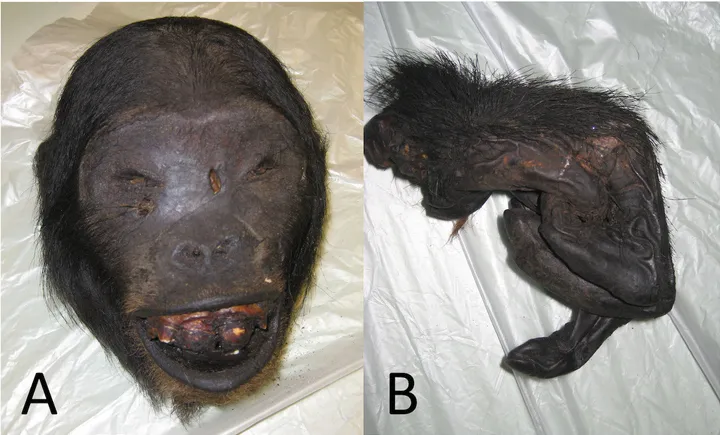
Thousands of pounds of primate parts, rodents and other dry, smoked or raw animals -- so-called "bushmeat" -- are smuggled into the United States as food every year, frequently hidden inside cases of similarly stinky but legal fish. Scientists now warn that the increasing practice may also be bringing deadly disease into the country.

"We know a fair amount about the risks of harvesting and slaughtering the animals in countries far away," said Nina Marano, branch chief of quarantine and border health services at the U.S. Centers for Disease Control and Prevention. "But we wanted to know more about the persistence, if any, [of pathogens] once the animals have been slaughtered."

In a small study published Tuesday in the journal PLoS ONE, Marano and colleagues from several institutions tested samples of some 44 nonhuman primates and rodents seized by customs agents at JFK International Airport in New York, as well as a few other U.S. points of entry. They then ran sophisticated genetic tests to detect pathogens.

Sure enough, the researchers found that several bugs had made the trip, including diseases that belong to the same family as HIV -- which also originated in African bushmeat.

"This is good example of why we want to know about these viruses. We want to prevent any kind of future epidemic similar to what happened with HIV," said Bill Switzer, a microbiologist at the CDC and preeminent expert on the simian foamy virus. First identified in the mid-1990s, SFV is common in nonhuman primates and known to spread quickly. It has also made the jump to humans, though it has yet to cause obvious symptoms.

Among the other pathogens found in the confiscated bushmeat were several forms of herpes, all of which could pose threats to humans.

"We are also worried about the viruses that we haven't identified yet," said Kristine Smith, the study's lead researcher and the associate director for health and policy at EcoHealth Alliance, a New York-based organization of scientists dedicated to the dual goals of conservation and public health.

Overall, an estimated three of every four emerging infectious diseases in humans originate in wildlife. As HuffPost reported last month, the live wildlife trade can also expose humans to infectious diseases such as monkeypox, bird flu and rat bite fever. Boris Pavlin, the head of the Northern Micronesia office of the World Health Organization who was not involved in the Smith study, warned of potential exposures from close contact with pets that can bite and scratch, noting that "a living being can create an infectious aerosol, which bushmeat normally would not."

Pavlin said he was not surprised by the results of the Smith study. "My research has shown that there are myriad species of imported animals that are known to be potential carriers of zoonotic pathogens," he said. "This study is the first to demonstrate virus directly in imported bushmeat, but it basically confirms what we all suspected."

A person handling meat may be directly exposed to an animal's blood and internal tissues, which Pavlin said "could be extremely dangerous, particularly as the bushmeat being prepared may be 'double-dead.'" In other words, the animal may have initially died from disease before being found and processed for consumption. This is the scenario that likely gave rise to the deadly Ebola virus.

People may also be exposed to disease by eating the bushmeat. As with chicken and salmonella, the level of risk depends on how well the meat is cooked, but millions of Africans rely on bushmeat for protein, and surveys of West African communities have found that many people are unaware that they could get sick from this practice.

While greater travel and immigration between the United States and Africa means the potential for more direct U.S. exposure, Smith suggests that even a bushmeat hunter contracting a disease abroad could affect health, economy, food and natural resources here.

"Unfortunately, it is 'One Health'," said Smith, referring to the emerging movement that seeks more recognition of the connections between the health of the environment, animals and human beings.

To get a better handle on just how much bushmeat is entering the country -- currently estimated at 15,000 pounds a year -- as well as the range of diseases that are traveling with it, Smith and her team are now expanding their study to include most of the U.S. airports that have a CDC quarantine.

Any bushmeat found by U.S. customs agents is already confiscated and destroyed. Ideally, the CDC would like to intervene earlier -- say, before someone abroad even plans their trip. "We are hoping that as we go along with these studies, we can develop educational campaigns to better inform people coming into the U.S. about the risks of bringing bushmeat," said Gale Galland, leader of the CDC's zoonoses team.

Such efforts may well pay dividends, Pavlin said. "The end users of bushmeat are likely to be very specific communities, which may benefit from targeted efforts to educate them about the potential risks associated with bushmeat," he said. "If we can decrease the demand, we can decrease the risk."

FOLLOW HUFFPOST GREEN

Thousands of pounds of primate parts, rodents and other dry, smoked or raw animals -- so-called "bushmeat" -- are smuggled into the United States as food every year, frequently hidden inside cases of ...
 
 
  • Comments
  • 51
  • Pending Comments
  • 0
  • View FAQ
Post Comment Preview Comment
To reply to a Comment: Click "Reply" at the bottom of the comment; after being approved your comment will appear directly underneath the comment you replied to.
View All
Favorites
Recency  | 
Popularity
Page: 1 2  Next ›  Last »  (2 total)
07:27 PM on 01/13/2012
revenge of the animals
11:12 AM on 01/13/2012
"frequently hidden inside cases of similarly stinky but legal fish". The picture indeed is disgusting, but what is worse is that nowhere in the story is there any support for this statement. While I prefer locally caught fresh or fresh frozen fish to imports, it really is not fair to condemn all imported fish with such an unsupported statement. Furthermore, fish which is fit for human consumption is not "smelly" but actually has no smell, or a saltwater fish may have a slight "ocean" smell. Check your facts before you print! Please!!
This user has chosen to opt out of the Badges program
03:36 AM on 02/28/2012
In the real world, lots of disgusting and rotten food makes it to our shores. Do you really believe that ALL imported fish has minimal smell? Do some homework on foods that originate in third world countries. Even something as simple as honey can be toxic and China will actually ship to Argentina, repackage and ship to the U.S. labeled "Product of Argentina" to get around the issue of taint. Food is much scarier than you think.
02:11 AM on 01/13/2012
Humans. What sick, chattering, insane primates some of you are.
I hope that anyone who murders and/or eats an ape dies slowly, painfully, and as horribly as possible--and let them know why.
12:41 AM on 01/13/2012
I'll take the sardines please...Thank you....
This user has chosen to opt out of the Badges program
photo
09:04 PM on 01/12/2012
People who eat that are getting what they deserve!
photo
artleads
Let's have a national retreat.
07:53 PM on 01/12/2012
The main picture is extremely distasteful and disturbing. You wouldn't put the human equivalent out there, so why do it to apes?
HUFFPOST SUPER USER
amwa
06:49 PM on 01/12/2012
We need MORE inspectors. I can't understand why we allow stinking fish in which it is hidden.
photo
HUFFPOST SUPER USER
Makos62
Time is an illusion. Lunchtime doubly so.
04:57 PM on 01/12/2012
What sort of nation have we become where allow the 1% trick us into thinking leaving our own people on the streets and starving is the right, moral thing to do while cash still flows to killing creatures foe the oddity of it.
04:47 PM on 01/12/2012
This cannot represent ignorance as the meat was sometimes hidden within legally imported "stinky" fish. Instead it's blatant disregard not only for the laws but also for the risks to the home population and environment. Our role as an invasive species extends not just to our acts in a specific ecology but to what we bring along with us--diseases, non-native seeds and species, ideologies, which may or may not prove beneficial, etc. In the past, many of these things would have been delimited by available transportation methods and technologies; today, however, we have to rely on regulatory oversight and innate goodness. We'll need all the help we can get relying on those....
10:24 AM on 01/12/2012
and there's a market for this? gross, who the heck would eat that?
photo
HUFFPOST SUPER USER
trespanieli
06:23 AM on 01/12/2012
As long as it's killing the monsters involved in this illegal, immoral trade, I say have at it.
photo
jp83
You're gramur and speling are impenetrable
03:21 PM on 02/10/2012
Yeah anyone partaking in that trade can get the Ebola virus for all I care. Or heck, create a new one that gives them their own personal-h311.
gravityhunter
Lock, wave n pull
05:56 AM on 01/12/2012
Can't be any more dangerous than chinese treats.....
01:02 AM on 01/12/2012
pandemic in the making. Wipe out humans, animals thrive... I LOVE IT !
09:44 PM on 01/11/2012
Really! This is actually a problem!! Seems to me that a couple of well trained German Shepard's should be able to sniff out dead meat festering in a suitcase, pretty quickly... Way to go TSA!
photo
Joeyjackal
Repetition doesn't change a lie into the truth
09:17 PM on 01/11/2012
I suppose it will take another outbreak of something equally horrible or worst than Ebola or HIV as far as symptoms and/or likelihood of transmission for us to take these instances of casual introduction of harmful micro-organisms from other species through their ingestion in the pursuit of human curiosity in the realm of affairs of the palate or culinary before we learn our lesson and seriously re-examine this practice.
photo
jp83
You're gramur and speling are impenetrable
03:22 PM on 02/10/2012
I agree. People never seem to change until they are taken to the "very edge of possible destruction."