iPhone app iPad app Android phone app Android tablet app More

National Biomass And Carbon Dataset Map Depicts U.S. Tree Density (PHOTO)

First Posted: 01/14/12 08:37 PM ET Updated: 01/14/12 08:37 PM ET

Where are most of the trees in the U.S.? Concentrations in areas like New York's Adirondack Park or the Cascade Range in the west are predictable, but other areas of dense biomass might surprise you.

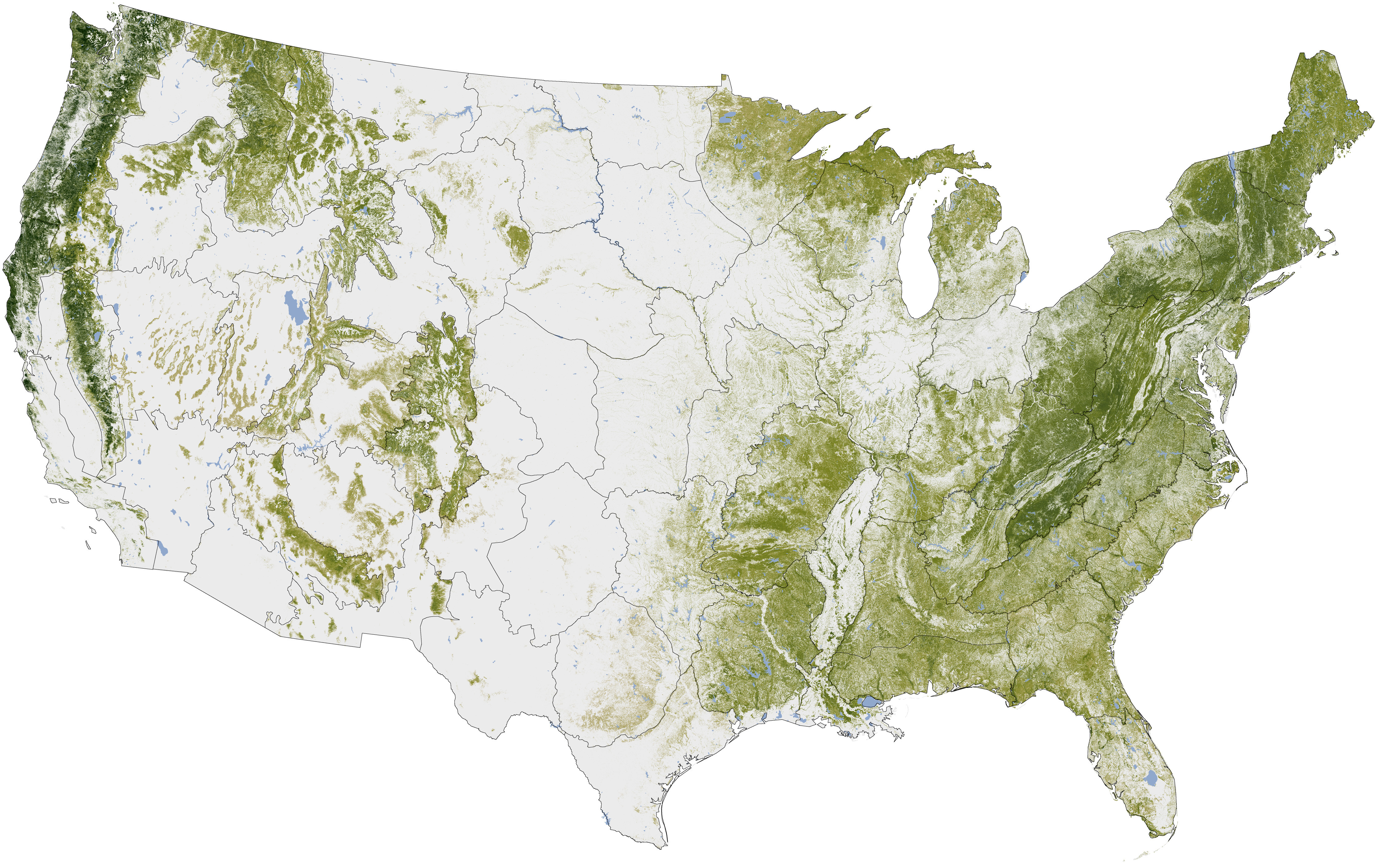
A newly released map, shown below, depicts the density of aboveground vegetation across the contiguous United States. Created by NASA Earth Observatory, the map represents years of data compiled by the Woods Hole Research Center (WHRC) in Massachusetts.

WHRC's National Biomass and Carbon Dataset (NBCD) project, released in 2011, measured the density of organic carbon in vegetation across the United States.

The project, which used computer models, space-based radar, satellite sensors and ground-based data, was completed in six years in collaboration with the U.S. Forest Service and U.S. Geological Survey. According to NASA Earth Observatory, "It is possibly the highest resolution and most detailed view of forest structure and carbon storage ever assembled for any country."

According to Gizmodo, the map has a 30 meter resolution. Thus every four pixels represent one acre (10 pixels to a hectare). WHRC's Josef Kellndorfer claims that the entire biomass mapping project measured "about five million trees," reported NASA Earth Observatory.

Despite the biomass concentrations in some areas and the protection of old-growth forests, not all of the U.S. has adequate tree cover. According to the Daily Mail, American cities have lost a quarter of their trees in the past three decades. In fact, 634 million trees would be needed "to provide adequate canopy cover for the largest cities."

Check out the biomass density map below. According to NASA Earth Observatory, the map's darker spots represent "the areas with the densest, tallest, and most robust forest growth." Image courtesy of NASA Earth Observatory and Robert Simmon.

Also on HuffPost:

FOLLOW HUFFPOST GREEN

Where are most of the trees in the U.S.? Concentrations in areas like New York's Adirondack Park or the Cascade Range in the west are predictable, but other areas of dense biomass might surprise you. ...
Filed by James Gerken  | 
 
 
  • Comments
  • 108
  • Pending Comments
  • 0
  • View FAQ
Post Comment Preview Comment
To reply to a Comment: Click "Reply" at the bottom of the comment; after being approved your comment will appear directly underneath the comment you replied to.
View All
Favorites
Recency  | 
Popularity
Page: 1 2  Next ›  Last »  (2 total)
photo
HUFFPOST SUPER USER
mynamesyow
Scientist, Gonzo, Champion of the Poor
02:13 PM on 01/18/2012
Cool!
photo
HUFFPOST SUPER USER
DonVitoCorleone
Autodidact, and proud of it!
08:46 PM on 01/17/2012
That's pretty cool. While I'm sure there are areas (e.g., my Wisconsin), that were heavily forested at one time, there are many places, e.g., the great plains, that didn't have many trees to start off with.
11:52 PM on 01/17/2012
wrong, the whole map would have been greener down to the last pixel 200 years ago. East of the Mississipi used to be almost all forest. (>80%)
photo
HUFFPOST SUPER USER
mater
mater
06:44 AM on 01/18/2012
Yes, and projects like Keystone aren't going to preserve trees, grasses, or crops either. I found it troubling that there were so few trees in northern MN--they must be logging the heck out of that area for paper , and there was a big forest fire up there which lasted for months last year. Unseasonably dry, caused by lightning. Alot of trees have had to be cut down and burned because of infestation from Emerald Ash Borer Beetle too.
11:00 AM on 01/19/2012
Before the settlements of Europeans began cutting down trees, a squirrel could climb into the trees on the east bank of the Mississippi river and stay in the trees clear to the Atlantic coast.

There were so many American Chestnut trees in the Appalachian mountains that a squirrel could climb onto an American Chestnut tree in northern Alabama and stay in the branches of American Chestnut trees clear into northern Maine.

Between the Mississippi and the Rocky Mountains very large areas of land were kept tree free by the gigantic herds of Buffalos.
This user has chosen to opt out of the Badges program
photo
06:56 PM on 01/17/2012
When non-nomadic humans occupy any area the very first thing they do cut down or burn the forests. You can see this any place on Earth.

The U.S. has been occupied for hundreds of years. Between direct human activity and desertification due to climate change (human induced?) all American forests have suffered greatly.

Imagine redwoods growing on the beach in Malibu? All of the Pacific facing mountain slopes covered with Ponderosa? Cabrillo documented these sights when he first explored California.

FACT!!
This user has chosen to opt out of the Badges program
photo
06:59 PM on 01/17/2012
. . . . very first thing they do IS cut down or burn the forests. . . whoops
photo
Vintage59
Seeking tickets to First Class
04:12 PM on 01/17/2012
They could have just emailed NOAA and gotten the rainfall data. It would have saved them a lot of time.
03:54 PM on 01/17/2012
where is AK and HI?
01:20 PM on 01/17/2012
Texas should plant some trees
05:22 PM on 01/17/2012
Nah, might soften them up a little and they're proud of being tough, old birds.
04:48 PM on 01/18/2012
LOL
photo
darkmark
religion, the veil of evil.
12:44 PM on 01/17/2012
APRIL is a member of the Royal Golden Eagle (RGE) group, one of the leading integrated resource-based PRIVATELY -owned industrial groups in the Asia Pacific region. is headquartered in singapore, a true fascist country. over 80% of its wood sells go to asia. so its privately owned and its HQ are in a fascist country meaning its unreachable by anyone opposed to their destruction of the planet.

"Singapore is home to more US dollar millionaire households per capita than any other country. The World Bank notes Singapore as the easiest place in the world to do business." i wonder what that means?

"APRIL’s main pulp subsidiary is Riau Andalan Pulp & Paper (RAPP). RAPP operates in Riau Province, Sumatra, Indonesia. Beginning operation in 1995, Friends of the Earth called RAPP the biggest paper pulp mill in the world, with a capacity of 2 million tonnes per year."
photo
HUFFPOST SUPER USER
Jcaesar319
Twas the worst of times;So we got more beer.
02:37 AM on 01/17/2012
Alot of that green you see in the southeast is Kudzu . Not worth spit but will grow through asphalt.
10:38 AM on 01/17/2012
Actually, Kudzu has some medicinal benefits. It is a member of the legume family:
Analyses of kudzu root have shown that it contains many amino acids including lysine and methionine and isoflavones and bioflavonoids such as genisten and daidzein which have been shown to have various benefits to the human body. It also contains minerals including zinc, manganese and selenium.
See further: http://herbs-treatandtaste.blogspot.com/2011/02/pueraria-or-kudzu-root-medicinal.html
Don't know why this cheap resource has not been harvested and processed. Article above
says the Chinese have been using it since the 6th century.
07:49 PM on 01/16/2012
New England is doing well, for the first time in Massachusetts developed acres are outnumbered by conservation acres. But cities fragment forests so there is no room for old growth, and everyone is shuffled into horrible, poor polluted cities with no green space. We need to create corridors and connected tracts.

Really scary is the NY Times report that there are ZERO healthy forests on Earth. Forests filter the air water and soil and provide stability. Climate change is killing forests. It has to stop.
photo
LMPE
I connect the most dissimilar things
06:26 PM on 01/16/2012
As for the absence of trees in west Texas, I'm sure that Rick Perry's praying will solve that.
photo
HUFFPOST SUPER USER
MS Ind
My micro-bio was empty.
03:16 PM on 03/27/2013
Even praying can't plant trees in a desert.
This user has chosen to opt out of the Badges program
photo
02:47 PM on 01/16/2012
Please notice - NOT Texas.
photo
HUFFPOST SUPER USER
RichieB
Science is true whether you believe it or not
03:03 PM on 01/16/2012
Not the mid west or heartland either. Those people need to start doing their share for the sake of the environment. :-))
photo
HUFFPOST SUPER USER
amConcerned
07:20 PM on 01/16/2012
Yeah... those ne'er-do-wells should stop growing crops that help feed people worldwide and get with the program.
photo
darkmark
religion, the veil of evil.
12:50 PM on 01/17/2012
the mid west is considered from on the south kansas and missouri then north to canada.
i thought it would have been from texas up but these people must know:

http://www.epa.gov/climatechange/kids/expeditions/agriculture/agriculture-508.pdf
photo
Lorindol
I shall consider it . . .
05:24 PM on 01/16/2012
Please notice - North Texas is plains, just like the entire corridor north of the panhandle; West Texas is desert, as is much of South Texas approaching the border; Central Texas is rocky hill country with a bit of green here and there. I live in East Texas, which is COVERED in forest. I live in the middle of Davy Crocket National Forest, and behind what we call "the Pine Curtain."
This user has chosen to opt out of the Badges program
photo
09:09 AM on 01/17/2012
Not long ago Texas had many more forested areas. FACT!
photo
HUFFPOST SUPER USER
whoknew222
I learn something new every day.
02:03 PM on 01/16/2012
I live in one of the greenest parts of the gulf coast and moved here for the trees and as I sit here on a beautiful day with the doors and windows open to enjoy the fresh air, my neighbor is burning leaves and filling that air with his nasty smoke, like he does every day, making me ill. I sooo want to take my fire extinguisher over there...
07:53 PM on 01/16/2012
I sympathize, my neighbor burns nasty stuff in his yard next to his neighbor's fence and we live in the suburbs!
01:59 PM on 01/16/2012
Am i the only one who reads this and is upset at the journalism? "but other areas of dense biomass might surprise you." The article fails to identify those areas! It's not cities that would be too obvious for tree loss. It's plain lazy eye catching journalism that does not explain or enlighten. Just a catchy title
photo
Vintage59
Seeking tickets to First Class
04:16 PM on 01/17/2012
Why bother to get upset? That won't bring back the past. Besides, the only people who would be surprised are too clueless to understand anything more complicated than a pretty picture on their best days.
05:03 AM on 01/18/2012
I agree. It's annoying.
photo
HUFFPOST SUPER USER
riverdivine
11:13 AM on 01/16/2012
How incredibly sad that so much of our country is now tree-less. :(
nschomer
Scientifically Progressive Libertarian Socialist
12:48 PM on 01/16/2012
I don't think that's the take-away. A lot of that "tree-less" area is central plains, it is grass/scrubland, and very sparsely populated. If you look at some of the highest density areas, like the East coast, it actually has the highest tree density. I don't think this is an indictment of the American timber industry, just the way trees are distributed naturally (like, closer to wetter areas near the coasts than the dry inland plains).
This user has chosen to opt out of the Badges program
photo
02:48 PM on 01/16/2012
Bee Ess
antipyrene
I wear the cheese, it does not wear me
07:06 PM on 01/16/2012
The growth of forests in heavily populated areas is a consequence of farmland being turned into suburbs
photo
HUFFPOST SUPER USER
Wanderland
Generic white guy
01:25 PM on 01/16/2012
Much of it was treeless long before European settlement.
07:35 PM on 01/16/2012
That's true, some of it was but by Native Americans whosed regenerative fire methods and mixed species crops which benefit the forests.
11:03 AM on 01/16/2012
Israel replanted millions of trees. We need to condemn that.