iPhone app iPad app Android phone app Android tablet app More

Flu Pandemic, Climate Pattern May Be Linked, Study Says

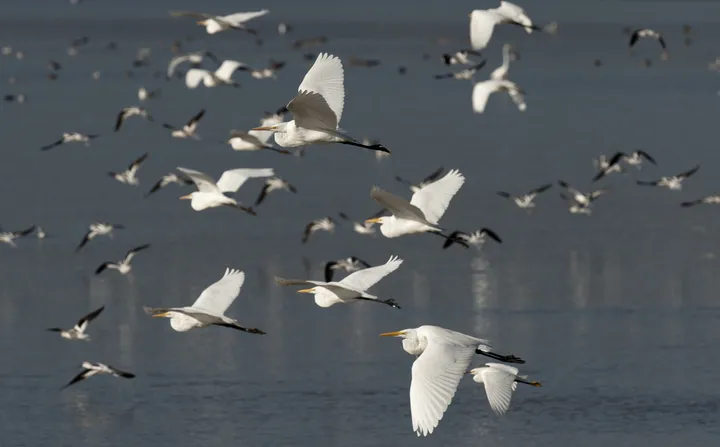
Migrating Birds

First Posted: 01/17/12 06:41 PM ET Updated: 01/17/12 08:21 PM ET

A shifting global climate pattern could portend a flu pandemic, and possibly an opportunity to stop the virus early, a study suggests.

The link, according to researchers, is weather's influence on the migratory patterns of wild birds, the primary pool for human flu.

"Changes in flight patterns -- length, stopovers -- can bring together bird species that otherwise wouldn't intermingle," said Jeffrey Shaman, an environmental health scientist at the Mailman School of Public Health at Columbia University, lead researcher of the preliminary study.

And while mixing with feathered strangers, particularly on water, birds can share viruses orally and fecally. Multiple versions of the flu may then enter a bird's cells, genetically mingling into a "radically different" viral strain "to which the human population has never been exposed," and are therefore susceptible, Shaman explained.

"That's what seeds a pandemic," Shaman told The Huffington Post. Other animals and their viruses may also participate in the pool party. The virus behind the 2009 swine flu pandemic, for example, was a mixture of genetic material from human, bird and pig flu.

In the study, published Monday in the Proceedings of the National Academy of Sciences, Shaman and his colleague, Marc Lipsitch of the Harvard School of Public Health, found that the last four major flu pandemics -- in 1918, 1957, 1968 and 2009 -- all followed a climate pattern called La Nina, which brings colder-than-normal sea surface temperatures in the central Pacific Ocean and generally results in cooler global temperatures. One of these episodes, which occur every two to seven years, is currently underway.

If the theory holds, it could provide "a little lead time" to prepare for what have generally been unpredictable pandemics, said Shaman. "It could allow us to intensify our vigilance and put more resources in place."

Shaman and other experts emphasized that it's too early to rule out the possibility of a coincidence. He also cautions against overreacting to the potential viral consequences of this year's La Nina. In fact, most La Ninas in the past several decades have not preceded a pandemic. La Nina is likely to be just one of several factors that affect a virus' spread within and between animal and human populations.

Still, anything that could help predict a pandemic would be welcomed by public health officials.

"This reinforces the need for us to be doing ongoing surveillance in human populations as well as in animal populations, and the need to look at the key elements that tie those patterns together," said Dr. Peter Rabinowitz, an environmental medicine expert at the Yale University School of Medicine, who was not involved in the study.

"The way that influenza circulates between poultry, swine, wildlife and people provides plenty of contact points that need to be better understood in order to keep us from being totally surprised," Rabinowitz said. "This holds potential, but we're still a long way off."

Peter Daszak, president of EcoHealth Alliance, a New York-based organization of scientists dedicated to the dual goals of conservation and public health, agreed with the need to improve surveillance -- both to predict pandemics and to collect the data necessary to confirm what factors are truly predictive. He called the study's results a "wake up call."

"If we start doing this properly, we might be able to beat these outbreaks before they happen," said Daszak. "It all comes down to economics. Are we prepared to do this long-term monitoring of wildlife and livestock for human pathogens? It costs money, but think about the impact of the flu: tens of billions of dollars and lives lost."

FOLLOW HUFFPOST GREEN

A shifting global climate pattern could portend a flu pandemic, and possibly an opportunity to stop the virus early, a study suggests. The link, according to researchers, is weather's influence on...
 
 
  • Comments
  • 103
  • Pending Comments
  • 0
  • View FAQ
Post Comment Preview Comment
To reply to a Comment: Click "Reply" at the bottom of the comment; after being approved your comment will appear directly underneath the comment you replied to.
View All
Favorites
Recency  | 
Popularity
Page: 1 2  Next ›  Last »  (2 total)
05:59 PM on 01/21/2012
I ADVISE, PROTECT EYES & FACE, FROM A WARM RAIN.6 yrs ago, i realized, many cases of flu,5 days after the a warm rain. my best guess: since viruses/bacteria flourish in warm climates, evaporation off sewer systems and livestock drain-off, was putting contaminants into warm rain clouds. the opposite/clouds that have passed through freezing temps before arriving. i don't see flu epidemics 5 days afterwards...birds as contaminators.....that is a new one for me to think on.
photo
HUFFPOST SUPER USER
getsit
good morning, I'm here
05:23 PM on 01/18/2012
I hate to interject more doom and gloom here but with the ice, snow and permafrost melting who knows what bacteria, viruses and parasites might be exposed. There are animals that come to life after being frozen. We do it with human sperm and eggs. There are already horror movies out with this idea.
04:14 PM on 01/18/2012
Knew I shouldn't have navigated away from the "Good News" section!

Looks like lots of commenters here are, not surprisingly, very knowledgeable about climate change. Wondering what you all think about this idea for making a small (but possibly repeatable) dent in net carbon emissions: start (or acquire) a travel reservation site (like Orbitz) and run it for the purpose of buying carbon offsets with the profits: travelers get the same service at the same price as that offered by the competition, but with a bonus of having some or all of their carbon footprint erased. (You can read a bit more on this idea at ConspiracyofDreamers.com)

IMO, we need to use the tools of capitalism to undo the stupid things it has, and is, doing. Government has proven itself incapable of dealing with climate change, and business will fight to protect the status quo: we have to explore options outside the conventional paradigm.
photo
HUFFPOST SUPER USER
madcityy
02:24 PM on 01/18/2012
DONT BLAME BIRDS FOR PEOPLE LIVING LIKE PIGSSSSSSSSSSSSSSSSSSSSSSSSSSSSS
photo
HUFFPOST SUPER USER
MikeWebster
Always happy.
12:33 AM on 01/19/2012
How dare you slander pigs.
photo
HUFFPOST SUPER USER
KarlaElisa
The atmosphere is Toxic
01:17 PM on 01/18/2012
I JUST watched a documentary yesterday called 'A River of Waste' that detailed how the biggest threat of a avian flu pandemic is really the conditions that exist in Confined Animal Feed Operations (CAFO's), NOT the normal lifestyle of migrating birds that aren't beak to beak, laying in their own filth, 24/7.

The film addresses EVERY concern originating out of Factory Farming and may be viewed in it's entirety on NetFlix or here: http://www.youtube.com/watch?v=c-WAGf-4gC8
photo
HUFFPOST SUPER USER
MikeWebster
Always happy.
12:36 AM on 01/19/2012
The problem with migrating birds is that they come into contact with domesticated birds. Domesticated birds in some countries live in close proximity to other livestock like pigs, and in close quarters with peoples.

The places where there are the highest probabilities of pandemic flu developing are not generally in Western countries, but in some of the Asian countries - like China, where large populations of people live in close proximity to their birds and other livestock.
This user has chosen to opt out of the Badges program
photo
12:09 PM on 01/18/2012
It's only a matter of time. It is certain there will be another 1918 Spanish flu outbreak situation. But this time it will be worse. People didn't travel back then like they do now. The spread rate and the mortality rate would be massive today with a virus like that 1918 Spanish flu. People think the swine flu was overblown but not really. We just got lucky and I say there is no such thing as a overreaction with a novel virus that contains part bird human and pig viruses. I got the H1N1 in Oct of that year when there was a large outbreak in CA. They tested it and it was influenza. Some say the H1N1 was milder than expected but I personally have never been that sick. 10 days. I had a fever of 104 and my body hurt like NEVER before from anything. My iunue
photo
HUFFPOST SUPER USER
KarlaElisa
The atmosphere is Toxic
01:19 PM on 01/18/2012
I don't know why I have it in my head that H1N5 had a 59% mortality rate, but I do...glad you survived the H1N1.
photo
HUFFPOST SUPER USER
MikeWebster
Always happy.
12:43 AM on 01/19/2012
I think it's been much higher than 59%. This again is the big thing that is worrying. This is a vastly higher death rate than even the 1918 pandemic had, which was actually quite low.

A lot of the concern about H1N1 was that it could combine the characteristics of a human transmissable flu, with no population immunity, with the deadliness of H5N1. As FactsVsFear mentions, that could well be a disaster not seen since the times of the black death in Europe.

BTW: I think the way that the combination of these two kinds of flu could happen, is in a human host, who has contacted H1N1 from other people, but simultaneously gets H1N1 from his/her birds. The two viruses then have an opportunity to share genes. This would likely happen somewhere in China, Indonesia, Malaysia, Thailand, or similar place.
HUFFPOST SUPER USER
healthanalyst
Banned from commenting, so?
05:22 PM on 01/18/2012
Did you get a flu shot that year?
10:46 AM on 01/18/2012
Help track the flu and curb pandemics: http://www.flunearyou.org/?a=9f3f354149f530
photo
HUFFPOST SUPER USER
Michael D Ballantine
Texas Justice Party - Chairperson
10:24 AM on 01/18/2012
The medieval warming period is credited with producing the black plague and other pandemics that decimated Europe and Asia. These epidemics did not end until the climate changed and the Earth went through a long cooling cycle. It would stand to reason that we can expect the same sort of occurrences now that the Earth is warming up. With high concentrations of animals and humans living together in squalid sanitation conditions, pandemics should be relatively common place over the next 100 years until the climate cycle reverses again. With the impact of overproduction of CO2 by man, we may offset the potential of a climate reverse and find ourselves stuck with deadly pandemics for 100 years. This is just one more reason that we need to aggressively reduce CO2 in our atmosphere.
photo
HUFFPOST SUPER USER
Jim Milks
Ecologist
12:28 PM on 01/18/2012
It will be far longer than 100 years before climate reverses. It will take around 1,000 years after CO2 emissions cease before temperatures start dropping (Solomon et al. 2009: http://www.pnas.org/content/early/2009/01/28/0812721106.abstract).
photo
HUFFPOST SUPER USER
getsit
good morning, I'm here
05:28 PM on 01/18/2012
If we change the composition of the air we won't be able to breath it. That's why it's unlikely we could live on other planets without some accommodation. It has been suggested that man wouldn't have been able to breath the air when the dinosaurs reigned so forget about "Terra Nova"!
photo
HUFFPOST SUPER USER
MikeWebster
Always happy.
12:45 AM on 01/19/2012
I think the main difference would have been much higher oxygen content. I'd guess that we'd be able to handle that. Certainly it seems like it should be easier than handling reduced oxygen in the air, which may well be what we are heading for.
photo
HUFFPOST SUPER USER
nellre
growth is not sustainable
09:14 AM on 01/18/2012
A previously unknown unknown. Now it's a known.
Many deleterious effects on health can be expected as the climate warms.

Civil unrest, famine, water shortages and drought are the biggies. These will happen whether you believe in climate change or not (unless we really start doing something about it right away).
Eventually they will not be able to keep it out of the evening news. I give it 10 years at the most.
HUFFPOST SUPER USER
alteredstory
Hold on to the center
09:56 AM on 01/18/2012
Disease is one of the biggies too, but it's got a slightly more subtle impact. Malaria is moving uphill in most of the tropics - having to pay for more cases of illness like that is a huge drain on any country's economy. By the time malaria makes it into Europe and the US, we'll already be hurting, and it'll make it that much worse.
photo
HUFFPOST SUPER USER
getsit
good morning, I'm here
05:29 PM on 01/18/2012
My understanding is that malaria is already here. And there are some pretty nasty parasites moving north and south.
photo
HUFFPOST SUPER USER
pepper1311
POGS are dirt
04:55 AM on 01/18/2012
All BS, fear factor being sold again in new improved packaging. Buy this if you may, but look in the closet and you'll find the old lie still unwrapped.
photo
HUFFPOST SUPER USER
MikeWebster
Always happy.
12:48 AM on 01/19/2012
Whoops, marked you as favourite. Have you any facts to support your assertions, or are you just going on your gut, or because god wouldn't want it that way?
04:09 AM on 01/18/2012
You can see it coming if you own a bird as a pet it will have to have emission equipment fitted an mot and be in a tax band dependent on size/
photo
HUFFPOST SUPER USER
MikeWebster
Always happy.
12:49 AM on 01/19/2012
So, you think this article might be about emissions from birds? A novel interpretation.
03:32 AM on 01/18/2012
The only "pandemic" is climate change fraud.
photo
HUFFPOST SUPER USER
Jim Milks
Ecologist
12:29 PM on 01/18/2012
The biggest pandemic is rampant ignorance, as evidenced by your post.
photo
HUFFPOST SUPER USER
niumarmion
a temporary being
12:33 PM on 01/18/2012
Not just his post. My newspaper reported that, due to climate change, the next ice age will come later then usual, and that was the only effect it reported.
photo
Publicola
Reality has a scientific bias
04:22 PM on 01/18/2012
What is your scientific education and profession­al experience that somehow leads you to believe that you understand more about climate science than the experts at the U.S. National Academy of Sciences?

----------­----------­-----
U.S. National Academy of Sciences (2010):

Human activities are influencin­g climate. As discussed in the following chapters, scientific evidence that the Earth is warming is now overwhelmi­ng. There is also a multitude of evidence that this warming results primarily from human activities­, especially burning fossil fuels and other activities that release heat-trapp­ing greenhouse gases (GHGs) into the atmosphere­. Projection­s of future climate change indicate that Earth will continue to warm unless significan­t and sustained actions are taken to limit emissions of GHGs.

http://www­.nap.edu/o­penbook.ph­p?record_i­d=12782
HUFFPOST SUPER USER
healthanalyst
Banned from commenting, so?
05:23 PM on 01/18/2012
Not only the US but at least 80 other national academy of sciences worldwide.
HUFFPOST SUPER USER
Rich Cash
Enlisted in 1971 - Retired in 1996
01:05 AM on 01/18/2012
It's really amazing how journalists can dumb down the English language. A 2009 "PANDEMIC"? There has been no real pandemic since 1918 when more than 20 million people died of the flu. The definition of the word "pandemic" means world wide mega-deaths due to contagious disease.
This user has chosen to opt out of the Badges program
photo
SkiingGator
Searching for the Castle Anthrax
01:09 AM on 01/18/2012
AIDS is most certainly a pandemic; just not a flu pandemic
HUFFPOST SUPER USER
Rich Cash
Enlisted in 1971 - Retired in 1996
07:28 AM on 01/18/2012
Again, the term "pandemic" has come to mean a virulent, fast-spreading disease with a high mortality rate. The "Spanish Flue Pandemic" of 1918-1920 resulted in 20,000.000 deaths world wide in less than 2 years. Aids is certainly an epidemic of sorts, but it's hardly a pandemic.
ThinkCreeps
Seriously, it's time.
06:51 AM on 01/18/2012
In 1919 there was a very lethal pandemic. The flu in the the other pandemics was much less lethal.

However, a new strain of flu did appear in 2009, and caused a large number of cases all over the world. That makes it a pandemic.
HUFFPOST SUPER USER
Rich Cash
Enlisted in 1971 - Retired in 1996
07:19 AM on 01/18/2012
The term "pandemic" has come to mean a world-wide epidemic causing large scale death in common parlance. The technical definition of "pandemic" is hardly relevant when the term is used to scare the hell out of the public by irresponsible articles like this one.
This user has chosen to opt out of the Badges program
SitandStay
Lorenzo&BushH8ter
11:29 PM on 01/17/2012
Man is the influenza of the universe.
And as humans expire from the flu, we are are witnessing nature's app for that.
HUFFPOST SUPER USER
Rich Cash
Enlisted in 1971 - Retired in 1996
01:14 AM on 01/18/2012
ROFLMAO! Damn, I really hope you're not working for any bio-tech companies, the CDC, or Fort Detrick. You sound like you'd be more than willing to smuggle out some mega-death causing virus. Just remember, you are no more immune than the rest of us.
This user has chosen to opt out of the Badges program
SitandStay
Lorenzo&BushH8ter
01:31 AM on 01/18/2012
Just observing life.......I have no desire to expire any faster than anyone else. Consequently, I vote democratic.
This user has chosen to opt out of the Badges program
SitandStay
Lorenzo&BushH8ter
03:50 AM on 01/18/2012
Read it again........mere observation.....Can you tell me of any other species that has brought about so much death and destruction to this planet (our tangible universe) ?
"Karma?"...I think this is purely scientific.....which is also karma.
And those bio-tech warfare facilities.....which species built those?
SIMPLY OBSERVATION. We could do better for ourselves...mankind that is.
But there are plenty of Harvard studies being funded for ways to take advantage of the least among us.
This user has chosen to opt out of the Badges program
photo
rysagr
whip me beat me just don't bore me to death
11:27 PM on 01/17/2012
lol