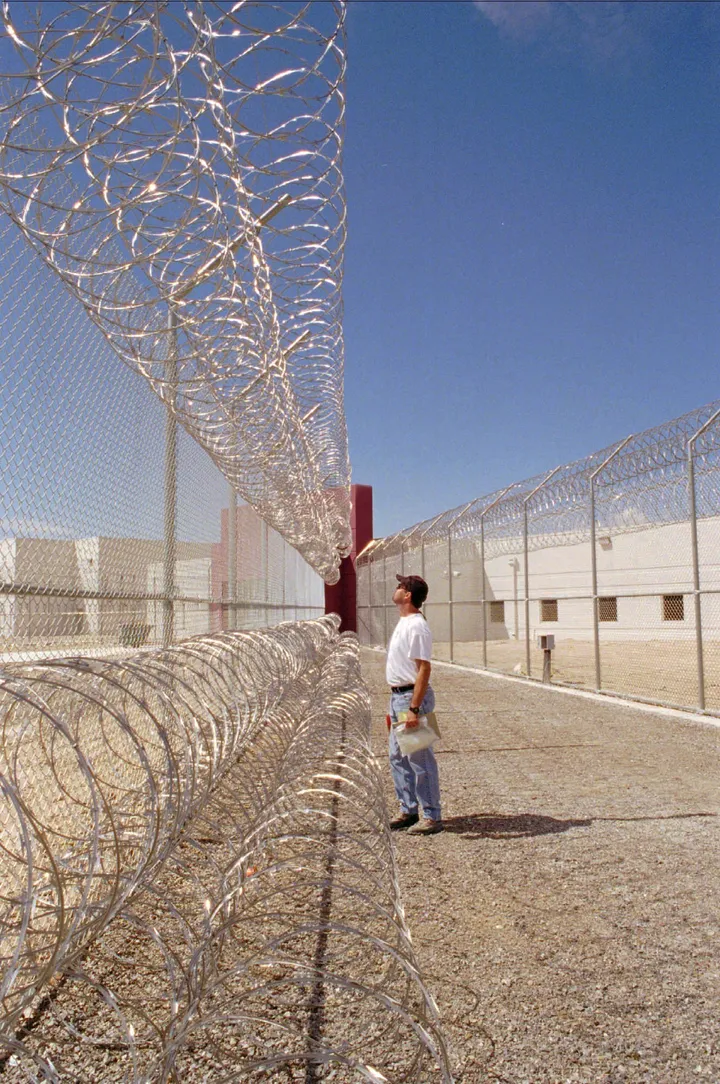
Florida this week faces a choice that is increasingly confronting much of the nation -- whether to hand over a major slice of its prison system to private, for-profit businesses that answer to Wall Street.
Lawmakers in Florida are taking a final vote on legislation that would result in the single largest expansion of for-profit prisons in the country, resulting in the privatizing of every state prison south of Orlando. This would amount to just under 30 facilities representing 20 percent of the state's sprawling correctional system. The state Senate postponed a scheduled vote on the issue Wednesday afternoon and is expected to address the measure as early as next week. The House would still have to approve a companion bill for the measure to become law.
Proponents have advanced the move as a cost-saving measure, a business-minded response to the state's budget shortfall. But a series of studies and the experiences of several other states that have experimented with privatizing prison systems raise significant doubts about the cost savings that are supposed to accrue: Private prisons have tended to take control of the lowest-cost inmates, those lacking health problems and posing less risk of violence, while leaving states to contend with the harder cases.
The action by Florida’s legislature comes after years of sustained lobbying by corporations that operate private prisons, an industry that has been expanding aggressively by offering itself as a solution to state budget shortages. The industry has contributed more than $1.4 million to Florida's Republican Party in recent years and has spent millions lobbying key lawmakers in that state.
The stakes are high: Florida has the third-largest prison system in the nation. Opponents decry the move as a perversion of the legislative process, one that would determine the shape of the corrections system not based on concerns over public safety, but as a means of distributing spoils to a well-financed special interest group.
"This is a major policy change," said state Sen. Mike Fasano, a Republican who opposes prison privatization despite his party's strong support, speaking during a recent hearing on the plan. "Do we privatize public safety now? Is that what we're doing -- just so some private companies, some multimillion dollar companies, can make a profit?"
The moves in Florida highlight a contentious debate, ongoing for the past two decades, about U.S. criminal justice and incarceration policies. As prison populations have surged nationwide since the 1980s, private corporations have positioned themselves to secure a growing share of the money expended on incarceration, courting influence in Washington and in state capitols across the country in a strategic bid to secure contracts.
Among proponents' primary talking points is the contention that they will save the taxpayer money -- an argument that experts say is difficult to prove.
"There is no real empirical data to say with any certainty that private prisons cost less or that they're more effective than public prisons," said John Hall, a public policy consultant in Florida who studied private prisons in recent years as the executive director of the Florida Center for Fiscal and Economic Policy.
But even as the Florida Senate considers final drafts of legislation on prison privatization, lawmakers have commissioned no outside studies to analyze the projected costs or benefits of the plan, which would more than double the number of private prisons and inmates under private supervision in the state.
Over the last two decades, Florida increasingly has come to rely on the private prison industry in such a fashion that experts say the history justifies taking a pause before approving the expansion plan. A 2005 report by a state inspector general's office found that the commission overseeing Florida private prisons had been unable to calculate the cost savings required by the state, while allowing contract modifications that benefited private prison operators -- changes that resulted in the state's being overbilled by millions of dollars.
While reports from the state's legislative research office show that Florida's seven existing private prisons cost less than public facilities -- a benefit cited repeatedly over the past week by supporters of the bill -- they also point out that "the cost savings estimates are subject to caveats and should be evaluated cautiously."
Cutting costs is a key issue in Florida, which faces a more than $3 billion budget deficit. But critics in the Senate have questioned why the bill has moved so fast even though the annual financial savings estimated by supporters come to no more than $30 million. The state’s Department of Corrections budget exceeds $2 billion.
"Privatization is good for certain functions, but it's not good in my mind for public safety," said Paula Dockery, another Republican state senator who disapproves of the privatization plan. "They have not done any true fiscal analysis on it, and I think it's really an embarrassment."
BIG SPENDING IN THE SUNSHINE STATE
One company that is especially well positioned to take advantage of new legislation in the Sunshine State is the GEO Group, a Florida business that is the nation's second-largest for-profit prison corporation. Based in Boca Raton, at the northern end of the Miami metropolitan area, GEO owns or manages more than 100 correctional facilities in the United States, the United Kingdom, Australia and South Africa.
The GEO Group already has contracts in Florida and aims for more. The Corrections Corp. of America, the country's largest operator of private prisons, also operates prisons in Florida.
Information about its potential Florida expansion is featured prominently on the GEO Group's home page, and executives have headlined quarterly earnings calls over the past year with discussion of the legislature's proposal.
"This is the largest single contract procurement in the history of our industry, and we've taken what we believe are important steps to put our company in a competitive position to pursue this unprecedented opportunity," GEO Group's chief executive, George Zoley, said in an August call with investors.
Corrections Corp.'s chief executive, Damon Hininger, sounded similarly eager in a conference call last year, saying the company was "aggressively pursuing this opportunity."
Both companies have been active contributors to the state's elected officials and have hired top-tier lobbyists in Tallahassee to influence legislators and officials in the governor's administration in recent years.
A spokesman for the GEO Group did not respond to requests for comment. Mike Machak, a spokesman for Corrections Corp. of America, wrote in an email that the company had a "longstanding and productive partnership with Florida."
"We would certainly be interested in expanding our presence as both a partner and corporate citizen in Florida," Machak wrote.
A Huffington Post analysis of campaign contributions over the last three election cycles finds that political action committees, executives and spouses at for-profit prison companies have donated nearly $1.8 million to Florida candidates and committees.
The Florida Republican Party over the last decade has been the single largest recipient of campaign money nationwide from both the GEO Group and Corrections Corp. of America. Prominent Florida lawmakers in federal and state offices are among the top recipients of campaign donations from the GEO Group.
U.S. Sen. Marco Rubio (R-Fla.) received $27,000 from the GEO Group during his 2010 campaign, and GEO was listed as contributing the maximum of $25,000 last year to the inaugural party for Florida's Republican Gov. Rick Scott.
State Senate President Mike Haridopolos, a major supporter of the prison privatization plan, also received more than $35,000 from the GEO Group last year when he decided to seek the Republican nomination for the U.S. Senate race to challenge the Democratic incumbent Sen. Bill Nelson. Haridopolos decided to drop out of the race last summer.
An analysis by the National Institute on Money in State Politics found that during the 2010 election cycle, private prison interests gave $998,000 to Florida state lawmakers. In a similar fashion, the Florida Police Benevolent Association, which until recently represented the state's correctional officers, donated about $1 million. The Police Benevolent Association also serves as a union for local police officers and many other law enforcement agents in the state.
HARD PUSH FOR PRIVATIZATION
This latest move to privatize South Florida's prisons is the second time in less than a year that the legislature has taken up the measure. Last spring, legislators included the prison privatization plan in a massive budget bill, rather than introducing separate legislation on the issue.
Using the budget approach, lawmakers avoided a direct up-or-down vote on the prison changes. The Florida Police Benevolent Association sued the state in July to halt the plan, arguing that the legislature had overstepped its authority by slipping such language into a budget bill.
A state judge in Tallahassee ruled last fall that the approach was unconstitutional and that lawmakers could not use the "hidden recesses" of the budget process to enact such a sweeping change in state policy.
After the court ruling was announced in September, the GEO Group's stock fell by nearly 5 percent in one day.
Lawmakers started anew on the privatization effort last month, swiftly moving the bills through committees. The head of the committee that sponsored the legislation in the state Senate, John Thrasher, was the former chairman of the Florida Republican Party, which has received more than $1.4 million in donations from political action committees and executives of for-profit prison corporations over the last three election cycles.
In recent debate in the Senate, Thrasher has argued that the goal of the legislation is cutting state costs.
"I've got taxpayers in my district who are concerned about the [shortfall] we have in the state of Florida, and they've asked us to look at ways that we can make government more efficient," Thrasher said in a committee meeting last week. "It's not a new concept. The evidence is that we're going to save money."
Supporters have argued that the state requires outsourced government services to be provided at a 7 percent discount and said the state would have the power to keep companies accountable for achieving the savings.
But evidence from numerous national studies has shown that the benefits of handing prisons off to private corporations can be illusory at best.
In Arizona, a 2010 report from the state's auditor general showed that it cost the state more to house prisoners in private facilities than public prisons, for both minimum- and medium-security facilities. After adjusting for the types of medical care provided in state prisons, the report found that the state spent more per inmate in private prisons than it did in its own public facilities.
Other outside research has found little in the way of convincing evidence that privatization significantly reduces prison costs. An analysis by the University of Utah that compiled a bevy of previous research on prison costs found that "neither cost savings nor improvements in quality of confinement are guaranteed through privatization."
Reports from Florida's legislative research arm, the Office of Program Policy Analysis and Government Accountability, noted that the financial savings were more of a cost shift. Recent reports showed that the biggest savings in Florida's private prisons resulted mostly from lower retirement benefits for private guards; but higher administrative costs turned up for the state, which is still charged with overseeing the entire corrections system.
Dockery, the Republican state senator who disapproves of the privatization plan, questioned why budget decisions should be made by effectively firing state workers who have the option of getting rehired by a private company with fewer benefits.
"You're not even really balancing the budget. You're giving this for-profit company all of the employees' benefits as their profits," she said. "If you had employees who were not doing a good job, then laying them off for reason is one thing. But you're really making all these cuts off the backs of 3,800 employees."
Once enacted, the legislation would give companies 30 days to draw up proposals to operate the 27 facilities in South Florida.
UPDATE: 2:50 p.m. -- This story originally stated that the Florida state Senate was expected to vote on the prison management bill Wednesday afternoon. It has been updated to reflect that the Senate postponed its vote.