
More

Science, Art Come Together As International Visualization Challenge Winners Announced (PHOTOS)


First Posted: 02/ 3/2012 10:53 am Updated: 02/ 5/2012 4:36 pm


By: Stephanie Pappas, LiveScience Senior Writer
Published: 02/02/2012 02:09 PM EST on LiveScience

From the dark-matter web of the universe to the rainbow of a mouse's retina, a new trove of award-winning science images reveals little-seen worlds.

The winners of the 2011 International Science and Engineering Visualization Challenge, announced today (Feb. 2) turn dry data into vivid imagery. The informational poster "The Cosmic Web," for example, used simulations and algorithms to create a fiery, beautiful representation of matter in the universe through time. The image, by Johns Hopkins University cosmologist Miguel Angel Aragon-Calvo, won a spot on the cover of the Feb. 3 issue of the journal Science, which co-sponsors the contest with the National Science Foundation.

The contest also includes interactive games. One honoree this year created one called "Build-a-Body," in which players can drag and drop organs into a virtual human body, learning anatomy and playing surgeon. Another game allows players to "zoom in" to the human body and look at individual cells.

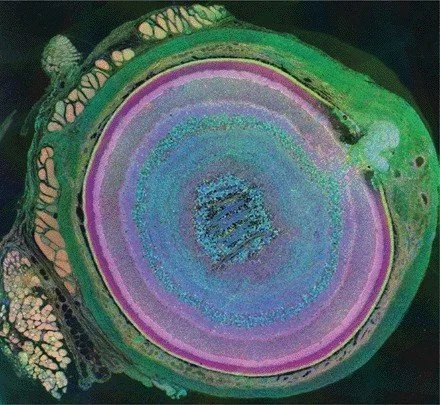
This year's winner in the photography category is a stunning photograph of a mouse's eye. Using a technique called computational molecular phenotyping, University of Utah neuroscientist Bryan William Jones reveals the metabolic diversity of the cells in the creature's retina. [See the Winning Images]

Another amazing close-up photograph captures the trichomes on the skin of a young cucumber. These vegetable defenses are tiny sharp spikes filled with bitter compounds to send plant-eaters running.

The contest, in its ninth year, had 212 entries. Judges picked those they felt had the most impact, the most effective communication, and the most originality. The goal is to honor recipients who use visuals to communicate the complexities of scientific research.

"The talent of these award winners is remarkable," Monica Bradford, the executive editor of the journal Science, said in a statement. "These winners communicate science in a manner that not only captures your attention, but in many instances strives to look at different ways to solve scientific problems through their varied art forms."

You can follow LiveScience senior writer Stephanie Pappas on Twitter @sipappas. Follow LiveScience for the latest in science news and discoveries on Twitter @livescience and on Facebook.

Copyright 2012 LiveScience, a TechMediaNetwork company. All rights reserved. This material may not be published, broadcast, rewritten or redistributed.
FOLLOW HUFFPOST SCIENCE

By: Stephanie Pappas, LiveScience Senior Writer Published: 02/02/2012 02:09 PM EST on LiveScience From the dark-matter web of the universe to the rainbow of a mouse's retina, a new trove of a...
Filed by Travis Korte  |  Report Corrections
 
 
  • Comments
  • 5
  • Pending Comments
  • 0
  • View FAQ
Post Comment Preview Comment
To reply to a Comment: Click "Reply" at the bottom of the comment; after being approved your comment will appear directly underneath the comment you replied to.
View All
Recency  | 
Popularity
11:02 AM on 02/08/2012
I tend to disagree with the video from the University of Utah that said robots are the most creepy when they are made to look like humans. Actually, the Bible states that God loved the world and that His Son Jesus Christ told people to love one another just as God loved planet Earth. With eternal progress where God was once a human but is now God so humans could progress so as to become like the loving God. Hence, I would think that robots would look the most best or like God when they are made to look like humans. Moses on Mount Sinai in the Exodus reportedly talked to God face-to-face when God came down in fire and smoke on the mount in the Bible and Mormon Joseph Smith said he encountered and saw God and His Son Jesus near Palmyra, New York, on about March 26,1820, when he saw the object come down from space and land on the ground and the two brilliant personages appeared standing in the air.
This user has chosen to opt out of the Badges program
05:04 PM on 02/05/2012
Nice pics! That breast cancer pic even looks like a monster!
01:05 PM on 02/05/2012
Very nice of what I could see - some of the links to the photos were broken.
03:32 PM on 02/04/2012
Really well nice shots.

btw image #3 is broken = [
Star2000dancer
Pay it forward, the movie..
08:23 PM on 02/03/2012
Too bad I could'nt see the pictures. Had to battle too much spam and ads, again. Disgusting.