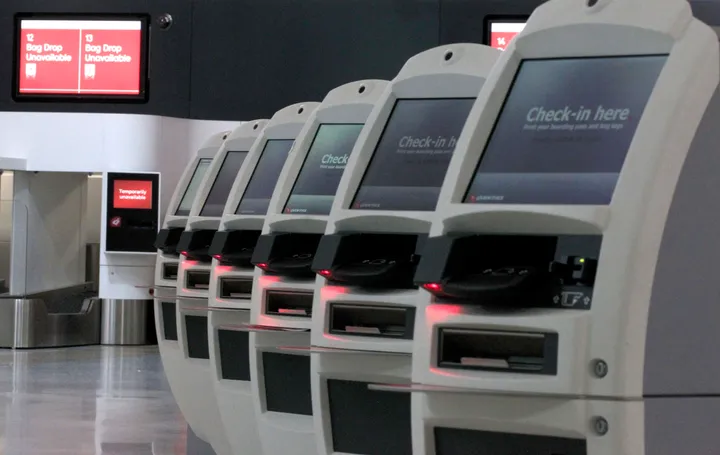
LONDON (Reuters) - Welcome to the airport terminal of the future.
There are self-service bag drops but no check-in desks. Your passage is seamless, punctuated behind the scenes only by discrete Near Field Communication (NFC) sensors.
Occasionally you stop to scan your NFC-enabled smartphone at a touch point. Your biometric information, picked up by automated surveillance cameras, will ensure there's no need to queue up to see whether you pose a security threat.
This is where travel needs to be, say technologists who also insist that their wizardry, if employed universally, could solder together the jagged edges of the industry.
It may sound far-fetched, but automated systems that talk to handheld devices are in the trial stage: In Australia, Qantas has rolled out frequent flyer cards with radio frequency identification (RFID) tags to streamline the luggage-tagging process; Japan Airlines (JAL) is deploying NFC-based mobile boarding passes later this year for domestic flights.
"Technology is joining the dots by giving passengers the opportunity to 'automate' their way through the airport touch points," says Renaud Irminger, a director at air transport communications and IT solutions provider SITA.
But a report from global IT group Amadeus on how airlines, airports, ground transportation firms and hotels can be more collaborative, argues that there is no focus on the interfaces where travelers feel the pain.
Andrew Curry, a director of The Futures Company who helped research the Amadeus report, told Reuters that if nobody leads on this, nothing could happen for five or 10 years.
The report is available at http://bit.ly/wMix0V.
Recent SITA surveys have reported that of the top 50 airlines almost 80 percent are planning to deploy NFC technology by 2014, but only 27 percent of airports expect to implement the technology by then.
This could be because they are unsure if the investment is worthwhile. For mobile solutions to work internationally for example, agreement across multiple jurisdictions would need to overcome a jungle of data privacy and security regulations.
"If only 10 percent of customers use new technology, all the old systems must remain, meaning you've simply added another layer of complexity, not greater simplicity," said Peter Morris, chief economist at aviation consultancy Ascend.
SITA projects 80 percent of travelers will use mobile check-in by 2018. Forced to bear the brunt of check-in responsibility, it is far from certain whether passengers will benefit from these airports of the future.
"We remain to be convinced about customer reaction, which should be measured by proper impartial surveys rather than simple assertions by self-interested purveyors of technology," Morris told Reuters.
Paul Behan, head of passenger experience at the International Air Transport Association (IATA), said a focus on mobile boarding neglects other aspects of traveler stress.
"The boarding process itself is not necessarily a major hassle for passengers; rather any frustration seems to come from the issue of trying to find all-important luggage space in the overhead bins."
The benefits of new technology are certainly being enjoyed by the aviation industry. IATA's "Simplifying the Business" program is, it has said, saving around $5.5 billion a year from the switch to e-ticketing, bar-coded boarding passes and self-service kiosks.
An ongoing baggage program replacing manual luggage systems will save an estimated $1.9 billion per year.
(Editing by Paul Casciato)
Our 2024 Coverage Needs You
It's Another Trump-Biden Showdown — And We Need Your Help
The Future Of Democracy Is At Stake
Our 2024 Coverage Needs You
Your Loyalty Means The World To Us
As Americans head to the polls in 2024, the very future of our country is at stake. At HuffPost, we believe that a free press is critical to creating well-informed voters. That's why our journalism is free for everyone, even though other newsrooms retreat behind expensive paywalls.
Our journalists will continue to cover the twists and turns during this historic presidential election. With your help, we'll bring you hard-hitting investigations, well-researched analysis and timely takes you can't find elsewhere. Reporting in this current political climate is a responsibility we do not take lightly, and we thank you for your support.
Contribute as little as $2 to keep our news free for all.
Can't afford to donate? Support HuffPost by creating a free account and log in while you read.
The 2024 election is heating up, and women's rights, health care, voting rights, and the very future of democracy are all at stake. Donald Trump will face Joe Biden in the most consequential vote of our time. And HuffPost will be there, covering every twist and turn. America's future hangs in the balance. Would you consider contributing to support our journalism and keep it free for all during this critical season?
HuffPost believes news should be accessible to everyone, regardless of their ability to pay for it. We rely on readers like you to help fund our work. Any contribution you can make — even as little as $2 — goes directly toward supporting the impactful journalism that we will continue to produce this year. Thank you for being part of our story.
Can't afford to donate? Support HuffPost by creating a free account and log in while you read.
It's official: Donald Trump will face Joe Biden this fall in the presidential election. As we face the most consequential presidential election of our time, HuffPost is committed to bringing you up-to-date, accurate news about the 2024 race. While other outlets have retreated behind paywalls, you can trust our news will stay free.
But we can't do it without your help. Reader funding is one of the key ways we support our newsroom. Would you consider making a donation to help fund our news during this critical time? Your contributions are vital to supporting a free press.
Contribute as little as $2 to keep our journalism free and accessible to all.
Can't afford to donate? Support HuffPost by creating a free account and log in while you read.
As Americans head to the polls in 2024, the very future of our country is at stake. At HuffPost, we believe that a free press is critical to creating well-informed voters. That's why our journalism is free for everyone, even though other newsrooms retreat behind expensive paywalls.
Our journalists will continue to cover the twists and turns during this historic presidential election. With your help, we'll bring you hard-hitting investigations, well-researched analysis and timely takes you can't find elsewhere. Reporting in this current political climate is a responsibility we do not take lightly, and we thank you for your support.
Contribute as little as $2 to keep our news free for all.
Can't afford to donate? Support HuffPost by creating a free account and log in while you read.
Dear HuffPost Reader
Thank you for your past contribution to HuffPost. We are sincerely grateful for readers like you who help us ensure that we can keep our journalism free for everyone.
The stakes are high this year, and our 2024 coverage could use continued support. Would you consider becoming a regular HuffPost contributor?
Dear HuffPost Reader
Thank you for your past contribution to HuffPost. We are sincerely grateful for readers like you who help us ensure that we can keep our journalism free for everyone.
The stakes are high this year, and our 2024 coverage could use continued support. If circumstances have changed since you last contributed, we hope you'll consider contributing to HuffPost once more.
Already contributed? Log in to hide these messages.