Asian American Performers Action Coalition Aims For Paradigm Shift In Casting

Asian Americans Broadway

First Posted: 02/17/2012 8:28 am Updated: 02/18/2012 10:10 am

In September of last year, an Asian-American actor posted an offhand status message on Facebook. He wrote that he'd finally been seen by one of the top Off-Broadway theater companies in the city, and he was excited about it. But he also wondered why, after graduating from one of the best graduate acting schools in the country, and living in the city for almost 10 years, it had taken him so long to get his foot in the door there.

The actor wasn't aiming to get someone in trouble or cause an uproar, really -- he was merely expressing a frustration. But it sparked a major response. Other Asian-American actors responded in droves: some who had been working for decades vented similar frustrations, while others mentioned that they had also never been seen by that theater and had hung onto similar thoughts for years.

Based on this online conversation, many started thinking on a wider scale. One night the following month, Ralph Pena, artistic director of the Mai-Yi Theatre Company in New York, gathered about 150 Asian-American actors, writers, directors and other professionals at a rehearsal studio, and they dove right into it. They talked for hours.

"The first thing you have to do to shift a paradigm [is] get something on people's minds," said Christine Toy Johnson, an Asian-American writer and performer with extensive theater, TV, and film credits, who is also the co-chair of the Actor's Equity union's Equal Opportunity Committee. "You have to prove that there really is a problem and then you have to do something."

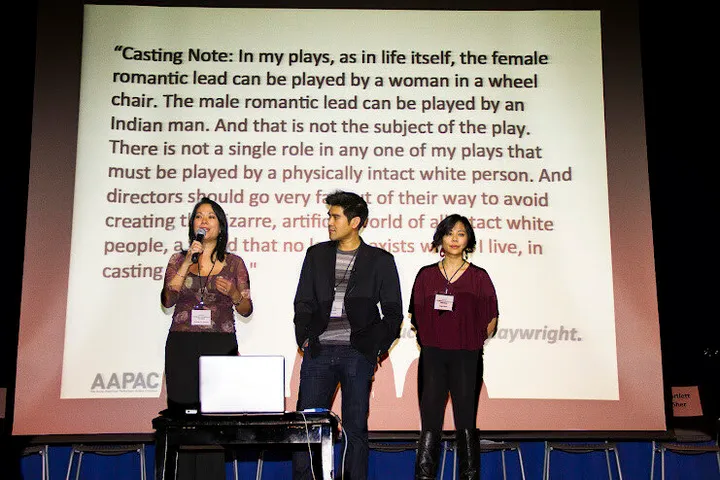
So they did. They formed AAPAC -- the Asian American Performers Action Coalition -- and set out to discover how many actors of their ethnic background were actually being cast in New York. Their initial steering committee researched actors in well over 400 productions, their specific ethnic backgrounds and stories, and what they found was more startling than they'd imagined.

In the report "Ethnic Representation on New York City Stages," AAPAC states that Asian-Americans received only 3 percent of all available roles in the non-profit sector, and only 1.5 percent of all available roles on Broadway in the past five years.

Whereas African-American and Latino actors saw their roles increase since 2007, "Asian-Americans were the only minority group to see their numbers go down from levels set five years ago," the study found. It also discovered that only 9 percent of all available roles city-wide had been cast "non-traditionally."

"Our [level] of research probably wouldn't have been able to happen without Google," said Pun Bandhu, an Asian-American actor who is currently performing in "Wit" on Broadway, and a member of AAPAC's steering committee. "We looked at interviews, read bios, anything we could find online, to see how [actors] identified themselves."

Johnson said the results weren't particularly surprising.

"There's this real subconscious perception in society that Asian-Americans are not actually American," she said. "It's a bit shocking, but every [Asian-American person] I know has had to deal with some sort of perception based on image."

Johnson noted that she and other Asian-American friends are often praised simply for "speaking English." Over the Thanksgiving break, she remembered, a stranger on the subway asked her a question and then proceeded to compliment her grasp of the English language, despite the fact that her family has lived in this country since 1865.

"The thing is: I don't think we are seen as part of the American fabric," Bandhu added. "Ultimately, you want to hire the best actor for the role, but how can you say you've found the best actor if entire demographic groups aren't even in the running? There's no reason now that for the role of the midwestern neighbor, you shouldn't call in an Asian actor."

It's not necessarily about closed-mindedness, Bandhu said. He and others in AAPAC are just trying to make theater professionals and audiences conscious of the issue. It took African-American and Latino actors years to shift the paradigm and earn roles that might have gone to Caucasian actors, but Bandhu doesn't want "to wait 20 more years" for this shift to take place for Asian-American actors -- for them to earn a better living and challenge themselves artistically.

Bandhu said that since non-white populations in New York City are on the upswing -- Asian-Americans make up almost 13 percent of its population and represent the country's fastest growing minority group -- the actors on its stages should reflect that diversity.

"When I was in grad school [at Yale] there was always colorblind casting," he explained. "So coming into the workforce here was really shocking at first."

Though there has been an influx of plays featuring Asian American actors in recent months -- "Outside People" at the Vineyard and "Chinglish" on Broadway especially come to mind -- both of those plays featured story-lines that were specific to Asian characters. That's part of the larger issue, Bandhu said; about half of the roles he auditions for requires him to play a very specific character with "some kind of Asian accent."

David Henry Hwang, the Tony award-winning playwright and Pulitzer Prize finalist who penned "Chinglish" and "M. Butterfly," among other Broadway plays, said that the older generations of theatergoers are "perfectly comfortable with works about Asians, particularly if they're in Asia," but are often less comfortable seeing an Asian-American in a lead role that isn't ethnic-specific.

"Even more challenging is having a family not entirely made up of the same ethnicity," Hwang added.

And this is what AAPAC is hoping to change. On Monday the organization held its first roundtable forum at Fordham University, and Hwang was among the 19 participants. Others included Tony award-winning director Bartlett Sher and Public Theater artistic director Oskar Eustis. The Public, according to the report, provided the highest rates of "non-traditional casting," casting non-white actors in 12.5 percent of roles since the 2006-07 season.

Eustis suggested that Asian-American actors might actually get out there and protest -- picketing theaters and forcing more diversity citywide. But Johnson said that that's not really their style. The broader goal is to raise awareness and shift perceptions. These actors want to be a part of the city's general theatrical landscape in addition to making their own, ethnically-specific work.

The New York Times noted that at the forum, Bandhu quoted a theater blogger who had concluded that perhaps "theater is for white people," since they're the ones showing up to most performances. But others who spoke suggested that theaters simply needed to continue diversifying their casting choices, better representing the minority population of the city, and in turn attracting more minority audiences.

Both at the forum and in an interview with HuffPost, Hwang brought up Jeremy Lin, the Asian-American NBA player who is currently on every sports fan's mind. Lin had to overcome preconceived notions, too -- he was dropped by school programs, initially undrafted by the NBA, and then waived by the Golden State Warriors and Houston Rockets. It even took the Knicks a while to play him, initially.

"And why? Jeremy Lin is 'like us.' He's an Asian American who grew up in Palo Alto. It means a lot to us and it says a lot about the insidiousness of the glass ceiling," he said. "Because now it's like: how did everybody miss him? What were they thinking?"

FOLLOW HUFFPOST CULTURE

In September of last year, an Asian-American actor posted an offhand status message on Facebook. He wrote that he'd finally been seen by one of the top Off-Broadway theater companies in the city, and ...
 
 
  • Comments
  • 117
  • Pending Comments
  • 0
  • View FAQ
Post Comment Preview Comment
To reply to a Comment: Click "Reply" at the bottom of the comment; after being approved your comment will appear directly underneath the comment you replied to.
View All
Favorites
Recency  | 
Popularity
Page: 1 2 3  Next ›  Last »  (3 total)
10:26 AM on 08/01/2012
Tony and Olivier award winner LEA SALONGA - she played both Eponine AND Fantine on Les Miserables.. onstage and on both the 10th and 25th anniversary concerts. She also played Cinderela off-broadway. I must say she did break the barrier and paved way for blind casting asians for roles made originally or traditionally for caucasians.
06:01 AM on 07/20/2012
The problem is even worse in the UK, which is much further behind the USA in terms of positive casting of Asian Americans.
04:43 PM on 02/22/2012
I think this problem goes way beyond the stage and onto TV as well. After years of calls for more diversity in television, all I see is one token minority among an all white cast instead of just an all white cast. That minority is most often african-american. If a show has more than one minority group, it is very often portrays a negative stereotype.
03:16 PM on 02/22/2012
Kudos to the members of AAPAC, not only for taking the initiative to form in the first place but also for putting Theatre and Hollywood on Blast for their continued regurgitant, not diverse enough, uninclusive methods. I am not an actor but as a viewer of various forms of media, I have often commented on the uneven balance of diversity and how it doesn't represent the real 'United States of America', you know the one that is made up of all Races! I know that if I was a Casting Director and there was a part available for a non 'A list' actor I would require the open call to be just that, seriously open to all!
photo
HUFFPOST SUPER USER
thetruthhoits
04:49 AM on 02/21/2012
Waikikian888-
You're right about many Asians being taught that entertainment is a lowly profession. My father is Indian and we were raised to follow the path of scholastic pursuits. To him, entertainers are court jesters. Of course, not all Indians feel this way with Bollywood being so pervasive, but among his caste entertainment is looked down upon.
This user has chosen to opt out of the Badges program
10:00 AM on 02/21/2012
that is not true. Asian were treated differently because of their color and skin.
The talents are there but the industry leaders which are mostly white choose to look the other way.
Part of the problem isn't all just white. The asian tend to fight among themselves which slowed the accend to the top.
10:31 AM on 02/21/2012
It is true that skin color and culture do play a big role in being cast in stage and movie roles. An Asian actor or singer must work twice as hard to be accepted as say, a White leading man in a Western play or movie. Unless you look like John Wayne or Cary Grant, you would have a hard hard time trying to be a western cowboy or suave English
lover. Saying that Asians "tend to fight among themselves" is not the general rule in Hollywood, where the few who are in movies and shows have a strong support group which help more than hurt each other. All roles in acting are open to audition process, and the competition is fierce for a movie role for Asians, but that is the nature of the game. Only when more Asian-based story lines and roles are created will they be on a level playing field. The challenge for Asian actors is there, and their time can and will come!
03:31 AM on 02/21/2012
There are all kinds of discriminatory behaviors in the U.S. Starting with dissing the president, it goes through the ranks of movie actors, and every facet of living in this otherwise great country..
As for actors, the major problem is in cash- paying audiences. As a minority Asians do not pay $$ as other ethnicities to go to movies and big concerts. Asians are outnumbered by mostly Whites in producing movie scripts and producing films and big concerts. ''Show me the money,'' is the prevailing entry point for being an Asian Hollywood or Broadway actor. When Asians begin to write more award winning plays and movies, and get the money to pay for production they can and will succeed in creating more Asian stars and entertainers. Especially the Chinese have abhorred becoming performance artists as it is looked upon as the least honorable profession in a culture that valued higher education and professional accomplishment. Until Asians begin to finance entertainment media, buy into sports teams ( NBA, AFL, NFL, etc.), they will have a hard time expecting Asian sports stars.
American born Asians like Jeremy Lin is a miracle in the making, who would normally have gone to work for Silicon Valley or Wall St. May his career flourish as an example for what could come true for other Asians.
04:22 AM on 02/21/2012
A superb and cogent analysis of the situation. Things are changing and the future will be different. But money speaks. So true. And there is a definite cultural bias against participating in the performing arts amongst Asian parents, who prefer other career options for their children But in the meantime we have rising stars in virtually all the entertainment fields, from the dazzling classical pianist, Lang Lang to the recent basketball favorite, Jeremy Lin.

As Asians move to to forefront by sheer talent and determination, money will follow them. The result for all Americans can only be a much richer and varied experience in all facets of our lives.
05:17 AM on 02/21/2012
One fifth to one sixth the world's population is Asian. Because movie making and concert shows were largely American-Euro generated arts for the past 70 years. Asians were never a seminal part of the entertainment industry in the West, suffering political - economic upheavals, followed by Communist rule and the degradation of elitist cultures of movie-making and show productions. The disdain for entertainment and sports by China was further exacerbated by the Cultural Revolution of 1966-76 and interest in them has only surfaced in recent years. Remember, Ping Pong was the national sport of China just 40 years ago, and the thought of major league ball playing was not even on the horizon, much less movies and Broadway - style theater. And no one in the West gravitated to the prevalent street entertainment of Beijing Opera, even to this day.
photo
HUFFPOST SUPER USER
thetruthhoits
04:40 AM on 02/21/2012
Waikiki-
Yes, you're right about entertainment being looked at as a lowly profession by many Asians. I'm half South Asian and my father would have NEVER wanted any of his kids to become performers. In his background entertainers are like monkeys with cymbals. Education was the only route. Of course, I think among many Indians that view is now gone b/c of how pervasive Bollywood has become in the culture. But among his "caste" entertainment was certainly not valued.
12:35 AM on 02/21/2012
in my opinion, asians need to speek up... get rowdy!.. get some crazy outraged leader to bring publicity to the cause... whatever it may be... otherwise, all of this will continue to be overlooked & people wil continue not to care. people will insult & run over those who they feel won't do anything about it... & perhaps more people need to be educated about things they know nothing about... bring light to it! YELL, don't whisper... nobody will hear you.
This user has chosen to opt out of the Badges program
10:09 AM on 02/21/2012
Ok, you do the yelling and get rowdy. LOL With my luck, I get arrested if I get rowdy up.
photo
HUFFPOST SUPER USER
PatientZeroBeat
Dying since 1962
10:03 PM on 02/20/2012
Mostly only old farts don't accept non-whites as not being "American". Virtually anybody under the age of 30 looks at Harold and Kumar and doesn't think it's strange that they're not white. I'm 49 and grew up with all kinds of people around me and the bigger thing that makes people "different" from me is when and where they grew up, not the colour of their skin. A person who looks exactly like me but who grew up in a different country or time will have less in common with me than a person who looks totally different but who grew up with a shared experience.
photo
HUFFPOST SUPER USER
robjh1
We Have Met the Enemy and he is Us: Pogo
12:25 PM on 02/20/2012
All races other than (a few ) whites face similar challenges on the American stage. You just have to keep at it.
07:26 PM on 02/20/2012
Or white casting directors (who are the majority) have to stop being racist. The responsibility lies there.
03:51 AM on 02/21/2012
There was a recent discussion by a few Hollywood movie directors as to why they did not use minorities in their movies. Cluelessly, most said they never thought about including Blacks, Asians, Hispanics and would think about using them more. The single Black director said he was outraged that Blacks were excluded when they are the largest minority in the population of the U.S.
This user has chosen to opt out of the Badges program
photo
michelleobamaok
Tampa Crookpalooza 2012!
06:05 PM on 02/19/2012
He didn't get the job because he is boring. He should probably goe overseas and get acting work with Asian companies. Being a superbrain is one thing; but being absolutely boring is another.
07:26 PM on 02/20/2012
LOL!
iconico62
don't blame the mirror if you have a broken nose
05:18 PM on 02/18/2012
It is my hope that, with interracial marriages, the so called American look will be so blended that it won't be uncommon to see kids with some asian features with blue eyes and afros. Pretty soon, most everyone would look like beautiful blend of ethnic features like some people do now. In that way, they can fit many roles. As in any meaningful struggles, it will take another generation of creative people to go beyond the shape of one's eyes or the color of one's skin or the texture of one's hair.
This user has chosen to opt out of the Badges program
photo
09:05 AM on 02/19/2012
OK then, let's get busy stirring up the gene pool;)!!!
08:48 AM on 02/20/2012
This perfectly describes my niece. My brother married a hapa girl (in Hawaii, half-Asian/half-White people describe themselves as hapa) and their daughter has light brown skin,super-fluffy blonde curls, and slanted blue eyes. She throws older people off-kilter, but her classmates seldom do a double-take.
photo
HUFFPOST SUPER USER
thetruthhoits
12:25 AM on 02/18/2012
As a person with some South Asian ancestry, it is getting confusing to hear "Asian" and not self-identify. If I have to say I'm South Asian, please specify what "Asian" is being discussed. I suspect people in America mean specifically South East Asian, but it's getting annoyingly confusing. It's the same thing when people w/ Native American blood used to ask me what tribe I was from when I said I had some Indian ancestry. It's almost disrespectful to the groups who are being overlooked when such broad terms are used b/c it's so darned confusing.
06:03 PM on 02/19/2012
No-one wants seems to want to use the term ''oriental'' to refer to folk from the Far East which would help differentiate Asian people.

The term ''Caucasian'' is outdated. Indians were originally classified as Caucasian. Then the Caucasian as White came in.

Common usage, government and legal usage and anthropological usages are all different. That can not help.
photo
HUFFPOST SUPER USER
thetruthhoits
07:01 PM on 02/19/2012
Eric14-
That's why I think they should be called Southeast Asian. We call people from Western Europe Western European and differentiate when we are being specific to Eastern Europe, Southern and Northern. No group can be termed the sole inhabitants of a whole continent such as Asia especially when Asia is the most diverse continent if I recall. "Oriental" is seen as offensive though and I don't think it's the right term since Orient doesn't refer to any specific region. In its original usage, Turkey was even considered the Orient.
12:25 AM on 02/21/2012
i understand what you are talking about but i think they are talking about all asians in this article. you also have to think about the country you are living in & what the people are use to saying. honestly, i don't think many americans break it down like, south asians, etc... but other asians do. americans will say indian, referring to indain american & native american to the first americans.
11:17 PM on 02/17/2012
It's really despicable. Especially the racial treatment Jeremy Lin had to go through to rise up in the ranks. With asian actors,they really have to protest at the top of their lungs about the casting discrepancies to make the industry really think about inclusion in their casting. Otherwise they will continue to be overlooked in favor of white actors.
09:36 PM on 02/17/2012
"Eustis suggested that Asian-American actors might actually get out there and protest -- picketing theaters and forcing more diversity citywide. But Johnson said that that's not really their style. The broader goal is to raise awareness and shift perceptions."

Well, Ms. Johnson, perhaps Asian American actors need to change their "style". People are used to the stereotypically docile AAs standing by waiting for someone to throw them a bone. Things need to be shaken up, but AAs won't protest because it's not their style? How is complacency going to shift perceptions? Instead of hoping to be noticed through inaction, perhaps it's time to make a few changes. SAG has done studies which have long indicated that Asian American and other communities are ridiculously under-represented in film. I believe the Director's Guild (DGA) has also done surveys on the dearth of ethnic representation behind the camera. Whether its Hollywood or Broadway, it strikes me as being way past time for even small changes to be made. For a while, it seemed there was movement toward getting Asian American related films produced independently. What happened? I mention film because that's where my interests lie, but certainly there's enough Asian American talent in theatre to pick up the ball (Linsanity, anyone?) and make things happen on a small scale before staging larger productions. Sorry to vent, but reading that bit about "it's not our style" pissed me off.
photo
HUFFPOST SUPER USER
faithnj
05:38 AM on 02/18/2012
Girl, you know it pissed me off, too. High 5!
11:11 AM on 02/19/2012
With all due respect, I'd like to point out that I did not suggest that "inaction" was our style. The shear number of grass roots people hours that went into organizing this event and culling statistics alone cannot be seen as "inaction". We made this dialogue come to the forefront, with national media coverage (Variety,NYTimes, Huff Post to name a few) and we are making change happen. Even if you disagree with the fact that I, personally, (and perhaps most of my AAPAC colleagues) would rather do this by nurturing our relationships and engaging in dialogue, please do not make the blanket assumption that our entire community needs to "change our style". I have been an extremely active advocate for diversity and inclusion in the arts for the past 15 years and respect the approach that other advocates use to tackle these issues. We certainly don't need to be divided amongst ourselves. Sincerely, Christine Toy Johnson
02:19 PM on 02/19/2012
I agree, we don't need to be divided amongst ourselves. Lack of inclusion of minorities--especially the Native and Asian American communities--in film and theater is nothing new. How successful has nurturing relationships and engaging in dialogue been in creating opportunities for AAs? Perhaps you and your AAPAC colleagues could try other tactics which have been effective from a civil rights perspective as a means to further the dialogue. Perhaps forming a coalition made up of other AA-related advocacy groups would also be effective. (IMO) to say that certain tactics are not your style--in an interview which reaches who knows how many decision-makers--cuts you off at the knees and waters down the effect of your message. We both want the same result, so if I came across as divisive in light of my disagreement with your comment, I apologize.
photo
HUFFPOST SUPER USER
Palaver
Men make laws, but the people follow custom.
06:05 PM on 02/17/2012
The greater injustice here is that Asian characters are more likely to be recast as white. But this is stereotypical of white culture--similar to their one drop rule on race. White people can join your club, but you can't join theirs. This freedom (or conquest) is their privilege only.

I'm a mixed race Asian American.