Fear Helps You Appreciate Abstract Art, Study Finds

Fear Art Kendall Eskine Jackson Pollock

Posted: 02/18/2012 8:27 am

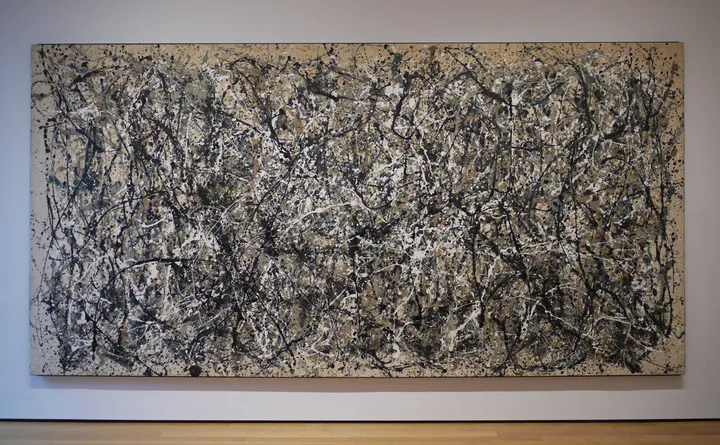
The next time you're having trouble appreciating Jackson Pollock, try seeing a horror movie first.

According to a new study, feeling fear may actually help people to better engage with abstract art.

In the study, which used 85 Brooklyn College students as a sample, participants were assigned randomly to one of five conditions: fear, happiness, high physiological arousal, low physiological arousal or a control group.

Fear was induced with a video of a screaming, zombie-like face, happiness with a clip of a baby and dog interacting, and high and low physiological arousal by having participants complete 30 or 15 jumping jacks, respectively. Participants were then shown four paintings by abstract artist El Lissitzky.

When results were tabulated, fear was the only factor shown to significantly increase the strength of viewers' reactions to the art. "Art’s allure may... be a byproduct of one’s tendency to be alarmed by such environmental features as novelty, ambiguity, and the fantastic," the study concluded.

"I wanted to focus on how our body literally shapes the way we think. The body is not just a vessel for the mind, it is the mind, it's all the same stuff," said Kendall Eskine, the study’s lead author, in an interview with The Huffington Post

Eskine, a research psychologist at Loyola New Orleans, is interested in the field known as embodied cognition, which explores the ways that physical states can influence the way that people think. Eskine is particular interested in how people process abstract concepts like beauty, truth, or morality.

One study in this field showed that participants holding a hot cup of coffee had more positive first impressions upon meeting a stranger than those holding a cold cup of coffee. Another study, run by Eskine, highlighted the connection between eating bitter food and increased feelings of moral disgust.

In the case of abstract art, Eskine explained, fear might stimulate viewers to the painting in front of them, in part because of the emotion's evolutionary basis.

"When you're in a fear state, it promotes fight or flight," he said. "When you're scared, [you focus on] the object that is involved in your fear state in a very special way. You couple the physical, visceral experience of fear with this object that has taken over your mental world -- a way of describing the sublime."

Eskine's definition of the sublime is taken from 18th century philosopher Edmund Burke, who believed that a truly great work of art should inspire both fear and pleasure. Though 18th century philosophy might seem out of place in a contemporary psych study, taking old philosophical ideas and testing them with empirical evidence is one of Eskine's passions.

"People for centuries have had provocative and interesting ideas and it doesn't hurt to see if they work," he said. "It's a great way to disseminate information to people who aren't scientifically trained."

Eskine plans to continue researching different aspects of aesthetic experience, including dance, film, music, and more. In one recent project, which has not yet been published, Eskine had participants sit on the edges of their seat. Afterwards, they expressed "more excitement/anxiousness," according to Eskine.

Eskine also pointed out that the results of his study could even be applied in reverse.

"Whenever you're asking people to look at art, if they're trying to get a sense of whether they like it, they could consider how it physically makes them feel and use that information as a cue to understand what it meant," he said.

FOLLOW HUFFPOST CULTURE

The next time you're having trouble appreciating Jackson Pollock, try seeing a horror movie first. According to a new study, feeling fear may actually help people to better engage with abstract art...
 
 
  • Comments
  • 379
  • Pending Comments
  • 0
  • View FAQ
Post Comment Preview Comment
To reply to a Comment: Click "Reply" at the bottom of the comment; after being approved your comment will appear directly underneath the comment you replied to.
View All
Favorites
Recency  | 
Popularity
Page: 1 2 3 4 5  Next ›  Last »  (5 total)
05:41 PM on 02/25/2012
Mark Grotjahnn know s this well.
09:42 PM on 02/20/2012
Fear and Trembling. Fear and Loathing. Fear and Whisky. Webern and Pollock. It's all good.
photo
johannesrolf
just a poor Tyrolean boy.
08:50 AM on 02/20/2012
For a look on the greatest abstract painter of our present time, check here:
http://www.nytimes.com/slideshow/2012/02/20/arts/design/02192012-richter-3.html
07:24 PM on 02/19/2012
www.flyingconcepts.com
photo
HUFFPOST SUPER USER
Mr Ware
I ate a Cornflake, so now I am a cereal killer.
08:30 PM on 02/19/2012
FLAGGED!
09:05 PM on 02/19/2012
Bon appetit cereal killer
photo
HUFFPOST SUPER USER
ignacio sanabria
Mirror synapses at work
10:48 AM on 02/19/2012
Fear can kill you if you are not able to get a grip on it. Fear is the most disabling of all emotions. The fear culprit is the amygdala.
This user has chosen to opt out of the Badges program
photo
AlaskanWannaB
BIG BIRD to Mittens: You're FIRED!!!
02:40 AM on 02/21/2012
Fear is also your most innate ability for protection, too, if you learn to appreciate it.
photo
HUFFPOST SUPER USER
ignacio sanabria
Mirror synapses at work
10:58 AM on 02/21/2012
Absolutely right. Fanned.
This user has chosen to opt out of the Badges program
photo
AlaskanWannaB
BIG BIRD to Mittens: You're FIRED!!!
02:50 AM on 02/21/2012
'The Gift of Fear and Other Survival Signals that Protect Us From Violence' is a very good read.
photo
johannesrolf
just a poor Tyrolean boy.
09:27 AM on 02/19/2012
for an overview of El Lissitzky see this from the Getty Research Institute.
http://www.getty.edu/research/tools/guides_bibliographies/lissitzky/flash/home.html

I believe this puts to rest the suggestion that he was not an abstract artist, which is not to say he did not produce representational work, especially in his propaganda posters.
photo
HUFFPOST SUPER USER
PaticaDeGato
Hissing and scratching with gusto.
09:41 AM on 02/19/2012
Lovely pieces. I had certainly seen them before, but I was not aware of his name.
photo
HUFFPOST SUPER USER
PaticaDeGato
Hissing and scratching with gusto.
09:22 AM on 02/19/2012
Fear of sounding like a philistine, is more like it (even if Pollock is bollocks).
photo
HUFFPOST COMMUNITY MODERATOR
BMcCue7
I'm Buddy McCue (and you're not.)
07:38 AM on 02/21/2012
That's the way I see it too.
photo
HUFFPOST SUPER USER
GnosisMan
09:06 AM on 02/19/2012
Inducing fear into us to appreciate abstract art is the most f**ked up theory I have ever heard These scientists have a lot of time & money & wasting it on theories that have no immediate social redeeming value. They ought instead to study why we are so gullible hence put inept people in office. Scientist ought to read Everett E. Allie book, The Origin of Social Dysfunction which makes abstract art nothing more that sentiment hence irrelevant to a greater awareness of our humanity. Such art is a distraction to our most pressing needs. Says Allie,

"Few are able to differentiate between opinion and knowledge; between groundless theories and evidence-supported premises. They have not been taught to think critically and to question authority. They have had to repress critical reasoning in order to keep the faith. The typical individual, in any culture, has little concern for truth, becoming cynical and grappling endlessly with his or her own beliefs, distorting perception and reasoning in a continuing struggle to make the pieces fit. Few dare discriminate between knowing and believing. Those who cannot are malleable and vulnerable to the chaos of propaganda and opinion poured over them".

So when scientist pour over us that inducing fear in our heart and mind makes us appreciate abstract art, we ought to think twice. As I see it, they are wasting time. Period.
mbrownNY
There's only one party... and we're not invited!
09:38 AM on 02/19/2012
you are a fool
HUFFPOST SUPER USER
June25
10:12 AM on 02/19/2012
If these scientist were good enough for a real job they wouldn't be on the Dole thinking up irrelevant studies to justify their job.
11:41 AM on 02/19/2012
Professors don't have real jobs? Who do you think taught many of the people posting on this forum, probably yourself included, assuming you went to college? Most professors could easily have "real jobs" where they'd make considerably more money, more easily in fact, because the academic job market is tough with more than a hundred people applying for 1 position. Most professors have chosen academic careers because they love teaching, inspiring, and occasionally even changing the lives others.
mbrownNY
There's only one party... and we're not invited!
11:53 AM on 02/19/2012
You clearly have no idea what you are talking about.
HUFFPOST SUPER USER
Richard Chan
08:42 AM on 02/19/2012
So I need to become frightened to better appreciate a Jackson Pollock paint collage - this benefits my life how?
mbrownNY
There's only one party... and we're not invited!
09:53 AM on 02/19/2012
Because you obviously didn't read the article.....

"I wanted to focus on how our body literally shapes the way we think. The body is not just a vessel for the mind, it is the mind, it's all the same stuff," said Kendall Eskine, the study’s lead author, in an interview with The Huffington Post

Eskine, a research psychologist at Loyola New Orleans, is interested in the field known as embodied cognition, which explores the ways that physical states can influence the way that people think. Eskine is particular interested in how people process abstract concepts like beauty, truth, or morality.

One study in this field showed that participants holding a hot cup of coffee had more positive first impressions upon meeting a stranger than those holding a cold cup of coffee. Another study, run by Eskine, highlighted the connection between eating bitter food and increased feelings of moral disgust.
photo
HUFFPOST SUPER USER
karen lyons kalmenson
i poem/paint, sometimes, i ain't
05:50 AM on 02/19/2012
jacksonpollockophobia should be a fear in itself;-D
photo
Quark50
So it goes.
05:33 AM on 02/19/2012
The real headline should be that there's a video on YouTube that can induce happiness. This will really cut into Big Pharma's profits on Prozac and Zoloft.
RealistBC
Micro-bios must pass muster.
04:57 AM on 02/19/2012
I'm afraid that I will never get Jackson Pollock. Does that qualify?
This user has chosen to opt out of the Badges program
photo
02:18 AM on 02/19/2012
AHHHHHHH!
This user has chosen to opt out of the Badges program
photo
Goliadkin
Irony: it's not just for smart people anymore.
01:04 AM on 02/19/2012
It would be very unwise to make any assumption about abstract art based on a single artist's work. These findings might show something about the way people respond to the work of Lissitzky, but I don't think that could be generalized to abstract art as a whole.
mbrownNY
There's only one party... and we're not invited!
03:52 AM on 02/19/2012
Would make for a perfect follow-up study!
This user has chosen to opt out of the Badges program
photo
Goliadkin
Irony: it's not just for smart people anymore.
01:44 PM on 02/19/2012
You mean, studying every artist in this way? Sure, why not? Funding might be sketchy, though.
01:01 AM on 02/19/2012
I thought that this article was going to be dumb- I am delighted that I was mistaken!