More

HuffPost Social Reading

Gauguin Exhibition Strikes Controversy: Should An Artist Be Docked For Personal Indiscretions?

Gauguib

First Posted: 02/21/2012 8:59 am Updated: 02/21/2012 8:59 am

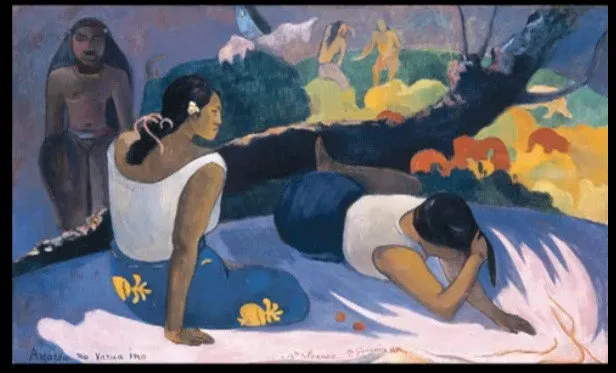
Almost as legendary as Paul Gauguin's colorful depictions of Tahitian utopia is the colorful story of how he got there and what he did once in the tropical locale -- the bourgeois stockbrocker picked up and left his wife and five children to embark on a hunt to discover the primitive. After testing out and abandoning lands not quite savage enough, Gauguin landed in Tahiti, where he indulged in the native lifestyle of taking adolescent girls as wives.

Decisions like impregnating a thirteen year old and giving her syphilis surely cast Gauguin in an unflattering light. And yet the artist's unethical and perhaps delusional escape to paradise led to one of the most revolutionary shifts in the visual vocabulary of all time. Gauguin's Primitivism used flat fields of acidic and unnatural color to convey stories that bridged history, myth, legend and dream. The utopias he painted expressed mystery, desire and the dark regions of psychology. This idea of making the invisible visible helped pave the way for contemporary abstraction. And no matter how you view it, the guy is an influential artist, even if he's someone you wouldn't want to take home to meet the folks.

What role, if any, should Gauguin's questionable ethics play in the reception of his art work? A recent review of Gauguin's exhibition at the Seattle Museum of Art by Jen Graves was hailed by some and reviled by others for enacting a personal critique of Gauguin as opposed to a purely aesthetic one.

Graves' article "You May Be Infected Already" on the exhibition "Gauguin & Polynesia" contains grating blows at Gauguin's persona, calling him, not-so discreetly, "vividly, eye-catchingly gross." Graves points out that Gauguin precipitated not only primitivism but also colonialism with a nice dash of misogyny. She applauded the SAM's exhibition for placing Gauguin's work in the context of Polynesian work in general, thus placing his delusions in close proximity with the islands' realities. Viewers get to see the European interpretation and the Tahitian interpretation, perhaps translatable to the orientalist interpretation and the native translation. Graves applauds the curators "who expose Gauguin's fantasies rather than indulge them." The exhibition does not simply worship Gauguin, it also unmasks him.

The comments section of the article exploded on both ends. While some backed Graves' morally inclusive reading, others declared her of being blinded to the art by the history of the artist. One comment by user Paddy Mac read:

"Huh. And what would you say about that sell-out Michelangelo? Or that violent drunk, Ernest Hemingway? You disqualify the art because of the misbehavior of the artist. Then how do you qualify it?"

Once you start looking at artists who behaved badly and disqualifying them for it, it becomes clear how many brilliant minds turned out to be horrible people.

The question is a tricky one. Is an artwork made by a racist inherently racist? Or is mulling over the artist's personal beliefs overlooking the image in front of you? In cases like Gauguin's, indecent actions can get buried in the past and become almost amusing additions to an artist's portfolio. Current moral offenders seem to suffer more for their personal decisions, from Woody Allen to Roman Polanski to the latest controversy over Chris Brown.

What do you think? Does talent allow one to ignore the social code? Does historical ingenuity compensate for personal faults? Let us know your opinion in the comments section.

Below are materials from "Gauguin & Polynesia", now on view at the Seattle Museum of Art until April 29.


FOLLOW HUFFPOST ARTS

Almost as legendary as Paul Gauguin's colorful depictions of Tahitian utopia is the colorful story of how he got there and what he did once in the tropical locale -- the bourgeois stockbrocker picked ...
Filed by Priscilla Frank  | 
 
 
  • Comments
  • 48
  • Pending Comments
  • 0
  • View FAQ
Post Comment Preview Comment
To reply to a Comment: Click "Reply" at the bottom of the comment; after being approved your comment will appear directly underneath the comment you replied to.
View All
Favorites
Recency  | 
Popularity
Page: 1 2 3  Next ›  Last »  (3 total)
01:01 PM on 03/01/2012
Who is Jan Graves to posthumously judge the life style of Gaugin or any deceased person be they Bohemian artist or Pope? Thomas Jefferson who kept a slave Sally Hemmings as a mistress even is quoted as saying,"The Earth is for the living". Jan Graves should get off her PC kick and judge art for art's sake and not decry the life style of the artist who cannot defend themselves since they have been dead for a century.
photo
HUFFPOST SUPER USER
hueylover
carry on
05:29 PM on 02/28/2012
Great posts on this subject - thanks everyone :)
photo
HUFFPOST SUPER USER
tnanimation
03:22 PM on 02/28/2012
If we go down this path I dare say NO artist would be acceptable.
12:07 PM on 02/26/2012
I don't think knowing the artist's life in all it's "glory" necessarily takes away from the artistic achievement. It just adds dimension to the knowledge of his life and influences. Van Gogh was certainly no angel and suffered severly but his work is hailed and no one seems to mind his past.
In the end, it is the art that speaks and all the rest is merely incidental.
AllegroTroppo
Appeaser feeds crocodile hopes to be eaten last
11:09 AM on 02/26/2012
Soviet style political correctness runs amok.
HUFFPOST SUPER USER
Peacockjp
To Err is Human-To Moo is Bovine
09:52 PM on 02/25/2012
Perhaps - to be perfectly fair, we should take a close look at the Life and failings of Jan Graves before we even begin to give any weight to her -- writings. How can I possibly understand, respect or give a hoot about her so called "reviews" "critiques" or whatever that rambling about Gaugin's life was all about until I know the totally of her life. Perhaps we should alert ourselves as to whom she might sleep with at night (is that proper English?)- or how she spends her afternoons. "Frankly, my dear, I don't give a damn". I'm afraid that I really don't have a great deal of respect for Picasso -- but who cares about what I think. Even I don't care about it much. I do have a story that has always given me a feeling of fun. The story goes that a poverty stricken Picasso lover approached him one day - He expressed his love for the artist's work - and how he could never afford any of it. He had brought along a check for $100. He showed it to Picasso and begged for something - anything - a scratch of paper thrown to the floor of the studio. Picasso took the check, turned it over and drew something on the back - signed it - and handed it back to the Art Lover. I hope that story is true - because I just love it.
-- As for Jan Graves - Please Behave yourself.
photo
HUFFPOST SUPER USER
metropixie
"Near normal" is close enough...
03:35 PM on 02/24/2012
As an ex-banker Gauguin may not have been as poor as artists of the day and even today may be perceived, but he was just as tormented by the need to express something that was forming within. While his images may have become postcard icons, the general public was and will always be far removed from what the life of the artist entails. If Gauguin's raw choices in "primitive" Tahiti were ultimately essential for furthering his personal language of color, form and narrative, then one could conclude that in historical context the morality attached to it by bourgeois latter day critics serves only their own strive to bring forth something of significance, and can be entirely dismissed today with the foresight that only the future offers retrospect but none of the tears, sweat, curses, pain, arguments, frustration, elation, and reverence the artist endured along with those close to him/her. Everything is perception and perception is everything.
12:50 PM on 02/24/2012
Artists are human. What often enables one to be a great artist is the ability to explore and/or live the darker parts of their humanity-parts which we ALL harbor, but which social conventions force us to conceal. Is it important to know that an artist was a "bad person"? Is it important to know that Walt Disney was anti-semetic? Will it change how the art affects you? Are we now to have political and social views posted for all art shows, museums and galleries? Who decides which artists are subject to such scrutiny? Is it all artists, or only those who are no longer living? I think that is a VERY slippery slope
jdiary
Conservatives, don't even try to keep up with me..
02:51 AM on 02/24/2012
Yay, I'm in Seattle and I get to see this! We've had some really great shows at SAM lately. Last year it was Picasso and we don't need to go into his history with women, now do we.

As an art over and feminist, I always struggle with issues like this. The thing is, great artists very often have some serious personal shortcomings. It's cliche but it's true. Also, most artists lauded as great are men. Combine these two facts and you get a very common and predictable pattern.

Over the years, because I appreciate their contributions so much, I've had to let go of how I feel about certain artists' personal behavior especially when it comes to their treatment of women. If I didn't, I'd never go to a museum again.

Ironically, I once met Chuck Close at an opening and I was so excited. I was all prepped for him to say something momentous and quotable. But he was such a bore - big yawn. Told my professor about it and she said something semi-profound (well, it was memorable at best): that just because an artist's work is 'bigger than life' doesn't mean his personality will be.
01:26 AM on 02/24/2012
"Civilization is what makes you sick." -- Paul Gauguin
11:56 PM on 02/23/2012
HUFFPOST SUPER USER
fuel4thefire
07:13 PM on 02/23/2012
I have read many articles and books about Gauguin, plus have read his own journals. Unknown to many, he was an interesting and talented writer. He rebelled against his class and abandoned his family to live an unencumbered life as an artist in the French Polynesian Islands - thus he was called the noble savage. He was not a prince or gentleman. He wanted to escape the shallow BS life he felt locked in to. He was an individual - not a saint, with flaws and much talent. He sculpted and was a master wood block carver & printer. His work will live on well beyond the critics who attack his lifestyle choices. He is dead, but the work lives on - beautiful, colorful, serene, alive, original, authentic. I can feel the tropical breezes and hear the wind in the palms....
06:16 PM on 02/23/2012
Ethics aside, Gauguin's biography and his work correspond, so it is pertinent. Sometimes they don't, sometimes they do, and the postcolonial analysis is definitely still valuable.
12:50 PM on 02/23/2012
Your questions at the end change the subject. You ask, "Does talent allow one to ignore the social code? Does historical ingenuity compensate for personal faults?" Those questions invite us to pass moral judgment on the artist (the obvious answer to both questions is no). The broader and more interesting question--more in keeping with the theme of the article--is "is it appropriate to include a moral assessment of the artist in our aesthetic judgments of art?" Just sayin'.
This user has chosen to opt out of the Badges program
photo
07:04 AM on 02/23/2012
I find the question a little silly. What, exactly, would be be "disqualifying" an artist from?

An artist's life provides the context for his/her work. They can't effectively be separated. Creativity isn't a license to violate society's rules, but it's not our place, looking back over the years, to sanction someone who's been dead for a century.

Gauguin wasn't exactly a paragon of virtue and what we know of his life should inform our evaluation of his work. I just don't understand the logic that would lead one to say, "Oh, I can't like Gauguin's work because he was a pervert." His contribution to the trajectory of art stands on its own. He was a deeply flawed individual and a great artist. The former can't cancel out the latter.