iPhone app iPad app Android phone app Android tablet app More

Potamites Montanicola, New Lizard Species, Discovered In Andes

New Colorful Lizard Potomites

Posted: 02/23/2012 2:50 pm

By Andrea Mustain, OurAmazingPlanet Staff Writer:

Researchers have discovered a new species of lizard in a strange place. The brightly colored, water-loving lizards live in the Andes Mountains in southern Peru -- an odd place to find them, scientists say, because of the chilly conditions.

The semi-aquatic reptiles, dubbed Potamites montanicola, grow to about 2.5 inches (6.4 centimeters) in length from nose to hindquarters. Because lizards are not warm-blooded, scientists are wondering how they survive the alpine settings.

The newfound lizards proved elusive quarry. In August 2010, researchers found a single specimen near a wooded mountain stream. From the moment he saw it, lead researcher Germán Chávez said, he knew the little lizard must be a new species, because it looked so different from other lizards in the Potamites genus.

The find kicked off a feverish hunt for more specimens. Chávez and his collaborators searched at similar elevations, in mountain forests between 5,000 and 7,000 feet (1,570 and 2,100 meters). [World's Tiniest Chameleon Discovered]
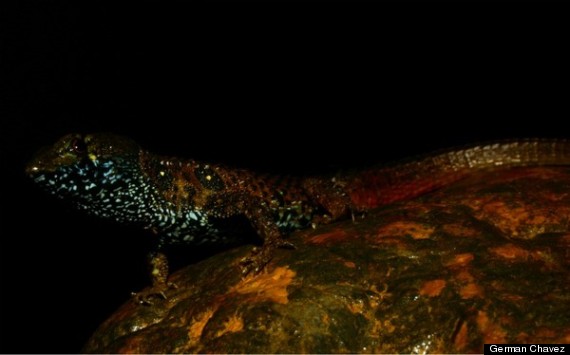

Three months later, in November, near another forested mountain stream about 40 miles (64 kilometers) from the original sighting, they hit the jackpot.

"During the day we didn't find any, but at night we found several individuals, males and females, running and swimming in the stream," Chávez told OurAmazingPlanet in an email. "That was a great moment for us."

It was not clear if the tiny creatures are nocturnal, and typically spend their nights running and swimming, or if the researchers simply roused them from sleep, and the lizards were trying to escape, Chávez said.

In fact, whether the creatures are active at night or during the day is only one of the mysteries surrounding the new discovery, according to the study announcing the find, which was recently published in the open access journal ZooKeys.

Chávez said temperatures in the mountains can drop to between 50 and 60 degrees Fahrenheit (10 to 15 degrees Celsius) at night -- harsh temperatures for cold-blooded creatures -- and it's not clear how the lizards could muster the energy to run or go for a swim in such chilly conditions.

"The thermoregulation in this lizard is the most important question for us," he said.
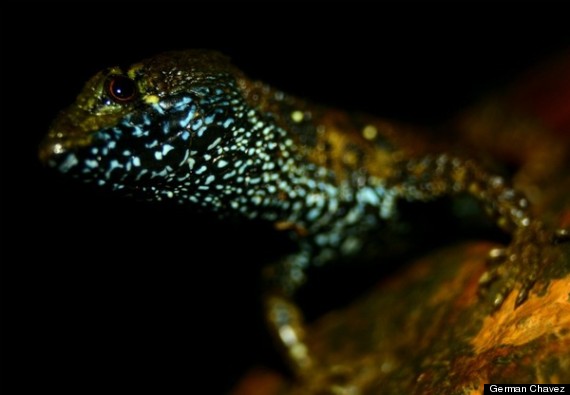

The home altitudes of P. montanicola are 3,300 feet (1,000 meters) higher -- and therefore chillier -- than areas frequented by its closest cousins.

"The reptiles here are amazing," Chávez said. "And I can imagine more 'lost places' in the Andes where probably other new species live right now."

He said he plans to continue the search. The fieldwork is often grueling and leaves little time for sleep, "but this is our passion," Chávez said. "I love my job, and things like this are the best reward for us."

Reach Andrea Mustain at amustain@techmedianetwork.com. Follow her on Twitter @AndreaMustain. Follow OurAmazingPlanet for the latest in Earth science and exploration news on Twitter @OAPlanet and on Facebook.


Copyright 2012 OurAmazingPlanet, a TechMediaNetwork company. All rights reserved. This material may not be published, broadcast, rewritten or redistributed.

Also on HuffPost:

FOLLOW HUFFPOST GREEN

By Andrea Mustain, OurAmazingPlanet Staff Writer: Researchers have discovered a new species of lizard in a strange place. The brightly colored, water-loving lizards live in the Andes Mountains in s...
Filed by James Gerken  | 
 
 
  • Comments
  • 8
  • Pending Comments
  • 0
  • View FAQ
Post Comment Preview Comment
To reply to a Comment: Click "Reply" at the bottom of the comment; after being approved your comment will appear directly underneath the comment you replied to.
View All
Favorites
Recency  | 
Popularity
04:51 AM on 03/02/2012
I love how lizards like to pose for the camera.
photo
HUFFPOST SUPER USER
Linus521
In wildness is the salvation of mankind
05:49 PM on 02/24/2012
Lizards are so special. The wild lizards where I live, tame so easily, becoming pets quickly. They have taught me so much; how much more intelligent they are than man knows. How fast they learn, and how quickly I learned to read their body language. To paraphrase a famous, English poet, we had conversations in our eyes. Intelligent, very adaptive and when treated with kindness and respect, wonderful companions.

I remember when one of my pet males decided to leave our property, heading out the gate, and we screamed at him to stop. He came to a screeching halt, turned around and came back to us. Gosh, all the times he took food from my hands, wild and free, but beloved by a family of humans.
10:04 AM on 02/24/2012
So great, cute little guy :)
photo
Redhunteur
If I damn yer POV will u turn the other cheek?
04:14 AM on 02/24/2012
Very cool. They must be pretty hardcore to thrive in such cold conditions.
09:54 PM on 02/23/2012
Please, please, please, can we once and for all eliminate the term "new species"? It is, in fact, a very old species that is new to science, newly discovered, etc.
This user has chosen to opt out of the Badges program
04:21 AM on 02/24/2012
You have a point but, at the risk of being pedantic, the term 'species' is something of an arbitrary term, applied by humans for our convenience in classifying the natural world. In that sense it has no meaning outside of the process of taxonomy. So in that sense a newly discovered creature IS a 'new' species.
But of course, you are absolutely right to say that this lizard is very, very far from being 'new'
photo
HUFFPOST SUPER USER
Carachama
I'm not apt to follow blindly the lead of others
09:03 PM on 02/26/2012
"New Species" is a designation governed by the codes of nomenclature - the rules by which one describes species. In order for a description of a hitherto unknown species to be valid, the new name must be followed by "New species", usually in English or Latin. So, I get your point, but it is still a new species.
09:30 PM on 02/23/2012
Very cool discovery.