iPhone app iPad app Android phone app Android tablet app More

Miniature Horse Sifrhippus Shrank Amidst Prehistoric Global Warming (PHOTOS)

Miniature Horse

  First Posted: 02/24/2012 9:23 am Updated: 02/24/2012 9:23 am

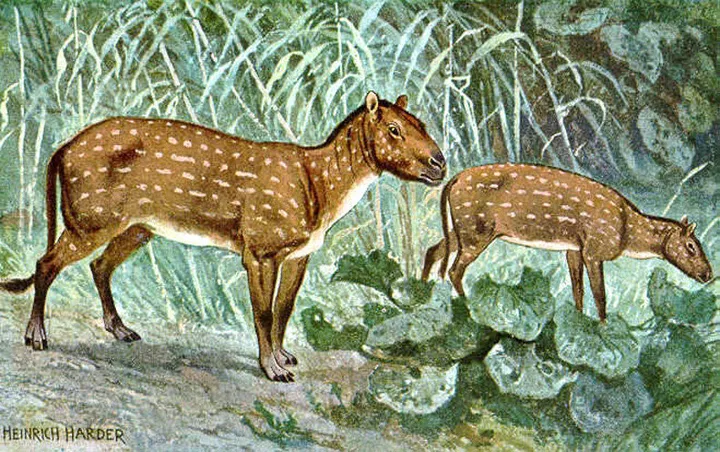
The first horses in North America would not have been able to hold their own in the Triple Crown. At just about 5.6 kilograms the Sifrhippus sandrae hoofed onto the scene some 56 million years ago about the size of a small dog.

But then a funny thing happened. In the next 130,000 years during the Paleocene–Eocene Thermal Maximum, these small equines got even smaller, reaching the tiny size of 3.9 kilograms—some 30 percent lighter than their initial heft. Just 45,000 years later, however, the genus had bulked up to seven kilograms. And the horses were not the only ones. Many other mammals in the area followed the same pattern.

These animals' sizes likely resulted from relatively rapid climate change, suggest the authors of a new study published online Thursday in Science.

The study "highlights the importance of temperature on evolution—particularly mammal evolution," says Felisa Smith, a professor of biology at the University of New Mexico in Albuquerque, who wrote an essay on the findings in the same issue of Science. And it adds a new high-resolution tracking of body size and temperature during a crucial—and long puzzling—time in geologic history.

Keep clicking for images of the Sifrhippus and other miniature horses. Story continues below slideshow.

Launch Slideshow
 HIDE THUMBNAILS
SHARE
BACK TO ARTICLE
1 of 9
PLAY ALL
VOTE ON THIS SLIDE

ADVERTISEMENT

Looking the small horse in the mouth
The researchers did not have complete skeletons to measure for all of the animals, so to track the size of the horses over time they looked at their teeth—in particular, their molars. "It turns out that teeth are much better than femurs," Smith says. A leg bone "does tell you something about size, but teeth are much better." And as far as teeth go, she says, "the best thing to know is the area of the first molar."

The teeth came from a fossil-rich area called Cabin Fork in Wyoming and are part of a substantial collection at the University of Florida built in part by study co-author Jonathan Bloch, an associate curator of vertebrate paleontology there. From the collection, the research team could estimate the size of about 44 diminutive adult horses.

Some 40 percent of other mammals in the area seem to have experienced similar shrinking and subsequent growth, notes co-author Ross Secord, a vertebrate paleontologist at the University of Nebraska–Lincoln. They stuck with the small horses, however, because they had much more solid records from which to accurately date the samples.

The researchers used oxygen isotopes left by freshwater in the fossils to track mean annual temperature from when the animals had been alive. In particular, they sampled the isotopes from teeth of a large, water-dwelling mammal Coryphodon. With these isotope readings, "you get a little, tiny window as to what the temperature was at that time," Smith says.

This close reading has excited Smith and others who have been tracking animal size over the ages. "Although we knew that temperature might set a maximum for body size," Smith says, the new findings actually present a mechanism—and do so in a very detailed manner, showing "how animals responded to a particular temperature at a particular place at a particular time."

Backing Bergmann's rule
The concept that ambient average temperature likely influences body size is not new. Naturalists have long observed this trend geographically, but as Smith notes, Secord and his colleagues present a strong case for the correlation to occur over deep archeological time.

And the mechanisms behind this theory, known as Bergmann's rule, have been fiercely debated since the mid-19th century, when it was introduced.

One argument posits that temperature affects body size for the ease of keeping cool—or of staying warm. As the overall volume of an object increases, the relative amount of surface area decreases. This relationship is handy if you live in high latitudes and are a mammal that needs to retain as much warmth as possible. But if you live in the tropics and are trying to avoid overheating, it should be better to have a smaller body size, which would give relatively more surface area through which to shed heat.

But this direct temperature correlation might not be the only force at work in the case of the mini horses. Previous studies have suggested that temperature and, more specifically, atmospheric carbon dioxide levels influence body size more via an indirect impact on food availability and nutritional content.

But the sustained shrinkage of these horses over tens of thousands of years suggests a deeper genetic change that held fast over generations. "We can't say it didn't have an effect," Secord says of the nutritional changes. But, he notes, "we saw some fluctuations from wet to dry to wet to dry in these intervals, and the body sizes of these animals aren't changing" in parallel. Instead, the animals' sizes followed the single up and down of the average temperatures.

A smaller, hotter future?
The new findings hold implications for digging deeper into the past—as well as looking into our own warmer future. Smith suggests using the data to learn more about the other organisms in Sifrhippus's world to see if they were largely following the same pattern. "What about the predators?" she asks. "Were there some lineages that responded in another way? I think that would be phenomenally interesting."

Before we can understand what past climate change meant for more animals—"there needs to be a lot more work on modern animals," Secord says. Ancient animals, however, might give us an insight into how modern animals might fare with our predicted climate change.

Although the era Secord and his colleagues studied experienced a similar increase in temperatures (five degrees Celsius or more) as is predicted for us for the near future (four degrees C), he points out the ancient animals had tens of thousands of years to adapt to changing temperatures—rather than just centuries.

"The question is now, over the next century or two, are we going to see a shift in body size?" Secord asks. "Are they going to be able to adjust quickly enough?" He hopes that many species will be able to keep pace, especially those with shorter generations. Many bird species have already been getting smaller over the past few decades.

And if animals do undergo size changes with future climate change, as Secord points out, we are not going to be seeing smaller race horses—unless we breed them that way. "This is certainly something that is going to be restricted to wild animals," he says. "Anything that has a way of artificially regulating temperature or diet is going to take it out of the loop." That would certainly apply to jockeys and the rest of us humans, too.

FOLLOW HUFFPOST SCIENCE

The first horses in North America would not have been able to hold their own in the Triple Crown. At just about 5.6 kilograms the Sifrhippus sandrae hoofed onto the scene some 56 million years ago ...
 
 
  • Comments
  • 103
  • Pending Comments
  • 0
  • View FAQ
Post Comment Preview Comment
To reply to a Comment: Click "Reply" at the bottom of the comment; after being approved your comment will appear directly underneath the comment you replied to.
View All
Favorites
Recency  | 
Popularity
Page: 1 2 3  Next ›  Last »  (3 total)
HUFFPOST SUPER USER
Cayce58
11:20 PM on 03/04/2012
In humans, you get taller as you get closer to the equator. Of course, you have to allow for nutritional differences. Areas that don't have protein will produce a smaller population but races that spent their time in the sun, the African nomads the best example, become tall and thin because it is easier to shed excess heat. A larger amount of heat shedding skin per pound of body weight. Inuits are the opposite.
photo
HUFFPOST SUPER USER
RJchoice
choose active solutions, not useless reactions.
11:23 AM on 02/27/2012
umm. humans have an unprecedented amount of awareness and hence 'control' of the selection process. unlike any other animal past or present. Just because our climate changes does not mean our evolutionary paths will diverge.. as a matter of fact we have been expanding our gene pool, faster than geography is capable of isolating it for at least the last 3000 years.

Will a hot day make a little guy 'hotter' (more sexually attractive) to a female of the species, over tall dark and handsome?.. I doubt it.
MajMike
Retired USAF Major, 100% DAV due to combat wounds
08:47 PM on 02/26/2012
In any natural crisis the smaller animals have a higher survival rate as they require less food, thus leading to them breeding more and the species as a whole shrinking. Like how in the dinosaur extinction no land animal over 50 pounds survived. Be it global warming or another major natural event causing increased competition for resources those needing less have an advantage.
photo
HUFFPOST SUPER USER
roger stillick
Forward for Everyone
02:39 PM on 02/26/2012
Middle Age suits of armor seem to show we have grown 15 percent in size in last 500 years... probably due to nutrition... less food, smaller size-no problem... some of my family live in a 130degree desert... climate change= yes... sky is falling= probably not...
photo
HUFFPOST SUPER USER
Jim Milks
Ecologist
06:28 AM on 02/27/2012
Unless climate change also means lower global crop yields (as has already been measured by Lobell et al. 2011: http://www.sciencemag.org/content/early/2011/05/04/science.1204531). Don't forget that while humans can survive in 130ºF desert heat, many other species cannot. Not even rainforest trees are doing that great, as increasing temperatures mean increased heat stress (Toomey et al. 2011: http://bit.ly/xSPsRQ).
photo
HUFFPOST SUPER USER
grappler1987
Heaven is a gift, not a reward
04:04 PM on 02/27/2012
Lobell acknowledges his limitations:
"If the location of crops has been changing significantly within countries since 1980, either as a response to warming trends or for other regions [sic], the study would fail to capture the effects of these changes."
http://iis-db.stanford.edu/pubs/23212/policy_brief_trends11.pdf

Crops are changing location quickly due to reasons other than climate change. Technology, introduction of hybrids, and economics play the primary factors.
http://pubs.giss.nasa.gov/docs/2003/2003_Reilly_etal.pdf
HUFFPOST SUPER USER
Cayce58
11:22 PM on 03/04/2012
animals don't have air conditioning
photo
snowballinhell
Humans have a 100% chance of extinction
01:59 PM on 02/26/2012
Ummm. Global warming. The solution for human weight reduction. Will global warming spell and end to obesity? Time will tell.
photo
HUFFPOST SUPER USER
TFlint
12:54 PM on 02/26/2012
You call these "photos"?
12:19 PM on 02/26/2012
The Inuit people (Eskimos) are short. The Watutsi are large. So how does that square with the theory of shortness in hot climes, and tallness in cold climes?
photo
mbkeefer
Elder Amateur Scientist
02:22 PM on 02/26/2012
Compact (the Inuit) is a another way to minimize surface area to volume ratio. A sphere verses a stretched cube. Especially when growing bigger is not really an option due to limited resources. The stretched cube (Watutsi) increase their surface area to volume ratio by growing taller and thinner. The African pygmies took the smaller route and are nearly extinct due to the Bantu taking their land and women.
09:40 AM on 02/26/2012
If we are going to get smaller as we go along ,better do it quick just look at out kidsnow feet are getting bigger and that is not all getting bigger .
08:46 PM on 02/25/2012
They look more like Deer to me.
This user has chosen to opt out of the Badges program
08:16 PM on 02/25/2012
are we gonna get smaller before we die off?
science is the complete acceptance of sensory perception.
everything i sense is exactly as i sense it.
the suggestion that our senses/observations are infalible and that our predictions of the future are inevitable is a little to much for this researcher.
photo
HUFFPOST SUPER USER
Jim Milks
Ecologist
06:35 AM on 02/27/2012
"science is the complete acceptance of sensory perception."

Is there any other way to investigate our surroundings? BTW, you're wrong about the "complete" part. If science were the "complete" acceptance, then there would have been no need to build instruments to enhance and augment our senses.

"everything i sense is exactly as i sense it."

Nope. There's an entire field dedicated to showing how our senses are wrong.

"the suggestion that our senses/observations are infalible and that our predictions of the future are inevitable is a little to much for this researcher."

Quite a strawman argument. Unfortunately, it's absolutely ridiculous, as is your claim to be a researcher.
HUFFPOST SUPER USER
ythri
11:45 AM on 02/29/2012
If that is the case, than why must experiments be designed to compensate for errors due to flaws in human perception?
07:38 PM on 02/25/2012
This is not new information. The fact that a warmer climate requires that species have less body mass to survive has long been known. It has also long been surmised that species will continue to evolve to smaller size as they become more efficient at regulating their body temperatures. Cold blooded dinosaurs had to be big to store body heat as they were unable to regulate their body temperatures. At that period when the state of warm bloodedness evolved the size of many species began to diminish as self regulation of body heat came along with the condition of warm bloodedness. Perhaps the article is a silly headline capturing version of this tidbit of concrete biology.
photo
mbkeefer
Elder Amateur Scientist
01:32 PM on 02/26/2012
The article pointed out the theory is not new.
"And the mechanisms behind this theory, known as Bergmann's rule, have been fiercely debated since the mid-19th century, when it was introduced."
It is pretty well accepted these days that dinosaurs were warm blooded, like the birds that evolved from them.
01:32 PM on 02/25/2012
I think this article was written by a skeptic who wanted to make the alarmists look foolish !

Regardless who did it, it worked.
photo
TheEmptyMonty
President of Antarctica
01:03 PM on 02/26/2012
The study was published in "Science," which might be the most well-respected and reputable journal that exists. The only one who looks foolish is you.
02:15 PM on 02/26/2012
That is just your opinion !

Sticks and stones and all that !
photo
HUFFPOST SUPER USER
Jim Milks
Ecologist
06:40 AM on 02/27/2012
And how did the article make "alarmists" look foolish?
This comment has been removed due to violations of our [Guidelines]
01:15 PM on 02/25/2012
Wait, it's not preposterous! In fact there were up to 4 branches of Neanderthal and "Cro Magnon" is an umbrella term denoting up to 40 branches of humans of all shapes and sizes, including the ancestors of Indonesias Homo floresiensis: the "Hobbit" people who were 3 feet tall.

Baldness and black hair only appeared around 6k years ago, white skin around 8k years ago, blond hair around 10k years ago. In fact black hair is a dominant gene that within a few centuries turned blond haired Greeks into black haired Mediterraneans who had to black over their blond nordic statues and paintings. As we uncover our history we in the western world are understanding that there is no one root of homo sapien, we are everyone - the giants, the hobbits, the trolls, the elfs.

Sorry, I get into the lore of yore when I read a story about wee-hobbit horses that were appearently bred down in size to suit Gandolf's children.
11:15 AM on 02/25/2012
Is guinea pig the dwarf cousin of the capybaras? Theories, theories---too many fundamental flaws in rationalization about heat transfer, etc.
HUFFPOST SUPER USER
ythri
06:01 PM on 02/25/2012
Explain them to use then.
11:08 AM on 02/25/2012
Theories, theories!!!
01:46 PM on 02/26/2012
Your point, your point!!!