iPhone app iPad app Android phone app Android tablet app More

Asteroid 2011 AG5 May Pose Threat to Earth in 2040

First Posted: 02/28/2012 8:51 am   Updated: 02/29/2012 2:23 pm

By: Leonard David
Published: 02/27/2012 12:18 PM EST on SPACE.com

Scientists are keeping a close eye on a big asteroid that may pose an impact threat to Earth in a few decades.

The space rock, which is called 2011 AG5, is about 460 feet (140 meters) wide. It may come close enough to Earth in 2040 that some researchers are calling for a discussion about how to deflect it.

Talk about the asteroid was on the agenda during the 49th session of the Scientific and Technical Subcommittee of the United Nations Committee on the Peaceful Uses of Outer Space (COPUOS), held earlier this month in Vienna.

A UN Action Team on near-Earth objects (NEOs) noted the asteroid’s repeat approaches to Earth and the possibility — however remote — that 2011 AG5 might smack into our planet 28 years from now.

The object was discovered in January 2011 by Mount Lemmon Survey observers in Tucson, Ariz. While scientists have a good bead on the space rock's size, its mass and compositional makeup are unknown at present. [The 7 Strangest Asteroids in the Solar System]

An asteroid desktop exercise

"2011 AG5 is the object which currently has the highest chance of impacting the Earth … in 2040. However, we have only observed it for about half an orbit, thus the confidence in these calculations is still not very high," said Detlef Koschny of the European Space Agency’s Solar System Missions Division in Noordwijk, The Netherlands.
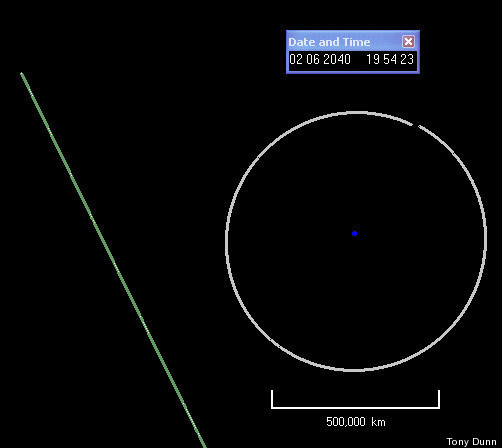
Gravity Simulator image of 2011 AG5 passing the Earth-Moon system in February 2040. Earth is the blue dot, the moon’s orbit is gray, and 2011AG5 is green. Simulation created with JPL Horizons data.

"In our Action Team 14 discussions, we thus concluded that it not necessarily can be called a ‘real’ threat. To do that, ideally, we should have at least one, if not two, full orbits observed," Koschny told SPACE.com.

Koschny added that the Action Team did recommend to the NEO Working Group of COPUOS to use 2011 AG5 as a "desktop exercise" and link ongoing studies to the asteroid.

"We are currently also in the process of making institutions like the European Southern Observatory aware of this object," Koschny said. "We hope to make the point that this object deserves the allocation of some special telescope time."

Non-zero impact probability

The near-Earth asteroid 2011 AG5 currently has an impact probability of 1 in 625 for Feb. 5, 2040, said Donald Yeomans, head of the Near-Earth Object Observations Program at NASA’s Jet Propulsion Laboratory in Pasadena, Calif.

This impact probability isn't set in stone, however. So far, researchers have been able to watch the asteroid for just a short time — the first nine months of 2011 — and the numbers may change after further observation, Yeomans told SPACE.com. [Photos: Asteroids in Deep Space]

"Fortunately, this object will be observable from the ground in the 2013-2016 interval," Yeomans said. In the very unlikely scenario that its impact probability does not significantly decrease after processing these additional observations, "there would be time to mount a deflection mission to alter its course before the 2023 keyhole," he added.

Keyholes are small regions in space near Earth through which a passing NEO's orbit may be perturbed due to gravitational effects, possibly placing it onto a path that would impact Earth.


Prudent course of action

2011 AG5 may zip through such a keyhole on its close approach to Earth in February 2023, which will bring the asteroid within 0.02 astronomical units (1.86 million miles, or 2.99 million kilometers) of Earth.

One astronomical unit is the average distance between Earth and sun, which is approximately 93 million miles (150 million km).

According to a JPL estimate, the 2023 keyhole — through which 2011 AG5 must pass in order for there to be a real chance of an Earth impact in 2040 – is roughly 62 miles (100 km) wide.

"Although this keyhole is considerably larger than the Apophis keyhole in 2029, it would still be a straightforward task to alter the asteroid’s trajectory enough to miss the keyhole – and hence the impact in 2040," Yeomans noted, referring to the asteroid Apophis, which could threaten Earth in 2036 if it zips through a keyhole in 2029.

"The prudent course of action is then to wait at least until the 2013 observations are processed before making any preliminary plans for a potential deflection mission," Yeomans said.

Processing additional observations in the 2013-2016 time period, he added, "will almost certainly see the impact probability for 2011 AG5 significantly decrease."

Wanted: Higher-fidelity assessment

"Yes, the object 2011 AG5 was much discussed at the AT 14 meetings last week, but perhaps prematurely," said Lindley Johnson, NASA’s NEO Observations Program Executive in Washington, D.C.

Johnson said NEO watchers have flagged the asteroid "as one we should keep an eye on." At present, he said, while researchers have better preliminary orbit data for 2011 AG5 than for many other asteroids in the NEO catalog, "we have only medium confidence in the derived orbital parameters."

"Fortunately, we are confident our uncertainties in the current orbit model will be reduced when we will have good observation opportunities in September 2013 with the larger follow-up assets," Johnson told SPACE.com. Observing opportunities are even better, he added, starting in November 2015 and for several months thereafter.

"This, in turn, will enable us to better assess the likelihood of any ‘keyhole’ passage in 2023 and therefore a much higher fidelity assessment of any impact probability for the 2040 time frame," Johnson said. [5 Reasons to Care About Asteroids]

"So, rather than a need to immediately jump to space mission solutions, the situation with 2011 AG5 shows the value of finding potentially hazardous objects early enough so that there is time for a methodical approach of observation and assessment as input to any need for an expensive spacecraft mission," Johnson said. "A more robust survey capability would improve the data available to make such assessments."

Decision challenge

Long-time NEO specialist and former Apollo astronaut Russell Schweickart played an active role in the dialogue about 2011 AG5. He represented the Association of Space Explorers (ASE) Committee on Near Earth Objects and presented to the Action Team an analysis of the situation with 2011 AG5.

The space rock presents a "decision challenge" to the international community, Schweickart suggested, "in the unlikely chance that its current low, but significant probability of impacting Earth in 2040 continues to increase after additional tracking becomes available."

Schweickart spotlighted a rough Association of Space Explorers analysis of the options to deflect the asteroid in the future, in the unlikely scenario that the Earth impact probability continues to increase.

He also provided to the Action Team several new appraisals of options for deflection of asteroid 2011 AG5 to avoid a potentially dangerous Earth encounter in 2040.

Delayed deflection campaign

A decision date for a keyhole deflection is very soon, if not now, Schweickart suggested. Asteroid 2011 AG5 represents an actual threat that underscores the need for a NEO hazard decision-making structure within the UN COPUOS, he said.

Based on the latest analysis, Schweickart reported, a deflection campaign delayed until after the 2023 close approach appears marginally possible, as long as a decision to commit is made immediately thereafter.

In the low-probability case in which the impact threat of the asteroid persists beyond its 2013 apparition, "should a keyhole deflection campaign be foregone — for whatever reason — the international community may be faced with the difficult decision of choosing between an expensive multikinetic impactor or a nuclear explosive to prevent an impact should the NEO indeed pass through the keyhole," Schweickart said.

The timelines that would be required to mount a successful deflection of the asteroid, Schweickart told SPACE.com, might be challenging. 

But first things first — researchers stress that more study of the asteroid’s trajectory is called for. The next tracking opportunities of 2011 AG5 will occur in September 2013, and then again in November 2015.

NASA chief: We still have time

In response to a letter from Schweickart regarding 2011 AG5, NASA Administrator Charles Bolden said that 2011 AG5 is "high on NASA’s list of NEOs to monitor for impact hazard potential," adding that "we take these duties very seriously."

Bolden also noted the opportunities for highly accurate ground-based observations in the near future.

"Based on these observations, a more informed assessment can then be made on the need for any type of mitigation," he said.

Bolden also remarked that the asteroid makes an apparition in 2015, more than seven years before the close keyhole passage in 2023 that could set in motion an Earth impact in the 2040 time frame.

"As a point of comparison, NASA’s Deep Impact mission [the Deep Impact probe smashed into comet Tempel 1 in July 2005] was conducted in six years from selection to impact under much less urgency, demonstrating the adequacy of a seven-year period for any necessary response," Bolden said.

Leonard David has been reporting on the space industry for more than five decades. He is a winner of last year's National Space Club Press Award and a past editor-in-chief of the National Space Society's Ad Astra and Space World magazines. He has written for SPACE.com since 1999.

Copyright 2012 SPACE.com, a TechMediaNetwork company. All rights reserved. This material may not be published, broadcast, rewritten or redistributed.


PHOTOS: AMAZING METEOR CRATERS:

Also on HuffPost:

FOLLOW HUFFPOST SCIENCE

...
...
Filed by David Freeman  | 
 
 
  • Comments
  • 2,546
  • Pending Comments
  • 0
  • View FAQ
Post Comment Preview Comment
To reply to a Comment: Click "Reply" at the bottom of the comment; after being approved your comment will appear directly underneath the comment you replied to.
View All
Favorites
Recency  | 
Popularity
Page: 1 2 3 4 5  Next ›  Last »  (64 total)
11:47 PM on 06/06/2012
What is the United States up to? Why would we just abandoned NASA Space flight capabilities? We put the space shuttle in moth balls and have no back up plan? Who is kidding who here? Something is not right! Come on people wake up or are you a munch of zombies already and I am not laughing. Should people not start asking questions and demand answers?
This user has chosen to opt out of the Badges program
07:38 AM on 05/28/2012
http://neo.jpl.nasa.gov/1950da/

The asteroid 1950 DA has had its trajectory calculated, and there is about a 1 in 300 chance of an impact in the year 2880, on March 16. The article above says that if it were to impact in the North Atlantic, the north eastern seaboard of the USA could get 400 foot tsunami waves, while down in Florida the tsunami might be only 200 feet high.

Meanwhile, a 26 meter diameter asteroid is going to pass as close to the Earth as the geo-synchronous satellites on Monday, May 28th.

http://www.spaceweather.com/
This user has chosen to opt out of the Badges program
06:27 AM on 05/13/2012
At the last minute, asteroid 2012 JU has been discovered. It is passing by Earth today, May 13, about half the distance from the moon. It is only about 13 meters in diameter, so it is not an extinction capable asteroid. Worst case scenario, if it had been on a collision course, it might have killed a few million people.

http://spaceweather.com/
photo
mbkeefer
Elder Amateur Scientist
07:08 PM on 05/25/2012
How about 2012 KP24 that found yesterday and will pass by Earth on May 28th about a ten of the distance from the Moon. It is about 26 meters in diameter. It would not make to the ground unless it is a nickle iron, but it would scare people a lot more than that one that blew up over California that was about a third that size.
This user has chosen to opt out of the Badges program
flipacoin
Heads they win, tails we lose.
09:06 PM on 05/12/2012
Is this asteroid big enough to take out Detroit? And if it's going to miss Detroit...can it be steered?
photo
KarmaPatrol
Riverboat Gambler, satellite whisperer. Independe
10:32 AM on 05/11/2012
Looks like some Mayan calendar makers have some 'splaining to do.
photo
HUFFPOST SUPER USER
Wanderland
Generic white guy
12:26 PM on 05/07/2012
Maybe we should put Bruce Willis into suspended animation, in case he needs to put together a team to...

Damn! We retired the space shuttle! We're screwed.
This user has chosen to opt out of the Badges program
06:52 AM on 05/11/2012
Would Bruce Willis be willing to volunteer for a mission into the deep freeze? In the meantime, you do know that the space shuttle was not designed for anything except low earth orbit, right?
photo
HUFFPOST SUPER USER
mater
mater
03:28 PM on 03/15/2012
Some will start praying about this and stock up on vittles, and bullets. Some will study it and try to come up with scientific options for our planet. And Will Smith will make a sequel to Independence Day and it will be another huge success.
photo
KarmaPatrol
Riverboat Gambler, satellite whisperer. Independe
12:59 PM on 03/09/2012
But thats when I become eligible for Social Security - the world can't end.
photo
HUFFPOST SUPER USER
mater
mater
03:30 PM on 03/15/2012
Poor bas*ard! Just when you thought it was going to be Miller Time! Actually, I hope you live for another 50 years, with those with whom you share love.
This user has chosen to opt out of the Badges program
06:50 AM on 03/06/2012
How good are our asteroid detection methods?

Asteroid 2012 EZ 1 made its closest approach to Earth on March 1st, but was not detected by astronomers until a few days after its moment of closest approach. It passed at about 0.6 lunar distance, roughly 140,000 miles.

Admittedly, it was only about 25 feet in diameter, but if it had been on a collision course we would not have known about it until its movement through the solar system was halted by its impact with Earth.

So I guess the questions I have on my mind are, how big does an asteroid have to be before we are likely to detect it before it impacts Earth, and, how far in advance would we have to detect an object in order to have a chance to prevent its impact, if, in fact, we even have that technology?
photo
mbkeefer
Elder Amateur Scientist
05:28 PM on 03/05/2012
More likely a Chinese mining ship meet it in 2023 and start processing it for usable materials. Among the things delivered in 2040 will be over a ton each of gold, platinum and Iridium.
This user has chosen to opt out of the Badges program
photo
The Smartest Monkees
Planet of the Apes? We're on it, baby!
04:00 PM on 03/04/2012
Well, it's good to know we're at least now keeping an eye out for these things. It's truly amazing how far we've come since I was a kid. Back then the planets were little more than fuzzy blobs in our best telescopic views, and now we've visited every planet except the minor planet, Pluto.
And Pluto has a visitor (New Horizons Spacecraft) arriving in 2015, which should be a spectacular show. I believe we're up to a four moon count, of bodies in orbit around that enigmatic little world.
And it hasn't been that long ago, that it was deemed pretty much impossible to detect planets around other stars because of the great distances involved and the glare from the parent star's blinding effect.
Now we've detected hundreds of planets around distant stars, with spacecraft and ground-based searches due to find even more. Who knows what amazing new techniques and resulting discoveries await us in the next few decades?
02:07 PM on 03/04/2012
You see...China will be on their moon colony laughing at us as they have a front row seat to earths distruction.
08:22 AM on 03/04/2012
This asteroid is only 460 feet. Most likely it would land in the ocean. If deflection failed, the coastal cities of the pacific or the atlantic would have to be evacuated due to a very likely HUGE tsunami. If it slams into land, hope its Afganistan. We would be able to send all our troops home and never send them back. Much of the area surrounding the Middle East ( and the Middle East itself would be devestated.
photo
mbkeefer
Elder Amateur Scientist
05:13 PM on 03/05/2012
This rock can only take out one city. A land will only leave a crater about one and half miles across. If you are at least fifty miles from the impact point the most you will need is a hard hat for the occasional small rocks that might drop out of the sky. So set up a grill and cooler and watch the show.
A water impact a hundred miles off shore will see a simple tsunami with a wave height of about 12 feet. These will be more like giant surf waves than the great flood waves that Japan experienced last year. 200 miles from the impact the wave height will be down to 6 feet and so on. The impact has to be only 15 miles off shore in deep water to get the same wave height as the Japanese tsunami of March 2011.
05:57 PM on 03/05/2012
Really it depends on the composition of the object, the velocity, the angle of decent through the atmosphere. A few years ago, there was a web site in which you could choose a senerio of an asteroid impact by choosing certain aspects of the object: size, composition, velocity and the effects of the impact you chose would be dispayed for your amazement and interest. The area of total destruction, size of fireball, the shockwave, wind velocity, the type of destruction. Frankly, I haven't looked up the effects this particular asteroid would have if it hit the Earth... and really, we know very little about what this rock is made of. You seem to be knowledgeable on this subject so I'm sure you would agree that impact would be much more sever if the rock were made of iron than it would be if it were a big dirty snowball with a little dirt on top.
photo
SKYPILOT54
life is a sonic boom
08:22 AM on 03/04/2012
NASA might be able to help in deflecting this thing, oh,, wait,,, obama closed there business.
08:26 AM on 03/04/2012
No. NASA is still open. The Russians are in control of getting our astronauts to and from the spacestation, France and India are in charge of launching communication and weather sats. and NASA is concentrating on interplanetary space probes, scientific sats and military sats. NASA is not out of business.
03:11 AM on 03/07/2012
Actually NASA is now working on taking us beyond low earth orbit for the first time in decades with the Orion project. We'll be on the moon again in the next ten years as a test and mars or an astroid after that (which any reading that you might do on space flight will tell you that's been an international goal for our next step after the ISS was finished).
08:17 AM on 03/04/2012
The politicians will stop talkng about jobs on that day because they'll be no more elections to worry about.