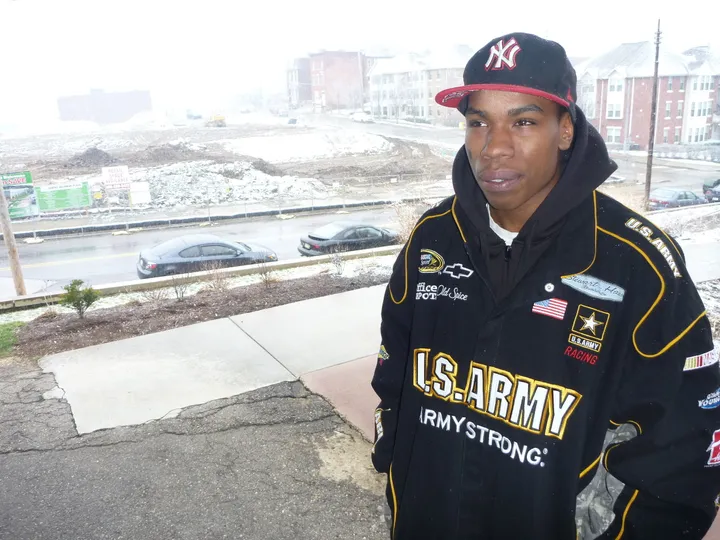
PITTSBURGH -- In the basement of Hill House, a community center just outside of this city's bustling downtown, Brooklyn Davis clutches a plastic fork and stabs eagerly at a styrofoam plate piled high with waffles and syrup. He keeps a broad-billed, oversized New York Yankees baseball cap pulled low over his ears, and has a NASCAR jacket -- festooned with the "Army Strong" trademark and corporate logos from Office Depot and Chevrolet and Old Spice -- wrapped around his thin frame.
"I found out I was poor in middle school," Davis says between bites, as he recalls intermittent forays into the drug trade. "I had holes in my shoes and I started getting ripped on. So I just started hitting the block, and I was like 'Man, nobody's going to be bothering me now. I've got money in my pocket.' But I realized that can't go on too long."
Davis is now a Hill House regular, keen to have a chance at breakfast, access to computers and the use of a telephone. The facility is anchored in the historic Hill District, a predominantly black and widely impoverished neighborhood that begins in the shadow of the recently completed Consol Energy Center arena -- the $320 million home to the Pittsburgh Penguins professional hockey team -- and rises eastward along several of the city's steep ridges.
Being six months unemployed and behind on his child support payments, Davis also comes here by a court order mandating that he be trained in skills that will lead to work, like creating a resume, preparing for interviews and hunting for jobs online.
For many young people born into the cyclic deprivations of urban poverty -- failing schools, broken families, lack of jobs, violence, crime and drugs -- such lessons come far too late in life. While Davis aspires to become a barber one day (he cuts his friends' hair, he says), at 23, he is already locked hard onto a path that will make that dream extremely difficult to realize.
Statistically speaking, Davis, like his parents, faces surprisingly high odds against ever escaping from poverty -- regardless of what happens in the wider economy.
Even in the best of economic times, America has long maintained pockets of deep and persistent poverty. From blighted urban neighborhoods like this one, hollowed out by the collapse of the steel industry more than a generation ago, to long-impoverished communities in the Mississippi Delta, or the San Joaquin Valley of California, or the uniquely dismal privations on tribal lands in South Dakota and elsewhere -- poverty has defined life for multiple generations.

Pittsburgh's historic Hill District has been struggling
economically for decades. Above, the boyhood
home of the playwright August Wilson, boarded up.
For policymakers of all stripes, it has often proved remarkably easy to characterize chronic poverty as a failure of character, a product of dependence on government largesse, or both. Such thinking defined the wholesale reformation of welfare under the administration of President Bill Clinton 15 years ago, and it continues to inform the rhetoric of Republican candidates now vying for the White House.
Former House Speaker Newt Gingrich, for example, has suggested that poor children want only for a work ethic, and that child labor laws ought to be adjusted accordingly. Mitt Romney, former governor of Massachusetts, has said the nation's "safety-net" is sound, and as such he is unconcerned with the very poor. Herman Cain, prior to his departure from the race, famously said: "If you don't have a job and you're not rich, blame yourself."
Given epidemics of what can appear to be inexplicable choices by those mired in hard times -- multiple teen pregnancies, dropping out of high school -- such unsympathetic viewpoints can resonate. On the ground, though, social workers, activists, poverty researchers and struggling Americans like Davis describe a situation that is infinitely more complex. From their view, the so-called safety-net, while effective in preventing atrocities of hunger familiar to other continents, can also act like a web, trapping its poorest patrons in a tangle of conditional services, conflicting requirements and punishing penalties that conspire to keep them poor -- often very poor.
The numbers underscore the problem. Federal data suggest that the share of Americans who are not just poor, but subsisting on incomes of less than half the official poverty threshold, has fluctuated between four and six percent -- well over 10 million people -- for most of the last 30 years. In September, the U.S. Census Bureau recorded the highest level of extreme poverty since it began tracking the metric in the mid-1970's.
At a human level, that data can prove suffocating.
"This ain't a healthy life," says Davis. "I feel like I'm stuck, like I can't breathe, like I'm in quicksand."
A cleaning job has recently become available at a hotel near the airport, and Davis is hopeful that it will work out. But the commute to and fro will take six buses, two hours, and $5.50 out of his pocket each day -- money that he doesn't have at the moment.
Hill House will help with the fare until he gets his first paycheck, but the minimum-wage job won't be enough to cover his bills, and the area transit authority has targeted one of the bus routes for a service reduction. Without a car, he'll likely lose the job in a few months' time.
"I don't want anyone to feel sorry for me. I'm not blaming the world for my problems," Davis says. "I'm just saying it's not easy."
POOR AND STUCK
Last fall, the Census Bureau revealed a troubling statistic: A full 6.7 percent of Americans, or roughly 20.5 million people, were earning less than half the official poverty rate -- a category generally known as "extreme poverty." For a family of four, including two dependent children, that would amount to an annual income of about $11,000 or less.
Nearly half of all Americans who are considered poor at all fall into this category.

While non-Hispanic whites comprise the largest population considered to be extremely poor -- more than 13 million people -- the rate of such impoverishment does not fall evenly along racial or ethnic lines. More than 13.5 percent of the black population are now considered extremely poor, according to the Census data -- a rate three times higher than that for whites. For Hispanics of any race, the rate is 10.9 percent.
Across all races, roughly one American child in every 10 is now extremely poor.
To be sure, the Census Bureau's poverty figures have long been criticized by advocates on both sides of the political spectrum. Conservatives have argued, accurately, that the figure fails to capture the value of a variety of benefits that many poor Americans receive, including food stamps and other government subsidies. Liberals have countered that the statistic ignores significant household expenses, including out-of-pocket medical costs, money for housing and even taxes.
In November, the bureau published supplementary poverty data that incorporated some of these factors for the first time. The new figures painted a somewhat mixed picture -- increasing the portion of all Americans considered nominally poor to 16 percent, up from 15.2 percent under the traditional measure, but reducing the percentage of people considered to be in extreme poverty from 6.7 percent to 5.4 percent.
Even by this supplemental measure, however, some 17 million Americans would be considered extremely poor, and multiple studies have suggested that a rebounding economy -- should one eventually take hold -- will not necessarily impact these stubborn statistics.
Lack of economic mobility is one reason. Americans by and large like to believe that the nation provides ample opportunity for the truly motivated to rise -- pulling oneself up by the bootstraps, as the saying goes. Research suggests that's simply not the case. In fact, American children born either rich, or poor, are more likely than children in other developed countries to maintain that station into adulthood.
Poverty, in other words, is often a trap.
A 2010 study by the Organization for Economic Co-Operation and Development, for example, examined the degree to which a son's earnings reflected those of his father in nine European countries, Australia, Canada and the United States. The U.S. displayed the third-highest correlation -- just behind Great Britain and Italy. A 2006 analysis from the Bonn, Germany-based Institute for the Study of Labor, comparing earnings mobility in the Nordic countries, Great Britain and the United States, arrived at a similar conclusion. While all countries had some measure of income stickiness, whereby offspring tend to end up in earnings brackets similar to those of their parents, the phenomenon was most pronounced in the United States.
The study also found that such earnings "persistence" was highest at the very upper and lower reaches of the income scales -- that is, the rich tend to stay rich and the poor tend to stay poor. In the United States, the researchers found a particularly high likelihood that the sons of the poorest fathers will remain in the lowest earnings bracket.
Such findings are unsurprising to researchers like Margaret Simms, director of the Low Income Working Families Project at the Urban Institute, a nonpartisan social policy think tank in Washington that has examined poverty persistence in the United States.
"We aren't as great an opportunity society as we think we are," Simms says. "The assumption is that anybody can pull themselves up by their bootstraps, but we don't always make it feasible for people to do that. If you live in a poor neighborhood, you're probably going to a school that is not as well stocked, that doesn't have as experienced teachers, and you're going to school with a lot of other poor kids who have the same disadvantages you do. People who are better off, they either live in a neighborhood that has better schools, or they can make those schools better, or they send their kids to private schools."
These sorts of challenges are particularly acute in areas where extreme poverty has metastasized into a chronic and common condition among residents. The Brookings Institution calls it "concentrated poverty" -- areas where at least 40 percent of the residents are at or below the national poverty level. Over the last decade, the rate of concentrated poverty nearly doubled in Rust Belt areas.
“Very poor neighborhoods face a whole host of challenges that come from concentrated disadvantage -- from higher crime rates and poorer health outcomes to lower-quality educational opportunities and weaker job networks," writes Brookings researcher Elizabeth Kneebone and her co-authors in a report issued last fall. "A poor person or family in a very poor neighborhood must then deal not only with the challenges of individual poverty, but also with the added burdens that stem from the place in which they live.”
These are not mere academic conjectures. The Panel Study of Income Dynamics constitutes the longest-running household survey on the planet, according to the University of Michigan, where it is maintained. Its dataset contains a nationally representative sample of 18,000 individuals in 5,000 families who have been tracked and surveyed on their employment, health, marital status, education and childbearing, among other topics, since 1968.
Caroline Ratcliffe and Signe-Mary McKernan, researchers at the Urban Institute, decided to mine that dataset and last year co-authored an analysis of poverty outcomes.

Looking at data for 1,795 Americans born between 1967 and 1974, including 972 whites, 734 blacks, and 89 categorized as another race, the researchers concluded, among other things, that 10 percent of American children spend at least half of their childhoods living in poverty. They call this category "persistently poor." Black children are seven times more likely than whites to experience persistent poverty, the analysis found (though for both blacks and whites, multiple years of exposure to poverty made it significantly harder to escape hard times, saddled as they often become with such things as teen pregnancy, high school dropouts, and inconsistent employment as young adults).

Ratcliffe said she and other researchers are busy looking into the specific characteristics of the neighborhoods in which poor children are raised to determine their impact on childhood development, including stress factors that might make poverty persistent.
"You can hypothesize a lot about what's happening -- from bad schools and impoverished neighborhoods and the presence of crime," Ratcliffe says. "That stress can change the way kids' brains develop, and part of the solution is really focusing resources on kids."
Margaret Simms sums up the problem. "It's a much harder climb for people to get out of poverty and into opportunity than it is for people who've got opportunity already," she says. "That's not to say that everyone is in that situation, but the odds of advancing economically are not in your favor if you start out life with few resources."
NO ONE EVER OFFERED US STEAK
On a recent Thursday morning, Brooklyn Davis is among a half-dozen young men, ranging in age from 18 to 33, plucking away at keyboards in a computer room at Hill House. Mike Rogers and Leroy Hayes, co-directors of the Young Fathers Program here, are coaching them on how to construct their resumes ahead of an afternoon job fair at a downtown hotel, where they would compete for a few openings on the cleaning staff.
On the wall of his office, Hayes keeps a series of images of President Obama alongside trappings of the executive office. Each image is superimposed with sartorial advice aimed at Hayes' youthful clientele.
One offers an image of a neck-tied Obama with Air Force One in the background. "To fly on this," the poster reads, "you have to look better than this --" and an image of a young man with his pants sagging completes the message.
A similar placard shows the White House. "To live in this crib, you have to look the part," it reads.
Davis and a few others have already acquired suits for the job fair, typically with help from a second-hand distribution center with ties to Hill House and other nonprofit organizations in the city. One young man sports a grey tuxedo. The collective display of ill-fitting, oversized blazers and hiked-up trousers, for all its aspiration to manhood, only reinforces how young all of them are.
With resumes printed out, the young men gather in a small classroom to talk about their lives. All of them were born into poverty, and most never knew their fathers growing up. All of them now have children of their own, often multiple children with different mothers. They are not married, and in most cases, the relationships are strained. A few, like Brooklyn Davis, finished high school. The youngest of the group notes that he is a second-generation attendee of the program, following in the footsteps of his father.
Most, unlike Davis, have criminal records that typically stem from any number of drug or assault convictions. Paris Payne, the oldest of the group, has spent much of the last 11 years in prison.
"I grew up in a foster family, and I'm watching the people I call my uncles sell drugs and be with multiple women," Payne says. "So when I turned 18 -- I did excellent in school, I graduated and everything, on time -- but it's just like, this is all I thought that I -- this is what I seen, so this is what I did."
Like many young men in his position -- unemployed, criminal record, dependent children -- Payne has seen his driver's license revoked, a common punishment for falling behind on child support. The penalty, while well-intended, often has the counter-effect of further limiting employment options. He was recently told that he would be eligible to re-acquire his driver's license in 2026.
"If I ever got to have my own business, I'd want to start a program just to let kids be aware of their choices and the consequences of the stuff they do," Payne says. "Something for kids like, from the ages of like 14 to probably 23. You're young and naive then and no one told me stuff like that."
"Nobody ever offered us steak," says 23-year-old Jahvan Baskin. "We always got offered McDonald's."

Having spent much of the last 11 years in prison,
he says he wishes someone had talked to him
about life choices. "No one told me stuff
Hayes, the program co-director, drives the point home. "A lot of times it's just passed on," he says. "There was a time when me and a few of my older brothers, we were working with our dad. Where else could we go and get the kind of bread he was putting out to us? How can you open up a drawer and you see nothing but bundles of cash, or open another drawer and see bundles of pot? You'd think, 'Hey I can make in one day all I need for a couple of months, so I'll take a chance.'"
The recession, Hayes says, has made finding honest work for the legion of young men at similar crossroads increasingly difficult -- not least because more highly-educated and more experienced workers from a few rungs up the ladder are now tumbling down and creating competition for the entry-level, minimum-wage jobs that were once the best bet for his clients. Without those, the choices are stark.
Mike Rogers, who came through the program himself before being hired to help administer it, leaves the room briefly and returns with pizzas. As the scent of pepperoni fills the room, the conversation turns to blame, and the group offers a refrain of personal ownership and assertions that society and circumstance must be held faultless.
"You can't blame no one but yourself," Baskin says.
But Davis is indignant. "I know I can't blame no one," he says. "But I can't better myself so I also can't blame myself. I'm pinned in this situation. Having a kid shouldn't mean it's the end of your life. I can't move."
Davis has had some advantages over his cohorts. When he was a child and his mother was struggling with an addiction to crack cocaine, he was raised ably by his grandmother in Trenton, N.J. As a teenager, he re-located to Pittsburgh, where he reunited with his mother and finished high school. Despite chronic underemployment -- he's held jobs as an usher at a movie theater and as an office cleaner, as a server at a deli and at McDonald's -- and occasionally dealing drugs, Davis has managed to avoid arrest as an adult.
Before a medical condition forced his discharge, Davis also spent a few brief months in the Army, where he learned discipline and what he calls the pride to be found in work.
"I'm a perfectionist," he says. "Like, cleaning is something that you can actually do and see that you've done something -- you can make it look like perfection."
But Davis has spent more than six months hunting for a job that will help him cover his required child support payment, as well as the back-payments he owes and his monthly utility and rent bills. As the other young men assess his story against their own, they grow gloomy. "If he can't make it," Payne says, "what hope is there for us?"
Hayes shakes his head.
"I laugh a little now," he says, "because I look back at it and I'm almost 70 years old and I was doing the very same thing these guys are doing and there's a lot of years between. So these issues that we're facing today, they're not new. They're old. It should have been resolved already."
THE BLAME GAME
Tricia Gadsen, the executive director of the Macedonia Family and Community Enrichment Center, a faith-based nonprofit tied to the Macedonia Baptist Church in the Hill District, shares the story of a family that came to her organization in search of financial help.
"They told us 'I wanted to buy my child a birthday gift so I didn't pay the utility bill.' And what do you say to that?" Gadsen asks. "Well, technically you're supposed to say you should have paid the bill. But the reality is, I'm a parent. I have a 20 year old and a 16 year old. I know there's times when I should have paid a bill and I looked at my husband and said 'OK, we're going to buy them something, they're good kids.' That's what parents do. But there's a different level of expectation for the poor," she says. "And what's particularly hurtful for the people who are receiving support is that there's this implied belief that they don't want to do better. That there's this generation of people saying, 'OK, I'm just going to live off the system.'"
"Now let's recognize that there's humanity here," Gadsen adds, "and so there are people who will take advantage of it, just as much as people in the corporate world will take advantage of cutting corners and bypassing certain laws and certain contractual procedures in order to get that leg up. That's humanity. But somehow or another, we've bought into the belief that this kind of behavior is reserved for the poor, and that all they want is a handout. No. All they want is to be able to make a decent living, and to be able to provide for their children."
The riddle of persistent poverty has been a near-constant source of social and political debate for the last 60 years -- not least because of the deep veins of racial and ethnic variation that run through it. Almost all observers agree that the rise in single-parent households is a key factor in persistent poverty. Yet, the question of whether that rise in single-parent households -- or policy, or culture -- is a cause or a symptom of poverty is hotly contested. Does public policy cause or perpetuate impoverished communities? Or do poor communities stay poor due to some inherent characteristic that makes them different from the comparatively well-heeled?
Beginning in the 1960's, multi-generational impoverishment was widely chalked up to what became known as a "culture of poverty," a monolithic view of poor communities arising principally from the work of anthropologist Oscar Lewis.
The central idea was that poverty, while perhaps set in motion by structural factors like unemployment and disinvestment, eventually created a distinct set of values and mores within poor communities -- wherever they happened to be -- that were self-perpetuating. Poor people were unable to delay gratification, for example, or had short-term orientations that made it difficult to lay ground for future betterment. And so, they stayed poor.
The thinking partly influenced the work of Daniel Patrick Moynihan's contentious 1965 report "The Negro Family: The Case for National Action," which raised alarms about the rising rate of single-motherhood in black communities, which at the time was approaching 30 percent. Moynihan did not attribute the phenomenon directly to a lack of jobs, or even discrimination, though he described their historic role in establishing higher rates of black impoverishment. Rather, he tied the fracturing of African American families to a patchwork of "pathologies" that grew out of long-term black impoverishment itself.
Charges of racism and "blaming the victim" soon followed, polarizing policymakers and poverty researchers for the next several decades.
Mario Luis Small, a professor of sociology at the University of Chicago, explains that the notion of culture here was simply too deterministic, and he points to recent data and numerous subsequent studies that undermine the suggestion that poor communities develop value systems or "pathologies" that set them apart from the wider economy. These include, for example, Census data that show single motherhood on the rise across all groups, not just blacks. Currently, the rate is 36 percent for whites -- higher than the 1965 rate for blacks that set off alarms for Moynihan.
"Across the board, everybody is going up," Small says. "It's not as if African Americans are somehow doing something that other racial groups are not doing."
The 1980's and '90s gave way to a more policy-driven concept of poverty that boiled down to incentives.
"If the amount of money you give in welfare is more than minimum wage, and it's only for women who are not married, than any rational woman is going to take the welfare check instead of being employed or marrying the guy -- that's how the thinking goes," Small explains. "It's the rational-choice perspective, in that any rational person in the same position would do the same thing."

Program at Hill House, coaches a client preparing
for a job fair. Hayes says it has taken too
long to solve the problem of persistent poverty.
This thinking, along with long-held beliefs that welfare breeds sloth and unhealthy dependence, gave rise to the wholesale reform of the welfare system under Clinton. Assistance became largely tied to work, or efforts to find work, and while the reformation moved significant numbers of people off the government dole and out of poverty, analysts now attribute much of the improvement to the concurrent booming economy of the 1990's. That is to say, fewer people were poor because there were more jobs to be had.
More recently, critics have raised questions about the effectiveness of the Clinton-era reforms when times turn rough -- precisely when assistance is needed most.
"There is a consensus that welfare reform, to the extent that it worked, worked because the economy presented the right circumstances," says Margaret Simms of the Urban Institute. "It was an expanding economy, there were a lot of job opportunities for people who may not have had the strongest work record or the highest skill level, and that was coupled with programs that promoted work, like the earned income tax credit [EITC] -- the more you work up to a certain point the more money you got. Those kinds of things -- child care subsidies -- all of that package made it more economically feasible to work and support your family if you were low skilled."
"But what we wound up with was a safety net that was mostly geared toward work, and when work isn't available, that safety net doesn't work very well," she says. "So, if you're not working you don't get EITC, if you're not working you don't get child care subsidies and therefore your resources are somewhat limited, they're either unemployment insurance or welfare, if you can get back on."
An analysis in September from the Economic Policy Institute, a nonpartisan think tank that focuses on low and middle-income workers, notes that virtually all of the decline in poverty achieved during the economic boom of the 1990's has been wiped out in the last 10 years.
"The large increase in poverty suggests that as anti-poverty policies have come to depend more on paid work as the main pathway out of poverty," the researchers note, "the safety net has become less effective in reducing economic hardship when the economy and job market are underperforming."
On the ground, stitching together meager employment income and the contingent drip of government assistance can become a humiliating game, according to Tara Marks, a co-director of Just Harvest, a Pittsburgh-based nonprofit.
After her husband left her, Marks, who was raised middle-class in Ohio, found herself a single mother living in Pittsburgh housing projects. She qualified for food stamps, but she ticks off the items that she was forbidden to buy with them, including soap, shampoo, household cleaning supplies, toothpaste, vitamins or cosmetics.
Also forbidden: diapers.
"There's no program for diapers," she says. "That's what we went to the food bank for. So we would stand in line at the diaper lady. We would run to that line, because boy you needed them. And she would cut the bag in half and she kept track of how old our children were, and she would do the grandmotherly thing and say, 'Why is your child still in diapers?' to encourage us to do potty training. Not because she was the Grinch, but because you only had so many diapers and there were mothers coming up behind you whose children were not in that age to start potty training."
Even for employed mothers, getting a leg up in the welfare-to-work era can prove enormously vexing.
April Townsend, a 31-year-old mother of two children living in the Hill, works as an administrative assistant at a community center for the elderly up the road from Hill House. Recalling a $40 per paycheck bump after Obama increased the Earned Income Tax Credit for low-income workers -- part of the 2009 stimulus package -- Townsend describes a frustrating game of one step forward, two steps back, with her increase in income triggering a revocation of assistance elsewhere.
"With me getting that extra 40 dollars, my rent went up 40 extra dollars and they took away some of my food stamps," she says. "There are still times when I don't have enough food that I have to skip a payment on a gas bill, or pay a portion of it. I can't pay the full amount because I have to get food. You have to do one thing to make up for the other."
Townsend says it's this sort of experience that makes "solutions" like Gingrich's notion to put poor kids to work as school janitors, or Romney's declaration that the poor are well-cared for, so infuriating.
"If you have never struggled, you cannot speak for people," she says. "You cannot say 'I feel as though poor people are comfortable.' Who is comfortable being poor? Who is comfortable not having enough to pay for food and skipping a bill?"
LET THEM WATCH TELEVISION
Davis manages to secure a hotel cleaning job, which will help keep him out of jail for getting too far behind on his child support payments. But he says he expects to still fall short and will need to supplement his income to stay on top of his bills.
"I've been to two staffing agencies already," Davis says. "I have a good driving record. I don't understand why it took me 6 months to find just this one job. I have no criminal record. I never got arrested dealing drugs. It shouldn't take that long to find a job."
The reality, however, is that the sort of jobs available to people like Davis are few, and poverty in and around the Hill District will likely continue.
Pittsburgh as a whole has managed to turn itself around after the steel industry tottered, in part by becoming a hub for computer software and biotech development. The city also doubled down on large and entrenched industries in the area, chiefly health care and education. It has fared far better than other cities amid the most recent recession, earning a rank of number 4 on Forbes' list of fastest-recovering cities.

looks out over greater Pittsburgh from a ridge
along Bedford Ave. "We are almost making it OK
to look at the poor with disdain," she says.
But those metrics are harder to detect in places like the Hill, which bear the brunt of statewide austerity efforts aimed at addressing massive budget shortfalls. Among these: $400 million in welfare cuts last year. The city's Port Authority is also promising deep cuts in service -- as much as 35 percent -- without an influx of state support.
That will almost certainly make life more difficult for Davis and other people served by Hill House, according to Cheryl Hall Russell, the facility's president and chief executive. After arriving last August from Indiana, where she headed up the state's Commission on Childhood Poverty, Russell asked Hill House staff to compile the latest metrics for the historic neighborhood, which was enshrined in the work of the Pulitzer Prize-winning playwright, August Wilson.
The metrics showed that while median household income was $20,721 -- compared to the median household income of $36,019 for the city as a whole -- 34 percent of Hill District households earned less than $10,000 annually. About 40 percent of the population is below the poverty line.
From her office, Russell can track progress on construction of the new Shop 'n Save next door -- the first full-service grocery store to appear in the neighborhood in a generation and one reason for optimism in what can often seem a grim tableau. A few blocks north, August Wilson's boyhood home is, like many other buildings in the area, boarded up.
When asked how she views the current political rhetoric regarding American poverty, Russell smiles and then folds her hands.
"I think they don't understand how difficult it is to move from situations of long-term impoverishment to the middle class," Russell says. "I think at one point it was easier. I think there were many more roads to the middle class. But as those roads began to close, the detour signs were sending people lower and lower and lower into the economic stream. They're still remembering the old economic streams -- 'Go get a job at a factory or a mill,' they'll say, but there's no place like that anymore. And because they're not living in it, they don't realize the barriers to it. Then the judgment comes in and we create public policy that makes people's lives even worse."
"We are almost making it OK to look at poor people with disdain and say, 'Well, you could have done better. There's something you could have done,'" Russell adds. "But the heart that's involved in saying 'You know, this guy has had it rough, and he's not going to make it through this if we don't help' -- that seems to have disappeared."
Robert Rector, a senior fellow at the Heritage Foundation, a conservative think tank, recently conceded that poor Americans "do not live in the lap of luxury."
The assertion was made as part of a background paper on poverty and inequality published in September. "The poor clearly struggle to make ends meet," Rector continued, "but they are generally struggling to pay for cable TV, air conditioning, and a car, as well as for food on the table.”
The implication, of course, is that American poverty needs to be taken in context, and that falling under the Census Bureau's official poverty threshold -- currently about $22,800 for a family of four that includes two dependent children -- is still likely to yield a standard of living far superior to the slums of Bangladesh, or the barren plains of Sudan.
Ninety-two percent of poor households in America have a microwave, the Heritage Foundation's analysis notes. Nearly two-thirds manage to have cable or satellite TV. Almost 75 percent have access to a vehicle.
"The poor man who has lost his home or suffers intermittent hunger will find no consolation in the fact that his condition occurs infrequently in American society," Rector says. "His hardships are real and must be an important concern for policymakers. Nonetheless, anti-poverty policy needs to be based on accurate information."
Brooklyn Davis carries a phone, though at the moment he's unable to use it to make calls, lacking funds for a service plan. He has no phone at home. He does have a microwave. He does not have a vehicle.
"They might think, 'Oh, poor is like the Great Depression," he says when asked for his thoughts on the Heritage data. "But there are other types of poor, other than starving and being out in boxes and stuff like that. I think that they think that just because people are indoors, that they consider them middle class. They think just being alive is a privilege."