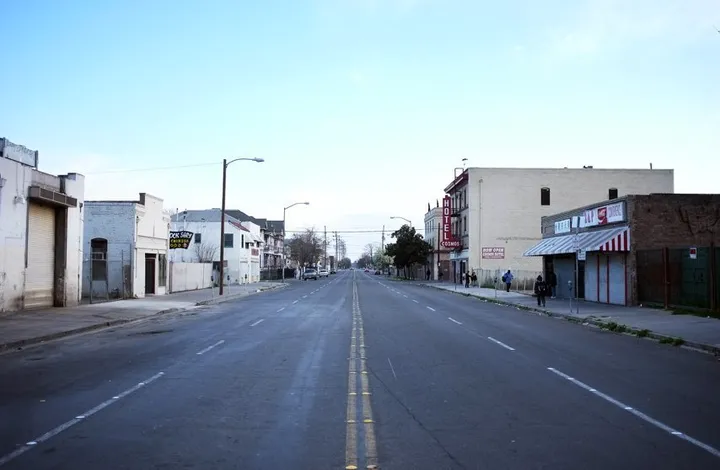
STOCKTON, Calif. –- Last year, Pablo Cano put to rest 12 murder victims, the most he's handled in four decades as an undertaker in this troubled city. Many of the dead were still in their teens.
No homicides have come his way so far this year, but in late February he buried a 16-year-old shot in the head, this time in an apparent accident. The job, he says, wears on him.
"I'm so tired of burying these young kids who barely have a chance to start their lives," says Cano, 70.
Some people grimly joke that the wave of Stockton murders -- which hit an all-time high of 58 in 2011 -- must be good for Cano's bottom line. That's hardly the case. Often the families of victims can scrape together only a few hundred dollars even after turning to friends and neighbors for help. He sometimes offers steep discounts so he doesn’t have to turn them away.
"In the last year, I've had to help a lot more people. They just don't have the money," he says. "They have tamale sales. I've had some pay for the balance with two car washes."
Stockton, a city of nearly 300,000 with a heavily agricultural economy, saw home construction soar during the housing frenzy that swept through here and the rest of the country several years ago, and became a foreclosure epicenter when the boom turned to bust. The pain of the housing and economic meltdown feels more apparent here, if only because Stockton has long been home to deep pockets of poverty and rampant street crime.
It is hardly alone in its struggles.
Despite clear success reining in crime nationally in recent decades, pockets of extremely high crime rates can still be found in almost every American city. These areas, virtually without exception, are populated by people at the very bottom of the socioeconomic ladder.
"You're not going to find a lot of homicide in high-income or even middle-income neighborhoods," says Alfred Blumstein, a criminologist at Carnegie Mellon University. "The bulk of the action is in these poor neighborhoods."
With a median income just two-thirds of the California average, Stockton has struggled for decades with some of the state’s highest crime rates. Public safety improved during the flush years of the housing boom, and in 2008, homicides fell to just 24, the lowest level in nearly 30 years. But those gains quickly slipped away with the collapse of the housing market and the recession.
To plug gaping deficits, the city council slashed the police department budget, shrinking the size of the force and cutting the pay and benefits of officers who remained. Stockton dismantled a narcotics force, scaled back community policing efforts -- and killings soared. Eight murders in January and February in 2012 put Stockton on pace to break the 2011 homicide record.

Poverty In Stockton
The causes of crime trends are notoriously difficult to measure, but criminologists say the police cuts almost certainly played a role. “When you make those kinds of drastic cuts, you have to believe that there’s an effect,” says Michael Jacobson, director of the Vera Institute of Justice in New York. “It’s unimaginable that something like that couldn’t make a difference.”
Relief is nowhere in sight. Late last month, the city council voted to suspend millions in debt payments and enter mediation with its creditors, a last-ditch attempt to save Stockton from becoming the largest city to file for bankruptcy in U.S. history. Projected deficits over the next several years mean more cuts are likely in all services, including policing.
"We've got one of the highest crime rates in the nation and yet we laid off 99 or more police officers," says Elbert Holman, a city councilman. "We cannot lay off more police officers and declare our city safe. There's just no way."
THE THIN BLUE LINE
Violent crime fell dramatically in the U.S. during the past two decades, after a record-breaking spike in the 1980s and early 1990s, when drug-fueled bloodshed engulfed inner-city neighborhoods. The most striking gains can be seen in the U.S. homicide rate, down by more than 50 percent since peaking in the 1980s.
But violence in the U.S. remains highly concentrated in the country’s poorest urban neighborhoods, and it's deeply enmeshed with other hallmarks of poverty such as unemployment, substandard education and housing, and splintered families.
Experts emphasize that crime rates in many poor and working-class neighborhoods are no higher than the national average, and that poverty alone does not predict danger. Yet where high crime does persist, it is invariably in areas in deep economic distress.
For residents of these impoverished areas, the crime epidemic of the 1980s and early 1990s is not a fading memory, but an all-too-present reality. “There are certain neighborhoods that feel like war zones,” says Jeffrey A. Butts, director of the Research and Evaluation Center at the John Jay College of Criminal Justice in New York.
FBI statistics show that national violent crime rates resumed their decline during the past four years, after stagnating several years ago. The drop is not nearly as sharp as in the 1990s, but criminologists think it's encouraging because it occurred during a recession, when some studies suggested some types of crimes would increase.
Yet some experts fear that the recession’s impact on city budgets could cause overall crime rates to stagnate again, and even rise.
Since the beginning of the recession, layoffs have claimed the jobs of roughly 12,000 officers and deputies across the country, while retirement and other losses through attrition contributed to a total of about 60,000 vacancies, according to an October 2011 report by the U.S. Department of Justice. The decline represents the first national drop in law enforcement positions in nearly 25 years, the report found.
"I know of very few places that have not been hit by layoffs," says Bernard Melekian, director of the Justice Department's COPS Office, a federal program that provides hiring grants to needy police departments. "There's no question that some cities are being devastated."
The impact of layoffs is hardly clear-cut, with some cities seeing increases in offenses, and others staying flat or registering declines. But even cities that have fared well so far could experience a delayed reaction from the cuts years down the road, according to James Alan Fox, a criminologist at Northeastern University.
“Time will tell whether these budget cuts have a lag effect,” Fox says. “The potential is there absolutely.”
Not all criminologists agree that fewer police naturally leads to higher crime. Some studies have found innovative policing strategies, coupled with community outreach and social services for potential offenders, can curb crime without a big increase in officers.
“If you’re committed to the wrong strategy, no number of cops will be good enough,” says David M. Kennedy, director of the Center for Crime Prevention and Control at John Jay College of Criminal Justice, and creator of a community-based anti-crime program used by more than 60 cities.
“There turn out to be ways to get on the right side of the dynamics of violent crime without having an awful lot of people,” Kennedy says.
Other research shows a strong connection between police power and crime. A November 2011 study by the Rand Corporation found that, on average, every 10 percent increase in the size of a city’s police force led to a decrease in the homicide rate by 9 percent, robbery by 6 percent and car theft by 4 percent.
Some cities are shedding officers they clearly cannot afford to lose.
Last January, Camden, a deeply impoverished New Jersey city of 80,000 located just outside Philadelphia, dismissed nearly half its police force -- despite its ranking as the second most dangerous city in the U.S. in 2009, according to CQ Press, a data analysis firm.
From 2010 to 2011, homicides rose by nearly 30 percent, and aggravated assaults with a firearm jumped by more than a third.
The effects of the layoffs became apparent in the summer and fall of 2011, as the city recorded a surge in drug-related violence, says Warren Faulk, the Camden County prosecutor.
"There was about a six-month delay. About June or July we started to see the effects of it," Faulk says. "It got really bad in October and November -- critically bad."
Camden did rehire some of the lost officers with federal and state grants, but in December city officials pleaded with the state to send in the National Guard to help quell violence.
"We're currently a city under siege," Frank Moran, president of the city council, said at a press conference that month, calling on the mayor to declare a state of emergency. "We are under siege by criminals."
Flint, Mich., devastated by the spiraling decline of its once-thriving auto industry, also laid off police during the recession -- more than half of its force since 2008. The city, home to 102,000 people, has one of the highest poverty rates in the country, at 37 percent. Nearly a fifth of residents live in extreme poverty, which the federal government defines as an income threshold of $11,000 per year for a family of four.
In 2008, Flint had 265 sworn officers on the street. By early 2012, that number had fallen to 125. In that same period, homicides rose more than 60 percent.
Joshua Freeman, a Flint city councilman, is not sure that the layoffs directly caused homicides to spike, but says they clearly contributed to a growing sense of lawlessness. "I think that people in this city feel that there aren't any consequences for their actions, because the city doesn't have the resources to implement consequences," Freeman says.
BATTERED BY CUTS
Police cuts weren't as severe in Stockton as in Flint and Camden. The impact, however, appears equally dramatic.
In 2008, as Stockton rode the housing boom, the city's police department reached its highest staffing level ever, with more than 450 sworn officers. The city took a far more aggressive approach to policing its most troubled neighborhoods, according to James West, chief of the Stockton Unified School district's police department, which works closely with the Stockton Police Department.
"That allowed the police department to take back some of the neighborhoods that the gangs had controlled for years," West says. "There was great progress being made."
Three years later, staffing sunk by a quarter and officers that remained saw their pay and benefits slashed by more than 20 percent. Many senior officers retired or left to work in more affluent communities in the state. As staffing declined, community-oriented policing and aggressive anti-crime strategies disappeared.
"We had special units doing proactive things, going out into communities and talking with people," says Steve Leonesio, a senior officer with the Stockton Police Department and president of the city's police officers' association. "We have none of that anymore."
"Now we go in there if they call us, then we leave and go to the next place that calls us," he adds. "It's a Band-Aid effect."
The abrupt surge in killings in tandem with the drop in police staffing strongly indicated that the two were connected, says Blumstein, the Carnegie Mellon criminologist. "It clearly is suggesting that murders rose as a result of the decline in the police force."
Other researchers, however, questioned whether Stockton might have avoided the surge in homicide with an aggressive, community-based, anti-crime program, far less costly than hiring large numbers of officers.
According to Kennedy, the John Jay criminologist, Stockton successfully experimented with an anti-crime strategy in the late 1990s. The program used outreach and communication with gang members and violent offenders. That approach showed results, Kennedy says, but Stockton abandoned it after a leadership change at the police department -- not, he says, because of money.
“The real issue there is will. It’s not money. It’s not people,” Kennedy says. “It fell apart because they let it fall apart.”
Stockton police disagree, pointing to a gang-outreach program in the city called Peacemakers that is similar to Kennedy’s violence prevention strategy. "It's been a good five or six years that we've been doing this program," says Leonesio, a member of the Stockton Police Department's SWAT team. "Honestly, I really don't see it causing a huge impact on the crime."
The majority of Stockton's homicides in 2011 were gang-related shootings, according to local police, and the killings have spilled over into 2012. Among the most recent victims was Arturo Marquez Jr., 14, shot while fleeing gunfire at a party on the city's south side.
Cesar Mercado, 45, the boy’s soccer coach and a newly retired Stockton police officer, says Marquez was a good kid and a standout player with huge potential. “He probably shouldn’t have been at the house he was at,” he says. “It was just a bad side of town.”
Gang members from the city showed up, and shots rang out. Marquez took a bullet in the chest. “It’s devastated the whole family,” Mercado says. “It’s devastated the community.”
Mercado left the force in late February, just after Marquez’s funeral, and is now weighing job offers from departments elsewhere in California. He’d served for more than 20 years, including 13 years in narcotics and five on the gang squad, and thought he’d retire in Stockton.
But in 2011, the city reduced his pay and benefits by more than 25 percent, and with talk of bankruptcy in the air, more cuts seem likely.
“I’m leaving because of the instability that’s coming around the corner,” he says. “I need to keep feeding my family and paying my mortgage.”
The death of Marquez, his star player, did not play a role in his decision. “It was just bad timing,” he says.
Virginia Ortega, 33, also saw her life recently upended by crime.
Ortega lives in central Stockton, less than a quarter-mile from the police department headquarters and city hall. A single mother of five, she shares a three-bedroom apartment with more than a dozen family members, including her mother and grandmother. More than 40 percent of people in her neighborhood live below the federal poverty line, according to Census data.
Last summer, Ortega's boyfriend, Dave Lewis, 34, a mechanic, was shot to death while walking at night past a nearby convenience store. Police have made no arrests.
Lewis "was making good money," Ortega says, helping to put food on the table and taking care of her children. Now she depends on her grandmother's monthly Social Security check to make the rent.
Early one evening in late February, she visited the store and the grimy patch of concrete where Lewis was shot. Young men in baggy clothes and crooked baseball caps loitered outside.
The police have virtually abandoned regular patrols of the neighborhood, coming now only in response to a shooting or other serious assault, she says. "We don't have any protection," Ortega says. "Even when you walk to your car you have to be careful. They can pull a gun on you any time."
AN UNCERTAIN FORECAST
For communities like Stockton, it's hard to predict when the violence might abate.
“Crime forecasts have been notoriously incorrect,” says Barry Krisberg, director of research and policy at the Earl Warren Institute on Law and Social Policy at the University of California at Berkeley School of Law. “Forecasting crime rates is like forecasting the Dow Jones.”
Violence has long been tied to deprivation, though is not closely linked to macroeconomic swings. The young men responsible for the lion’s share of violent crime, particularly gun violence, often come from households mired in desperate poverty and have little of value but their self-image, Blumstein says.
“They have nothing in the world. They have no opportunity. They have no jobs. All they have is ego. And anyone who insults their ego, they will avenge that, one way or another,” he says.
Yet rising unemployment has little immediate direct effect on violent crime, researchers say, because the small number of hardened criminals responsible for the vast majority of offenses long ago gave up on participating in the legitimate labor market.
“They have no connection to the workforce in the first place,” says Kennedy.
One crucial driver of lower crime rates, many believe, has been waning cocaine and crack use, which reached epidemic proportions in the 1980s and early 1990s. As the trade became more lucrative and prices for the drugs rose, it fueled lethal competition between rival drug-dealing gangs.
The sharp increase in U.S. imprisonment rates in recent decades is another factor in falling street crime. Incarceration has removed potential offenders from the streets, in many cases for decades or life. "Incarceration may not be the most cost-effective way of fighting crime, but it certainly does work," says Fox, the Northeastern criminologist.
Additionally, a growing number of studies show that community-based gang intervention and conflict mediation efforts, modeled on public health initiatives, can achieve significant results in curbing homicides.
"At the deepest level, many of these shifts, taken together, suggest that crime in the United States is falling -- even through the greatest economic downturn since the Great Depression -- because of a big improvement in the culture," James Q. Wilson, the recently deceased Harvard professor and criminologist, wrote in a June 2011 City Journal article about falling crime rates.
In fact, public opinion among those not surrounded by violence is that the nagging problem has been solved, analysts say.
In a 1994 Gallup poll, 37 percent of Americans rated crime as their biggest concern, making it the top issue in the poll. By 2012, a similar poll by Gallup found that just 1 percent called crime their top concern -- on par with gay rights, foreign aid and abortion.
"The prevailing view is that crime is not a problem any more," says Fox.
However, a lack of widespread public interest in crime may impact rates in the future particularly if they result in cuts to programs that have shown success, he adds. “If we shift our priorities and resources elsewhere, crime can rebound.”
'I'M AN INDOOR PERSON NOW.'
Around 1805, Gabriel Moraga, a Spanish army officer, stumbled across a pile of human bones, the remains of a massacre, while hiking along a yet-unnamed tributary of the San Joaquin River, which runs through California's Central Valley before emptying into San Francisco Bay. He named the tributary, now in the heart of modern-day Stockton, El Rio de las Calaveras, the River of Skulls.
For Kevin White, a pastor at Stockton's Crosstown Community Church, the discovery set the tone for the next 200 years or so. "We've kind of been violent ever since," he says.
White is more than familiar with Stockton's dark side: For more than 10 years, he has helped run a support group for family members and loved ones of homicide victims. He is also a survivor himself. More than 20 years ago, a deranged man savagely beat to death White's brother, a Stockton police officer, while he was on patrol.
"When people tell their stories here it's like leaching poison out of their system," White says. "You can't fix them. But you can give them hope."
On a cool Thursday night in February, about 30 residents -- mainly from the city’s poorer quarters -- gathered for a meeting of the group in White's humble, wood-paneled church, in a residential neighborhood on the city's east side. Sitting in folding chairs arranged in a large circle, each took a turn telling the story of losing a loved one to violence. The majority remain unsolved.
Renata Martinez, 36, came to talk about her 17-year-old son Juan who was shot in the head last June while riding his bike nearby around 10 p.m. A boxer, he was headed into his senior year in high school and enlisted in the Army. He'd never been in trouble with the law. The murder investigation has gone nowhere.
"We don't know what happened," says Martinez. "Nobody wants to say who he was with."
At her home on Stockton's south side, near the train tracks that bisect the city, Martinez keeps a memorial for her son on her mantel. Close-by is a cabinet full of the model cars he treasured.
The night of his murder, Renata Martinez was being treated at an in-patient rehab clinic for addiction to methamphetamine. "My son was basically on his own," she says.
The violence around her seems to creep closer with each passing day. Just a few weeks earlier, her teenage nephew was helping an uncle load boxes into a truck early one night when a running gun battle broke out up the street. A stray bullet struck her nephew Jose Silva in the forearm.
In the dining room, Silva, 13, shyly pulls off his hoodie to reveal a purple full-arm cast. The surgeons placed seven pins and a plate in his arm, he says. "I only remember hearing firecrackers," he recalls. "Then I felt something stabbed me. My sister got grazed."
The shooting and the murder of his cousin have left him afraid. "It got all wrong around here," he says. "I'm an indoor person now."
Cano, the undertaker, performed the service for Martinez's son. During more than 40 years in the mortuary business in Stockton, Cano has seen the city's fortunes wax and wane. In the 1980s, he chased away drug dealers that congregated on the sidewalk in front of the funeral parlor where he was director.
Now he owns Cano's Funeral Home, far from the city center where street crime is not a problem. But he says Stockton is still a city under siege.
Last year, for the first time, the police department planted an undercover detective in the audience at a memorial service he held to guard against a possible retaliatory attack by suspected gang members in attendance. Cameras at his front door track the young men that walk in and out of services and congregate in the parking lot. He counts himself lucky that so far his business has been left in peace.
Like any other ordinary citizen, though, he still worries. "I tell my wife to be careful when she goes to the mall at night," he says.
FBI statistics clearly show the acceleration of Stockton's crime problem. In 1985, the city averaged about 880 violent crimes per 100,000 people. By 2005, the rate had nearly doubled, making Stockton one of the most dangerous cities in California. A 2006 report commissioned by the city found that the Stockton Police Department was seriously understaffed, with an officer-to-population ratio more than 40 percent lower than the national average for a city its size.
By the mid-2000s, however, the city's financial picture brightened, as residential construction seemed poised to overtake agriculture as the engine of regional growth. Homebuyers priced out of rapidly appreciating real estate markets in the Bay Area and Sacramento came in droves to Stockton.
A surge in revenue from new home sales poured into city coffers, and local leaders borrowed heavily for major civic development, including a sports arena, a minor-league baseball park and a marina. In 2008, growth in the police department budget allowed staffing to climb sharply, and homicides fell to a 25-year low.
But by then, the bottom already had fallen out of the housing market. Developments halted mid-construction, and foreclosures swept through neighborhoods. Then the financial crisis hit with full force in 2008, sending unemployment soaring to nearly 20 percent locally.
A CITY IN COLLAPSE
Nearly three years later, Stockton has yet to hit bottom.
The city has slashed public services, and closed firehouses, libraries, community centers. It has laid off hundreds of city workers.
But the cuts failed to strengthen Stockton's budget, which is also being sapped by mounting employee retirement costs. According to the most recent projections from the Stockton city manager, the city faces annual deficits of more than $20 million until at least 2015. The council recently voted to begin a mandatory mediation with its creditors.
"We can't print money and we have no one to pass this down to, like the state," says Elbert Holman, a city councilman. "Cities have nowhere to go. All we can do is cut services."
He is aware the effects police cuts have on Stockton's poorest neighborhoods."They're catching the brunt of it," he says. "The people that are less fortunate, they're experiencing this stuff every day."
"The folks in the gated communities are not hearing gunshots every night," he adds.
Holman said he agreed with other city leaders that further cuts in public safety were simply unacceptable, and that the city is justified in taking drastic steps, even bankruptcy, to balance its budget. "We're in the midst of a storm and we've got to deal with it," he says.
But even bankruptcy is unlikely to solve Stockton's financial problems, or to avert the need for further cuts, according to Matt Fabian, managing director of Municipal Market Advisors, a financial analysis firm.
Instead, the city may have no choice but to keep cutting -- and adjust to a new normal.
"They may have to abandon some of the things that they do," Fabian notes. "The kind of police service that they used to have may no longer be possible."