iPhone app iPad app Android phone app Android tablet app More

Spring Equinox, Vernal Equinox: Whatever It's Called, New Season's Arrival in 2012 Is Unusually Early

Posted: 03/20/2012 7:38 am Updated: 03/20/2012 8:03 am

Vernal Equinox

By: Joe Rao
Published: 03/19/2012 01:48 PM EDT on SPACE.com

Across much of the United States, this has been an unusually mild winter, especially for those living east of the Mississippi. Not a few people have noted that spring seems to have come early this year. Of course, in a meteorological sense that could be true, but in 2012 it will also be true in an astronomical sense as well, because this year spring will make its earliest arrival since the late 19th century: 1896, to be exact.

The vernal equinox — the first day of spring — will arrive tomorrow (March 20) at 05:14 Universal Time, or 1:14 a.m. EDT. Even more intriguing is that for those in the Mountain and Pacific Time zones, the equinox will actually arrive tonight (March 19).  

Astronomers define an equinox as that moment when the sun arrives at one of two intersection points of the ecliptic (the sun's path across the sky) and the celestial equator (Earth's equator projected onto the sky). One such intersection point is located in western Virgo; the sun arrives there on Sept. 22 or 23, and appears to cross the equator from north to south, marking the beginning of autumn in the Northern Hemisphere.

The other intersection point, in eastern Pisces, is where the sun will be tomorrow. The sun is now migrating north of the equator, hence this is the "vernal" or spring equinox. At 5:14 UT next Tuesday, the sun will be shining directly over the equator from the point of view of a spot in the Indian Ocean, 757 miles (1,218 km) southeast of Colombo, Sri Lanka. [Earth's Equinoxes & Solstices (Infographic)]

Why so early?

Now maybe this rings false. After all, when some of us of a certain age were growing up, the first day of spring was always on March 21, not March 20, right? Now all of a sudden spring is coming on March 20, and as we just noted, even earlier — March 19 — for some.  

Is this unheard of? Not if you look at the statistics. In fact, did you know that during the 20th century, March 21 was actually the exception rather than the rule? The vernal equinox landed on March 21 only 36 out of 100 years — most of these occasions coming during the early and middle part of the 20th century. Yet from 1981 to 2102, Americans celebrate the beginning of spring no later than March 20. Still, for many March 21 is ingrained in our culture as the traditional first day of spring, even though it's been more than 30 years since that last happened.

There are a few reasons why seasonal dates can vary from year to year. 

  • A year is not an even number of days, and neither are the seasons. To try to achieve a value as close as possible to the exact length of the year, our Gregorian Calendar was constructed to give a close approximation to the tropical year, which is the actual length of time it takes for Earth to complete one orbit around the sun. It eliminates leap days in century years not evenly divisible by 400, such 1700, 1800 and 2100, and millennium years that are divisible by 4000, such as 8000 and 12000.
     
  • Another reason is that Earth's elliptical orbit is changing its orientation relative to the sun (it skews), which causes Earth's axis to constantly point in a different direction, called precession. Since the seasons are defined as beginning at strict 90-degree intervals, these positional changes affect the time Earth reaches each 90-degree location in its orbit around the sun.
     
  • The pull of gravity from the other planets also affects the location of Earth in its orbit.

The current seasonal lengths for 2012 in the Northern Hemisphere are:

Winter: 88.994 days
Spring: 92.758 days
Summer: 93.651 days
Autumn: 89.842

The warm seasons of spring and summer combined are 7.573 days longer than the colder seasons, fall and winter (good news for warm weather admirers). However, spring is currently being reduced by approximately one minute per year and winter by about half a minute per year. 

Summer is gaining the minute lost from spring, and autumn is gaining the half-minute lost from winter.  Winter is the shortest astronomical season, and with its seasonal duration continuing to decrease, it is expected to attain its minimum value — 88.71 days — by about the year 3500.

Not equal on the equinox

Another complication revolving around the vernal equinox concerns the length of day versus night. 
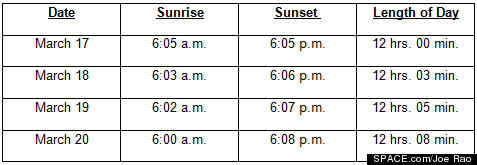
We have been taught that on the first days of spring and autumn, the day and night are equal to exactly 12 hours all over the world. Yet, if you check the calculations made by the U.S. Naval Observatory or the sunrise/sunset tables in any reputable almanac, you will find that this is not so. In fact, on the days of the spring and fall equinox, the length of daylight is actually longer than darkness by several minutes.

Take the case of New York City, for example. As the table below shows, days and nights are equal not on the equinox, but on Saint Patrick's Day.

One factor is that the moments of sunrise and sunset are considered to be when the top of the sun, and not its center, is on the horizon. This fact alone would make the time of sunrise and sunset a little more than 12 hours apart on these days. The sun's apparent diameter is about equal to half a degree.

But the main reason that this happens can be attributed to our atmosphere, which acts like a lens and refracts (bends) the sun's light above the edge of the horizon.

In its calculations of sunrise and sunset times, the U.S. Naval Observatory routinely uses 34 minutes of arc for the angle of refraction and 16 minutes of arc for the semidiameter of the sun's disc. In other words, the geometric center of the sun is actually 0.83 degrees below a flat and unobstructed horizon at the moment of sunrise.

Or, put in another way, when you watch the sun either coming up above the horizon at sunrise or going down below the horizon at sunset, you are actually looking at an illusion — the sun is not really there, but is actually below the horizon!

As a result, we end up seeing the sun for a few minutes before its disk actually rises and for a few minutes after it has truly set. Thus, thanks to atmospheric refraction, the length of daylight on any given day is increased by approximately six or seven minutes.

Other parts of the world

For Europe, spring began on March 21 in the year 2007. That, however, was the last time until 2102. 

For places much farther to the east, such as Tokyo (nine hours ahead of Greenwich, England), spring will fall on March 21 in two out of every four years from 2014 through 2023 (2014, 2015, 2018, 2019, etc.), and then once every four years from 2027 through 2055. But then that's it until 2101.

Joe Rao serves as an instructor and guest lecturer at New York's Hayden Planetarium. He writes about astronomy for The New York Times and other publications, and he is also an on-camera meteorologist for News 12 Westchester, New York.

Copyright 2012 SPACE.com, a TechMediaNetwork company. All rights reserved. This material may not be published, broadcast, rewritten or redistributed.

FOLLOW SCIENCE

By: Joe Rao Published: 03/19/2012 01:48 PM EDT on SPACE.com Across much of the United States, this has been an unusually mild winter, especially for those living east of the Mississippi. Not a f...
Filed by David Freeman  | 
 
 
  • Comments
  • 276
  • Pending Comments
  • 0
  • View FAQ
Post Comment Preview Comment
To reply to a Comment: Click "Reply" at the bottom of the comment; after being approved your comment will appear directly underneath the comment you replied to.
View All
Favorites
Recency  | 
Popularity
Page: 1 2 3 4 5  Next ›  Last »  (7 total)
HUFFPOST SUPER USER
tulsey
I was Bill Hicks.
11:54 PM on 03/29/2012
The intense rise of combustion during WW2 helped set the stage for our oil dependant culture. We out oiled the axis. And now we will reap our rewards.
06:57 AM on 03/28/2012
Very interesting read, and well thought out and presented. I learned something new, thank you.
This user has chosen to opt out of the Badges program
photo
02:27 PM on 03/27/2012
Hey, news flash -- nothing is "wrong"! Climate change is part of this planet's life , it it wasn't we'd be Mars! Yes, factors such as land use, carbon loading, the shrinking of the heliosphere, may exacerbate this, we take whatever measure we need to to keep the planet livable for our species!

Creationists cover your eyes NOW!

Humans adapt, that's how we have survived so far .. . even a smart Neanderthal knew that just because Sirius was in a particular portion of the sky, or they had nine days until summer solstice, the berries might still not be ripe 'cause they justs had two weeks of cool rainy weather . . . ;)
This user has chosen to opt out of the Badges program
photo
02:11 PM on 03/27/2012
The calendar's an artificial construct superimposed on a natural cycle by whichever ruling elite controls of the chalkboard.. If you add in DST we've moved so far from a natural reckoning of the seasons, no wonder lots of us are ridden by angst and suffer SAD!

However, there are still various holy days referred to as movable feasts: most Christians celebrate Easter/Oster on the first Sunday after the first full moon after the vernal equinox, e Jewish High Holidays are also movable feasts determined by a lunar cycle calculation, as is as is Ramadan. And why June 19 - 23 referred to as mid summer instead of the 1st day of summer, and why December 19-23 is referred to as mid winter?

Oh yes, and another thing climate and weather, have far more to do with when certain activities are appropriate than the calender, which again is merely a inflexible approximation of reality -- just ask a gardener -- you plant your early peas when the soil temperature and the light are right -- not by what the calender says!

There are uses for a calendar in coordinating activities in society, BUT it does have limitations for some uses. That said, if you're interested, you might like to check out the following site, http://www.archaeoastronomy.com/

Sorry I'm grumpy, but was way to early for me to come out of hibernation -- despite what the calender says! ;) zzzzz. . .

f hibernation
photo
southingtonian
"I'm a Capricorn and you can't make me do sh*t.."
06:42 AM on 03/27/2012
Still doesn't explain the 2 month difference in our local climate. A few years back, I was digging out of 6 feet of snow on St. Pat's. this year I was rototilling the garden.
photo
michelesda
My micro-bio is empty.
10:00 AM on 03/26/2012
None of this actually explains the backyard parties we were having around here in our shorts in the first week of March.
photo
vandegrasse
Don't Panic
05:11 PM on 03/25/2012
People need to get something through their heads, especially wingers: just because you deny something is happening doesn't mean it's not happening.
09:38 PM on 03/25/2012
Just close your eyes, plug your ears and say LALALA very loudly :)
This user has chosen to opt out of the Badges program
photo
A Meat Beetle
Heck no, I'm not crazy. Why? Do I look crazy?
08:32 AM on 03/23/2012
What spring? It snowed in Portland, Oregon yesterday!
This user has chosen to opt out of the Badges program
photo
Alex Luck
proud godless commie
08:53 AM on 03/23/2012
And in Southwest Harbor, Maine, it was 80 degrees and I was sailing. Good thing 'global warming' is a hoax. It might get worrisome otherwise. 8-(
fisch123
For those of you who don't know 1T = 1000B.
08:58 PM on 03/23/2012
In Winnipeg otherwise known as winterpeg it hit 24C the other day, Normal high 0C
09:40 PM on 03/25/2012
A Meat Beetle,
And where I live, just west of Salem, we got 3-4 inches of snow, the neighborhood kids were out building snowmen....brrrr!
photo
BannedInBoston
Everyone is entitled to my opinion.
10:52 PM on 03/22/2012
A couple of days early for the Vernal Equinox isn't enough to cause the kind of early summer weather we've been seeing here for the past week....
photo
HUFFPOST SUPER USER
johnmrchase123
05:13 PM on 03/22/2012
and if you read article they say, spring is tomorrow (20th) tomorrow is 23rd ... way to go Huffpost
photo
HUFFPOST COMMUNITY MODERATOR
MoreDimensions
09:39 PM on 03/22/2012
The article is dated 3/19.
HUFFPOST SUPER USER
gdloops
04:15 PM on 03/22/2012
Does this mean I can put my long undies away? Hmmmm?
photo
vandegrasse
Don't Panic
05:09 PM on 03/25/2012
It means you can put your children's and your children's children's future away! We're going down!
03:12 PM on 03/22/2012
It is way too warm for this time of year, something is just not right.
photo
BannedInBoston
Everyone is entitled to my opinion.
10:54 PM on 03/22/2012
Could it possibly be...climate change?...
photo
southingtonian
"I'm a Capricorn and you can't make me do sh*t.."
06:44 AM on 03/27/2012
I-G- n-o-r-e! I-G- n-o-r-e! I-G- n-o-r-e! (sung loudly with hands over ears)
02:37 PM on 03/22/2012
Only Government could believe that cutting a foot of fabric off the top of a blanket then sewing it on the bottom would result in a longer blanket.
photo
HUFFPOST SUPER USER
jaguare70
12:58 PM on 03/22/2012
The vernal equinox came early because we moved up the date for setting day light savings time. Quit fooling with time.
This user has chosen to opt out of the Badges program
12:54 PM on 03/22/2012
Thanks for not reporting on what I expected this article to be about....the unusually early arrival of spring weather. Did not expect this useless article.