iPhone app iPad app Android phone app Android tablet app More

Spring Weather 2012: If Spring Came Early, What Will Summer Feel Like?

Posted: 03/24/2012 7:11 am Updated: 03/24/2012 7:11 am

From Russell McLendon and Mother Nature Network:

March 20 is the official launch date of spring in the Northern Hemisphere. But much like a hit single or a Super Bowl ad, spring was leaked a few weeks early this year -- lifting spirits for now, but also raising concerns that summer might try to upstage it.

This is only happening in select U.S. markets so far: The Midwest and East Coast are sizzling, for example, but the West is cool and stormy. Minneapolis was nearly 40 degrees warmer than average last Friday, one of more than 2,200 daily U.S. heat records already set this month. Meanwhile, a winter storm slammed Arizona and New Mexico Sunday, dumping nearly 2 feet of snow and stirring up 60 mph winds.

[Video: Wild weather hits U.S. on last day of winter]

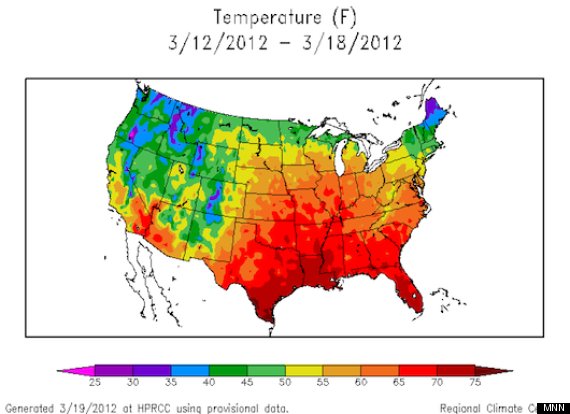
So what's going on? The weird weather is at least partly due to a "blocking pattern," or stationary set of atmospheric conditions, hovering over the country. A sprawling area of high pressure is fueling the Eastern and Midwestern heat waves, while a low-slung jet stream is keeping winter alive out West. Here's a map that illustrates the effect, showing average temperatures across the Lower 48 states from March 12-18:
But that map doesn't tell the whole story. The map below, also for March 12-18, shows temperature anomalies, with dark red indicating the warmest departures from normal:
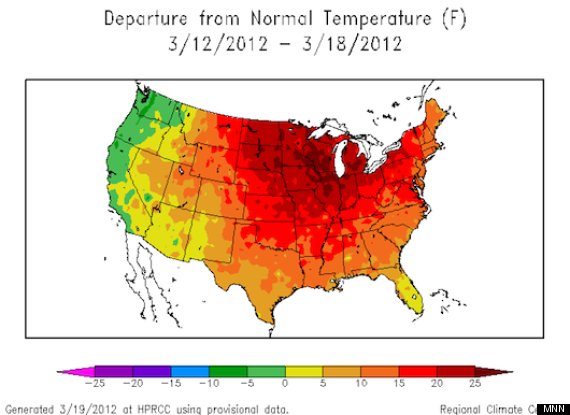
In a statement issued this week, the National Weather Service explains that "It is extraordinarily rare for climate locations with 100+ year long periods of records to break records day after day after day ... though it is very difficult to precisely quantify just how rare it is because as the period of record grows the likelihood of seeing so many consecutive record-breaking days decreases."

The heat also causes trouble in less obvious ways: Excess warmth is being blamed for Michigan's recent tornado outbreak, as well as other unusually early thunderstorm activity this year (similar to the record 2011 tornado season). And it's also wreaking havoc with some wildlife that uses weather to coordinate life cycles -- many plants now flower too early, for example, leaving themselves vulnerable to late frosts and making less food available to birds and insects. A recent study highlighted this effect in the Mormon fritillary butterfly, which is suffering population declines as wildflowers adapt to rising temperatures in the Rocky Mountains.

While it's impossible to definitively link one season's weather quirks to multiyear climate patterns, this does fit a broader trend toward earlier springs -- one that dates back decades and is expected to continue for decades to come. As climatologist Heidi Cullen wrote in a March 19 New York Times op-ed, the vernal equinox may no longer be a useful starting point for spring; instead, she suggests the "first leaf" index, which estimates the day when leaves appear on plants. And, as she notes, this date has drifted three days earlier for much of North America since the 1950s:

'First leaf' has gone from March 20 (1951-1980 average) to March 17 (1981-2010 average). This forward creep is consistent with the effects of an overall warming climate, roughly 1.4 degrees over the past century, what we refer to as global warming.

This trend is already significant, but in many cases it will likely accelerate in the near future. Consider Washington, D.C.'s famous cherry trees: They now bloom about five days earlier than they did 90 years ago, but a study in the journal PLoS ONE reports they could bloom as much as four weeks earlier within the next 70 years.

Of course, it's not just spring that's growing warmer. The winter of 2011-'12 was estimated to be the fourth-warmest on record, which meant much less snowfall across the Lower 48 states than in the previous two winters. On one hand, that's good news -- the National Weather Service estimates there will be a reduced risk of flooding this spring. "We're not forecasting a repeat of recent historic and prolonged flooding in the central and northern U.S., and that is a relief," Laura Furgione of the NWS says in a statement. "The severity of any flooding this year will be driven by rainfall more so than the melting of the current snowpack."

But on the flip side, small snowpack is also one of the dangers associated with global warming, especially in the U.S. West. That's because many major rivers in the region are fed by spring snowmelt, and reduced flow in those rivers can worsen water shortages downstream. So while the overall risk of spring flooding may be low in 2012, the risk of lengthy droughts across the country's southern tier is relatively high.

On top of a warmer winter and spring, the prospect of a warmer and drier summer in 2012 is especially troubling to many Americans. La Niña may start fading away in the next few months, potentially bringing some relief from southern U.S. droughts, and the recent thunderstorms have already helped. But much of the Southeast and Southwest will remain parched through June, and El Niño -- which sometimes brings rain to the South -- isn't expected to immediately follow La Niña. Regardless, the NWS forecasts above-average heat for several regions of the country at least until July.

Here are three maps illustrating what U.S. forecasters expect this summer to be like:

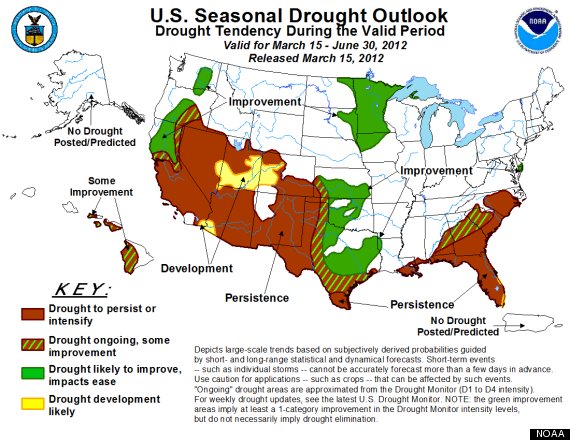
1. Seasonal drought outlook: Low spring snowmelt is a big reason why many drought-stricken areas may not get relief anytime soon. Combined with warm weather, this could once again create dangerous fire conditions in the Southwest and parts of the Southeast. The retreat of La Niña and the eventual re-emergence of El Niño are wild cards in determining how dry the U.S. is this summer.
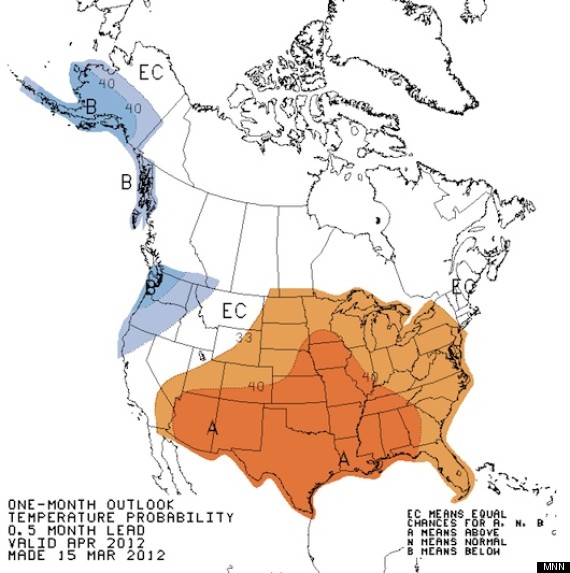
2. One-month temperature outlook: This map shows the likelihood that various regions will have above- or below-average temperatures in April 2012. The Mid-Atlantic, Midwest, Great Plains and Southwest are expected to continue sweltering, while Alaska and the Pacific Northwest are expected to remain cooler than usual.
3. Three-month temperature outlook: This map shows the same type of information as above, but projects three months into the future, covering April, May and June. It indicates prolonged heat waves in the Gulf Coast and the Southwest, as well as the potential for unusual warmth across the Eastern Seaboard and Midwest.
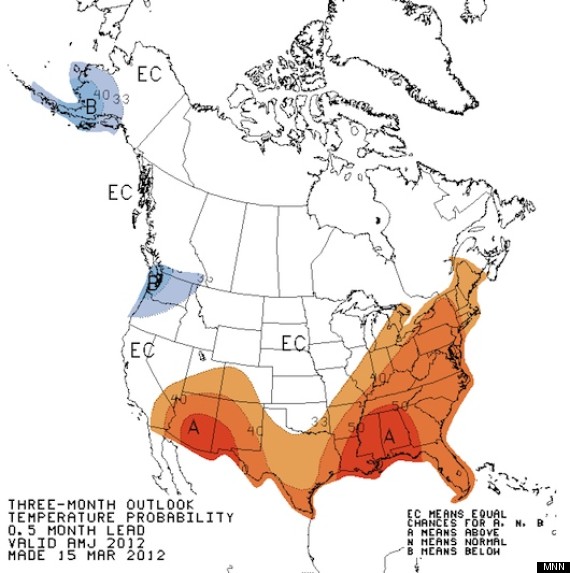
It's still too early to make specific predictions about summer weather, but we might find out soon enough. As the maps above suggest, summer could follow spring's lead, offering Americans a sneak preview well before the solstice arrives on June 20.

Also on MNN:
Vernal equinox 2012 earliest in 100 years
Early spring is bad news for butterflies
10 foods that fight spring allergies

Also on HuffPost:

FOLLOW GREEN

From Russell McLendon and Mother Nature Network: March 20 is the official launch date of spring in the Northern Hemisphere. But much like a hit single or a Super Bowl ad, spring was leaked a few we...
Filed by James Gerken  | 
 
 
  • Comments
  • 59
  • Pending Comments
  • 0
  • View FAQ
Post Comment Preview Comment
To reply to a Comment: Click "Reply" at the bottom of the comment; after being approved your comment will appear directly underneath the comment you replied to.
View All
Favorites
Recency  | 
Popularity
Page: 1 2  Next ›  Last »  (2 total)
photo
StephenBP
What's he building in there?
11:58 AM on 03/28/2012
Well, after the unseasonably warm spell, we got a significant frost as I had guessed. Various fruit trees had already bloomed and are liable to have diminished crops because of the frost. Climate change really shakes up the jar for farmers, upon whom we all depend to survive. Agriculture is the point where, IMO, we are going to be most perceptibly and rapidly impacted by global warming and resultant climate change.

The change of global temperature is slow, barely perceptible, and skeptics can point to that slowness, or to noise in the warming trend line and proclaim that there is no global warming, hence, no unusual climate change. Concerted efforts by vested interest continually try to diminish the authority of climate scientists on the issue of climate in order to justify continued inaction. But the majority of the world's relevant scientific bodies and climatologist are all saying that something is going on and we ought to pay attention.

It is truly a testament to the power of the carbon combustion fuel industries that we are not steering our technology away from carbon energy sources, when every rational analysis of the risks and benefits shows that benefits of sticking with carbon are short term and plutocratic, the risks are staggering, and the benefits of leaving carbon are powerful and beneficial to nearly everyone alive and to future generations; and the risks are exaggerated.
photo
HUFFPOST SUPER USER
kate99
09:58 PM on 03/27/2012
I still dont get how anyone can say climate change is not happening I know fox news and the right wing dont belive in it what is fox says its all volcanos on the moon when its to late and we are messed up like this all you who think its not real are going to look like such fools
photo
Norge
Rolf K. Artist, worker of metal, writer of poems
08:58 PM on 03/26/2012
Enjoy. Bask and cook in the sun, the smell of flowers, hot breezes. Oh the luxury of it all. Swimming pools, oh the luxury of it all. Bask and cook in the sun. Enjoy.
This user has chosen to opt out of the Badges program
photo
SallyMaclennane
Yes I did build that!
08:14 AM on 03/26/2012
" If Spring Came Early, What Will Summer Feel Like?"

Uhhhhhh......warm? But don't worry, I hear there will be a cold spell this winter.
photo
HUFFPOST SUPER USER
silverwolf13
I know that I do not know.
08:30 PM on 03/25/2012
Here in DC, set a high record last week. Spring flowers already in full bloom, which is weird for March. The Cherry Blossom Festival will be early this year.
photo
HUFFPOST SUPER USER
Stephen Thorpe
Every breath you take - I'll take one too!
03:54 PM on 03/25/2012
HOT! Dry! Drought again this year.
This user has chosen to opt out of the Badges program
03:23 PM on 03/25/2012
Judging from the following graph, across the U.S. and over several decades the ratio of extreme highs to extreme lows in temperature has been increasing fairly steadily.

http://www.skepticalscience.com/nasa-giss-what-global-warming-looks-like.html
This user has chosen to opt out of the Badges program
photo
SallyMaclennane
Yes I did build that!
08:15 AM on 03/26/2012
"Several decades" is miniscule when compared to the fact that the earth is 4,500,000,000 years old. That is called statistical insignificance.
This user has chosen to opt out of the Badges program
05:14 PM on 03/26/2012
Ahh...so your point is that mankind's stint on Earth is statistically insignificant.
This user has chosen to opt out of the Badges program
07:35 PM on 03/27/2012
Regarding MacIennane's cherry-picking. First ask:

why pick 5,408 years BP (before 1950 AD), when the same EPICA data shows as recently as from 64 to 55 BP, a bigger 2.69 deg.C jump?

Did Earth warm from 1884-1895 AD by 2.69 degs. C?

Or cool

from 223 to 212 BP by 2.86 degs. C? From 1888 - 1872 BP by 2.85 degs.C? From 2060 - 2043 BP by 2.54 degs. C? Of course not.

Indeed, comparing EPICA data with Vostok:

AGE YRS______EPICA_______VOSTOK

64 – 55 BP____+2.69 degs. C
69 – 51 BP_________________+0.05 degs. C

223 – 212 BP___- 2.86 degs. C
235 - 213 BP________________+0.01 degs. C

1888 – 1872 BP_- 2.85 degs. C
1890 – 1852 BP______________- 0.12 degs. C

2060 – 2043 BP_- 2.54 degs. C
2082 – 2043 BP______________- 0.03 degs. C

5408 -- 5389 BP_+2.68 degs. C
5408 – 5363 BP______________+0.02 degs. C

ftp://ftp.ncdc.noaa.gov/pub/data/paleo/icecore/antarctica/vostok/vostok_deld.txt
ftp://ftp.ncdc.noaa.gov/pub/data/paleo/icecore/antarctica/epica_domec/edc3deuttemp2007.txt

showing that Vostok temperatures fluctuate far less than EPICA's.

Unlike Vostok, note that EPICA Dome C is an ice summit, 3,233 meters above sea level.

The above highlights my main point – you can't assume that temperature data from just one Antarctic site corresponds in any way to the GLOBAL AVERAGE.
Linda from Deerfield
Paying attention
02:06 PM on 03/25/2012
Our parents and grandparents in the Midwest used to speak of the peonies blooming just in time for "Decoration Day" ("Memorial Day" to us). Living a little further north and in proximity to the Great Lakes for about a third of a century, I've noted that peonies around here barely make their deadline, although they are quick on the heels of it. The way they've all burst prematurely through the surface of the ground this year, I'm anxious to see whether they will bloom early, and by how much. Hopefully, they will survive the rude push. It's interesting, but quite unnerving.
This user has chosen to opt out of the Badges program
photo
SallyMaclennane
Yes I did build that!
08:16 AM on 03/26/2012
Who cares.....I've been golfing since February. I'm all for it.
Linda from Deerfield
Paying attention
09:05 AM on 03/26/2012
Don't you have a nice stimulus project to go work on somewhere?
photo
HUFFPOST COMMUNITY MODERATOR
hazbro24
When the going gets weird, the weird turn pro- HST
02:06 PM on 03/25/2012
Puget Sound below normal again. Climate change has made it so we don't even have seasons anymore here. Occasional storm here or there. No summer last year. No real winter either this year. Just meh. Year round October weather.
photo
teardownthiswallst
Only Truth will set us Free
09:53 AM on 03/25/2012
Here’s the whole problem with originally framing the science with the words ‘global warming.’ Who doesn’t like an early spring?

Telling people they will be punished with something they want is a nonstarter. You have to live on the equator for those words to feel threatening.

So nobody took it seriously, and it seems to be happening much faster than we thought realistic. It’s too late to completely stop it, but not too late to do anything.

‘Climate change’ has replaced ‘global warming’ in our vernacular now, but both phrases depict a global viewpoint, while people think locally. Erratic, increasingly violent, unpredictable weather patterns are what hits people where they live. That’s what we feel.

In 50 years we’ll donate those DC cherry trees to Canada and grow palms. Iguanas and snakes will hang from them. Scorpions will sting people on the National Mall. DC may not even be there. Nobody knows how far the oceans will rise. Who doesn’t like the idea of Wall St underwater, literally?

Informed scientists know climate change is an incontestable fact. They know what we will have to confront, but cannot predict exactly how fast or extreme the changes will be. We have altered the earth’s physics and chemistry. We do not know what this could catalyze. We are toying with our world, fiddling around, playing God, like that’s what we were put here to do.

Did the dinosaurs ever see it coming? Or were they just stupid reptiles like us?
photo
HUFFPOST SUPER USER
Gottlieb
hated by left since 1973 and right since 1982
10:54 AM on 03/25/2012
Good comment. Don't forget tropical diseases will move north with rising temperatures. Fewer freezing winters will allow more harmful insects to survive to breed and attack food crops, timber-lands, and people. If you like to fly fish for native trout in Montana, I recommend you go now since the streams there are warming up beyond the point native trout can survive without summer glacial run off to cool the streams.

Here in Portland, Oregon we had several snow falls this month of March. When climate change starts to be noticeable in the weather, people will demand action but it will be too late.

http://www.wrh.noaa.gov/pqr/pdxclimate/PG84.html

Most people don't have the ability to understand complex issues so they trust "authority figures" who also don't have the ability but have an ideology to expound on.
photo
Kristin Talbott
One should always be a little improbable.
12:34 PM on 03/25/2012
I'm in Portland too, and I gotta say those snow falls constituted pretty noticeable climate change to me.

Quite weird to see the cherry blossom trees in full bloom and snow covering the ground below. Not to mention the news footage of several inches of snow at the beach...
photo
Conspiracy2Riot
Go ahead, try and eat that fiat currency
11:28 AM on 03/25/2012
F/F
photo
HUFFPOST SUPER USER
RickW44
09:48 AM on 03/25/2012
Did the article forget to mention global warming? I guess we have to be "politically correct" not to upset all the global warming deniers out there and cry like babies everytime an article points out the evidence of man made climate change.
This user has chosen to opt out of the Badges program
photo
fumes
Midnight Toker
08:59 AM on 03/25/2012
Fahrenheit 451 by July..

and the good news:

food served on paper plates..

will stay warmer longer
photo
HUFFPOST SUPER USER
DARK STAR
One small step for Man...
07:16 AM on 03/25/2012
Hot, very hot.
photo
intolleft
ObamaTAX...getting you shovel ready
01:16 PM on 03/26/2012
Like every summer I can remember.
This user has chosen to opt out of the Badges program
photo
eaarth2
“An era ends when its illusions are exhausted
05:02 AM on 03/25/2012
As the NOAA Maps indicate- its going to be a warmer then normal summer along the east coast. It looks an above average year also for temperatures for the east coast and the south, Midwest and Great Plains- this spreads into the southwest as well.
photo
HUFFPOST SUPER USER
wanamoka
11:44 PM on 03/24/2012
It will be a beating.