iPhone app iPad app Android phone app Android tablet app More

Posted: 03/29/12 09:23 AM ET  |  Updated: 03/29/12 05:19 PM ET

Milky Way PHOTO Shows Billion-Plus Stars

More than a billion stars blaze brightly in a new photo of our Milky Way galaxy snapped by an international team of astronomers.

The new picture, which was released today (March 28), combines infrared images of the Milky Way taken during sky surveys by two different instruments, the UK Infrared Telescope in Hawaii and the VISTA telescope in Chile. The photo is part of a 10-year project that is gathering mountains of data to help guide future research, scientists said.

"This incredible image gives us a new perspective of our galaxy, and illustrates the far-reaching discoveries we can make from large sky surveys," Nick Cross, of the University of Edinburgh, said in a statement. "Having data processed, archived and published by dedicated teams leaves other scientists free to concentrate on using the data, and is a very cost-effective way to do astronomy."

Cross will present the image Thursday (March 29) at the 2012 National Astronomy Meeting in Manchester, the United Kingdom.

Story continues below.
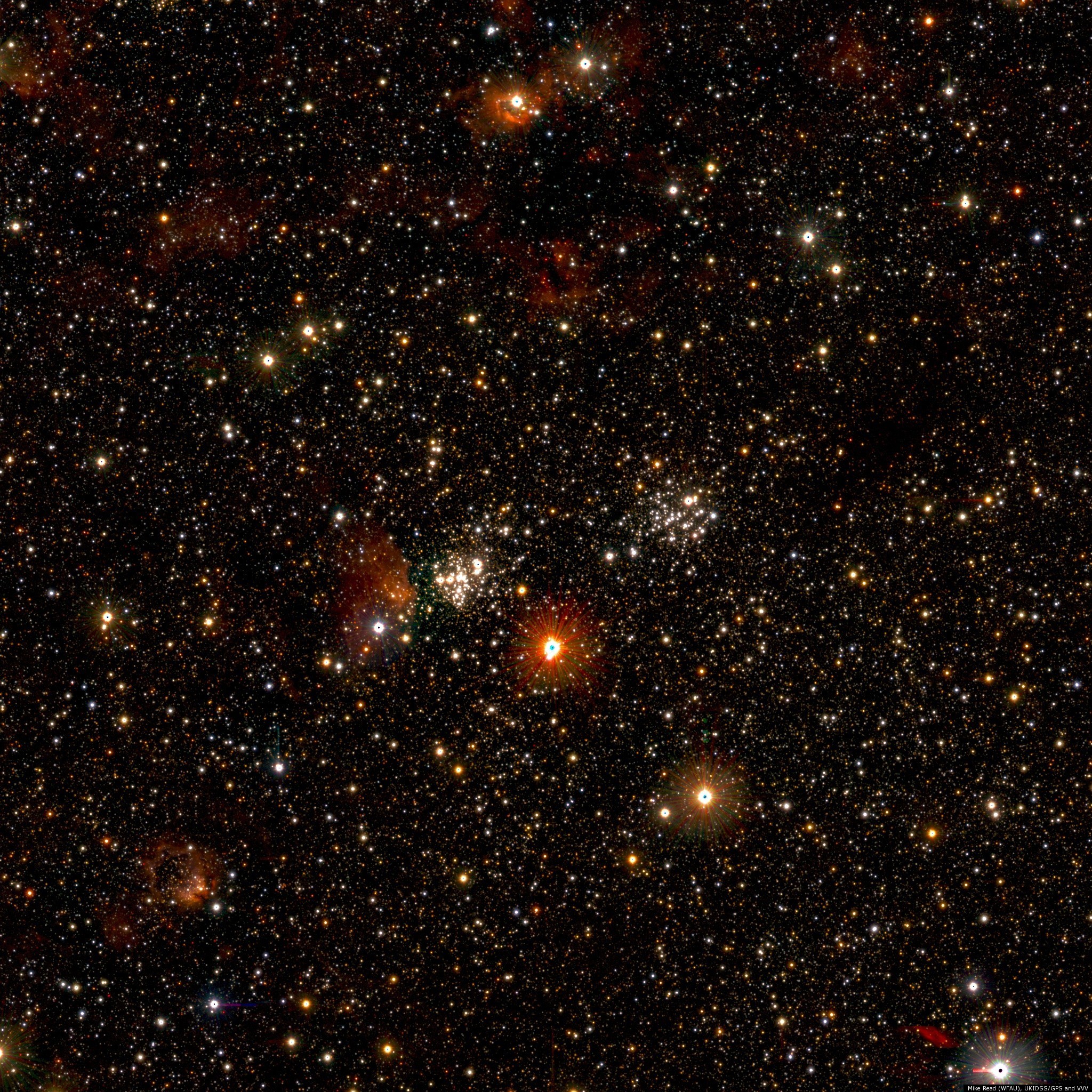
The photo shows the plane of the Milky Way, which is often described as looking like two fried eggs back-to-back, with a flat disk in the middle. Earth is close to this disk's edge; the new image shows a cross-section through the disk as seen from our planet's perspective, researchers said.

Because the image was taken in infrared light, it cuts through much of the Milky Way's obscuring dust, allowing astronomers to observe details of the galactic center. Large-scale structures are also visible, such as large clouds of dust and gas where stars are forming at rapid rates.

While the new photo captures an unprecedented number of stars, it's far from a complete stellar picture of the Milky Way. Astronomers think our galaxy contains at least 100 billion stars, and perhaps as many as 400 billion. Getting all of them in a single frame would be quite a feat.

Follow SPACE.com for the latest in space science and exploration news on Twitter @Spacedotcom and on Facebook.

Copyright 2012 SPACE.com, a TechMediaNetwork company. All rights reserved. This material may not be published, broadcast, rewritten or redistributed.

Also on HuffPost:

PHOTOS: BIGGEST NASA DISCOVERIES OF 2011
Loading Slideshow...
  • Entire Sun Imaged

    In February, <a href="http://www.nasa.gov/mission_pages/stereo/main/index.html" target="_hplink">NASA's STEREO probes</a>, two observatories that were launched in 2006 to survey the sun, reached opposite ends of the sun and thus, were able to give scientists (and the rest of us!) a never-before-seen view of the far side of the star at the center of our universe. The composite image above was captured on June 1, 2011, <a href="http://www.nasa.gov/mission_pages/stereo/news/farside-060111.html" target="_hplink">and according to NASA</a>, "is the first complete image of the solar far side, the half of the sun invisible from Earth." <a href="http://www.huffingtonpost.com/2011/02/07/nasa-stereo-sun-images-video_n_819510.html" target="_hplink">Click here for more</a> on the STEREO probes.

  • Messenger Reaches Mercury

    While it's not a "discovery," <em>per se</em>, it's a milestone that will no doubt lead to many new findings about the smallest and innermost planet in our solar system. In March, after a 6 1/2-year, 4.9 billion mile journey, <a href="http://www.huffingtonpost.com/2011/03/18/nasa-messenger-mercury_n_837503.html" target="_hplink">NASA's Messenger spacecraft reached Mercury's orbit</a>. Messenger, the first spacecraft to orbit Mercury, <a href="http://messenger.jhuapl.edu/mer_orbit.html" target="_hplink">orbits the planet</a> every 12 hours. In November, <a href="http://www.nasa.gov/mission_pages/messenger/media/MissionExtends.html" target="_hplink">NASA announced that the spacecraft's mission</a>, which was supposed to end on March 17, 2012, would be extended for an additional year.

  • Pluto's Tiny Moon

    In July, NASA said that its Hubble Space Telescope <a href="http://www.huffingtonpost.com/2011/07/20/new-pluto-moon-hubble-space-telescope_n_904578.html" target="_hplink">discovered an eight to 21-mile-wide moon</a> circling the dwarf planet.

  • Black Hole Eats A Star

    In March, <a href="http://www.huffingtonpost.com/2011/04/07/nasa-cosmic-blast_n_846333.html" target="_hplink">NASA's Swift satellite saw an unusually long explosion of gamma-rays</a>. After studying the X-rays, <a href="http://www.huffingtonpost.com/2011/08/25/black-hole-eats-star-video_n_937150.html" target="_hplink">scientists found that they came from</a> a black hole that had become reenergized when it devoured a star. <a href="http://www.nasa.gov/home/hqnews/2011/aug/HQ_11-271_Swift_Black_Hole.html" target="_hplink">From NASA</a>: <blockquote>Astronomers soon realized the source, known as Swift J1644+57, was the result of a truly extraordinary event -- the awakening of a distant galaxy's dormant black hole as it shredded and consumed a star. The galaxy is so far away, it took the light from the event approximately 3.9 billion years to reach Earth. </blockquote>

  • Huge Mountain Discovered On Asteroid

    <a href="http://www.nasa.gov/mission_pages/dawn/main/index.html" target="_hplink">NASA's Dawn</a>, an ion-propelled spacecraft that traveled 1.7 billion miles before reaching the asteroid Vesta in July, sent back images in October revealing that <a href="http://www.huffingtonpost.com/2011/10/05/vesta-mountain-dawn-nasa_n_996282.html" target="_hplink">Vesta is home to a mountain larger than any mountain</a> on Earth. In December, NASA released new images that Dawn took when it was orbiting only 130 miles above the asteroid, the closest it will get to Vesta. Dawn will continue to image Vesta until next summer, when it will make its way to Ceres, a bigger asteroid.

  • 'Star Wars'-Like Planet

    <a href="http://www.huffingtonpost.com/2011/09/15/kepler-16b-planet-two-suns_n_964799.html" target="_hplink">NASA's Kepler spacecraft found a planet</a> that orbits two suns, driving fans of the "Star Wars" franchise <a href="http://blog.moviefone.com/2011/09/16/astronomers-discover-real-life-tatooine-star-wars/" target="_hplink">to call it a real-life Tatooine</a>. Astronomers announced Kepler-16b, which is the first circumbinary planet -- meaning it orbits two stars -- in September. <a href="http://www.huffingtonpost.com/2011/09/15/kepler-16b-planet-two-suns_n_964799.html" target="_hplink">Click here for more</a> on Kepler-16b.

  • 'Habitable Zone' Planet Found

    Scientists in early December <a href="http://www.huffingtonpost.com/2011/12/05/kepler-22b-new-planet-discovered-habitable-zone_n_1129591.html" target="_hplink">announced the discovery of Kepler-22b</a>, a planet with a temperature of around 72 degrees that's in the so-called <a href="http://en.wikipedia.org/wiki/Habitable_zone" target="_hplink">"Goldilocks," or habitable zone</a>. While the temperature of the 600-light-year away planet could sustain water, it has a radius of 2.4 times that of Earth's, so <a href="http://www.huffingtonpost.com/huff-wires/20111206/us-sci-alien-planet/" target="_hplink">it's probably too big</a> to harbor life.

  • Biggest Black Holes Ever Discovered

    Astronomers announced in early December that <a href="http://www.huffingtonpost.com/2011/12/05/black-hole-scientists-discover-huge_n_1129727.html" target="_hplink">they had found the biggest black holes to date</a>. The massive black holes, which are 10 billion times the size of the sun, are located over 300 million light years away.

  • Europa's 'Great Lakes'

    Scientists had long-thought that a large body of water existed under the surface of Europa, Jupiter's moon, but it was thought to be tens of miles below an icy crust. In November, though, astronomers analyzing data from <a href="http://solarsystem.nasa.gov/galileo/" target="_hplink">NASA's Galileo spacecraft</a> found evidence that suggests blocks of ice interact with water below the surface, which could mean that nutrients and energy are moving between the underground ocean and icy shell. <a href="http://www.ig.utexas.edu/people/staff/britneys/" target="_hplink">Britney Schmidt</a>, the lead author of the study, <a href="http://www.nature.com/nature/journal/v479/n7374/full/nature10608.html" target="_hplink">which appeared in the journal Nature</a>, said that the interaction "could make Europa and its ocean more habitable for life." <a href="http://www.huffingtonpost.com/2011/11/17/europa-water-jupiter-moon-photo-video_n_1099463.html#s480278&title=Europa" target="_hplink">Click here to read more</a> about water on Europa.

  • 'Bubbles' At The Edge Of Solar System

    NASA's Voyager probes -- launched over 30 years ago -- found huge magnetic "bubbles" at the edge of the solar system. "The sun's magnetic field extends all the way to the edge of the solar system," astronomer Merav Opher of Boston University <a href="http://www.nasa.gov/mission_pages/voyager/heliosphere-surprise.html" target="_hplink">said in a NASA statement</a>. "Because the sun spins, its magnetic field becomes twisted and wrinkled, a bit like a ballerina's skirt. Far, far away from the sun, where the Voyagers are, the folds of the skirt bunch up." Voyager 1 and Voyager 2 were launched in 1977. Voyager 1 is currently 11 billion miles away and may exit our solar system within the next few years.

  • Gypsum On Mars

    In December, scientists announced that NASA's <a href="http://www.huffingtonpost.com/2011/12/08/mars-water-opportunity-rover-gypsum_n_1136483.html" target="_hplink">Mars Rover Opportunity may have found gypsum </a>that had been deposited by water. "This tells a slam-dunk story that water flowed through underground fractures in the rock," <a href="http://astro.cornell.edu/people/facstaff-detail.php?pers_id=112" target="_hplink">Steve Squyres</a>, a planetary scientist at Cornell University and the principal investigator for Opportunity <a href="http://www.nasa.gov/mission_pages/mer/news/mer20111207.html" target="_hplink">said in a NASA statement</a>. NASA's Curiosity Rover <a href="http://www.huffingtonpost.com/2011/11/26/nasa-mars-curiosity-launc_n_1113995.html" target="_hplink">is en route to the Red Planet</a> and will arrive in August 2012.

  • Earth-Size Planets Discovered

    Weeks after <a href="http://www.huffingtonpost.com/2011/12/05/kepler-22b-new-planet-discovered-habitable-zone_n_1129591.html" target="_hplink">the announcement of Kepler-22b</a>, scientists said that <a href="http://www.huffingtonpost.com/2011/12/20/new-planets-kepler-exoplanets_n_1161213.html" target="_hplink">they'd discovered Kepler-20e and Kepler-20f</a>, two planets that are about the size of Earth. While the planets are too close to their sun-like star to harbor life as we know it, the discovery proved that the Kepler spacecraft was capable of spotting planets that are Earth-size, and brings us one step closer to finding a true Earth twin. <a href="http://www.huffingtonpost.com/2011/12/20/new-planets-kepler-exoplanets_n_1161213.html" target="_hplink">Click here for more</a> on the new planets.

  • Charles Camarda: NASA Innovation

FOLLOW SCIENCE

More than a billion stars blaze brightly in a new photo of our Milky Way galaxy snapped by an international team of astronomers. The new picture, which was released today (March 28), combines infrar...
Filed by Travis Korte  | 
 
 
  • Comments
  • 2,061
  • Pending Comments
  • 0
  • View FAQ
Post Comment Preview Comment
To reply to a Comment: Click "Reply" at the bottom of the comment; after being approved your comment will appear directly underneath the comment you replied to.
View All
Favorites
Recency  | 
Popularity
Page: 1 2 3 4 5  Next ›  Last »  (39 total)
11:17 AM on 05/29/2012
Article describing how image was put together, processed and put online:
http://iipimage.sourceforge.net/2012/05/one-billion-stars-and-iipimage/
photo
CropCircles
Fall down 7 times: stand up 8.
07:02 PM on 04/07/2012
My God! It's full of stars!
photo
BluePhantom2
The Blacksmith & the Artist reflected in their art
09:14 PM on 04/01/2012
Amazing! And this is just the neighborhood we live in. We start getting numb to the numbers, billions and trillions but the universe's vastness never ceases to amaze me.
photo
lensamy
Humpty Dumpty was pushed.
02:57 PM on 03/31/2012
Amazing...I wonder if they are there at all now.
This user has chosen to opt out of the Badges program
photo
CharlesW299
I could take offence, but that would make no sense
12:31 PM on 03/31/2012
All this in 6 days, or was it 1 day?
Or maybe 7000 years?
Stunningly beautiful though.
This user has chosen to opt out of the Badges program
photo
Raglimidechi
standing on fishes
10:47 AM on 03/31/2012
Astronomers think our galaxy contains at least 100 billion stars, and perhaps as many as 400 billion: "He counts the stars and gives each one a name."
photo
HUFFPOST SUPER USER
JohnHopwood2
Happiness is a 9 letter word
12:21 AM on 03/31/2012
That image of the sun makes me hungry. I wish I could eat it like an orange.
photo
buggeroffyou666
Hierophant of the Crawling Chaos
08:34 PM on 03/30/2012
Welcome to just one of the reason that I don't need myths or gods.
I feel so small because I am such a insignificantly small part of THIS.
I feel so LARGE because I am a part of ALL OF THIS.
photo
papapj
..light as a feather..
08:41 PM on 03/30/2012
Physics and metaphysics agree with you, bro...We are all part of the one...we ARE One...
This user has chosen to opt out of the Badges program
07:58 PM on 03/30/2012
I have a question.

For all those who believe that God made this in 6 days and then took off on Sunday, how do you get from that to encouraging your children to study the universe with an eye to becoming a scientist and one day, hopefully, leading a team of astrophysicists to devise a way to go to other planets, and to to the other side of the universe if need be to continue the human race when our sun, following it's natural course, begins to exhaust it's supply of gases, turn into a red giant, incinerating earth and all the planets in the near solar system, and burn out.

Since you believe none of the above science, will your children just become preachers of creationism and sit by idly watching what appears to you to be a natural progression of Gods wishes as the future of mankind burns up?
05:39 PM on 03/30/2012
Its a real shame the vast majority of humans insist on believing various fairy tales=religions.Every one of them is so basicly rediculous,its amazing modern humans with extensive educations and high IQs still wallow in such nonsense. IMO pictures as this and many others,in addition to the extremely complicated nature of life itself,proves far more in the possibility of a God of some form or fashion.
This user has chosen to opt out of the Badges program
07:48 PM on 03/30/2012
GO take an astronomy course.
08:01 PM on 03/30/2012
Go take a reading comprehension course,you missed my point ENTIRELY. lol
photo
HUFFPOST SUPER USER
bbriani3842
400+ yrs of science & STILL no evidence for a god
10:35 PM on 03/30/2012
You won't find any gods in astronomy.
photo
HUFFPOST SUPER USER
JohnHopwood2
Happiness is a 9 letter word
12:24 AM on 03/31/2012
Really, why? Because it's complicated? That does not mean their is a god. It just means its complicated.
HUFFPOST SUPER USER
yummypumpkin
01:30 PM on 03/30/2012
A billion+ stars...but not one of them is in the Republican party!
photo
HUFFPOST SUPER USER
bbriani3842
400+ yrs of science & STILL no evidence for a god
10:38 PM on 03/30/2012
Stars require brightness ...
This user has chosen to opt out of the Badges program
photo
bby328
Life is not fair or balanced
11:48 AM on 03/31/2012
Hey ... a death star should count for somethin'.
12:55 PM on 03/30/2012
That's a neat image, but if the real image doesn't have at least a billion pixels, it can't show a billion stars.
11:53 AM on 03/30/2012
us.
This user has chosen to opt out of the Badges program
photo
dutchdragonfly
Take Hwy 101 North, then veer Left
10:15 AM on 03/30/2012
Now that's the true definition of *awesome.
photo
HUFFPOST SUPER USER
musicmasterno1
Euthanize the dogfighter, not the dog.....
10:06 AM on 03/30/2012
100-400 Billion stars just in the Milky Way. I don't think anyone can image what 100 Billion of anything looks like.

I did watch a documentary entitled "Paper Clips" once. It was about schoolkids in Tennessee collecting one paper clip for each victim of the Holocaust. They collected over 11 Million paper clips representing all the victims of the Nazi reign of terror.

If you watch it, you'll see what an astronomically large number 11 million really is.....and then multiply that by 10,000 to get an idea of what 100 Billion looks like.

Mind-blowing!
photo
HUFFPOST SUPER USER
LeftRight
TANSTAAFL
08:54 PM on 03/30/2012
That's one way. Personally I like to think of such large numbers in terms of seconds...

So for example, 100 seconds is about a minute and a half. 31 million seconds pass every year. one BILLION seconds takes:

31 years
251 days
7 hours
46 minutes
40 seconds

So, one hundred billion seconds would take

3,168 years
295 days
9 hours
46 minutes
40 seconds.
photo
HUFFPOST SUPER USER
bbriani3842
400+ yrs of science & STILL no evidence for a god
10:37 PM on 03/30/2012
How about a trillion seconds?

31,688 Years
269 Days
1 Hour
46 Minutes
40 Seconds

Longer than mankind has had civilization AND recorded history ....