iPhone app iPad app Android phone app Android tablet app More

Posted: 04/02/12 12:32 PM ET  |  Updated: 04/04/12 12:05 PM ET

Mars Debate: Should U.S. Green-Light Manned Mission To Red Planet?

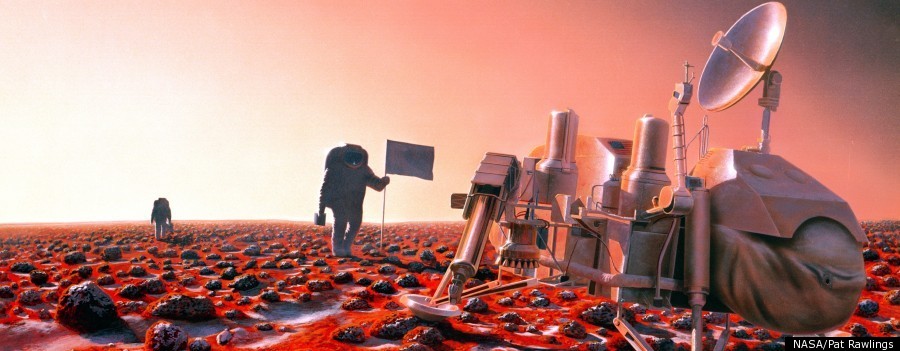
When it comes to Mars exploration, the U.S. has been there, done that—with robotic rovers. But while many proposals have been put forth for sending astronauts to the Red Planet, none has gotten the green light.

Yet.

That’s fine with Rep. Barney Frank, the Massachusetts congressman—he’s been an outspoken critic of plans to send astronauts to Mars. But others—including Dr. Robert Zubrin, the president of the Mars Society and the author of "The Case For Mars: The Plan To Settle The Red Planet And Why We Must"—say the time has come for humans to make their way to our planetary neighbor.

What’s your position? Before you pick a side, have a look at what Frank and Zubrin have to say in our online debate. Then decide whose case is more persuasive, and cast your vote…

Step
1

Pre-debate poll:

Tell us your opinion before the debate starts to set the starting line

The U.S. Should Send A Manned Mission To Mars

Agree - Thanks for voting! Please proceed to read the debate below

Please vote to proceed to the debate

Step
2

Who makes the better argument?

Dr. Robert Zubrin President, The Mars Society

America's human spaceflight program is now adrift. The space shuttle has made its final flight, and the Obama administration has no coherent plan as to what to do next. Instead, it has proposed that the United States waste the next decade spending $100 billion to support a goalless human spaceflight effort that goes nowhere and accomplishes nothing. In a deeply mistaken move, the administration has even cancelled NASA plans for this decade's robotic probes to Mars, thus derailing the agency's most productive program. In the face of a mounting imperative to find ways to cut the federal deficit, this has set up the nation's space program for the ax.

In order for NASA's exploration effort to make any progress, it needs a concrete goal, and one that is really worth pursuing. That goal should be sending humans to Mars.

As a result of a string of successful probes sent to the Red Planet over the past 15 years, we now know for certain that Mars was once a warm and wet planet, and continued to have an active hydrosphere for a period on the order of a billion years -- a span five times as long as the time it took for life to appear on Earth after there was liquid water here. Thus, if the theory is correct that life is a natural phenomenon emerging from chemistry wherever there is liquid water, various minerals, and a sufficient period of time, then life must have appeared on Mars.

If we go to Mars and find fossils of past life on its surface, we will have good reason to believe that we are not alone in the universe. If we send human explorers, who can erect drilling rigs which can reach underground water where Martian life may yet persist, we will be able to examine it. By doing so, we can determine whether life on Earth is the pattern for all life everywhere, or alternatively, whether we are simply one esoteric example of a far vaster and more interesting tapestry. These things are truly worth finding out.

Furthermore Mars is a bracing positive challenge that our society needs. Nations, like people, thrive on challenge and decay without it. A humans-to-Mars program would be an invitation to adventure to every young person in the country, sending out the powerful clarion call: "Learn your science and you can take part in pioneering a new world." In return for such a challenge we would get millions of young scientists, engineers, inventors, and medical researchers, making technological innovations that create new industries, find new cures, strengthen national defense, and increase national income to an extent that utterly dwarfs the expenditures of the Mars program.

But the most important reason to go to Mars is the doorway it opens to the future. Uniquely among the extraterrestrial bodies of the inner solar system, Mars is endowed with all the resources needed to support not only life but the development of a technological civilization. For our generation and those that will follow, Mars is the New World. We should not shun its challenge.

We're ready. Despite its greater distance, we are much better prepared today to send humans to Mars than we were to send men to the Moon in 1961, when President Kennedy started the Apollo program- and we were there eight years later. Future-fantasy spaceships are not needed to send humans to Mars. The primary real requirement is a heavy lift booster with a capability similar to the Saturn V launch vehicle employed in the 1960s. This is something we fully understand how to create.

The mission could then be accomplished with two launches. The first would send an unfueled and unmanned Earth Return Vehicle (ERV) to Mars. After landing, this vehicle would manufacture its own methane/oxygen return propellant by combining a small amount of hydrogen imported from Earth with a large supply of carbon dioxide acquired from the Martian atmosphere. The chemistry required to perform this operation has been widely practiced on Earth since the gaslight era.

Once the propellant is manufactured, the crew is sent to Mars in a habitation module launched by the second booster. The hab module is landed near the ERV and used for a year and a half as the crew's base for exploring the Martian surface, after which the crew enters the return vehicle and flies home. The hab module is left behind on Mars, so each time a mission is flown, another habitation is added to the base. There is nothing required by such a plan that is beyond our technology.

The issue is not money. The issue is leadership. NASA's average Apollo-era (1961-73) budget, adjusted for inflation, was about $19 billion a year in today's dollars, only 5 percent more than the agency's current budget. Yet, the NASA of the '60s accomplished a hundred times more because it had a mission with a deadline, and was forced to develop an efficient plan to achieve that mission. If NASA were given that kind of direction, we could have humans on Mars within a decade. If not, we may soon have no human spaceflight program at all.

The American people want and deserve a space program that really is going somewhere. It's time they got one.

Rep. Barney Frank Chairman, Financial Services Committee

Two alternative formulations about how to make public policy decisions present themselves to me in analyzing whether or not America should commit the enormous amount of money it will take to launch a manned trip to Mars. One comes from the discipline of economics; the other from the patter of one of our great comedians of the '40s, '50s, '60s. The economists give us the concept of opportunity costs -- of the reality that any decision you make in a universe of limited resources to use some of the resources for a particular objective has two aspects: first, what you can achieve; second, all the things you cannot achieve because you have put those limited resources to the first objective.

Henny Youngman's way of putting it was, characteristically of him, terse, funny and wise: "How's your wife?" he asked himself in his rapid pattern. "Compared to what?" he answered.

Thus in two ways the case against committing hundreds of billions? trillions? -- to sending human beings to Mars and back.

The question is not whether America as a society can afford it. It is whether the America of today, with a very large public debt that needs to be reduced -- although not immediately because that would damage our economic recovery efforts -- and very difficult decisions to be made about how much of our national wealth is to be committed to other national priorities, can afford to spend a very large chunk of money over the next several years on a project that is justified more in philosophical and even spiritual terms than scientifically.

I very much favor and have voted for funds for the scientific exploration of Mars, as part of a space program dedicated to the advancement of science. But the addition of human beings to the program adds astronomically to the expense, with very little compensation in scientific knowledge. The arguments for manned space travel have always involved notions of both building national character and of exhibiting our strengths, although during the Cold War period, there was clearly an element of military competition as well. I understand that many will feel a great deal of pride in sending human beings to Mars and back. But if we do that, given the current severe fiscal constraints facing the federal government -- I do not see on the horizon the political will to raise taxes in anything like the amount that we would need to offset such a project -- we will send human beings to Mars only at the expense of improving the quality of our life here at home, and providing for those who are greatly in need.

Medicare and Social Security are already under assault from those who would undo our great 20th century accomplishment of substantially reducing the likelihood that most people will live out their last years in poverty. Programs to provide for poor children are under assault. Funding for medical research -- both economically important to the U.S. and obviously important for the quality of life -- is no longer likely to increase by the amounts it has previously seen. These are difficult problems now. Committing untold sums to send human beings to Mars and back exacerbates every one of them.

In the economists' terms, the opportunity cost of sending human beings to Mars will undoubtedly be substantially reduced medical research, far less money available to develop alternative forms of energy, less support for the nutrition and health needs of poor children, fewer police and firefighters on our streets, and far less money to help students with limited means get the college education that will be very important if some of them are to have genuine equality of opportunity.

In Henny Youngman's terms, given the large amounts of money involved, the comparison is between the satisfaction we will feel as a nation in having sent human beings to Mars and back, versus the pride I would rather feel in having made substantial strides in reducing the ravages of cancer and the terrors for people who have Alzheimer's, providing decent healthcare for all Americans, rebuilding our deteriorating roads and bridges, and constructing a first class rail network. When I compare these to the largely psychological benefits of sending people to Mars and back, I do not understand the argument for the latter.

Obviously I have no objections in principle to sending human beings to Mars, and I recognize that there is some scientific benefit from it. But the main reason to send people to Mars -- attested to by most of the scientists with whom I have spoken -- is simply to show that we can do it as a matter of national achievement, and what we will learn will mostly be how to do what we are doing. That is, sending people to live on Mars is not likely to produce the benefits for those living on Earth anything like what we can do by health research, cleaning the air, providing a safer environment, etc. The overwhelming majority of scientists I have spoken to have told me they believe that space exploration will be less productive from the standpoint of improving our knowledge of the universe and yielding benefits that will have tangible impact here at home, if we direct substantial amounts to human space travel.

I do not argue that America will never be wealthy enough to support human travel to Mars without significantly diminishing other important things we should be achieving. I am very skeptical that any time in the foreseeable future will see us with a political will sufficient to raise the resources to do so.

Step
3

POST DEBATE POLL

Did one of the arguments change your mind?

The U.S. Should Send A Manned Mission To Mars

VIEW DEBATE ROUND 1 RESULTS

Agree - Thanks for voting again! Here are the results:

Before

After

moreless AgreeDisagreeUndecided

Dr. Robert ZubrinRep. Barney FrankNeither argumenthas changed the most minds

Also on HuffPost:

FOLLOW SCIENCE

When it comes to Mars exploration, the U.S. has been there, done that—with robotic rovers. But while many proposals have been put forth for sending astronauts to the Red Planet, none has gotten ...
Filed by Travis Korte  | 
 
 
  • Comments
  • 1,396
  • Pending Comments
  • 0
  • View FAQ
Post Comment Preview Comment
To reply to a Comment: Click "Reply" at the bottom of the comment; after being approved your comment will appear directly underneath the comment you replied to.
View All
Favorites
Highlights
Bloggers
Recency  | 
Popularity
Page: 1 2 3 4 5  Next ›  Last »  (31 total)
08:42 PM on 05/25/2012
It would be a complete failure on a massive scale if we do NOT send man to Mars. There are so many valid reasons to go there, beyond just seeing if there ever were life there. If the United States doesn't go, then the Russian's will gladly take up our slack. Congressmen speak about the high cost of such a mission, but if the HUGELY over-inflated salaries of those men were cut I'm sure we could find some more funding. I've lost so much faith in our government in the area of space exploration lately that I believe Elon Musk and SpaceX will be to the red planet far before we will.
photo
HUFFPOST SUPER USER
neolow
Radicalized Dem
07:55 PM on 04/13/2012
The Republican Corporatists want the American people to be nothing more than something that produces a profit with little investment in infrastructure, education, environment, retirement, health,... They want us to consume while others produce. But we're more than that. We went to the moon, we developed the computer, we built Hoover Dam, the highway system, the TVA, ... This is not the end of our innovation, our drive to reach new frontiers. The Republicans want to destroy government so that it cannot invest in these sort of long-term, non-profit endeavors. Private business won't do it. The space program spawned home computers, silicon chip technology, PV technology, new materials, the space station, and more. The yield was millions of times more than the initial investment. We have to believe that we're more than what the corporatists' envision us to be. I shudder when I see us not going anywhere, not wanting more than the products business tells us to want. We will no longer be Americans.
03:28 AM on 07/04/2012
i stopped reading after the first 2 words because the rest is just garbage
09:18 PM on 04/12/2012
We have to get to space sometime, the sooner the better. Barney Frank cant go a sentence without mentioning money, so it's clear money is more important than technological development to him. That's the type of attitude that kept electric cars from becoming standard. That argument "we need to solve the problems here on Earth first" is moot because as long as violent religious people exist we will never go to space. We have to wait for these people to stop thinking Jesus/Mohammed is coming back and shooting each other before we can get off this tiny, tiny speck of dust? Forget that. Terraform Mars and leave them here. This planet won't be here forever, that is a fact.
ThinkCreeps
Seriously, it's time.
05:34 AM on 04/19/2012
Money is very important. We can learn about Mars using machines for less than 10% of the cost of sending people.

Electric cars didn't become standard because gas is cheap and batteries have a low energy density. Their time may be coming in the next few decades as that changes.

Let's worry about the long-term habitability of earth in 500 million years. At the moment, partly due to the babbling of religious crazies of all stripes, we have bigger issues to sort out within 100 years.
HUFFPOST SUPER USER
commento
New Year, New Hopes
03:52 AM on 04/12/2012
The challenge of discovery is not wanting on planet Earth because there are still a lot of things that need to be discovered.
HUFFPOST SUPER USER
commento
New Year, New Hopes
03:00 AM on 04/12/2012
Solve Earthly Problems First. Mars Can Wait.
09:03 PM on 04/12/2012
Earthly problems will never be solved by sticking here with our limited knowledge of space around us. There is far more out there than there is here. Not to mention, there were a LOT of Earthly problems going on when we went to the moon.
HUFFPOST SUPER USER
commento
New Year, New Hopes
05:01 AM on 04/13/2012
Jei Art, You said that Earthly problems will never be solved, do you think that we can solve Extraterrestrial problems ? Like how to survive in the harsh Martian atmosphere and things of that nature?
ThinkCreeps
Seriously, it's time.
05:36 AM on 04/19/2012
People on Mars can wait - forever. Solving earthly problems will benefit by not diverting funds to pointless enterprises like setting foot on Mars.

How many schoolchildren did the Mars rovers inspire to be more involved in science, math and engineering this last decade?
HUFFPOST SUPER USER
commento
New Year, New Hopes
06:36 AM on 04/19/2012
ThinkCreeps, I agree with you on solving earthly problems as a top priority.
08:50 PM on 05/25/2012
No offence, but that is not an intelligent comment on this subject. So going to Mars is pointless eh? Well have you considered that something may one day happen to this planet and we may need a new home? Yes, it's unlikely so on and so forth, but the day may come. I agree that there are problems on Earth needing to be solved, but to do so at the cost of our future in space exploration would be, quite frankly, ignorant. How about NOT going to war with countries and cutting out that "black budget" our country has? There is more than enough funding to be had. Sorry if this comes across as harsh, but when I hear someone saying it is pointless to send man to Mars...I cannot get my head around such a preposterous notion.
06:00 PM on 04/11/2012
I think once we have fixed the problems here and have learned to live as Tokens Elves, then it is time to spread our wisdom and order. And until then we should stay right here. In other words we are stuck here until the end of the world. Which is not exactly a bad thing.

It does not take much brain to see that there are people who need the money and effort that this would take. If we can not understand this than how come we can claim to under stand the laws of the universe?

And what good does a moon base do us? You still have to launch it to the moon in the first place.
This user has chosen to opt out of the Badges program
photo
02:29 PM on 04/11/2012
Yes
photo
HUFFPOST SUPER USER
El Saltine
02:54 PM on 04/09/2012
We went to the moon a few times and stopped. We buily the shuttle system and never built the next generation. And now what do we have? Nothing. And you want to talk about going to mars? The sspace station should be 4 times the size it is, we should have a base on the moon. Mars? Forget it, we're no ware near going to Mars.
06:43 AM on 04/10/2012
Why would we build the next generation of space shuttle? The first generation was already a technological nightmare. It could carry only a quarter of the payload of the Saturn V, at the same launch cost, and it killed 14 people.
photo
HUFFPOST SUPER USER
jsgaetano
Legum servi sumus ut liberi esse possimus
01:40 PM on 04/09/2012
Maybe they can drop off supplies for Moonbase Newt on their way out there. BTW, anyone remember when George Dubai Bush said he was sending a manned mission to Mars? And all the Gooptards believed it?
photo
Norge
Rolf K. Artist, worker of metal, writer of poems
01:23 PM on 04/09/2012
Of course, after 7 billion human beings on earth have had breakfast.
06:33 PM on 04/10/2012
Good, someone with some smarts.
photo
Norge
Rolf K. Artist, worker of metal, writer of poems
01:34 PM on 04/11/2012
Mischievous Puck
Thank you for your generous response. Tragicly, breakfast,.lunch and dinner seems to be a luxury for those of us born in the right place at the right time. Perhaps if they go ahead with their plans and get far enough out there, theirs will be vaporized as I doubt they will be allowed to proceed very far.
Norge
09:06 PM on 04/12/2012
Good luck with that. By the way, how many technological advancements have come out of handouts?
11:29 AM on 04/08/2012
"A necessary aspect of basic research is that its applications lie in the future, sometimes decades or even centuries ahead. What’s more, no one knows which aspects of basic research will have practical value and which will not.

If scientists cannot make such predictions, is it likely that politicians or industrialists can?

If free-market forces are focused only towards short-term profit – as they certainly mainly are in an America with steep declines in corporate research – is not this solution tantamount to abandoning basic research?"
[Carl Sagan]
09:06 PM on 04/12/2012
Finally someone with a lot of smarts.
photo
macaac
End the petro era buy a gas guzzler
11:07 AM on 04/08/2012
While I believe humans will eventually get to Mars and beyond, I suggest our efforts should be put into developing a more cost effective means of getting humans and materials into orbit and building a permanent orbital space platform. I know it sounds like science fiction but I think the space elevator concept would be the best option for these purposes. Although the permanent platform would be in a much higher orbit than the current ISS, and a frieght hauling system from the elevator terminus to the higher platform would need to be developed, it would still be more cost effective over time than disposable rocket launches. But from such a platform/station interplanetary craft could be built and launched with less effort than from the earth's surface. I would also suggest that much of the orbital space junk could possibly be havested and forged into building materials for these projects using a solar powered furnace/factory on the orbital platform.
06:23 PM on 04/08/2012
The space elevator does not solve a problem as much as it replaces one problem, the necessity to give one object (rocket plus payload) a high kinetic energy, with another one, by putting an awful lot of energy into the tension of another object (the cable).

In any case, getting to orbit is not as much of a problem as living in space for months or years at a time. We know how to launch 100 tons of spacecraft. It's called a Saturn V and it was a very successful rocket architecture. The equivalent of the ISS could have been launched with just four or five Saturn Vs, at a launch cost of no more than $5 billion. The major cost driver for the ISS was the use of the Shuttle, which required a small, compartmentalised piecemeal approach that increased total cost at least by an order of magnitude.

As for your idea about space based production, that's flat out ignorant of the realities of industrial manufacturing. I would suggest an apprenticeship in precision metalworking for a more realistic approach to the problem.
photo
macaac
End the petro era buy a gas guzzler
01:48 PM on 04/09/2012
Obviously I wasn't talking about the "'current' realities of industrial manufacturing". Regarding reuse of scrap metal, it's done quite often on the planet's surface. Granted an orbital forge would present many NEW technological challenges such as low/no g controls for oxidizer injection, smelting, and effluent/metals. But, other than scooping the debris up and sending it to the sun, (oops, new technology), or pushing the flotsam to burn up in a decaying orbit (new technology again, sorry), how would you suggest clearing the debris shroud surrounding the planet? I don't believe putting MORE expended upper stage boosters, cables, hoses, collars, nuts, bolts, and aerodynamic farings, up there is a good idea. Yeah, rocketry is great and all, being a 2000 year old proven technology, but it has it's limitations and inefficiencies too.
10:26 AM on 04/08/2012
HUMANS on MARS and beyond

H-Net Announcement
HUMANS on MARS (book) published 2012 Available on http://Amazon.com
Location: United States
Date Submitted: 2012-03-06
Announcement ID: 192920
HUMANS on MARS
by
HB Paksoy, D. Phil.

The purpose of this collection is not to discuss the technologies required for the round trip. Nor is it to discuss the ‘inevitability’ of human quest to explore. Instead, the focus is on ‘what will happen’ when the humans reach Mars.

When the ‘white men’ arrived on the new (American) continent, they brought much of their own culture and world view with them. Despite the existence of natives who were already living there, the newcomers began to establish the institutions they imported. And those new institutions were to the detriment of the existing natives. That did not stop the newcomers, nor, by-and-large, saddled them with moralistic issues.

Mars, to our current knowledge, does not contain any native populations. However, the Earthlings arriving there, once again, will bring their own institutions with them. In this case, we may even surmise, more than one system, given the proliferation of space technology among nations of diverse backgrounds. That also means there will be more than one culture, as well as Governance method. Does that herald a clash of cultures and Governance modes? At that point, it becomes necessary to spend some overview time, looking at the behavior on Earth.
photo
White Raven
Eyeballs are tasty
05:43 AM on 04/08/2012
The problem with Barney Frank's argument is that he seems to foresee some golden age in the future when the time will be right that we can send human explorers to Mars. I submit that no such age will come. We had a national debt when we sent astronauts to the moon, and we're going to have a national debt in the future for as far as any of us can see. This argument to me smacks of couples who forever wait to have children "until the time is right". There is never a right time.

The right time to do a thing, or at least prepare to do a thing, is now.

Mars is a worthwhile endeavor for us all. I think we should go. And I truly believe that space exploration is one of the best investments we could all make in the future of our species.
This comment has been removed due to violations of our [Guidelines]
HUFFPOST SUPER USER
Dallas Dunlap
07:43 PM on 04/07/2012
It's pretty clear that the US in its present debilitated condition does not have the will or the resources to go to Mars. However, a look at the International Space Station shows how this stuff can be done. The ISS was originally a US operation, but the Russians now provide transportation to the station and scientist/astronauts from many countries are involved.
Start an international consortium for a manned Mars program - Recruit the US, the EU, Japan, China, and Russia as funders-particpants, along with any private corporations that want to participate.
Have the program run by scientists and administrators not under the direct control of their govts.
Award contracts and build components according to cost efficiency, not pork barrel politics. Aim for a manned landing on Mars 15 years from the start of the program.
ThinkCreeps
Seriously, it's time.
06:27 AM on 04/08/2012
ISS is fully international - and always has been. It morphed from Reagan's daft `Freedom' into a keep-mischievious-hands busy in the former USSR program.

Human space flight in the US is all about pork-barrel politics. Space science is done mostly in CA, CO and MD. Spam is put in the can in TX, AL and FL.

Wait for the big Curiosity rover to land on Mars in the summer - there is absolutely no point in sending humans. They will die, on the way, on the way back, or relatively soon after.
06:25 PM on 04/08/2012
ThinkCreeps, you rock, as always!