iPhone app iPad app Android phone app Android tablet app More

NASA's Gemini Program PHOTOS, 50 Years Later: Spacewalks, Earthrises & Space Food

The Huffington Post  |  By Posted: 04/ 6/2012 1:23 pm Updated: 04/ 6/2012 2:40 pm

Gemini Missions

April 2012 marks 50 years since the beginning of NASA's Gemini program. Carried out from 1962-1966, during the feverish middle years of the space race, the Gemini missions achieved a wide range of American firsts, from the earliest space walk to the earliest in-flight docking of two spacecrafts.

The successes of the Gemini missions allowed the U.S. to overcome the advantage held by the Soviets since the late 1950s—in the process, NASA built up a pool of experience that would later be essential for lunar missions. All three men who would later fly aboard Apollo 11, the first spacecraft to reach the moon, had flown first on a Gemini mission.

In the slideshow below, see pictures from the Gemini missions, from breathtaking Earthrise photos to candid shots of the astronauts' excited family members on the ground.

The space-walk photos are especially exciting. Edwin "Buzz" Aldrin Jr. may be best known as the second man to set foot on the moon, but he was also the first man to perform an extended extra-vehicular activity (also known as a space-walk), and he did it aboard Gemini 12. If the photos below are any indication, that might have been even scarier than walking on the moon.

For more memorable NASA images, see these slideshows commemorating John Glenn's historic first Earth orbit and the Space Shuttle Columbia disaster.

Loading Slideshow...
  • View of food packets for the Gemini 7 space flight packaged and ready for loading on the Gemini spacecraft.

  • The Gemini-Titan 4 prime crew, astronauts James A. McDivitt (left), command pilot; and Edward H. White II, pilot, are pictured during water egress training at Ellington Air Force Base, Texas.

  • Astronauts Charles Conrad (left), command pilot, and Richard F. Gordon (right), pilot, demonstrate tether procedure between their Gemini 11 spacecraft and the Agena Target Docking Vehicle at the post flight press conference. They use models of their spacecraft and its Agena to illustrate maneuvers.

  • Astronaut Edwin E. Aldrin Jr., backup crew pilot of the Gemini 9 space flight, practices donning the Astronaut Maneuvering Unit (AMU) back pack in bldg 5 of the Manned Spacecraft Center, Houston.

  • Artist concept of Gemini spacecraft and Command Module with two astronauts seated at the controls.

  • Effects of the weightless environment on cell division, the basic growth process for living tissue, studied during the Gemini-Titan 3 flight on March 23, 1965.

  • Astronaut James A. McDivitt, commander of Gemini IV, suited in preparation for weight and balance tests. The objective of the Gemini IV mission was to evaluate and test the effects of four days in space on the crew, equipment and control systems. Pilot Edward White II successfully accomplished the first U.S. spacewalk during the Gemini IV mission.

  • Astronaut Edwin E. Aldrin Jr., backup crew pilot of the Gemini 9 space flight, practices donning the Astronaut Maneuvering Unit (AMU) back pack in bldg 5 of the Manned Spacecraft Center, Houston.

  • The Gemini VI, scheduled as a two-day mission, was launched December 15, 1965 from Pad 19, carrying astronauts Walter M. Schirra Jr., Command Pilot, and Thomas P. Stafford, Pilot. Gemini VI rendezvoused with Gemini VII, already orbiting the Earth.

  • Gemini-Titan 4 (GT-4) lift-off carrying James McDivitt and Ed White for a four-day mission. This flight included the first spacewalk by an American astronaut, performed by Ed White.

  • Atlas Agena target vehicle liftoff for Gemini 11 from Pad 14. Once the Agena was in orbit, Gemini 11 rendezvoused and docked with it.

  • Aerial view of the Gemini/Titan-II launch vehicle #1 liftoff at Cape Kennedy, Florida.

  • Labeled photograph of the Middle East was taken by the crew of the Gemini 4 flight. Areas in Egypt, Syria, Iraq, Israel, and Saudi Arabia are labeled.

  • A bank of clouds over the western Pacific Ocean was photographed by Astronaut Frank Borman and James A. Lovell during the Gemini 7 mission. In the background the moon can be seen.

  • Astronaut Alan B. Shepard Jr., chief, astronaut office, NASA's Manned Spacecraft Center in Houston, chomps vigorously on a cigar during relaxing moments following the Gemini-6 liftoff.

  • View of the tracking screen at the front of the Mission Control Center during the Gemini-5 spaceflight.

  • Astronaut Roger B. Chaffee is shown at console in the Mission Control Center, Houston, Texas during the Gemini-Titan 3 flight.

  • The wives of Gemini 4 astronauts James A. McDivitt and Edward H. White II visited the Mission Control in Houston. Left to right are: Mrs. Patricia McDivitt and Mrs. Patricia White. The wives were taking the opportunity to speak to their astronaut husbands as they passed over the United States.

  • NASA successfully completed its first rendezvous mission with two Gemini spacecraft-Gemini VII and Gemini VI-in December 1965. This photograph, taken by Gemini VI crewmembers Walter Schirra and Thomas Stafford, shows Gemini VII in orbit 160 miles (257 km) above Earth. The main purpose of Gemini VI was the rendezvous with Gemini VII. The main purpose of Gemini VII, on the other hand, was studying the long-term effects of long-duration (up to 14 days) space flight on a two-man crew. The pair also carried out 20 experiments, including medical tests. Although the principal objectives of both missions differed, they were both carried out so that NASA could master the technical challenges of getting into and working in space.

  • The Augmented Target Docking Adapter (ATDA) as seen from the Gemini 9 spacecraft. The docking adapter protective cover failed to fully separate on the ATDA and prevented the docking of the two spacecraft. The ATDA was described by the Gemini 9 crew as an "angry alligator."

  • The Agena Target Vehicle as seen from the Gemini 8 spacecraft during rendezvous. This was the first time two spacecraft successfully docked, which was a critical milestone if a mission to the Moon was to become a reality.

  • This photograph taken on December 15, 1965 shows the Gemini 7 spacecraft as it was observed from the hatch window of the Gemini 6 spacecraft during rendezvous manuevers and station keeping at a distance of approximately 9 feet apart.

  • The Gemini 10 spacecraft is successfully docked with the Agena Target Vehicle. The Agena display panel is clearly visible as is glow from Agena's primary propulsion system.

  • Edwin E. Aldrin Jr., pilot of the Gemini 12 spacecraft performs extravehicular activity (EVA) during the second day of the four day mission in space. Aldrin is positioned next to the Agena work station.

  • An unusual view of the Gemini 9 spacecraft taken by Eugene Cernan during his Extravehicular Activity (EVA). His umbilical and spacecraft are visible though he is not.

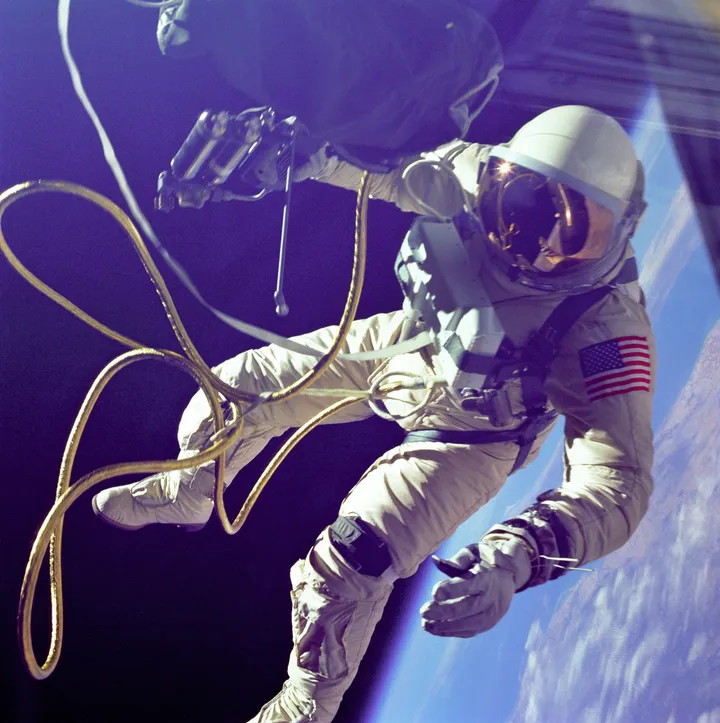
  • Edward H. White II, pilot of the Gemini 4 spacecraft, floats in the zero gravity of space with an earth limb backdrop. The extravehicular activity was performed during the third revolution of the Gemini 4 spacecraft and represents the first time an American has stepped outside the confines of his spacecraft. White is attached to the spacecraft by a 25-ft. umbilical line and a 23-ft. tether line, both wrapped in gold tape to form one cord. In his right hand White carries a Hand-Held Self-Maneuvering Unit (HHSMU). The visor of his helmet is gold plated to protect him from the unfiltered rays of the sun.

  • Astronaut Edward H. White II, pilot for the Gemini-Titan 4 space flight, floats in zero gravity of space. The extravehicular activity was performed during the third revolution of the Gemini 4 spacecraft. White is attached to the spacecraft by a 25-ft. umbilical line and a 23-ft. tether line, both wrapped in gold tape to form one cord. In his right hand White carries a Hand-Held Self-Maneuvering Unit (HHSMU). The visor of his helmet is gold plated to protect him from the unfiltered rays of the sun.

  • On June 3, 1965 Edward H. White II became the first American to step outside his spacecraft and let go, effectively setting himself adrift in the zero gravity of space. For 23 minutes White floated and maneuvered himself around the Gemini spacecraft while logging 6500 miles during his orbital stroll. White was attached to the spacecraft by a 25 foot umbilical line and a 23-ft. tether line, both wrapped in gold tape to form one cord. In his right hand White carries a Hand Held Self Maneuvering Unit (HHSMU) which is used to move about the weightless environment of space. The visor of his helmet is gold plated to protect him from the unfiltered rays of the sun.

  • Astronaut Edward H. White II, pilot for the Gemini-Titan 4 space flight, floats in zero gravity of space. The extravehicular activity was performed during the third revolution of the Gemini 4 spacecraft. White is attached to the spacecraft by a 25-ft. umbilical line and a 23-ft. tether line, both wrapped in gold tape to form one cord. In his right hand White carries a Hand-Held Self-Maneuvering Unit (HHSMU). The visor of his helmet is gold plated to protect him from the unfiltered rays of the sun.

  • On June 3, 1965 Edward H. White II became the first American to step outside his spacecraft and let go, effectively setting himself adrift in the zero gravity of space. For 23 minutes White floated and maneuvered himself around the Gemini spacecraft while logging 6500 miles during his orbital stroll. White was attached to the spacecraft by a 25 foot umbilical line and a 23-ft. tether line, both wrapped in gold tape to form one cord. In his right hand White carries a Hand Held Self Maneuvering Unit (HHSMU) which is used to move about the weightless environment of space. The visor of his helmet is gold plated to protect him from the unfiltered rays of the sun.

  • Waves of clouds along the east flanks of the Andes Mountains cast off an orange glow by the low angle of the sun in the West. The dark area to the left is the Earth's terminator. This view was photographed by astronaut Frank Borman and James A. Lovell during the Gemini 7 mission, looking South from Northern Bolivia across the Andes. The Intermontane Salt Basins are visible in the background.

  • Astronauts Neil A. Armstrong and David R. Scott sit with their spacecraft hatches open while awaiting the arrival of the recovery ship, the USS Leonard F. Mason after the successful completion of their Gemini VIII mission. They are assisted by USAF Pararescuemen Eldrige M. Neal, Larry D. Huyett, and Glenn M. Moore. The overhead view shows the Gemini 8 spacecraft with the yellow flotation collar attached to stabilize the spacecraft in choppy seas. The green marker dye is highly visible from the air and is used as a locating aid.

  • As a helicopter hovers above, the Gemini-12 spacecraft with parachute open descends to the Atlantic with astronauts Jim Lovell and Edwin "Buzz" Aldrin aboard.

  • Navy divers exit their helicopter to recover the Gemini 5 spacecraft and astronauts shortly after splashdown.

  • Astronaut Charles Conrad, Jr., command pilot of the Gemini 11 space flight, is hoisted aboard a recovery helicopter from the U.S.S. Guam. Astronaut Richard F. Gordon, Jr., pilot, sits in life raft below waiting to be picked up.

  • Dr. Louis P. Ballenberger, Captain, USN, begins a preliminary physical examination of astronaut L. Gordon Cooper Jr., Gemini-5 command pilot, following the successful recovery of the Gemini-5 crew in the splashdown area in the Atlantic Ocean.

  • Gemini 5 astronaut Charles 'Pete' Conrad Jr. looking out of the helicopter window after recovery from his spacecraft after the splashdown.

Also on HuffPost:

FOLLOW SCIENCE

April 2012 marks 50 years since the beginning of NASA's Gemini program. Carried out from 1962-1966, during the feverish middle years of the space race, the Gemini missions achieved a wide range of Ame...
 
 
  • Comments
  • 46
  • Pending Comments
  • 0
  • View FAQ
Comments are closed for this entry
View All
Favorites
Bloggers
Recency  | 
Popularity
Page: 1 2  Next ›  Last »  (2 total)
photo
HUFFPOST SUPER USER
guntotinganglion
Moe, Larry, THE CHEESE!
08:20 PM on 04/12/2012
The shot of the recovery of Gemini VIII is erroneously listed as being after the successful completion of their mission. Their intended landing zone was in the Atlantic...that picture is in the Pacific 800 km east of Okinawa!

Shortly after Neil Armstrong and Dave Scott completed the first ever docking with another spacecraft in space, they began a maneuvering sequence with the Agena upper-stage they were docked with. As they proceeded with the maneuver, the spacecraft began to roll. Armstrong, using the Orbit Attitude and Maneuvering System (OAMS) brought the roll under control. When he stopped, the roll would begin again. They then shut down the Agena and that helped, but it soon started again. The OAMS was the problem...one of its thrusters was stuck on.

Armstrong cut the Agena loose, pulling away to avoid a collision. Then the trouble really began...with the roll rate up to 360 degrees per second...along with a high yaw rate. The only way to stop the gyrations was to use the re-entry control system (RCS), which they did...but this ended the mission since the rule was, once the RCS was activated, they had one orbit to splashdown.

So...that picture (32) shows them alive and well AFTER an unsuccessful mission. The mission was a failure, although bringing the astronauts home alive was a success! They did succeed in the world's first docking though, which was major.
Rocketman1
Lincoln would be mortified
10:01 PM on 04/11/2012
While everyone has focused on the manned space missions in lower orbit and the Moon landings, NASA has been exploring virtually every kind of celestial object in the Solar System with unmanned probes. All of the planets have been visited by at least two probes, and dwarf-planet Pluto has a probe on the way which will arrive in 2015. Mars has been explored by by several landers and orbital vehicles and new knowledge is garnered every day. Several asteroids have been visited, and one actually had a probe land on it with some nifty unauthorized flying/programming by its mission control. The moons of Jupiter and Saturn have been photographed and probed extensively, and Saturn's magnificent rings likewise pictured in detail. Several comets have been visited, and one was blasted by a probe, and the debris of the collision analyzed to determine it's composition. Even the Sun has been been the object of scrutiny of several unmanned probes. All of this knowledge of our Solar System has been gained by unmanned probes at a fraction of the cost of manned spaceflight. Yes, the Hubble telescope owes much of it's existence and timely updates to the Space Shuttle, but it has explored the far reaches of the universe along with several other unmanned telescopes which view space in different wavelengths of the spectrum. Manned flight itself may be at a lull, but NASA should get high praise for its efforts. Thanks NASA, you rock!
HUFFPOST SUPER USER
Rich Cash
Enlisted in 1971 - Retired in 1996
10:14 PM on 04/07/2012
The Mercury program captured everyone's imagination because they were our first ventures into space and inspired many documentaries and one major motion picture, "The Right Stuff". The Apollo program captivated the entire planet because we were actually going to the moon and also inspired many documentaries and the movie "Apollo 13". The Gemini program has been largely ignored by documetarians, ignored by Hollywood, and largely forgotten by the American public. These missions were just as exciting as Mercury and Apollo. The first rendevous in space, the first docking of two spacecraft, the first Extra Vehicular Activity (space walk), the longest time spent in zero gravity (which exceeded the longest time spent by any Apollo crew), and many other firsts. I'll never forget the image of Buzz Aldrin riding the Agena spacecraft, straddling it like a horse.
01:56 PM on 04/07/2012
Quit calling it "zero gravity". There is no such thing anywhere in the universe.
photo
HUFFPOST BLOGGER
messy
artist, writer, adventurer
10:15 AM on 04/07/2012
Let's see....the first Gemini launch was in 1964 and the first men was a year later....how does this mark the 50th anniversary of anything?
photo
HUFFPOST SUPER USER
Watching rock grow
FE = Iron, and Female = Iron Male :)
06:24 PM on 04/07/2012
They start the date from the programs charter that include development not actual flight dates.
photo
HUFFPOST BLOGGER
messy
artist, writer, adventurer
04:58 PM on 04/08/2012
So it should have been in 1960 or '61.
photo
HUFFPOST SUPER USER
ljm123
God is NOT a Republician
10:03 AM on 04/07/2012
I have always been in awe of those that had the courage to be strapped into a vessel the size of a large trash can that was attached to an Inter-Continental Ballistic Missile and having someone fire it.
photo
ProCynic
Those that govern intend to be our masters.
10:02 AM on 04/07/2012
America's lost legacy. As a child of the Space Race, complete with plastic helmet, space suit, and Major Matt Mason doll in hand, I dreamed of where we would be when I was grown up.

Back then, 2012 would see us with a base on the Moon, and missions to Mars.

The reality now: 2012 sees us hitching a ride on Russian launch vehicles because our politicians have no vision and our NASA explorers have turned into bureaucrats.
02:32 PM on 04/07/2012
It was bad planning and insufficient funding. The truth is that NASA will never be able to do two manned things at once. So until the ISS is gone, we won't be doing many missions beyond just building the rocket and capsule.
This comment has been removed due to violations of our [Guidelines]
04:33 AM on 04/07/2012
Why don't we do stuff like this anymore?..........The 40 year war by conservatives trying to convince everyone that space travel is not the problem; government is the problem.
photo
HUFFPOST SUPER USER
rjhuntington
left is right and right is wrong
04:28 AM on 04/07/2012
"the Gemini missions achieved a wide range of American firsts, from the earliest space walk to the earliest in-flight docking of two spacecrafts."

That's just not so. Soviet cosmonaut Alexey Leonov became the first human to conduct a space walk on March 18 1965. And the Soviets carried out the first in-flight docking between Cosmos 186 and Cosmos 188 on October 30 1967.
07:11 AM on 04/07/2012
alexey's suit expanded to the point he could not get back into the spacecraft. he nearly died from a heart attack. he somehow managed to release enough pressure to squeeze back in before passing out.
photo
HUFFPOST SUPER USER
rjhuntington
left is right and right is wrong
08:28 AM on 04/07/2012
Did Alexey Leonov leave his orbiting spacecraft and remain outside the craft in space for some time? Yes. Did Alexey then return from outside in space to back inside the orbiting craft? Yes. And did Alexey return in the spacecraft back to Earth? And was Alexey Leonov the first person to actually do that? Yes.

No need to julienne the facts.
photo
macaac
End the petro era buy a gas guzzler
09:38 AM on 04/07/2012
While it is true the Soviet's were first to dock and spacewalk the article did say "American firsts". These maneuvers were essential procedures required for later Apollo and STS missions. I remember eagerly watching and reading about those early Mercury and Gemini missions as a kid.
photo
HUFFPOST SUPER USER
rjhuntington
left is right and right is wrong
10:02 AM on 04/07/2012
Oh, ok, I withdraw my comments then. I misconstrued "American firsts". These are the first time Americans did those things. Yes, Thank you. Sorry.
This user has chosen to opt out of the Badges program
03:02 AM on 04/07/2012
A reminder of the time the government actually worked to make sure the country was moving forward instead of wasting its time and money making sure no one ever had their feelings hurt.
08:44 AM on 04/07/2012
You are right, but there's more. Compare today's super-low tax rates to the graduated rates of the 60's. The Government did not have a revenue problem like it does today.
photo
ProCynic
Those that govern intend to be our masters.
09:56 AM on 04/07/2012
The government wasn't spending anywhere near what they are now.
photo
HUFFPOST SUPER USER
mrhandyman3105
Independent Voter
01:14 AM on 04/07/2012
When I think about how immense the "universe" is, its mind boggling, and makes me think that any alien race with the technology and know how to reach the stars and other galaxies, and who would have access to the unlimited resources as the universe could offer, wouldn't waste their time or resources in contacting or even visiting such an immature small minded, petty race as the "Human" race who can't even effectively manage their own planet, resources, or people fairly, let alone come to any kind of collective agreement on any issue, even the most insignificant or minuscule of matters affecting them. I would issue a warning to any other intelligent star faring race to stay as far away from this planet or system as possible and that any contact with the Human race no matter how small would be at their peril.
photo
TakeSake
The United States for All Americans
12:30 AM on 04/07/2012
Transcripts of some of the missions:
http://spacelog.org/
photo
Wall Str33t
Science is not a liberal conspiracy.
04:42 AM on 04/07/2012
Hey wow, super cool. That's a great site.
This user has chosen to opt out of the Badges program
photo
Rudderman
GOP: All fringe, no carpet.
12:29 AM on 04/07/2012
Wonderful trip down old memory lane. Thanks HP.
One thing that struck me was just how cramped these capsules were.
I don't know how these guys could stand being wedged inside those tiny machines.
At any rate, this was indeed a time when the country was rivited by space exploration and science.
No more. Instead of science and education, the right has made religion and social issues a priority. And America much the worse for it.
This user has chosen to opt out of the Badges program
11:43 PM on 04/06/2012
Gemini was the technological progenitor of everything we needed for Apollo, except for how to land on the moon. Besides, it was one cool looking spaceship; something like an 18,000mph Cessna 150.