iPhone app iPad app Android phone app Android tablet app More

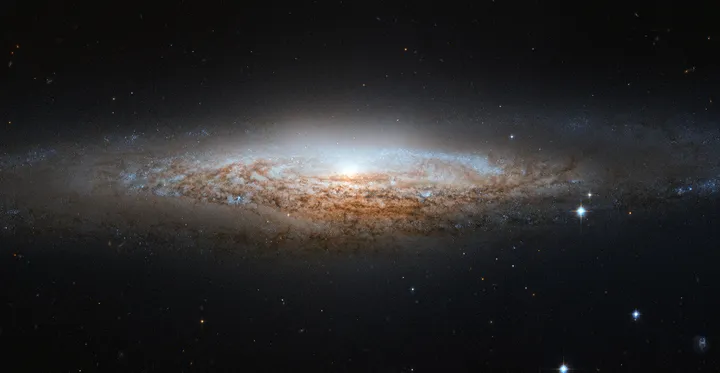
'UFO Galaxy' NGC 2683 Spotted by NASA's Hubble Space Telescope (PHOTO)

Posted: 04/12/2012 9:05 am Updated: 04/13/2012 9:52 am

By: SPACE.com Staff
Published: 04/12/2012 06:54 AM EDT on SPACE.com

The Hubble Space Telescope has found a UFO, but this one is filled with stars instead of little green men.

The iconic space telescope snapped an amazing new photo of the "UFO Galaxy" — a galaxy 35 million light-years from Earth that is officially known as NGC 2683.

"NGC 2683 is a spiral galaxy seen almost edge-on, giving it the shape of a classic science fiction spaceship," NASA officials wrote in a recent image description.

The galaxy was originally discovered on Feb. 5, 1788 by famed astronomer William Herschel. It is located in the Lynx constellation in the northern sky. But it was astronomers with the Astronaut Memorial Planetarium and Observatory in Cocoa, Fla., that dubbed NGC 2683 a cosmic UFO.

Astronomers suspect that NGC 2683 is a barred spiral galaxy, but the edge-on view from Hubble and other telescopes makes it difficult to see the object's structure directly. The off-kilter vantage point, however, does offer scientists a unique galactic perspective.

"In particular, it gives astronomers a great opportunity to see the delicate dusty lanes of the spiral arms silhouetted against the golden haze of the galaxy’s core," NASA officials explained. "In addition, brilliant clusters of young blue stars shine scattered throughout the disc, mapping the galaxy's star-forming regions."

Astronomers combined two views (one in visible light and the other in infrared) from Hubble's Advanced Camera for Surveys to create the new image of the UFO Galaxy, which was unveiled on March 26. A gap between Hubble's light detectors created a blurry strip across the width of the image, so scientists filled it in with images from ground-based telescopes.

The Hubble Space Telescope has been snapping spectacular views of the universe for more than 20 years. It is a joint mission by NASA and the European Space Agency.

Follow SPACE.com for the latest in space science and exploration news on Twitter @Spacedotcomand on Facebook.

Copyright 2012 SPACE.com, a TechMediaNetwork company. All rights reserved. This material may not be published, broadcast, rewritten or redistributed.

Related on HuffPost:

PHOTOS: BIGGEST NASA DISCOVERIES OF 2011
Loading Slideshow...
  • Entire Sun Imaged

    In February, <a href="http://www.nasa.gov/mission_pages/stereo/main/index.html" target="_hplink">NASA's STEREO probes</a>, two observatories that were launched in 2006 to survey the sun, reached opposite ends of the sun and thus, were able to give scientists (and the rest of us!) a never-before-seen view of the far side of the star at the center of our universe. The composite image above was captured on June 1, 2011, <a href="http://www.nasa.gov/mission_pages/stereo/news/farside-060111.html" target="_hplink">and according to NASA</a>, "is the first complete image of the solar far side, the half of the sun invisible from Earth." <a href="http://www.huffingtonpost.com/2011/02/07/nasa-stereo-sun-images-video_n_819510.html" target="_hplink">Click here for more</a> on the STEREO probes.

  • Messenger Reaches Mercury

    While it's not a "discovery," <em>per se</em>, it's a milestone that will no doubt lead to many new findings about the smallest and innermost planet in our solar system. In March, after a 6 1/2-year, 4.9 billion mile journey, <a href="http://www.huffingtonpost.com/2011/03/18/nasa-messenger-mercury_n_837503.html" target="_hplink">NASA's Messenger spacecraft reached Mercury's orbit</a>. Messenger, the first spacecraft to orbit Mercury, <a href="http://messenger.jhuapl.edu/mer_orbit.html" target="_hplink">orbits the planet</a> every 12 hours. In November, <a href="http://www.nasa.gov/mission_pages/messenger/media/MissionExtends.html" target="_hplink">NASA announced that the spacecraft's mission</a>, which was supposed to end on March 17, 2012, would be extended for an additional year.

  • Pluto's Tiny Moon

    In July, NASA said that its Hubble Space Telescope <a href="http://www.huffingtonpost.com/2011/07/20/new-pluto-moon-hubble-space-telescope_n_904578.html" target="_hplink">discovered an eight to 21-mile-wide moon</a> circling the dwarf planet.

  • Black Hole Eats A Star

    In March, <a href="http://www.huffingtonpost.com/2011/04/07/nasa-cosmic-blast_n_846333.html" target="_hplink">NASA's Swift satellite saw an unusually long explosion of gamma-rays</a>. After studying the X-rays, <a href="http://www.huffingtonpost.com/2011/08/25/black-hole-eats-star-video_n_937150.html" target="_hplink">scientists found that they came from</a> a black hole that had become reenergized when it devoured a star. <a href="http://www.nasa.gov/home/hqnews/2011/aug/HQ_11-271_Swift_Black_Hole.html" target="_hplink">From NASA</a>: <blockquote>Astronomers soon realized the source, known as Swift J1644+57, was the result of a truly extraordinary event -- the awakening of a distant galaxy's dormant black hole as it shredded and consumed a star. The galaxy is so far away, it took the light from the event approximately 3.9 billion years to reach Earth. </blockquote>

  • Huge Mountain Discovered On Asteroid

    <a href="http://www.nasa.gov/mission_pages/dawn/main/index.html" target="_hplink">NASA's Dawn</a>, an ion-propelled spacecraft that traveled 1.7 billion miles before reaching the asteroid Vesta in July, sent back images in October revealing that <a href="http://www.huffingtonpost.com/2011/10/05/vesta-mountain-dawn-nasa_n_996282.html" target="_hplink">Vesta is home to a mountain larger than any mountain</a> on Earth. In December, NASA released new images that Dawn took when it was orbiting only 130 miles above the asteroid, the closest it will get to Vesta. Dawn will continue to image Vesta until next summer, when it will make its way to Ceres, a bigger asteroid.

  • 'Star Wars'-Like Planet

    <a href="http://www.huffingtonpost.com/2011/09/15/kepler-16b-planet-two-suns_n_964799.html" target="_hplink">NASA's Kepler spacecraft found a planet</a> that orbits two suns, driving fans of the "Star Wars" franchise <a href="http://blog.moviefone.com/2011/09/16/astronomers-discover-real-life-tatooine-star-wars/" target="_hplink">to call it a real-life Tatooine</a>. Astronomers announced Kepler-16b, which is the first circumbinary planet -- meaning it orbits two stars -- in September. <a href="http://www.huffingtonpost.com/2011/09/15/kepler-16b-planet-two-suns_n_964799.html" target="_hplink">Click here for more</a> on Kepler-16b.

  • 'Habitable Zone' Planet Found

    Scientists in early December <a href="http://www.huffingtonpost.com/2011/12/05/kepler-22b-new-planet-discovered-habitable-zone_n_1129591.html" target="_hplink">announced the discovery of Kepler-22b</a>, a planet with a temperature of around 72 degrees that's in the so-called <a href="http://en.wikipedia.org/wiki/Habitable_zone" target="_hplink">"Goldilocks," or habitable zone</a>. While the temperature of the 600-light-year away planet could sustain water, it has a radius of 2.4 times that of Earth's, so <a href="http://www.huffingtonpost.com/huff-wires/20111206/us-sci-alien-planet/" target="_hplink">it's probably too big</a> to harbor life.

  • Biggest Black Holes Ever Discovered

    Astronomers announced in early December that <a href="http://www.huffingtonpost.com/2011/12/05/black-hole-scientists-discover-huge_n_1129727.html" target="_hplink">they had found the biggest black holes to date</a>. The massive black holes, which are 10 billion times the size of the sun, are located over 300 million light years away.

  • Europa's 'Great Lakes'

    Scientists had long-thought that a large body of water existed under the surface of Europa, Jupiter's moon, but it was thought to be tens of miles below an icy crust. In November, though, astronomers analyzing data from <a href="http://solarsystem.nasa.gov/galileo/" target="_hplink">NASA's Galileo spacecraft</a> found evidence that suggests blocks of ice interact with water below the surface, which could mean that nutrients and energy are moving between the underground ocean and icy shell. <a href="http://www.ig.utexas.edu/people/staff/britneys/" target="_hplink">Britney Schmidt</a>, the lead author of the study, <a href="http://www.nature.com/nature/journal/v479/n7374/full/nature10608.html" target="_hplink">which appeared in the journal Nature</a>, said that the interaction "could make Europa and its ocean more habitable for life." <a href="http://www.huffingtonpost.com/2011/11/17/europa-water-jupiter-moon-photo-video_n_1099463.html#s480278&title=Europa" target="_hplink">Click here to read more</a> about water on Europa.

  • 'Bubbles' At The Edge Of Solar System

    NASA's Voyager probes -- launched over 30 years ago -- found huge magnetic "bubbles" at the edge of the solar system. "The sun's magnetic field extends all the way to the edge of the solar system," astronomer Merav Opher of Boston University <a href="http://www.nasa.gov/mission_pages/voyager/heliosphere-surprise.html" target="_hplink">said in a NASA statement</a>. "Because the sun spins, its magnetic field becomes twisted and wrinkled, a bit like a ballerina's skirt. Far, far away from the sun, where the Voyagers are, the folds of the skirt bunch up." Voyager 1 and Voyager 2 were launched in 1977. Voyager 1 is currently 11 billion miles away and may exit our solar system within the next few years.

  • Gypsum On Mars

    In December, scientists announced that NASA's <a href="http://www.huffingtonpost.com/2011/12/08/mars-water-opportunity-rover-gypsum_n_1136483.html" target="_hplink">Mars Rover Opportunity may have found gypsum </a>that had been deposited by water. "This tells a slam-dunk story that water flowed through underground fractures in the rock," <a href="http://astro.cornell.edu/people/facstaff-detail.php?pers_id=112" target="_hplink">Steve Squyres</a>, a planetary scientist at Cornell University and the principal investigator for Opportunity <a href="http://www.nasa.gov/mission_pages/mer/news/mer20111207.html" target="_hplink">said in a NASA statement</a>. NASA's Curiosity Rover <a href="http://www.huffingtonpost.com/2011/11/26/nasa-mars-curiosity-launc_n_1113995.html" target="_hplink">is en route to the Red Planet</a> and will arrive in August 2012.

  • Earth-Size Planets Discovered

    Weeks after <a href="http://www.huffingtonpost.com/2011/12/05/kepler-22b-new-planet-discovered-habitable-zone_n_1129591.html" target="_hplink">the announcement of Kepler-22b</a>, scientists said that <a href="http://www.huffingtonpost.com/2011/12/20/new-planets-kepler-exoplanets_n_1161213.html" target="_hplink">they'd discovered Kepler-20e and Kepler-20f</a>, two planets that are about the size of Earth. While the planets are too close to their sun-like star to harbor life as we know it, the discovery proved that the Kepler spacecraft was capable of spotting planets that are Earth-size, and brings us one step closer to finding a true Earth twin. <a href="http://www.huffingtonpost.com/2011/12/20/new-planets-kepler-exoplanets_n_1161213.html" target="_hplink">Click here for more</a> on the new planets.

  • Charles Camarda: NASA Innovation

FOLLOW SCIENCE

By: SPACE.com Staff Published: 04/12/2012 06:54 AM EDT on SPACE.com The Hubble Space Telescope has found a UFO, but this one is filled with stars instead of little green men. The iconic space t...
Filed by David Freeman  | 
 
 
  • Comments
  • 329
  • Pending Comments
  • 0
  • View FAQ
Post Comment Preview Comment
To reply to a Comment: Click "Reply" at the bottom of the comment; after being approved your comment will appear directly underneath the comment you replied to.
View All
Favorites
Recency  | 
Popularity
Page: 1 2 3 4  Next ›  Last »  (4 total)
HUFFPOST SUPER USER
Luke Mancuso
06:16 PM on 06/08/2012
and to think, there are most certainly intelligent civilizations living in that galaxy, yet we have no clue they are there! i wanna visit these galaxies in the afterlife
photo
HUFFPOST COMMUNITY MODERATOR
rusane
My micro-bio is empty, cold and jaded.
12:06 AM on 04/16/2012
35 million light years away? And here I thought the universe was only 4k years old. Hmmm.
photo
HUFFPOST SUPER USER
musicmasterno1
Euthanize the dogfighter, not the dog.....
03:32 PM on 04/16/2012
Do you even know what constituted a "year" in biblical times?

It's really easy to poke fun at people who didn't have the world at their fingertips, couldn't access the works of thousands of years of science, and therefore had to reconcile their existence in period-relevant terms the uneducated masses could understand.

Imagine taking Hawking's "A Brief History of Time", translating it into ancient Hebrew and using only ancient Hebrew words to describe technical data.

It would sound pretty much like the bible, wouldn't you say?
photo
michelesda
My micro-bio is empty.
01:11 PM on 04/18/2012
And chances are it wouldn't make any better sense.
10:46 PM on 04/13/2012
...strangley, the dark side of the sun looked exactly like the bright side of the sun...
photo
HUFFPOST COMMUNITY MODERATOR
rusane
My micro-bio is empty, cold and jaded.
12:07 AM on 04/16/2012
- I'm going to be the first man to land on the sun!

- You can't land on the sun, you'd burn up before you even got close.

- I'm going to do it at night!
photo
zvibenyosef2030
I am a deeply religious nonbeliever
06:58 PM on 04/18/2012
Want to know how much you would weigh?

http://www.exploratorium.edu/ronh/weight/
photo
LMPE
I connect the most dissimilar things
08:33 PM on 04/13/2012
Damn! The cool stuff is always millions of light years away!
photo
HUFFPOST COMMUNITY MODERATOR
rusane
My micro-bio is empty, cold and jaded.
12:08 AM on 04/16/2012
Nah. There is cool stuff in our solar system, on our planet even. And our galaxy is cool too.
photo
zvibenyosef2030
I am a deeply religious nonbeliever
06:59 PM on 04/18/2012
You don't have to go too far, the coolest stuff is right here on Earth, it is absolutely amazing
10:33 AM on 04/13/2012
Even small people on earth are part of creation. Someday religion will not make since to you. Everybody in kind thoughts can be a friend
HUFFPOST SUPER USER
kutepi4791
01:32 PM on 04/13/2012
namaste
02:00 PM on 04/13/2012
Huh?
07:23 PM on 04/14/2012
I believe the Sun is like a God to the world with the Moon
This user has chosen to opt out of the Badges program
10:04 AM on 04/13/2012
Interesting stuff! This is a fine example of taxpayer funds being used wisely. So much has been seen and discovered since the Hubble Telescope began operating. So much to see and we've only seen a minute fraction of what's out there.
10:05 PM on 04/13/2012
I find it pretty amazing we're still in contact with and receiving data from the voyager probes that were launched back in 1977. Voyager 1 is 11 BILLION miles away and about to exit the solar system. That's pretty amazing it hasn't been destroyed over 30 years of floating around the solar system.
01:12 PM on 04/14/2012
Well, there's not much out there to run into. It is amazingly long-lived, though -- those radioisotope thermal generators are really great.
This user has chosen to opt out of the Badges program
photo
05:16 PM on 04/14/2012
They'll be the first manmade objects to enter interstellar space.
07:53 AM on 04/13/2012
Spock.....is that you?
photo
HUFFPOST SUPER USER
btflash
09:52 AM on 04/13/2012
Yes captain. It appears that we have klingons orbiting uranus!
This user has chosen to opt out of the Badges program
10:02 AM on 04/13/2012
Didn't they use to be considered some kind of berries?
photo
bdl00
Sarcastic. Twenty-1.
11:34 PM on 05/01/2012
LOL
photo
LMPE
I connect the most dissimilar things
08:35 PM on 04/13/2012
Ah yes, Dr. Spock. Didn't Spiro Agnew claim that protesters were raised on his literature or something?

(just kidding, I know what you meant)
09:05 PM on 04/13/2012
nice come back
photo
HUFFPOST SUPER USER
bjhmger
07:45 AM on 04/13/2012
As I age into my sunset and marvel at the images of the entire universe as well as gaze at photos of galaxies it just makes you feel like you are part of some giant chemical reaction. Gravity is relative to this massive, entire universe.

Molecules interact in many ways to form life. Our planet has so many species. Are we all just viruses? So fascinating and so little time. Keep the images coming from dust storms and volcanoes on Mars to storms on our sun to......
09:51 AM on 04/13/2012
incredible images of the ice volcanoes on Europa, the majesty of a nebula in a radio/optical image
This user has chosen to opt out of the Badges program
10:07 AM on 04/13/2012
Agreed. It is all so mindboggling. We are so miniscule in the scope of the universe it is almost beyond comprehension. And for all our exploration of space, we have yet to find any life outside our little, blue planet (or have we?)
This user has chosen to opt out of the Badges program
photo
05:21 PM on 04/14/2012
It IS beyond comprehension.

The first radio broadcasts are only ninety light years out there. So who would even know we're here? 90 light years is like just down the street, in astronomical terms.
07:10 AM on 04/13/2012
It's exciting and disappointing at the same time.We'll never know what's there,so why search beyond our own galaxy?
09:56 AM on 04/13/2012
although we ourselves may never know whats outside of our own galaxy, we have no clue what type of technological innovations may occur in the next few hundred years. If we could get a satellite outside of the heliosheath, it would potentially yield some interesting new images of the universe as a whole
photo
HUFFPOST SUPER USER
CarlIII
Liberal Virginian living in Remlap Alabama
07:28 PM on 04/14/2012
What an incredibly stupid question. By studying distant galaxies we can determine how they were formed. Their life cycle, their relation to one and another and to help in the search for "Dark Matter". Also we study "Super Novas" in distance galaxies since they happen very rarely. By the way the farther we look in space the farther back in time we go.
09:07 PM on 04/14/2012
Will dark matter make you any smarter? Whatever you learn today they will rewrite tomorrow.It is almost impossible to pinpoint what is really going on that far out into space.We still can't figure out how to stop calling people stupid on planet earth!
photo
HUFFPOST SUPER USER
Ethel Brooks Marshall
04:47 AM on 04/13/2012
Our eye in the sky is awesome. We are just a drop in the bucket in our family of galaxies.
photo
HUFFPOST SUPER USER
ddokken69
Wonder whats in store for tomorrow?
04:24 AM on 04/13/2012
My thought is this, if we are looking at a galaxy that took 35 million lightyears for us to even be able to see the galaxy then how do we know that it still exist and hasn't burned out or moved on since we are looking back in time to begin with???
HUFFPOST SUPER USER
RED BONE
NDN to the Bone
photo
HUFFPOST SUPER USER
Artsnwords
In that awkward stage between birth & death
06:42 AM on 04/13/2012
For that matter, even the light from the person sitting across from you at the dinner table takes a nano second to reach your eyes. So maybe they aren't there anymore either! :o}
06:52 AM on 04/13/2012
you're talking photons, I believe the eyesight is instant, it's the photons that travel at the speed of light. When a solar flare erupts on the sun, it takes time for the photons/radiation to reach earth, but we see the solar flare as it happens. Just my opinion.
photo
HUFFPOST SUPER USER
Artsnwords
In that awkward stage between birth & death
07:17 AM on 04/13/2012
According to Einstein, nothing is faster than the speed of light. The light from the sun takes approximately 8 minutes to reach us. If photons are faster than the speed of light, than Einstein is incorrect.
03:45 AM on 04/13/2012
Amazing, fascinating......but......so? (In the meantime....I have to go shopping, do the bills, finish my "real" work, and get a plumber...but thanks for the diversion).
06:53 AM on 04/13/2012
no problem, anytime you fell like taking a break, just let me know.
12:21 PM on 04/13/2012
Thanks! What a relief!!
r8dj
I could use another hour of not this.
01:28 AM on 04/13/2012
I didn't realize it had been lost since 1788.
This user has chosen to opt out of the Badges program
photo
pollie-graff
Who Knows What The Future Holds. Forward
12:44 AM on 04/13/2012
What I find most amazing is that it was originally discovered on Feb. 5, 1788 by famed astronomer William Herschel. Very cool.
photo
HUFFPOST SUPER USER
talari
01:01 AM on 04/13/2012
I bet it was there quite some time before it was discovered. 2012 minus 1788 equals 224 years, not even a tick of the clock in cosmic terms. I agree, this is amazing and we are all made of "star stuff".
09:48 AM on 04/13/2012
You mean stars went supernova so we could live?
12:33 AM on 04/13/2012
STAND BY TO GO TO WARP...

WARP DRIVE NOW MR ZULU.....
MR SPOCK , GET YOUR BROTHER , WE ARE GOING TO LOOK FOR GOD.
photo
HUFFPOST SUPER USER
WorkhelpWorkhelp
Control your money locally. Charter banks now.
01:39 AM on 04/13/2012
Just get a mirror.